Fighter Jets
America's first swept-wing jet fighter, and the MiG-15's rival over Korea.
Updated: by Tim de Vries
The latest aviation news and stories sent to your inbox.
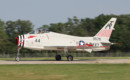
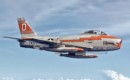
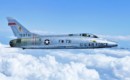
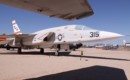
The North American F-86 Sabre was America’s first swept-wing jet fighter and the main US opponent of the MiG-15 in the Korean War, where Air Force pilots claimed 792 MiGs. Counting licence-built Sabres and the Navy’s FJ Fury, total production is usually given as 9,860. Bolivia retired the last military Sabres in 1994, and a small number still fly as civilian warbirds.
Live Fleet Activity (F86)
Fetching live data…
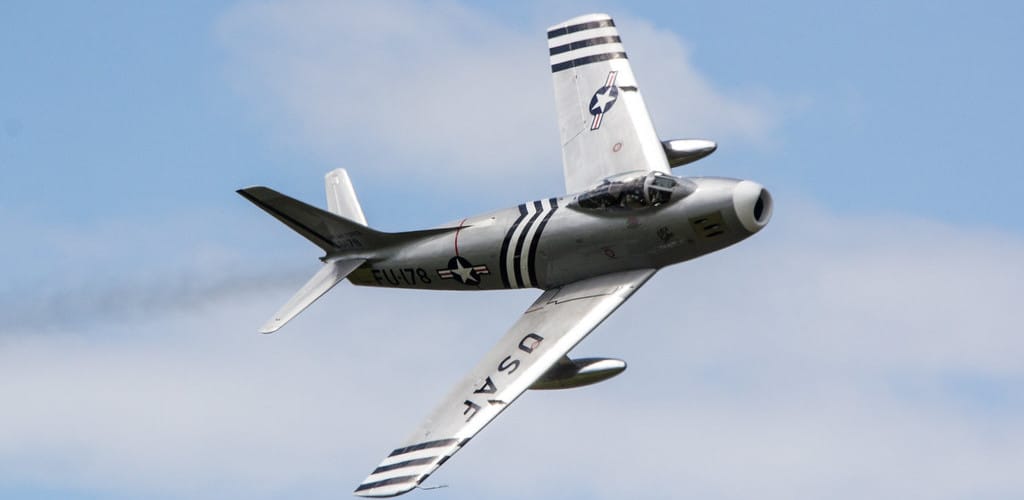


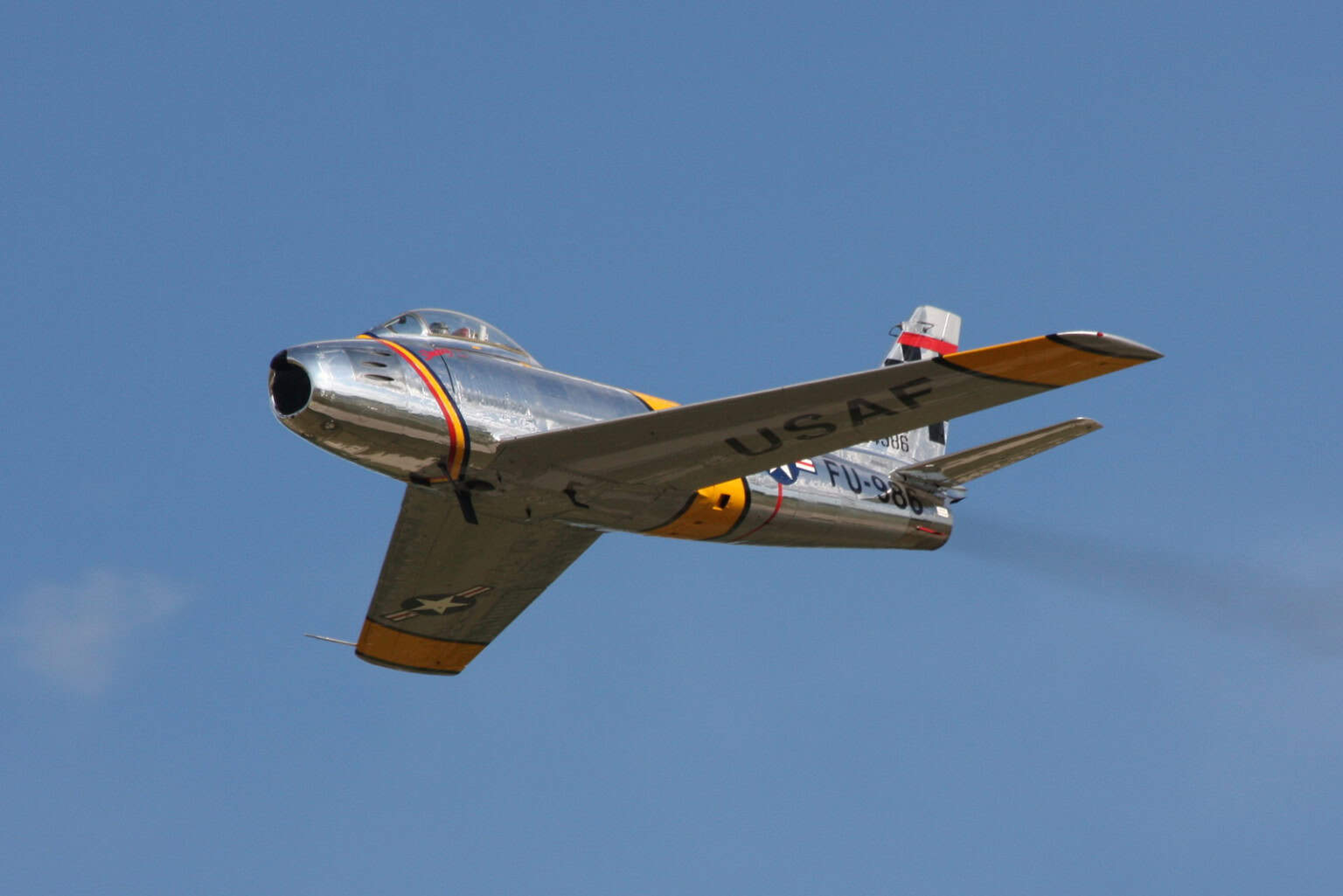
The North American F-86 Sabre, sometimes called the Sabrejet, is a single-seat jet fighter and America’s first swept-wing fighter. It is best known for fighting the Soviet-built MiG-15 over Korea from December 1950 to the armistice in July 1953.
The prototype first flew on October 1, 1947, and the Sabre entered US Air Force service in 1949. Counting licence-built Sabres and the Navy’s FJ Fury, total production is usually given as 9,860.
The specification panel on this page describes the F-86F-40, the final version of the most-produced day fighter. The all-weather F-86D interceptor shared the name but was a largely different aircraft.
North American first designed the XP-86 around the straight-winged FJ-1 Fury, its first jet for the Navy, whose wing was derived from the P-51 Mustang. By the summer of 1945 it was clear the design would fall well short of the 600 mph (966 km/h) the Army Air Forces wanted.
Early studies also showed it would perform no better than its rivals, the XP-80 and the XP-84. North American feared the program would be cancelled.
Captured German aerodynamic data changed the plan. It showed that a swept wing delayed the compressibility effects that build up near the speed of sound, so the designers chose a 35-degree sweep.
Swept wings handle poorly at low speed, so the Sabre got automatic leading-edge slats, a design based on the Messerschmitt Me 262’s. Some senior North American staff resisted changing the wing so late, but wind tunnel results won the argument.
George Welch flew the XP-86 for the first time on October 1, 1947, from Muroc Dry Lake, now Edwards Air Force Base. In April 1948 the prototype exceeded Mach 1 in a shallow dive.
The first production aircraft flew in May 1948, and the P-86A was redesignated F-86A in June. On September 15, 1948, Major Richard Johnson set a world speed record of 671 mph (1,080 km/h) in an F-86A.
Colonel K. K. Compton won the 1951 Bendix air race in an F-86A, averaging 553.76 mph (891.19 km/h).
On May 18, 1953, Jacqueline Cochran became the first woman to break the sound barrier, flying a one-off Canadian-built Sabre Mk 3 alongside Chuck Yeager.
The F-86A was the first production model, and 554 were built. The F-86E, with 456 built, added an all-flying tailplane with power-operated controls, which greatly improved maneuverability at high speed.
The F-86F was the definitive day fighter, and 2,239 were built. It had the more powerful J47-GE-27 engine and the “6-3” wing, a fixed leading edge without slats that improved high-speed agility but raised the landing speed.
The final F-86F-40 put improved slats back on the wing and extended the tips, raising the span from 37 ft 1 in to 39 ft 1 in (11.92 m). Stall speed fell from 144 mph to 124 mph, and the Air Force upgraded many earlier F models to the same standard.
The F-86D was a search-radar interceptor with an afterburning engine, a radar nose and rockets instead of guns. It shared only about 25 percent of its parts with other Sabres, and 2,506 were built, with the F-86K and F-86L derived from it.
The F-86H was a redesigned fighter-bomber with a deeper fuselage, the more powerful J73 engine and a low-altitude bombing system for nuclear weapons, and 473 were built.
Canadair built 1,815 Sabres in Canada, and the Mk 6 is generally rated the most capable Sabre of all. In Australia, Commonwealth Aircraft Corporation built 112 Avon Sabres around the Rolls-Royce Avon, with roughly 50 percent more thrust than the J47.
Fiat in Italy built 221, and Mitsubishi assembled 300 F-86F-40s in Japan from kits made in California. The Navy’s carrier-based FJ Fury family added 1,115 more, which is how the 9,860 total is reached.
Not every source counts the same way. The National Air and Space Museum gives 8,443 Sabres, and the Air Force museum says more than 5,500 day fighters were built in the US and Canada.
The full specification table for the F-86F-40 is on this page. Several of its figures need context, because published Sabre numbers vary by model, by load and by source.
Speed first. The panel’s 678 mph (1,091 km/h) is the sea-level top speed that Joe Baugher and the Hill Aerospace Museum give for the F-86F-40, while Wikipedia’s specification prints 687 mph. At 35,000 feet the top speed falls to 599 mph, roughly Mach 0.9, so the Sabre was not supersonic in level flight.
Range is the next trap. The panel’s 1,325 nm (1,520 mi, 2,450 km) is a ferry range with drop tanks. Baugher gives a combat radius of 463 miles, and Wikipedia’s specification gives a 414-mile combat range with two 1,000 lb bombs and two drop tanks.
The fuel figure is internal fuel only, 440 US gallons (1,700 L). Two 200-gallon drop tanks were standard, and from 1953 the F-86F could carry four.
Weight depends on the load. Baugher gives 15,198 lb clean, 18,152 lb with two drop tanks and 20,611 lb with tanks plus two 1,000 lb bombs. The panel rounds the heaviest, 20,611 lb, to 20,600 lb (9,350 kg), because Wikipedia labels the 18,152 lb figure as the maximum even though it is only the two-tank weight.
Ceiling and climb figures also spread. Wikipedia gives a 49,600-foot ceiling at combat weight and a 9,000 ft/min sea-level climb, while Baugher lists a 47,000-foot service ceiling and an 8,100 ft/min initial climb.
The day-fighter Sabres carried six .50-caliber M3 Browning machine guns in the nose, with 1,800 rounds in total. The guns fired at about 1,200 rounds per minute and were harmonized to converge 1,000 feet (300 m) ahead.
Early aircraft had a manually ranged gunsight. The last 24 F-86A-5s and the F-86Es introduced the A-1CM gunsight with AN/APG-30 radar ranging, which proved an advantage against MiGs.
The F-86F-40’s four hardpoints could carry up to 5,300 lb (2,400 kg). The usual maximum load was two 1,000 lb bombs on the outer pylons and two drop tanks on the inner ones, and napalm, rockets and a tactical nuclear weapon were also options.
In early 1953, seven F-86F-2s armed with four 20 mm cannons each were combat-tested in Korea as Project Gun-Val. It signaled the end of the .50-caliber machine gun in the air-to-air role, and later F-86Hs carried four 20 mm cannons.
The swept-wing MiG-15 appeared over Korea in November 1950 and outperformed every United Nations aircraft there. Three squadrons of F-86s were rushed to the Far East in December.
On December 17, 1950, Lieutenant Colonel Bruce Hinton of the 4th Fighter-Interceptor Wing shot down a MiG-15. The National Air and Space Museum calls it the first known combat between swept-wing fighters.
The fighting centered on MiG Alley, near the mouth of the Yalu River on the border with China. Sabre pilots flew from bases such as Kimpo, near Seoul, and were not allowed to pursue MiGs across the border, although units frequently engaged over the Manchurian bases anyway.
On June 20, 1953, F-86Fs scored 16 aerial victories, the best one-day record of the war according to the Hill Aerospace Museum. Of the 41 American pilots who became aces in Korea, all but one flew the Sabre; the exception was a Navy Corsair night-fighter pilot.
It appears in our roundup of the fighter jets of the Korean War.
On paper, the early MiG-15 had the edge. It beat early F-86s in ceiling, firepower, acceleration, turning and climb, while the Sabre was marginally faster and could out-dive it.
The F-86F, introduced in 1953, closed much of the gap, and by the end of the war many experienced American pilots claimed a marginal advantage for it. The MiG-15 could not safely exceed Mach 0.92, a real limit in near-sonic combat.
The Sabre’s other edges were its radar-ranging gunsight and its pilots. Soviet engineers who studied a recovered Sabre in October 1951 credited its combat success mainly to the APG-30 radar gunsight, and many American pilots were World War II veterans.
Many MiG-15s, though, were flown by experienced Soviet pilots, especially early in the war. That makes the kill ratio the most contested number in the Sabre’s history.
The Air Force’s own 1953 statistical digest credits F-86 pilots with 792 MiG-15s destroyed. The Air Force museum calls that a kill ratio of about 8:1, while the Air and Space Museum describes a victory ratio of more than 10 to 1.
Those were claims, not confirmed kills. After the war, an Air Force review code-named Sabre Measure Charlie cut the Sabre’s ratio against the MiG-15 by half, and the service internally accepted that its pilots had downed about 200 MiGs.
A 2008 RAND briefing, citing recent scholarship, put the real kill-to-loss ratio at 1.8:1 overall and closer to 1.3:1 against Soviet-flown MiGs. That ratio does not count other aircraft types the MiGs shot down, such as the B-29.
Soviet records show 335 MiG-15s lost in Korea to all causes, and China puts its own losses at 224. The Soviets also claimed more than 600 Sabres, a figure that cannot be reconciled with US loss records.
American sources credit the MiGs with 78 Sabres in air-to-air combat. The Air Force’s 1953 statistical digest lists 110 F-86s lost to enemy action of all kinds, and 224 lost in the theater to all causes, including accidents.
Taiwan’s air force received 320 F-86Fs and seven RF-86Fs by June 1958. In the Second Taiwan Strait Crisis, which began that August, its Sabres fought Chinese MiG-15s and MiG-17s.
Under a secret program called Operation Black Magic, the US Navy had supplied the AIM-9 Sidewinder, its first infrared-homing air-to-air missile, and Sabres were modified to carry two. The missile took away the height advantage the MiGs had enjoyed, and it proved devastatingly effective.
Pakistan received more than 100 F-86Fs from 1954. In April 1959 one shot down an Indian Canberra reconnaissance jet over Rawalpindi, the Pakistan Air Force’s first aerial victory.
In the 1965 war with India, Pakistani Sabres armed with Sidewinders claimed 15 Indian aircraft, including nine Hawker Hunters, and India admitted losing 14 combat aircraft to them. Sabres flew again in the 1971 war, and Pakistan withdrew its last in 1980, replacing them with Shenyang F-6 fighters.
Portugal sent F-86Fs to Portuguese Guinea in 1961. During the independence war there they flew 577 combat sorties, 430 of them ground attack and close support, before US pressure brought them home in 1964.
A captured Sabre also shaped Soviet designs. The Soviets copied its gunsight and radar, and the resulting system went into the MiG-17.
Besides the US Air Force, 20 other nations flew the Sabre, including West Germany, Japan, Spain, Great Britain and Australia, according to the Air Force museum.
Some of the largest fleets were Taiwan’s 320 F-86Fs, Spain’s 270, Japan’s 180 US-built F-86Fs plus the 300 Mitsubishi-assembled jets, Norway’s 115 and South Korea’s 112. Canada flew Canadair-built Sabres.
In US service, the F-86 day fighter was to be replaced by supersonic types. The F-100 Super Sabre was conceived as a higher-performance successor to the F-86.
Production of the F-86F first ended in August 1954, then restarted to supply allies such as Taiwan and Japan. The F-86F-40 was built purely for export and never served operationally with the Air Force.
The last of the 280 California-built F-86F-40s was delivered in December 1956. It was the last of 5,035 Sabres built in California, and Mitsubishi finished the last Japanese-assembled Sabre on February 25, 1961.
Sabres stayed useful long after that. In the Air Force’s Feather Duster tests, Air National Guard F-86Hs stood in for the MiG-17 against the F-105 and the F-100, and one pilot said both were inferior to the F-86H in a dogfight except nose down at full throttle.
Abroad the Sabre served for decades. Pakistan retired its last in 1980, Argentina in 1986 and South Korea in 1990, and Bolivia deactivated the last operational F-86 squadron in 1994.
Yes, in civilian hands. The FAA’s aircraft registry database, dated September 11, 2026, lists 26 F-86-family aircraft on the US civil register, including Canadair- and Australian-built Sabres. A registration does not mean an aircraft is airworthy.
The Planes of Fame Air Museum in Chino, California, lists its F-86F 52-5012 as flyable. It was built in November 1953, served at Nellis Air Force Base and then flew 26 years with the Argentine Air Force until August 1986.
In Europe, a former West German Air Force Canadair Sabre Mk 6 joined The Flying Bulls collection in Salzburg, Austria, in May 2026. Vintage Aviation News described it as the only flying Sabre based in Europe.
For how private ownership of former military jets works, see our guide to whether a civilian can buy a fighter jet.
New, an F-86F had a flyaway cost of $211,111, according to Knaack’s figures as tabled by Wikipedia. That is in approximately 1950 dollars, not adjusted for inflation, and covers the airframe, engine, electronics, armament and ordnance.
The other models cost $178,408 for the F-86A, $219,457 for the F-86E and $582,493 for the heavier F-86H.
Surviving Sabres change hands privately, and asking prices depend heavily on condition. In January 2018, an airworthy F-86F was offered for $475,000; that aircraft, 52-4959, is now registered as N86JZ.
In March 2022, a non-flying, unrestored F-86F without its engine was listed at $179,000. Prices from those listings are dated, and the market has moved since.
Yes, a small number fly as civilian warbirds. As of September 2026, the FAA register lists 26 F-86-family aircraft, though registration does not mean airworthy, and Planes of Fame lists its F-86F as flyable. In Europe, a Canadair Sabre Mk 6 joined The Flying Bulls in May 2026.
Neither was clearly better. The early MiG-15 out-climbed, out-turned and out-gunned early Sabres, while the F-86 was slightly faster, could out-dive the MiG and had a radar-ranging gunsight. The F-86F of 1953 closed the gap, and many American pilots judged it marginally superior.
American sources give 78 Sabres lost in air-to-air combat in Korea. The Air Force’s 1953 statistical digest counts 110 F-86s lost to enemy action and 224 lost in the theater to all causes. Soviet claims of more than 600 Sabres cannot be reconciled with US records.
The wartime claim was 792 MiG-15s, which the Air Force museum gives as about 8:1. A post-war Air Force review halved the ratio, and a 2008 RAND briefing put the real figure at about 1.8:1 overall and 1.3:1 against Soviet pilots.
In the US Air Force, the supersonic F-100 Super Sabre was conceived as the F-86’s successor. Abroad, replacements varied: Pakistan replaced its last Sabres with Shenyang F-6 fighters in 1980.
The F-86F-40’s top speed was 678 mph (1,091 km/h) at sea level, according to Joe Baugher, and 599 mph at 35,000 feet. Wikipedia gives 687 mph at sea level. It could exceed Mach 1 only in a dive.
The XP-86 prototype first flew on October 1, 1947, and the first production F-86A flew in May 1948. The Sabre entered US Air Force service in 1949 and first met the MiG-15 in combat in December 1950.
Total production is usually given as 9,860, counting 1,815 Canadair, 112 Australian, 221 Fiat and 300 Mitsubishi Sabres plus 1,115 Navy FJ Furies. The National Air and Space Museum gives 8,443 Sabres.
Most Sabres used a General Electric J47 turbojet. The F-86F’s J47-GE-27 produced 5,910 lbf (26 kN), the F-86H used the more powerful J73, later Canadian Sabres used the Orenda, and Australian Sabres used the Rolls-Royce Avon.
New, an F-86F cost $211,111 in approximately 1950 dollars. Private sale prices depend on condition: an airworthy F-86F was offered for $475,000 in 2018, and a non-flying project for $179,000 in 2022.
Sources and references used for research and fact-checking.