

In 2022, one of America’s big network airlines pulled its regional flights out of 29 airports in a single year. A federal audit later traced cuts like that to pilots: the big carriers had hired thousands away from the regional airlines, and the regionals could not refill their captain seats.
That is the part the “pilot shortage” headlines usually miss. The FAA counted 887,519 active pilots at the end of 2025, nearly 196,000 more than in 2020, and the number of student pilots has climbed by roughly two-thirds over the same five years.
What airlines actually run short of is narrower and much slower to make: captains. Here is why the shortage lives in the left seat, why a federal rule makes it impossible to rush, and why the retirement wave everyone warns about keeps moving.
Is There a Pilot Shortage?
Not in raw numbers. Of those 887,519 active US pilots, 181,742 held an airline transport pilot certificate at the end of 2025, the top-level license airline pilots carry, according to FAA data reported by AVweb.
The hiring data tells the same story. Major US airlines hired 13,357 pilots in 2022 and 12,196 in 2023, then just 4,834 in 2024 and 4,509 in 2025, according to FAPA, a pilot career advisory firm that tracks hiring at the big carriers.
Hiring has picked up again in 2026, with 3,863 pilots hired through July and roughly 8,000 expected for the year. But the shortage that made headlines in 2022 was never really a shortage of people. It was a shortage of experienced captains at the regional airlines, and it rises and falls with hiring at the top.
The answer at a glance
The US counted 887,519 active pilots at the end of 2025, and major-airline hiring has swung from over 13,000 a year back below 5,000. What runs short is captains: a US airline captain needs 1,000 hours of airline flying on top of the hours required to be hired, and federal limits cap every airline pilot at 1,000 flight hours a year.
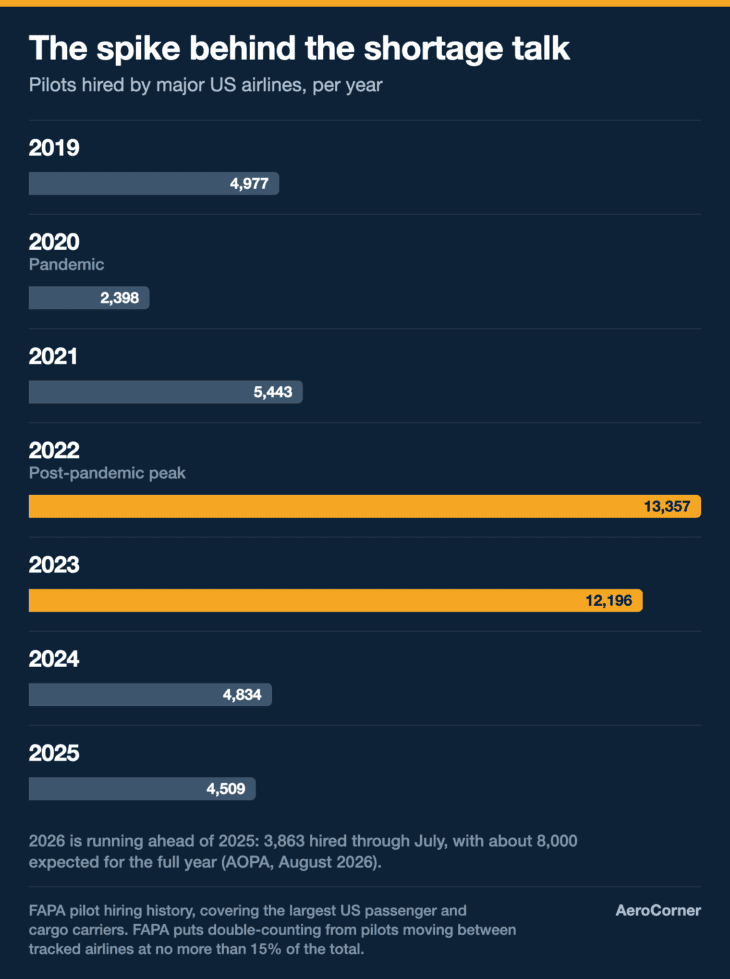
FAPA’s Tim Genc has put a healthy year at about 5,000 hires. By that yardstick, 2024 and 2025 were ordinary years, and it was 2022 and 2023 that were the anomaly.
The Rule That Makes a Captain Slow to Build
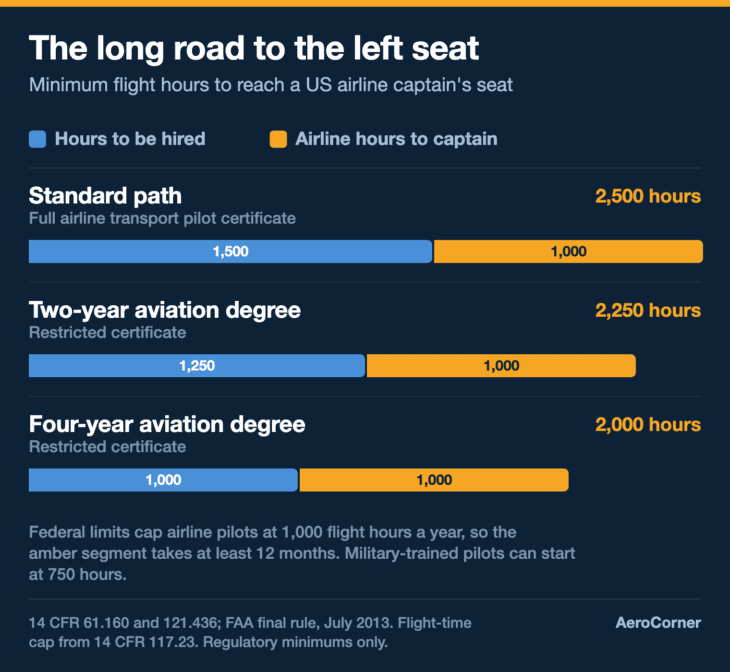
A US airline cockpit has two gates, and the second one is the one that matters. To be hired as a first officer, a pilot needs an airline transport pilot certificate, which requires 1,500 hours of flight time and a minimum age of 23.
There are shortcuts, but only so far. A restricted version of the certificate lets military-trained pilots start at 750 hours, graduates of four-year aviation degrees at 1,000, and graduates of two-year aviation degrees at 1,250.
The second gate is the captain’s seat. Under federal rule 14 CFR 121.436, an airline captain also needs 1,000 hours of flying in air carrier operations, logged as a first officer at an airline or as captain in certain larger charter and commuter operations.
That is where the clock becomes a wall. Federal flight-time limits cap every airline pilot at 100 flight hours in any 28 days and 1,000 in any 365 days, the same limits that shape how airline crew rest rules work.
So a first officer who arrives with no airline time needs at least a year of flying at the legal maximum to become eligible for the left seat. No amount of recruiting, signing bonuses or flight school capacity can compress that year.
The rules date to one crash. On February 12, 2009, Colgan Air Flight 3407, operating as Continental Connection, stalled on approach to Buffalo and crashed into a house in Clarence Center, New York, killing all 49 people aboard and one person on the ground.
Congress responded with the Airline Safety and FAA Extension Act of 2010, and the FAA’s rule took effect on August 1, 2013. Before it, a first officer could be hired with a commercial pilot certificate, which requires as little as 250 hours. Colgan’s own minimum for new hires at the time was 600 hours.
The rule is still argued over, partly because of an awkward detail in the NTSB report: the Colgan captain had 3,379 hours and the first officer 2,244, both above the new minimum. The NTSB blamed the captain’s response to a stall warning, and listed training, fatigue and professionalism among the safety issues.
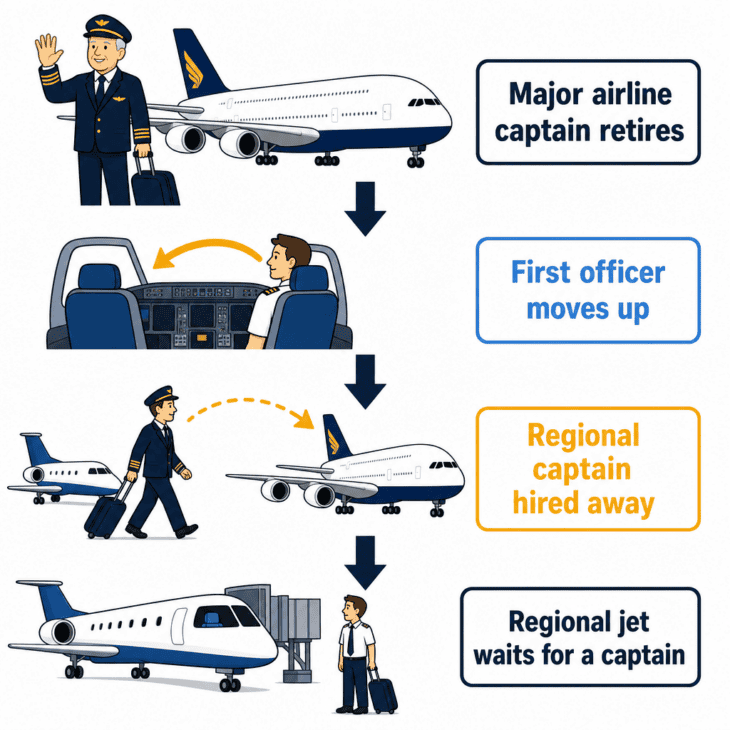
How One Retirement Parks a Regional Jet
The shortage lives in the left seat because of how US airline careers are built. Pilots typically start at a regional airline, log airline hours there, and move to a major carrier, where pay climbs almost entirely on seniority.
Every vacancy at the top pulls a chain of pilots upward. A major-airline captain retires, a first officer there moves to the left seat, and the airline fills the gap by hiring from the regionals, including their captains.
Pull hard enough on that chain and it snaps at the bottom. The regional loses a captain it cannot replace from its own ranks until one of its first officers has logged those 1,000 airline hours, so the jet sits.
That is what happened after the pandemic. The GAO found that network and low-cost airlines hired more than 15,000 pilots in 2021 and 2022, taking brand-new captains and even first officers from the regionals, which “were not able to fill captain vacancies with pilots at the needed experience levels.”
The same report found regional first officers “were not able to build their flight hours toward captaincy at a normal pace.” Regionals lifted first officer pay from about $52 an hour in 2021 to $93 in 2024 and offered retention bonuses of up to $150,000, but money could not manufacture hours.
29 airports in one year
In 2022, a single US network airline withdrew regional service from 29 airports, according to an April 2026 GAO report. The GAO tied cuts like that to regional pilots leaving for bigger carriers, which left small communities to absorb a shortage that began at the top of the industry.
FAPA’s Genc put the mechanism in one sentence: “If they’re not moving, the people below them aren’t moving.” The chain works in both directions, which is why a slowdown at the majors, like the one in 2024 and 2025, eases the pull on the regionals.
The Retirement Wave Keeps Moving
The top of the chain is set by law. US airline pilots must retire at 65, a limit raised from 60 by the Fair Treatment for Experienced Pilots Act, which took effect on December 13, 2007.
About 42,000 airline pilots will reach that age over 15 years, FAPA estimated in 2025. Its forecast peak has already moved, from 2026 to 2031, which is one reason shortage predictions keep missing their dates.
Looking further out, Boeing’s July 2025 outlook puts North America’s need at 119,000 new pilots through 2044. Worldwide, Boeing expects about two-thirds of all new aviation personnel to replace people leaving the industry rather than to crew new aircraft.
The obvious fix, raising the age limit to 67, keeps stalling. The House voted 351 to 69 for it in July 2023, but the Senate dropped the provision from the final FAA Reauthorization Act of 2024.
In 2025, ICAO’s 42nd Assembly rejected an IATA proposal to raise the global limit, keeping 65 as the cap for international multi-crew flying. Two new US bills, H.R. 5523 and S. 4452, had not moved beyond introduction as of September 2026.
Even if one passed, the ICAO cap would still bar US pilots over 65 from international flights into countries that follow the global standard. Those are often exactly the senior widebody seats where the retirements hit first.
The Myth vs. the Reality
Myth: not enough people are learning to fly
Student pilots rose from 222,629 in 2020 to 370,286 in 2025, by FAA count. The bottleneck is not interest in flying. It is the years of experience between a new certificate and a captain’s seat, and that part cannot be hurried.
The more telling number is the one that fell. New airline transport pilot certificates rose from 4,449 in 2017 to a peak of 11,218 in 2023, then dropped to 9,513 in 2024 and 7,714 in 2025.
Aviation industry analyst Jason Blair reads that drop as hiring returning to normal rather than a collapse in interest. Even the 2025 figure is well above where it stood in 2017.
The other common claim is that the 1,500-hour rule caused the shortage. It does lengthen the road to the right seat, but the requirement that grounded regional jets was the captain’s 1,000 airline hours, which no supply of new first officers can shortcut.
So when a small-town route gets cut or a regional jet sits parked, the missing ingredient is rarely a pilot. It is a pilot with a very specific logbook: 1,000 hours flown in an airline cockpit, no faster than federal limits allow.
That is why the shortage never quite goes away and never quite arrives. It builds every time the majors hire hard, and it drains away as the first officers underneath log their hours and earn the left seat.
Sources and references used for research and fact-checking.
- AOPA, The pipeline squeeze
- AOPA, Demand for airline pilots 'normalizes'
- FAPA, Pilot Hiring History
- AVweb, FAA Pilot Population Climbs Again In 2025
- US Government Accountability Office, Aviation Workforce: FAA Could Strengthen Regional Pilot Pipeline by Establishing Timelines for Training Initiatives (GAO-26-107856)
- VSL Aviation, The FAA Pilot Production Paradox
- JasonBlair.net, ATP Certification Rates Cool in 2025
- Boeing, Boeing Forecasts 20-Year Global Demand for Nearly 2.4 Million New Commercial Pilots, Technicians, Cabin Crew
- Legal Information Institute, Cornell Law School, 14 CFR 121.436, Pilot qualification: Certificates and experience requirements
- Legal Information Institute, Cornell Law School, 14 CFR 61.160, Aeronautical experience: Airplane category restricted privileges
- Legal Information Institute, Cornell Law School, 14 CFR 117.23, Cumulative limitations
- Legal Information Institute, Cornell Law School, 14 CFR 61.129, Aeronautical experience (commercial pilot)
- Federal Register, Pilot Certification and Qualification Requirements for Air Carrier Operations (final rule)
- National Transportation Safety Board, Loss of Control on Approach, Colgan Air, Inc., Operating as Continental Connection Flight 3407 (NTSB/AAR-10/01)
- US Government Publishing Office, Public Law 110-135, Fair Treatment for Experienced Pilots Act
- Office of Rep. Troy E. Nehls, U.S. House of Representatives Adopts Nehls Amendment to Raise Mandatory Retirement Age
- Simple Flying, Why The FAA's Pilot Retirement Age Rule Is Being Challenged Like Never Before
- AeroTime, ICAO rejects pilot age-67 proposal and Russia's bid to rejoin council
- GovTrack, S. 4452: Let Experienced Pilots Fly Act
- GovTrack, H.R. 5523: Let Experienced Pilots Fly Act of 2025
Get the Newsletter
The latest aviation news and stories sent to your inbox.
About the Author

Tim is the owner and lead editor of AeroCorner since 2019, overseeing aviation content covering aircraft, airlines, airports, and the broader aviation industry. Through years of researching, writing, editing, and publishing aviation-focused content, he has developed extensive practical knowledge of commercial aviation and air travel. Based in Asia and a frequent traveler himself, Tim also brings firsthand passenger experience to AeroCorner’s coverage. Outside of publishing, he has also explored aviation firsthand through hands-on flight training in New Zealand.