

Table of Contents
Six full-length beds, two sessions a flight, and a price that was widely reported in the wrong currency. Here is what the Skynest actually is.
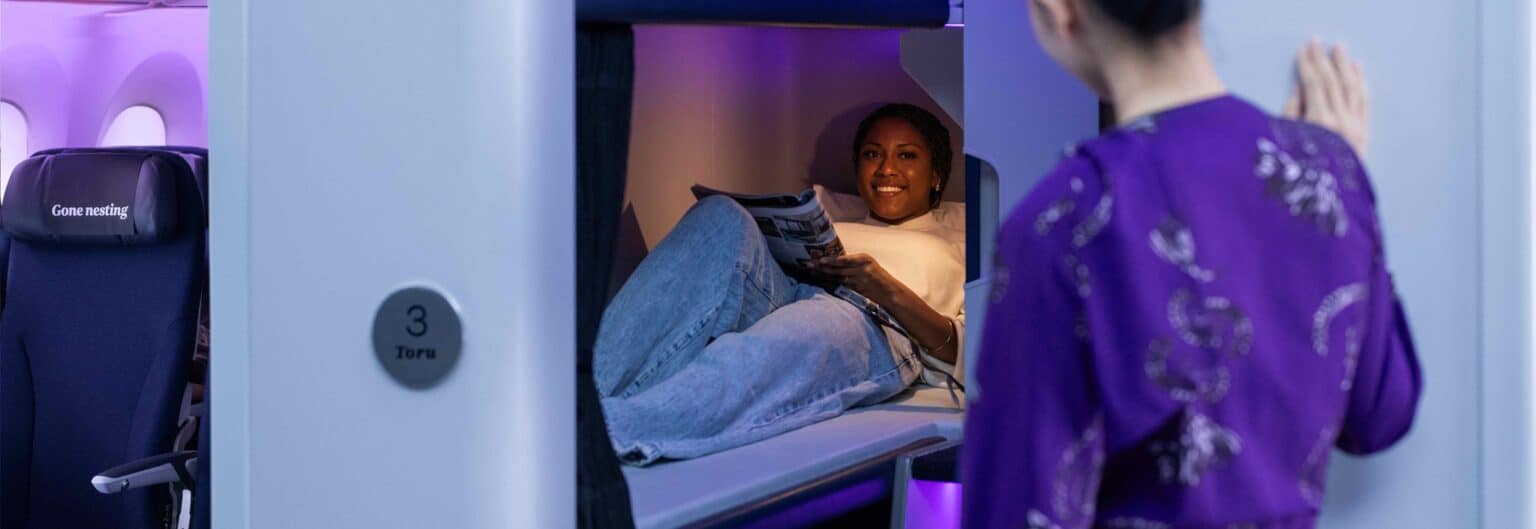
Air New Zealand’s Economy Skynest is a stack of six lie-flat bunks you rent by the session on its new Boeing 787-9s. A four-hour session starts at NZ$495, about US$281 at the Oct. 22, 2026 exchange rate, not the US$495 many headlines printed.
You keep your economy or premium economy seat, and the bed is an extra. The first route is Auckland to New York JFK, with the airline promising Skynest “from December” 2026, a month later than it first announced.
Why Air New Zealand Built a Bed It Rents by the Hour
The answer is geography. Air New Zealand’s New York to Auckland flight, NZ1, covers 8,828 miles (14,207 km) and is scheduled at 17 hours 50 minutes, one of the longest flights in the world.
On a flight that long, a business class bed is the only way to sleep flat, and most passengers are not paying for one. The airline has been trying to close that gap from the back of the plane for 15 years.
Its first attempt was the Skycouch, launched in April 2011 on the 777-300ER between Auckland, Los Angeles and London. Buy a row of three economy seats, raise the footrests, and the row becomes a couch.
The problem is length. With the window armrest up, a Skycouch is 5 feet 1 inch (1.55 m) long, according to the airline’s own figures. That works for a child or a curled-up couple, not a stretched-out adult.
The Skynest was the fix. Air New Zealand first showed it in 2020 and confirmed it in 2022, and says it tested the design with more than 200 customers before putting it on sale.
“Skynest started with a simple challenge to make some of the world’s longest journeys better,” Chief Customer Officer Jeremy O’Brien said in September 2026.
The Numbers Behind a NZ$495 Nap
The pods sit between the economy and premium economy cabins, stacked in three tiers. Each is about 80 inches (2.03 m) long and 25 inches (64 cm) wide at the shoulder, tapering to about 16 inches (41 cm) at the feet.
Air New Zealand sells two four-hour sessions per flight at launch. Six pods times two sessions is 12 bed slots on a plane that carries hundreds of passengers.
| Measure | Economy Skynest | Economy Skycouch |
|---|---|---|
| In service since | December 2026 (scheduled) | April 2011 |
| Sleeping length | About 80 in (2.03 m) | 5 ft 1 in (1.55 m) |
| What you buy | One 4-hour session, plus your own seat | A row of 3 economy seats |
| Units per aircraft | 6 pods, 2 sessions each | Rows in forward economy |
| Starting price | NZ$495 per session | Varies by route and fare |
| Aircraft | New 787-9s only | All 777s and 787-9s |
The price confusion comes from the airline itself. Its April 2026 release said “from $495 per session” with no currency attached, and much of the US coverage read that as dollars.
Bookings out of New Zealand show NZ$495, as The Alviator found when it priced a session the day bookings opened. The same blog saw US$495 when booking from the New York end, and it was unclear whether that was intended.
At NZ$495, four hours works out to about NZ$124 an hour, or roughly US$70. On the same blog’s sample fare, a NZ$1,669 one-way economy ticket became NZ$2,164 with a session added.
The Rules That Come With the Bed
The Skynest is an add-on, not a cabin. You must hold an economy or premium economy ticket, and you go back to that seat when your four hours end.
The airline’s terms set out the rest. Passengers must be 15 or older, can book one session per flight, and must climb in and out of the pod unaided, which can mean kneeling, crawling or climbing.
The pods cannot be used for takeoff or landing, and sessions are scheduled outside meal service. Each pod has its own seatbelt, worn over the blanket.
Each session includes a full-size pillow, sheets and a blanket changed between sessions, plus a “Nestcessities” kit with an eye mask, earplugs, socks and a toothbrush. There is a privacy curtain, a reading light, USB-A and USB-C power and a crew call button.
What it is not is a cheap business class. The best premium economy cabins sell a better seat for the whole flight, while Skynest sells a bed for less than a quarter of it.
That makes it a different bet from the airlines topping the best economy class rankings, which compete on legroom, food and service in the seat itself.
Where Skynest Stands Before Its First Flight
Bookings opened on May 18, 2026. Air New Zealand’s April release said the new 787-9s would fly “from November,” but its Skynest page now says travel starts in late December 2026.
AirlineRatings reports the first Skynest flights begin on Dec. 24, 2026, and blames the product’s repeated delays on late Boeing 787 deliveries.
The airline is launching it in a hard year. It posted a NZ$336 million pre-tax loss for its 2026 financial year. Engine groundings, including Rolls-Royce Trent 1000 problems on its 787s, cost it about NZ$190 million.
Only the newly delivered Boeing 787-9 Dreamliners get the pods at first. Air New Zealand plans to retrofit its existing 787s, with no firm timeline, and its 777-300ERs will not get Skynest at all.
Those 777s keep the older idea instead: their own cabin retrofit, from March 2027, keeps 16 Skycouch rows. For now, Air New Zealand’s full-length economy bed is a rental, on one route, six at a time.
Sources and references used for research and fact-checking.
- Air New Zealand, Economy Skynest
- Air New Zealand Newsroom, The future of long haul travel: Air New Zealand's Economy Skynest on sale from May 2026
- Mirage News (Air New Zealand release), Air New Zealand's world-first Skynest wins global recognition
- Air New Zealand, Skycouch
- CAPA Centre for Aviation, Air New Zealand takes delivery of first Skycouch B777-300ER
- The Alviator, Air New Zealand's Skynest Goes On Sale From NZ$495 (Not US$495)
- AirlineRatings, Air New Zealand's Skynest is now on sale
- Wikipedia, Longest flights
- Frankfurter (European Central Bank rates), NZD to USD reference rate, Oct. 22, 2026
Get the Newsletter
The latest aviation news and stories sent to your inbox.
About the Author

Tim is the owner and lead editor of AeroCorner since 2019, overseeing aviation content covering aircraft, airlines, airports, and the broader aviation industry. Through years of researching, writing, editing, and publishing aviation-focused content, he has developed extensive practical knowledge of commercial aviation and air travel. Based in Asia and a frequent traveler himself, Tim also brings firsthand passenger experience to AeroCorner’s coverage. Outside of publishing, he has also explored aviation firsthand through hands-on flight training in New Zealand.