

Table of Contents
Picture a 24-year-old first officer stepping into the right seat of a regional jet for the first time. She has a fresh airline ID badge, a captain sitting next to her, and roughly $100,000 in flight training debt trailing behind her from the day she first sat in a Cessna.
What happens next depends almost entirely on timing. A decade ago, that first paycheck barely covered rent near a big-city base. In 2026, it can come with a five-figure signing bonus.
Either way, the “become a pilot, make bank” pitch skips the part that actually determines the outcome: what training really costs, what the job really pays at each stage, and why that number swings harder than almost any other skilled profession.
The short answer
Becoming an airline-ready pilot costs roughly $80,000 to $130,000 in training before a single paycheck arrives. In 2026, that investment starts paying off fast: regional first officers now earn around $95,000 to $130,000 in year one, a complete reversal from the near-poverty regional pay of the 2000s and 2010s.
From there, pay climbs almost entirely on seniority rather than skill, topping out at major-airline widebody captain: over $465 an hour, worth roughly $465,000 to $520,000 a year in total compensation as of 2026.
The pay curve in one line
Six figures of debt, then years of modest regional pay, then a seniority-driven climb that can eventually clear $400,000 to $500,000 a year in a major-airline widebody captain seat, if the hiring cycle cooperates.
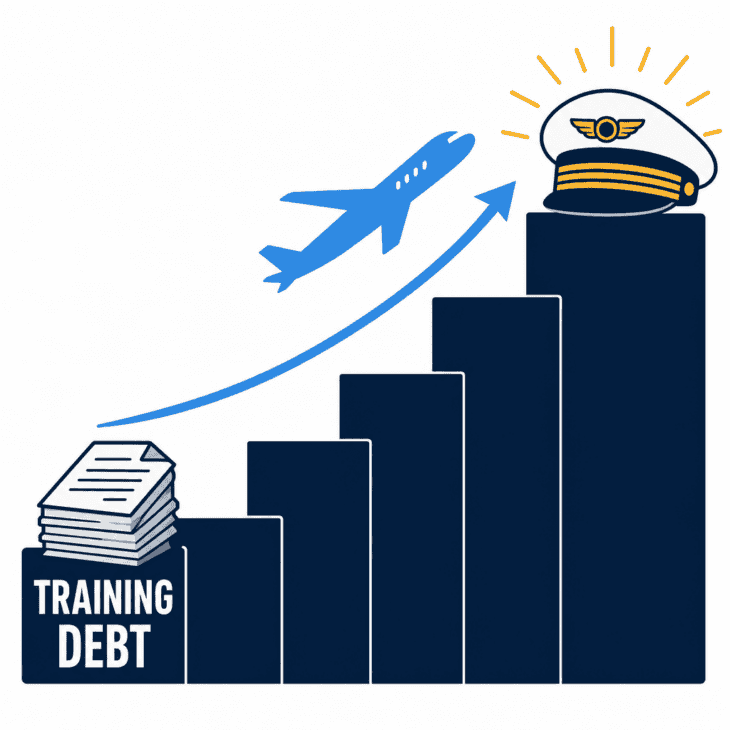
The six-figure entry fee
Nobody hands a 22-year-old an airliner. The path runs through a private pilot certificate, an instrument rating, a commercial certificate, and usually a flight instructor certificate, so a new pilot can build flight hours by teaching others while getting paid something.
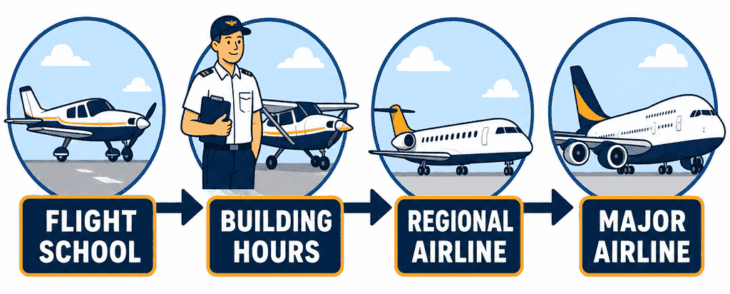
Since the FAA’s 1,500-hour rule took effect in 2013, following the Colgan Air Flight 3407 crash, that hour-building stretch is mandatory for almost everyone.
A four-year aviation degree can trim the requirement to 1,000 hours, and military pilots need as few as 750. Most civilian trainees still fly the full 1,500 before an airline will look at them.
Most of that money is borrowed. Flight training loans are typically unsecured, since a 20-something with no assets has nothing to put up as collateral, which pushes interest rates well above a standard student loan.
The flight school a trainee chooses changes the total bill by tens of thousands of dollars, sometimes more than the choice of aircraft type or instructor.
| Stage | Typical cost (2026) |
|---|---|
| Private pilot certificate | $8,000 to $20,000 |
| Instrument rating | $8,000 to $15,000 |
| Commercial pilot certificate | $25,000 to $45,000 |
| Flight instructor certificate | $5,000 to $9,000 |
| ATP certification training (ATP-CTP) | $5,000 to $8,000 |
The years regional pay used to be poverty pay
For most of the 2000s and 2010s, the payoff for that debt was thin. Regional airlines, the training ground almost every pilot passes through before a major carrier, paid new first officers wages that struggled to cover rent in the cities they flew out of.
$16,254 a year
That was the reported salary of the first officer on Colgan Air Flight 3407, which crashed near Buffalo in 2009. Investigators found she was commuting overnight rather than paying to live near her base, and lawmakers cited the pay as a factor in the fatigue that contributed to the accident.
That crash, and the pay it exposed, is the reason the 1,500-hour rule exists. It did not fix regional pay on its own. The real shift came a decade later, when a wave of retirements and a post-pandemic travel rebound collided, and major airlines started hiring far faster than regionals could replace the first officers they poached.
Regionals had no choice but to raise pay to compete for a shrinking pool of eligible pilots. By 2026, first-year first officer hourly rates and signing bonuses look nothing like the Colgan era.
| Regional carrier | First-year first officer rate (2026) |
|---|---|
| Endeavor Air | $105/hour |
| Envoy Air | $102/hour |
| PSA Airlines / Republic Airways | $100/hour |
| SkyWest / Piedmont | $98/hour |
| GoJet Airlines | $97/hour |
| Mesa / Air Wisconsin | $95/hour |
The climb to six figures, and well beyond it
Airline pay runs almost entirely on seniority, not performance. A first officer and a captain flying the same route on the same day can be separated by hundreds of thousands of dollars a year, purely because one has been on the seniority list longer.
How fast a pilot climbs that list depends on how many senior pilots are retiring ahead of them. That is why the current hiring wave has compressed timelines that used to take a decade into a few years at some carriers.
Seniority buys more than pay, too. It also buys the ability to hold better trips and a schedule that does not run someone ragged, a big part of how often pilots actually get home.
At the top of that ladder sits the major-airline widebody captain. As of 2026, United, American, and Delta all pay top-scale widebody captains $465.13 an hour, roughly $465,000 to $520,000 a year once profit-sharing and retirement contributions are included.
It is one of the reasons airline pilot keeps showing up on lists of the best jobs in aviation, provided a pilot survives long enough to reach it.
Myth vs. reality: the boom can reverse overnight
The myth
That the pilot shortage guarantees rich pay indefinitely, so timing does not matter, only getting the ratings does.
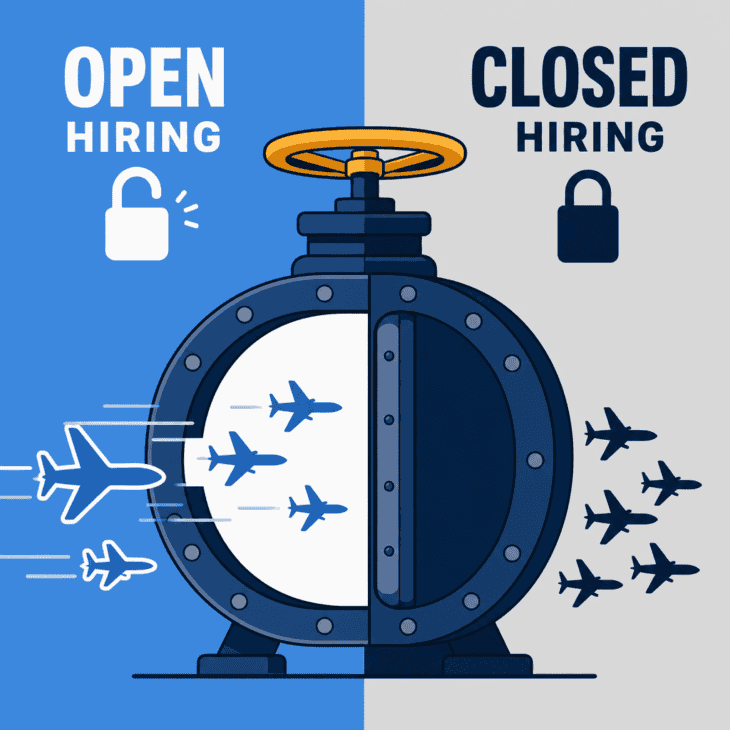
The reality is that pilot hiring runs in sharp cycles, and a trainee who starts flight school today has no guarantee of what the market looks like when they finish two years later. The last decade shows exactly how fast it can swing.
2009
Colgan Air Flight 3407 crashes near Buffalo. Investigators find the first officer earned about $16,254 a year, exposing how thin regional pilot pay had become.
2010
Congress mandates 1,500 flight hours for an airline transport pilot certificate, a direct response to the crash.
2021 to 2023
A retirement wave meets a travel rebound. Major airlines hire roughly 12,000 to 13,000 pilots a year, pulling regionals into a bidding war that doubles first-year first officer pay.
2024
Hiring stalls. Major carriers hire only around 5,000 pilots, a fraction of the prior pace, and some regionals pause new-hire classes.
2025 to 2026
Hiring reaccelerates. Major-airline hiring rises about 17 percent, analysts project the pilot supply gap will peak near 24,000 in 2026, and Congress debates raising the mandatory retirement age from 65 to 67.
That last item matters more than it looks. If Congress raises the retirement age, senior captains stay in their seats two years longer than expected, which slows the seniority climb for everyone hired underneath them. The economics of this job are not fixed at graduation; they keep moving for the entire career.
What it actually adds up to
That 24-year-old first officer from the opening scene is, by pure luck of timing, flying into one of the better years this job has offered in two decades. A pilot who finished training in 2024 instead would have a very different story to tell.
The debt is real, the early years are still a grind, and the six-figure captain seat is not guaranteed to anyone. But the mechanism rewarding pilots today is the same one that once left them commuting overnight on $16,000 a year: how many seats need filling, and how many senior pilots are stepping out of them.
Sources and references used for research and fact-checking.
- NBC New York, Congress Stunned by Flight 3407 Pilots' Pay
- Simple Flying, Over $400,000: The US Airlines With The Highest Widebody Captain Pay In 2026
- Simple Flying, A Look At The Hourly Pay Of US Regional Airline First Officers In 2026
- ATP Flight School, How Much Does it Cost to Become a Pilot in 2026
- Electronic Code of Federal Regulations, 14 CFR 61.160: Aeronautical experience for a restricted privileges airline transport pilot certificate
- M9 News, US Pilot Shortage Deepens Despite Slower Hiring
Get the Newsletter
The latest aviation news and stories sent to your inbox.
About the Author

Tim is the owner and lead editor of AeroCorner since 2019, overseeing aviation content covering aircraft, airlines, airports, and the broader aviation industry. Through years of researching, writing, editing, and publishing aviation-focused content, he has developed extensive practical knowledge of commercial aviation and air travel. Based in Asia and a frequent traveler himself, Tim also brings firsthand passenger experience to AeroCorner’s coverage. Outside of publishing, he has also explored aviation firsthand through hands-on flight training in New Zealand.