Fighter Jets
NAA F-86 Sabre
ICAO: F86
The first of the Century Series, and the longest-serving US jet fighter-bomber of the Vietnam War.
Updated: by Tim de Vries
The latest aviation news and stories sent to your inbox.
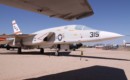
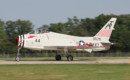
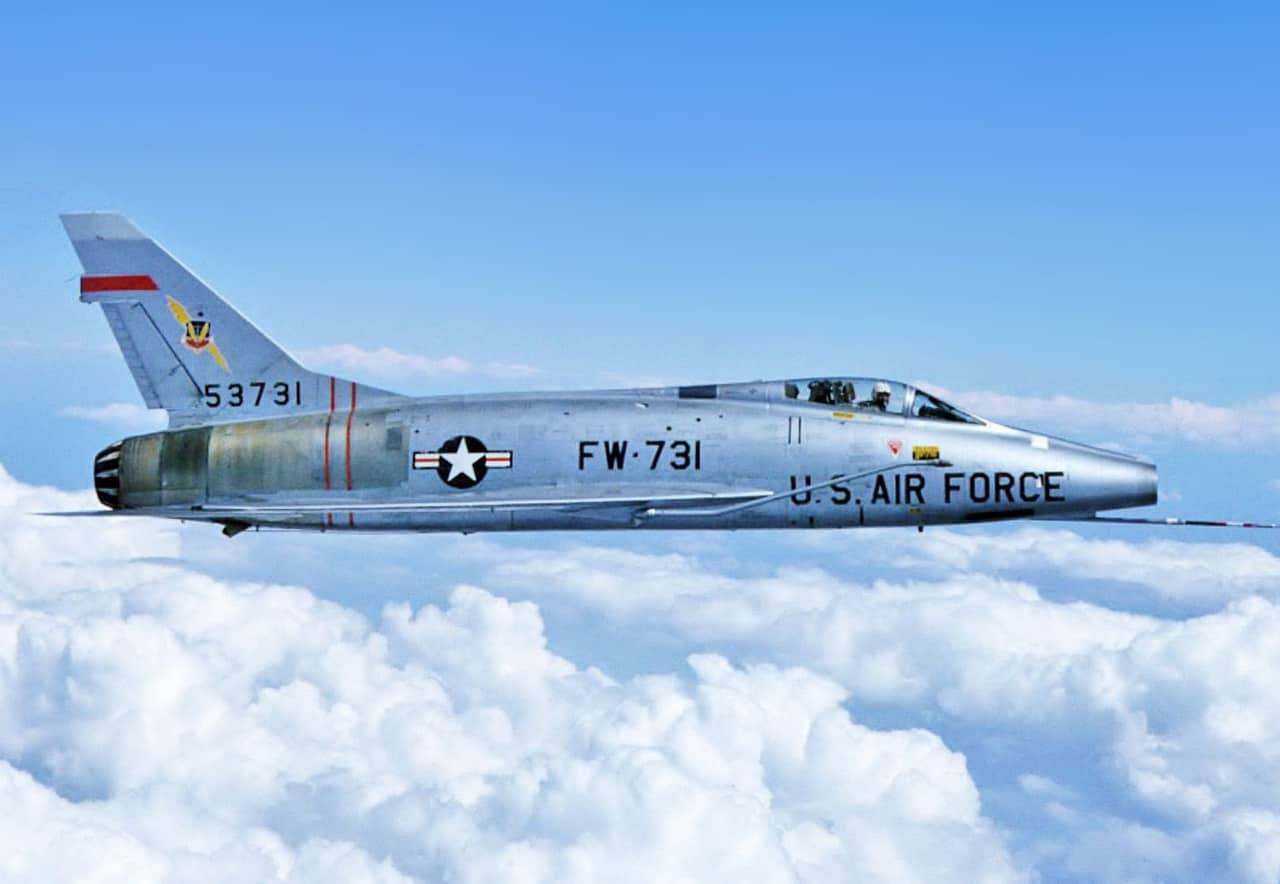
The North American F-100 Super Sabre was the first U.S. Air Force fighter capable of supersonic speed in level flight, and the first of the Century Series. North American built 2,294 between 1953 and 1959, and in Vietnam it flew 360,283 combat sorties as a fighter-bomber, Misty forward air controller and the first Wild Weasel. The Air National Guard retired its last in 1979, and two F-100Fs were still airworthy as civilian warbirds in 2026.


The North American F-100 Super Sabre is a single-engine supersonic fighter-bomber, and the first of the Century Series of American jet fighters. It was the first USAF fighter capable of supersonic speed in level flight.
North American Aviation designed it as a faster successor to its own F-86 Sabre, and built 2,294 between 1953 and 1959. Crews called it the “Hun,” short for “one hundred.”
It was planned as a day fighter but made its name dropping bombs. It became the longest-serving US jet fighter-bomber of the Vietnam War, and it flew with the Air National Guard until 1979. The specification panel on this page describes the single-seat F-100D, the most-produced model.
The design began as an internal North American study in 1949. It was called the Sabre 45, after its 45-degree wing sweep, and was essentially a much-developed F-86.
North American sent the Air Force an unsolicited proposal for a supersonic day fighter in January 1951. The service accepted it as the F-100 on November 30, 1951, and ordered two prototypes on January 3, 1952.
Chief test pilot George Welch flew the YF-100A for the first time on May 25, 1953, seven months ahead of schedule. Once level at 35,000 feet, he accelerated past the speed of sound, leaving his chase pilot in an F-86D behind.
The type set records early. On October 29, 1953, the first YF-100A set a world speed record of 755.149 mph (1,215 km/h) at low altitude, and on August 20, 1955, an F-100C set a supersonic world speed record of 822.135 mph (1,323 km/h).
The F-100A entered service on September 27, 1954, with the 479th Fighter Wing at George Air Force Base, California. The Tactical Air Command had pushed for it urgently, partly because the F-84F Thunderstreak program was running late.
The early jet had a dangerous flaw. In certain conditions it was unstable in yaw, which produced inertia coupling: a sudden yaw and roll, too fast for the pilot to correct, that could overstress the structure until the airframe broke up.
George Welch was killed that way on October 12, 1954, while dive-testing an early production F-100A. By November 10, 1954, the F-100A had suffered six major accidents, and the Air Force grounded the whole fleet.
Flights resumed in February 1955. Fixes for the handling problem included a reshaped vertical tail and a larger rudder chord. The F-100D later got a wingspan 26 inches (66 cm) longer and 27% more vertical tail area, and a yaw damper was added from the 146th F-100C onward.
The F-100 was also one of the first aircraft with a stabilator, an all-moving horizontal tail, and it used titanium extensively in key parts of the airframe.
The F-100A was the original single-seat day fighter, and 203 were built. Two YF-100A prototypes came before it.
The F-100C, with 476 built, added fighter-bomber capability, extra fuel in the wings, a probe-and-drogue refueling system and, on late-production aircraft, the uprated J57-P-21 engine. It entered service on July 14, 1955, and was considered an excellent platform for nuclear toss bombing because of its high top speed.
The F-100D was the definitive model, and at 1,274 built it outnumbered all the others combined. It first flew on January 24, 1956, and brought landing flaps, a larger wing and fin, an autopilot, a low-altitude bombing system and, from the 184th aircraft, the ability to carry AIM-9 Sidewinders.
The two-seat F-100F first flew as a production aircraft on March 7, 1957, and 339 were built. It kept the D’s six wing hardpoints but carried two cannon instead of four.
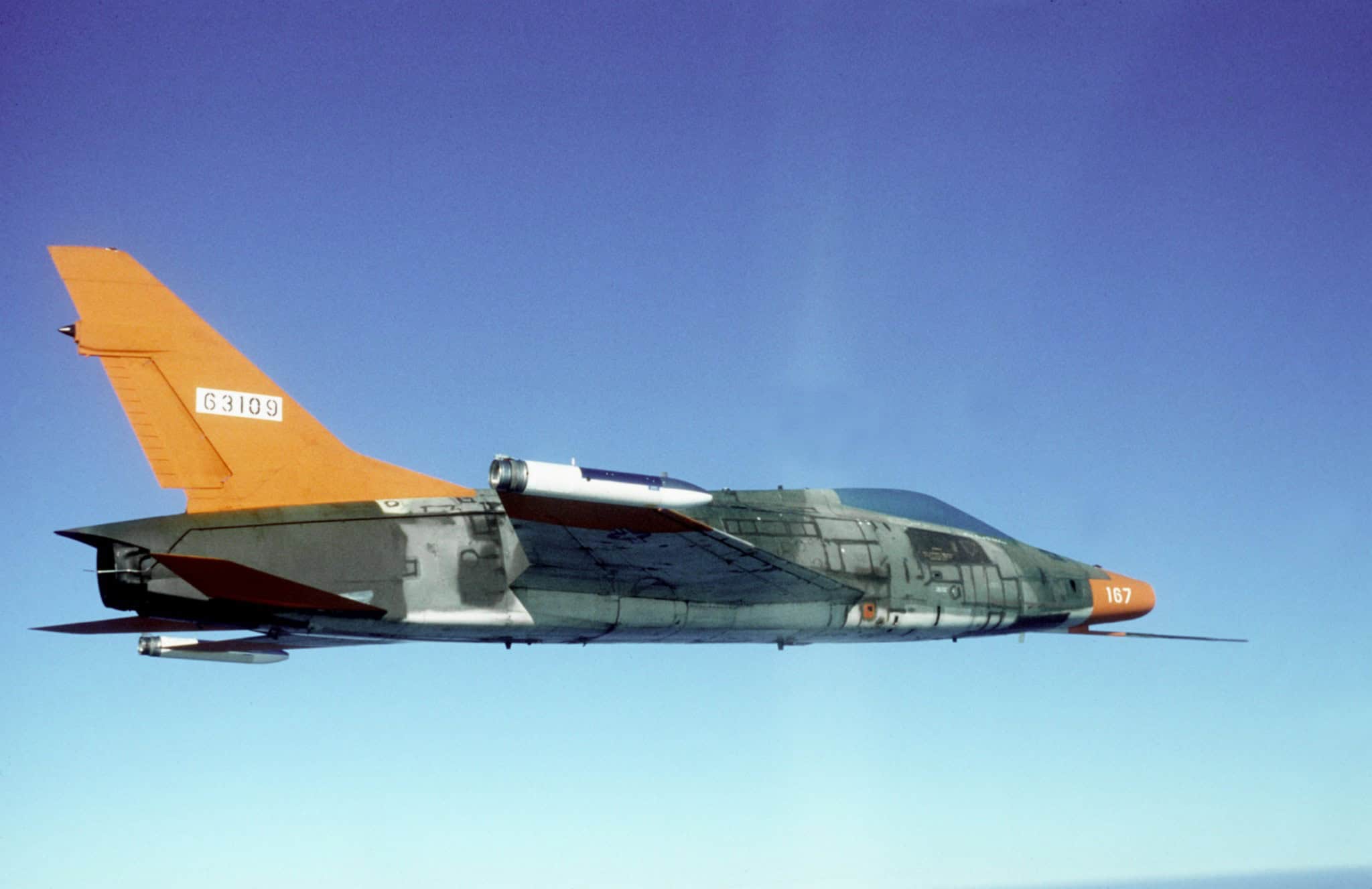
Six F-100As were converted into unarmed RF-100A “Slick Chick” reconnaissance jets, used for overflights of Soviet Bloc countries. Late in life, 209 F-100Ds and Fs became QF-100 remote-controlled target drones, shot down in tests of Air Force air-to-air missiles.
A heavily redesigned version first known as the F-100B became the F-107. It was passed over in favor of the competing F-105 Thunderchief and never produced in quantity.
The full specification table for the F-100D is on this page. Several of its figures need context, because published F-100 numbers vary by model and by source more than most.
Start with speed. The panel uses the F-100D’s 924 mph (1,487 km/h), or Mach 1.4, and the Air Force museum gives a similar 926.6 mph. The often-quoted 864 mph is the Federation of American Scientists’ figure for the earlier F-100C, and the museum lists the two-seat F-100F at 875 mph.
Range is the next trap. The panel’s 1,995 miles (1,734 nm) is the range in Wikipedia’s F-100D specification, and the Air Force museum gives 1,970 miles for the D.
A combat radius is a different measure: the distance out to a target with enough fuel to return. The Super Sabre Society lists the F-100D’s combat radius as 520 nm (598 miles).
The fuel figure is internal fuel only, 1,189 US gallons (4,500 L) on the F-100D. Drop tanks of 200, 275, 335 and 450 US gallons carried more on top of that.
Weights also differ between sources. The panel’s 38,048 lb (17,258 kg) maximum takeoff weight is the Super Sabre Society’s figure and matches the Air Force museum’s loaded weight, while Wikipedia’s specification gives 28,847 lb (13,085 kg) gross and 34,832 lb (15,800 kg) maximum.
Ceiling figures range widely too. The panel’s 50,000 feet (15,240 m) matches Wikipedia’s F-100D specification, while the museum quotes 55,000 feet and the Super Sabre Society 39,600 feet for the D.
The single-seat F-100s carried four 20 mm M39 revolver cannons, with 200 rounds per gun on the F-100D. The two-seat F-100F kept two.
The F-100D’s six hardpoints could carry up to 7,040 lb (3,193 kg). Loads included conventional bombs, AIM-9 Sidewinders, rocket pods and, on 65 aircraft modified in 1959, the AGM-12 Bullpup air-to-ground missile.
The nuclear mission drove the fighter-bomber versions from the start. The F-100D could carry the Mark 7, Mk 28, Mk 38 or Mk 43 nuclear bomb, and it was fitted with the AN/AJB-1B low-altitude bombing system.
So many post-production changes piled up that, by 1965, about 700 F-100Ds went through the “High Wire” modification program to standardize their weapons systems. Wikipedia puts the cost of the whole project at $150 million.
On September 4, 1955, an F-100C won the Bendix Trophy, covering 2,235 miles (3,597 km) at an average of 610.726 mph (982.868 km/h).
On December 26, 1956, two F-100Ds became the first aircraft to perform buddy refueling, with one jet refueling another. On May 13, 1957, three F-100Cs set a single-engine distance record by flying 6,710 miles (10,800 km) from London to Los Angeles in 14 hours and 4 minutes, with in-flight refueling.
On August 7, 1959, two F-100Fs became the first jet fighters to fly over the North Pole. The Air Force also tested a zero-length launch system on the F-100D, launching one from a standing start with a booster rocket on March 26, 1958.
The F-100 was a front-line crisis fighter through the late 1950s and early 1960s. On July 15, 1958, the 354th Tactical Fighter Wing sent 29 F-100Ds and Fs to Incirlik, Turkey, during the Lebanon crisis.
That August, F-100Ds went to Taiwan during the Second Taiwan Strait Crisis. During the Cuban Missile Crisis, 181 F-100s from three wings gathered at Homestead Air Force Base, Florida, ready for a possible strike on Cuba.
Yes, for longer than any other US jet fighter-bomber. Six F-100s deployed from the Philippines to Don Muang, Thailand, on April 16, 1961, the first to enter combat in Southeast Asia, and strike missions against Pathet Lao forces in Laos began in June 1964.
The first air-to-air jet combat of the war for the US Air Force came on April 4, 1965. F-100s escorting F-105s against the Thanh Hoa Bridge engaged North Vietnamese MiG-17s, and Captain Donald W. Kilgus fired on one with his cannon.
The Air Force recorded that engagement as a probable kill, and no F-100 was ever officially credited with an aerial victory. The F-4C Phantom II soon took over MiG escort duty.
After 1967, F-100s flew into North Vietnam less and mainly flew close air support in the South. The fleet peaked at 490 aircraft in 1969, and it flew 360,283 combat sorties before its wartime operations ended on July 31, 1971.
Four Air National Guard squadrons flew F-100s in Vietnam in 1968 and 1969, from Colorado, New York, Iowa and New Mexico. From May 1968 to April 1969, the Guard Super Sabres flew more than 24,000 sorties, and lost 14 aircraft to enemy action and seven pilots killed. It appears in our roundup of the fighter jets of the Vietnam War.
Wikipedia, citing Hobson’s loss study, puts the total at 242 F-100s of all models. None were lost to enemy fighters.
The Air Force museum’s breakdown for 1964 to 1971 counts 186 shot down by anti-aircraft fire, seven destroyed by enemy ground forces and 45 lost in operational accidents. That adds up to 238, slightly below the 242 total, so the two published counts do not quite match.
The two-seat F-100F found two dangerous jobs in Vietnam. As a “Misty” fast forward air controller, under the secret Commando Sabre project, it flew over North Vietnam and Laos from Phu Cat and Tuy Hoa, spotting targets for other fighter-bombers and flying road reconnaissance and search-and-rescue missions.
Major George “Bud” Day became the first commander of the Misty detachment in June 1967. On August 26, 1967, flying F-100F 56-3954 as Misty 01, he was shot down over North Vietnam, and he spent five years and seven months as a prisoner. He received the Medal of Honor on March 4, 1976.
The F-100F was also the first Wild Weasel, a jet whose crews hunted enemy surface-to-air missile sites. Four were fitted with radar homing and warning receivers, arrived at Korat, Thailand, in November 1965 and began combat missions in December, later carrying the AGM-45 Shrike anti-radiation missile.
The F-100F on display at the National Museum of the US Air Force is a former Misty aircraft. It was flown by Generals Merrill McPeak and Ronald Fogleman, both later Air Force chiefs of staff.
As a fighter-bomber, the F-100 was durable and heavily used, flying ground attack in Southeast Asia from 1964 to 1971. As a pure air-to-air fighter it was less successful, with no official kills and a quick handover of MiG escort work to the F-4.
Its safety record was poor. Over its USAF career, 889 F-100s were destroyed in accidents and 324 pilots were killed, and the worst year, 1958, cost 116 aircraft and 47 pilots.
The Air Force museum links the high accident rate partly to pilot inexperience with the Super Sabre, which is why the two-seat F-100F trainer was built. Even so, the F-100F’s own manual warned that it would not recover from a spin.
The Air Force Thunderbirds flew the F-100C from 1956 until 1964.
After a brief switch to the F-105 Thunderchief, the Thunderbirds returned to the F-100, flying the F-100D from July 1964 until November 1968 before moving to the F-4E Phantom II. The F-100D at the Air Force museum is a former Thunderbirds jet from that period.
France received 100 F-100s, 85 F-100Ds and 15 F-100Fs, starting on May 1, 1958. French Super Sabres flew strike missions from bases in France against targets in Algeria, and the last unit kept the type until 1978.
Denmark operated 72: 48 F-100Ds and 10 F-100Fs delivered from 1959 to 1961, plus 14 ex-USAF two-seaters bought in 1974. Turkey received 206 F-100C, D and F Super Sabres, and used them in the 1974 invasion of Cyprus.
Danish and Turkish F-100s flew until 1982. Taiwan, the only foreign air force to fly the F-100A, operated more than 110 of them and retired its last Super Sabres in 1988.
According to Knaack’s Encyclopedia of US Air Force Aircraft and Missile Systems, an F-100D had a flyaway cost of $697,029. That covers the airframe, engine, electronics, armament and ordnance, in contemporary dollars not adjusted for inflation.
The other models cost $1,014,910 for the F-100A, $663,181 for the F-100C and $804,445 for the F-100F. The Air Force museum rounds the F-100D to $704,000, and Knaack gives $583 per flying hour for the D and F.
In Vietnam, the F-100 was progressively replaced by the F-4 Phantom II and the F-105 Thunderchief. The Air Force retired the F-100A for good in early 1970, and the F-100C was phased out in June of that year.
By 1972 the F-100 was mostly out of active USAF service and flying with the Air National Guard. There it was replaced by the F-4, the A-7D Corsair II and the A-10 Thunderbolt II, and the last F-100 retired in 1979 as the F-16 arrived.
A large number of retired F-100s ended up as targets. Converted into QF-100 drones under the Full Scale Aerial Target program, they were flown remotely, mainly from Tyndall Air Force Base in Florida, and destroyed in tests of air-to-air missiles.
No air force has flown the F-100 since Taiwan retired its last in 1988, but a few survive in civilian hands. The best known is the Collings Foundation’s F-100F 56-3844, delivered to the Air Force in November 1957 and later flown by Denmark.
That jet returned to flight at Ellington Field in Houston on March 14, 2026, flown by Rick Sharpe of the Vietnam War Flight Museum. Vintage Aviation News described it as one of only two airworthy F-100Fs in the world.
For 2026, FighterJets Inc planned to fly it at airshows in the colors of Bud Day, both solo and in a dissimilar combat demonstration with a MiG-17F.
The other airworthy example, F-100F 56-3948, spent nearly three decades with Dean Cutshall at Fort Wayne, Indiana. Citing trouble getting insurance, he passed it to Jordan and Nicole Brown, and it was flown to Terre Haute on December 20, 2025, with the new owners planning to fly it in 2026.
For how private ownership of former military jets works, see our guide to whether a civilian can buy a fighter jet.
Yes. US Air Force F-100s flew more than 360,000 combat sorties in Southeast Asia, with strike missions over Laos from June 1964 and operations ending on July 31, 1971. French F-100s struck targets in Algeria, and Turkish F-100s fought in the 1974 invasion of Cyprus.
It was a strong fighter-bomber but a flawed fighter. It flew ground attack in Southeast Asia from 1964 to 1971, and the F-100C was rated an excellent nuclear toss-bombing platform.
Against that, it scored no official air-to-air kills, and 889 were destroyed in USAF accidents, killing 324 pilots.
Wikipedia, citing Hobson, gives 242 F-100s lost in Vietnam. The Air Force museum counts 186 shot down by anti-aircraft fire, seven destroyed by ground forces and 45 lost in operational accidents, and none were lost to enemy fighters.
In Vietnam, the F-4 Phantom II and the F-105 Thunderchief replaced it. In the Air National Guard it gave way to the F-4, the A-7D Corsair II and the A-10, with the last F-100 retiring in 1979, and the Thunderbirds replaced their F-100Ds with the F-4E.
The F-100D’s top speed was 924 mph (1,487 km/h), or Mach 1.4, and the Air Force museum lists 926.6 mph. Earlier and two-seat versions were slower: 864 mph for the F-100C according to the Federation of American Scientists, and 875 mph for the F-100F according to the museum.
“Hun” is a shortened form of “one hundred,” from its F-100 designation. The nickname took hold in the later part of its service life, and warbird operators still use it today.
North American built 2,294 F-100s between 1953 and 1959. That total covers 2 YF-100A prototypes, 203 F-100As, 476 F-100Cs, 1,274 F-100Ds and 339 two-seat F-100Fs.
It was the first US Air Force fighter capable of supersonic speed in level flight. The National Museum of the US Air Force describes it as the world’s first production airplane able to fly faster than sound in level flight.
Every F-100 had one Pratt & Whitney J57 afterburning turbojet. The F-100C and D used the J57-P-21 series, rated at 16,000 lbf (71 kN) with afterburner, and from the 1970s F-100s were refitted with afterburners from retired F-102 Delta Daggers to cure compressor stalls and maintenance problems.
Only in civilian hands. As of September 2026, the Collings Foundation’s F-100F returned to flight in March 2026 and was scheduled for airshows that year, and a second F-100F moved to new owners in Indiana who planned to fly it in 2026.
Sources and references used for research and fact-checking.