

Table of Contents
A nursery is a room you decorate for a baby. A kid’s bedroom is different, because now there is an actual person in there with opinions, energy, and a tendency to turn the floor into an airport at 7 a.m. An aviation theme is made for exactly that kind of room. It gives a child planes to fly, a runway to taxi down, a control tower to command, and a sky to fall asleep under, all of which invite play rather than just sitting on a wall looking nice.
The ideas below span a wide range, from a quick weekend upgrade to a full room build, and from pocket-money cheap to a real centerpiece purchase. Some are bold and immersive, like a plane-shaped bed or a painted sky. Others are clever and practical, where the storage and shelving a kid’s room always needs just happens to look like a hangar or a wing. A few are built to grow, aging up from a five-year-old who wants to be a pilot to a twelve-year-old who already knows the difference between a turboprop and a jet.
Treat this like a runway map, not a to-do list. Pick one big idea that makes your child light up, surround it with a few smaller touches, and leave space for the room to evolve as they do. If you decorated a themed nursery first, several of these will feel like a natural next step. Here are 25 aviation bedroom ideas kids will actually love.
01. Airplane-Shaped Bed
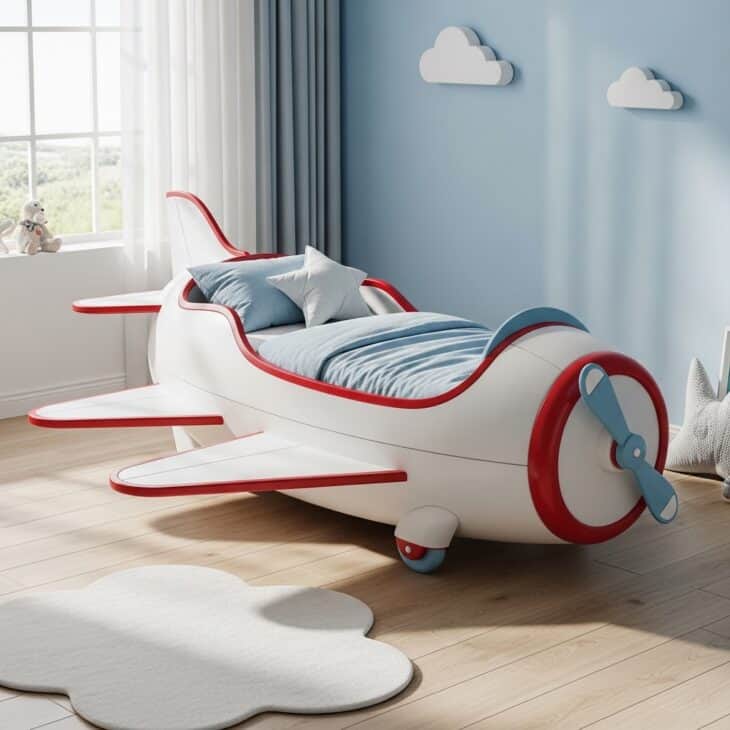
What you see The bed itself is the plane. A rounded fuselage holds the mattress like a cabin, stubby wings stick out on either side, and a friendly nose points toward the door. It is painted soft white and pale blue so it reads as fun rather than loud, and a kid climbing in at night is climbing aboard.
Why it works Nothing anchors a themed room like a bed that is the theme. A plane-shaped bed becomes the hero everything else orbits, and it turns the most ordinary nightly routine into a small adventure. It is also the piece kids brag about to friends, which is half the point of a themed room at this age.
How to get it Buy a ready-made airplane bed frame sized to a toddler or twin mattress, checking it meets current safety standards and has rounded edges. If that is out of budget, a plain low bed plus a plywood headboard cut and painted into a nose-and-cockpit shape gets most of the effect for far less. Keep the wings shallow so they do not block a walkway. Match the bed’s two main colors elsewhere in the room to tie everything together.
02. Cockpit Loft Bunk Bed
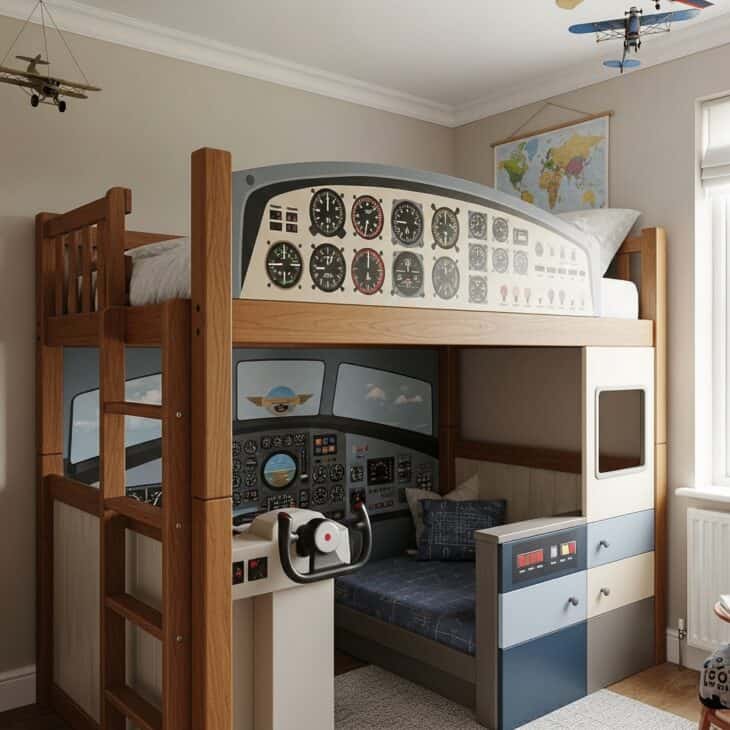
What you see A raised loft bed sits up high like a flight deck, with a painted instrument panel full of round dials serving as the headboard. Underneath, the open space becomes a den with a little steering yoke, so one piece of furniture is both the bed and the cockpit the kid plays in all afternoon.
Why it works Loft beds are gold in a kid’s room because they double the usable floor space, and theming the underneath as a cockpit turns dead space into the best play spot in the house. The height feels like sitting up front, and the painted panel gives imaginative play a believable anchor without any electronics.
How to get it Start with a sturdy, properly rated loft or bunk frame, and follow the maker’s age guidance for the top bunk, usually six and up. Paint or mount a panel of round gauges on the headboard, and add a toy yoke or a salvaged steering wheel below. String a few warm fairy lights under the platform so the den glows. Keep a guardrail on the loft and a solid, well-anchored ladder.
03. Sky and Cloud Mural Wall
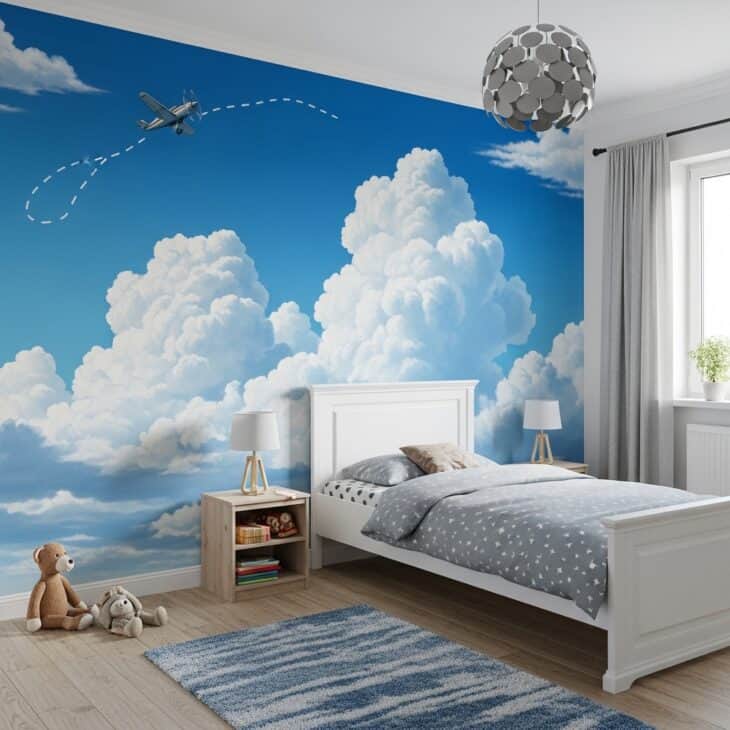
What you see One whole wall becomes the sky, a bright cheerful blue stacked with big fluffy clouds, and a single little propeller plane crossing it with a dashed trail behind. It is the view from a window seat blown up to room size, and it makes the bedroom feel like it is already in the air.
Why it works A feature wall delivers the most theme for the least clutter, covering a big surface in one confident move while leaving the other walls calm. For a kid’s room you can go brighter and bolder than a nursery would, with deeper blue and a plane the child can actually point at and name.
How to get it Choose one wall, ideally behind the bed, and roll on a bright sky-blue base. Sponge on clouds with white paint thinned slightly with water, keeping the bottoms flatter than the tops. Add one small plane and a dashed line freehand or with a stencil, so the eye has somewhere to land. If painting feels like too much, a peel-and-stick sky mural gives the same punch and comes straight off when tastes change.
04. Glow-in-the-Dark Plane Ceiling
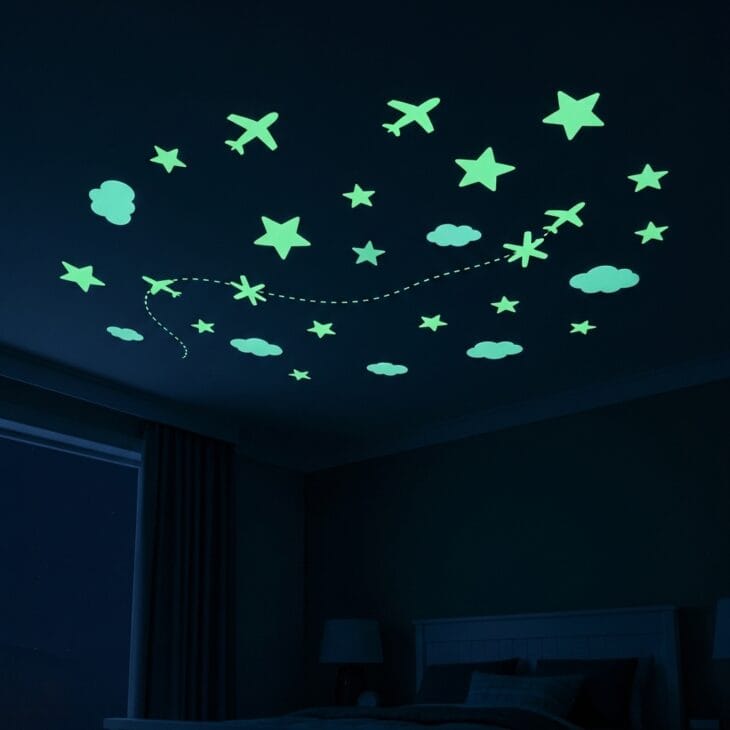
What you see By day the ceiling looks plain. Switch off the light and it comes alive, a soft green glow of stars with little planes and clouds tracing a flight path overhead. A kid lying in bed gets their own private night sky, complete with aircraft cruising between the constellations.
Why it works The ceiling is the last thing a child sees before sleep, and a glowing flight path turns lights-out into something to look forward to rather than resist. It is cheap, completely reversible, and it scratches the same itch as a planetarium with a clear aviation twist that pure stars do not.
How to get it Use peel-and-stick glow stars plus glow plane and cloud shapes, or glow-in-the-dark paint dabbed on with a fine brush. Charge them with a bright lamp or daylight before bed for a stronger glow. Arrange the planes along a gentle curving path rather than scattering them, so it reads as flight. Keep the density light near the bed and busier toward the center so it feels like depth.
05. Control Tower Bookcase
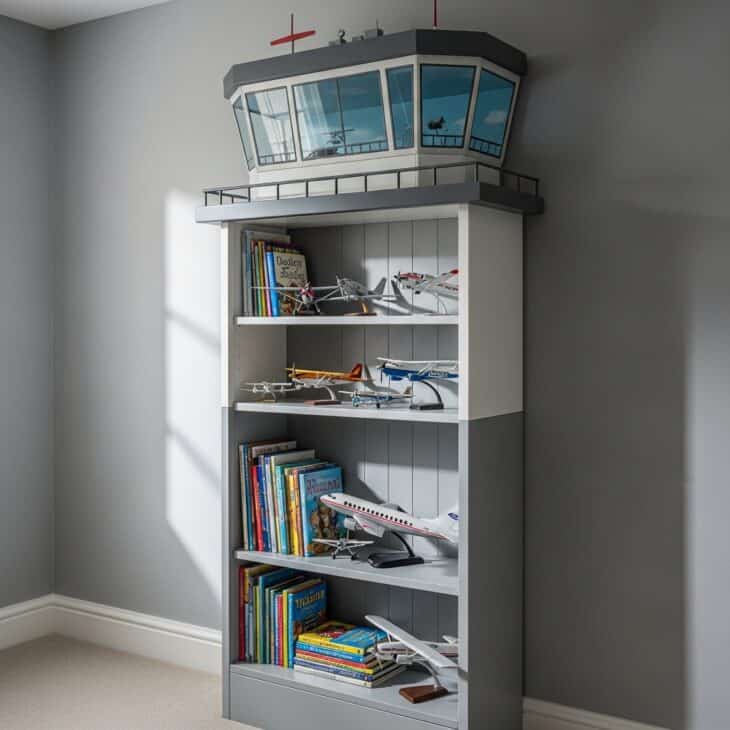
What you see A tall, narrow bookcase stands in the corner dressed up as a control tower, with a glassy cab look near the top and rows of little painted windows down the shaft. The shelves hold books and a parked model or two, so the thing that manages the whole airport also manages the room’s clutter.
Why it works The control tower is the command post of any airport, which makes it a brilliant shape for the one piece of furniture a kid is supposed to feel in charge of. It uses vertical space that a low room wastes, and styling real storage as a landmark means the theme earns its keep instead of adding more stuff.
How to get it Take a tall, slim bookcase and paint it in muted tower colors, then add painted or decal windows up the sides and a darker glazed band near the top for the cab. Always anchor a tall bookcase to the wall with an anti-tip strap, which is non-negotiable in a kid’s room. Keep heavy books low and light models high. A small toy beacon or windsock on top finishes the look.
06. Runway Floor Rug
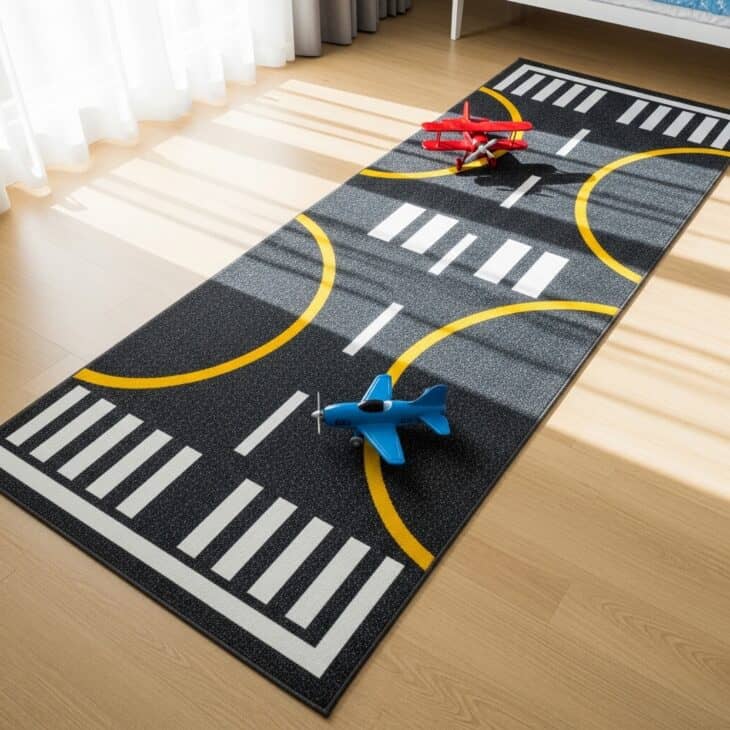
What you see A long rug runs across the floor as a full runway, dark asphalt grey with crisp white threshold bars, a dashed center line, and yellow taxiway markings curving off to one side. Toy planes line up at one end, ready for takeoff, and the floor becomes the busiest part of the room.
Why it works A runway rug is the rare decor piece that is also a toy. It hands a child a built-in game, a place to taxi, take off, and land everything with wheels, and it turns floor play into part of the theme. It also defines a clear play zone, which helps a room feel organized rather than scattered.
How to get it Look for a low-pile, machine-washable play rug with realistic runway and taxiway markings, since this one will take real traffic. A long rectangle reads as a runway far better than a square. Put a non-slip pad underneath so it stays put during enthusiastic play. If you cannot find one you like, marine-grade tape on a plain grey rug lets you lay your own threshold and center lines.
07. Departures Board Chalk Wall
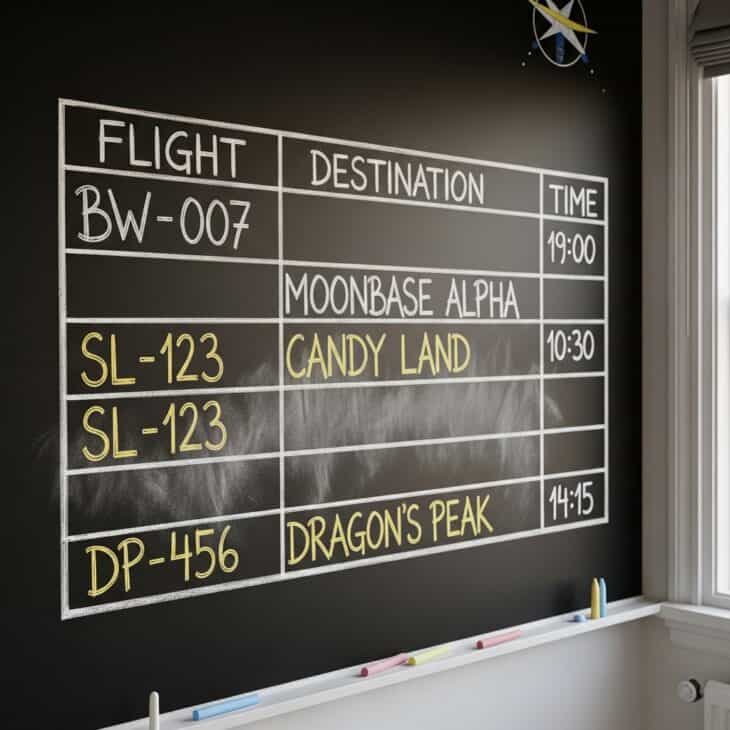
What you see A panel of wall is painted chalkboard black and ruled into columns like a departures board, with flights, destinations, and times chalked in. The destinations are wherever the kid wants to go that week, from Grandma’s House to The Moon, rewritten whenever the mood strikes.
Why it works A chalk wall is interactive in a way most decor is not, and framing it as a departures board folds drawing and writing straight into the theme. It grows with the child, from scribbles to actual spelling and time-telling practice, and it gives them a corner of the room that is genuinely theirs to change.
How to get it Tape off a neat rectangle and roll on two coats of chalkboard paint, then season the surface by rubbing chalk over all of it and wiping clean. Paint or tape thin column dividers and a header reading Departures. Keep a tray of dustless chalk nearby and a damp cloth for edits. A magnetic chalkboard paint underneath lets you add little magnetic planes that move between gates.
08. Hanging Model Squadron
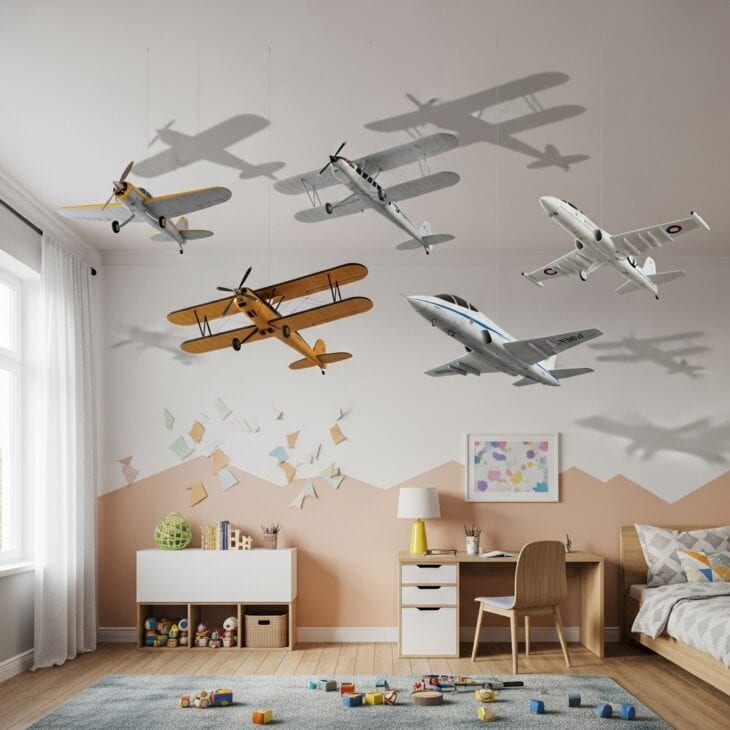
What you see A whole squadron hangs from the ceiling, a handful of model planes banking and climbing at different heights as if caught mid-formation. From the bed they look frozen in a dogfight or an air show pass, and the empty air above the room suddenly has something going on in it.
Why it works Ceiling space is almost always wasted, and a flying squadron fills it with motion without taking a single inch of floor or shelf. A mixed fleet doubles as a low-key history lesson, and it is the kind of display a kid keeps adding to, turning a birthday or museum trip into one more aircraft overhead. Many of the most famous aircraft come as easy build-it-yourself kits.
How to get it Hang lightweight plastic or balsa models on clear fishing line from small ceiling hooks screwed into joists or proper anchors. Vary the heights and angle each plane as if banking, so the group looks alive rather than parked. Keep them clear of the ceiling fan and well above head height. Start with three or four and leave gaps, because a squadron is meant to grow.
Build it together
Hanging models, sorting a runway rug, or chalking the departures board are all jobs a child can help with. Letting them place a plane or pick a destination makes the room feel like theirs and turns the decorating itself into part of the fun.
09. Aviation Bedding Set
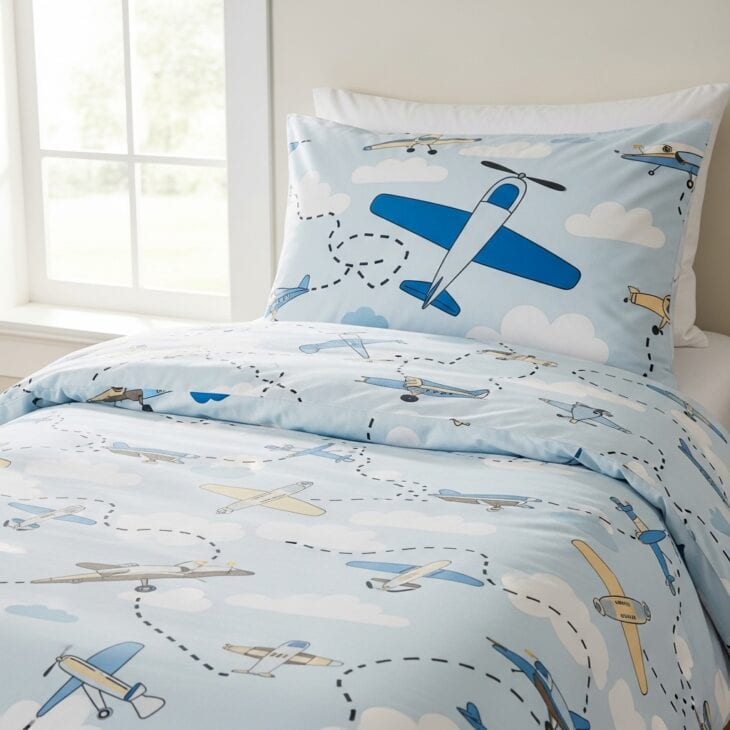
What you see The bed wears its theme outright, a duvet scattered with little planes, clouds, and dashed routes, topped with a pillow carrying one bold aircraft. It is soft, washable, and the single largest patch of pattern in the room, doing a lot of decorating work just by being made each morning.
Why it works Bedding is the easiest and most reversible way to commit to a theme, since you can swap an entire room’s mood for the price of a duvet cover. In a kid’s room the bed is the biggest object, so a themed cover sets the tone instantly, and washable fabric is exactly what an active child’s room needs.
How to get it Choose a duvet cover in a palette that matches your walls and rug, leaning on soft blues, creams, and greys so it stays calm at bedtime. Pick a pattern that is fun but not so busy it overstimulates. Buy a spare set if you can, because a kid’s bedding gets washed often. Plain sky-blue sheets underneath a patterned cover keep the look from getting too loud.
10. Hangar Storage Lockers
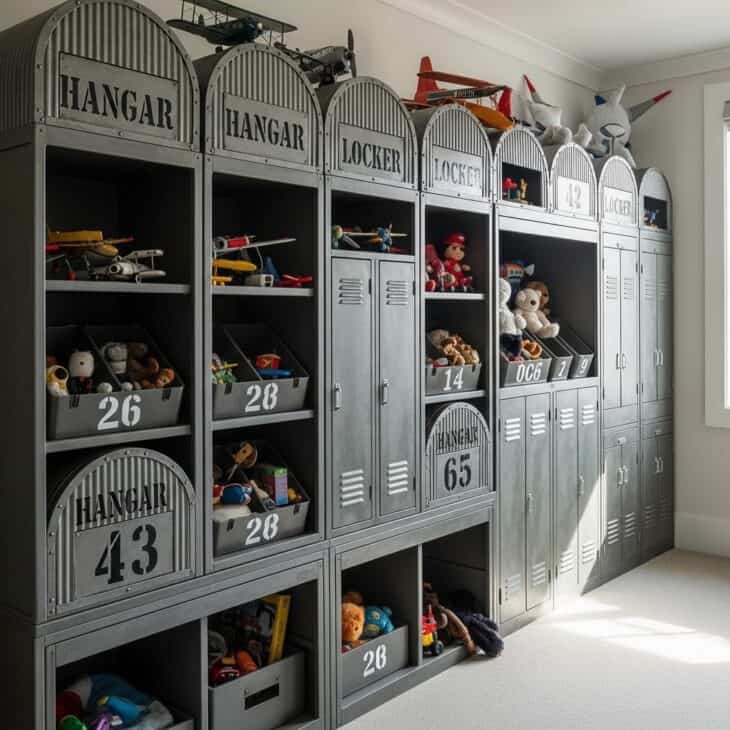
What you see A bank of cubbies and bins lines one wall, fronted to look like a row of hangars with corrugated metal faces and stenciled numbers. Each bay swallows a category of toys, and at tidy-up time the planes really do get put away in their hangars.
Why it works Storage is the eternal problem in a kid’s room, and disguising it as an airfield makes tidying feel like part of the game instead of a chore. Numbered bays give everything a home, which actually helps things get put back, and the industrial look adds texture that plain plastic bins never will.
How to get it Start with a simple cubby unit or open shelf and add fabric bins, then dress the fronts with grey-green paint, thin painted lines for corrugation, and stenciled hangar numbers. Label each bay with a picture for pre-readers so they know what goes where. Keep the unit low and anchored so a child can reach and cannot tip it. A painted apron line on the floor in front sells the airfield feel.
11. Propeller Wall Clock
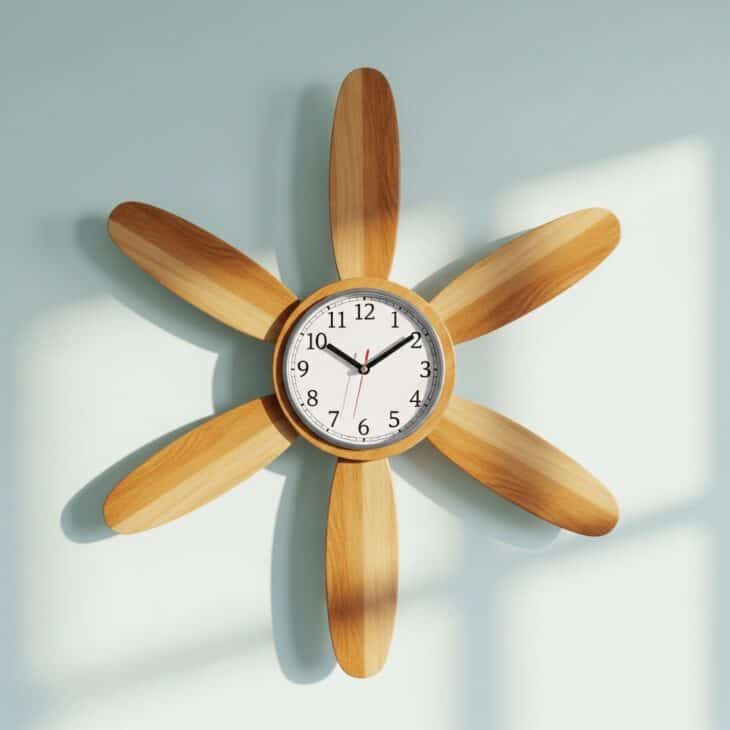
What you see Above the desk hangs a clock built into a wooden propeller, the face set into the central hub and the blades sweeping out across the wall. It tells the time and reads as a piece of aircraft at the same time, a small detail that quietly confirms the theme.
Why it works A clock is something a kid’s room needs anyway, especially once school mornings start, so making it a propeller means a practical object carries the theme for free. The radiating blades make a bold graphic shape on an empty wall, and learning to read it becomes one more bit of cockpit fluency.
How to get it Buy a propeller-style wall clock or make one by fitting a cheap clock mechanism through the hub of a decorative wooden propeller. Choose clear, easy-to-read numerals if your child is learning to tell time. Hang it where they will actually glance at it, above the desk or near the door. A silent sweep movement avoids a ticking that could bother a light sleeper.
12. Vintage Map Accent Wall
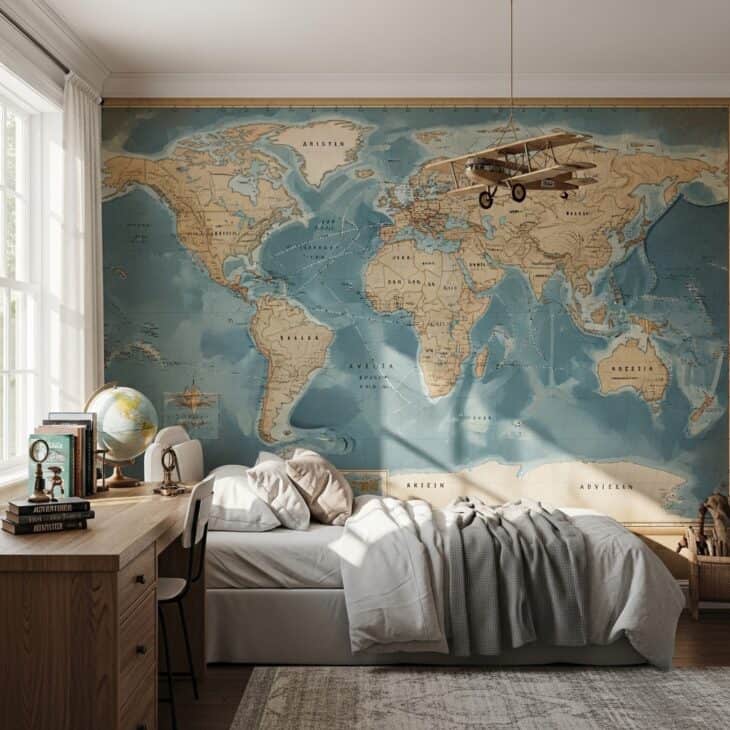
What you see One wall carries a big old-world map, sepia coastlines and faded blue oceans crossed by dotted flight routes leaping between cities. It turns the head of the bed into an explorer’s study and gives a curious kid something to trace with a finger and ask questions about.
Why it works Aviation is really about reaching faraway places, and a map says that better than any single plane. For an older child it doubles as a learning tool, sparking geography and travel daydreams, and the muted tones keep it grown-up enough to last well past the cartoon-plane phase.
How to get it Use a peel-and-stick map mural for a renter-friendly wall or a paste-the-wall version for permanence, choosing a vintage palette over a bright modern atlas. Line the panels up carefully at the top and hide any trim near the floor. Add a few pins or stickers marking places the family has been or wants to go. For less commitment, frame three or four large map prints in a row instead.
13. Pilot Dress-Up Station
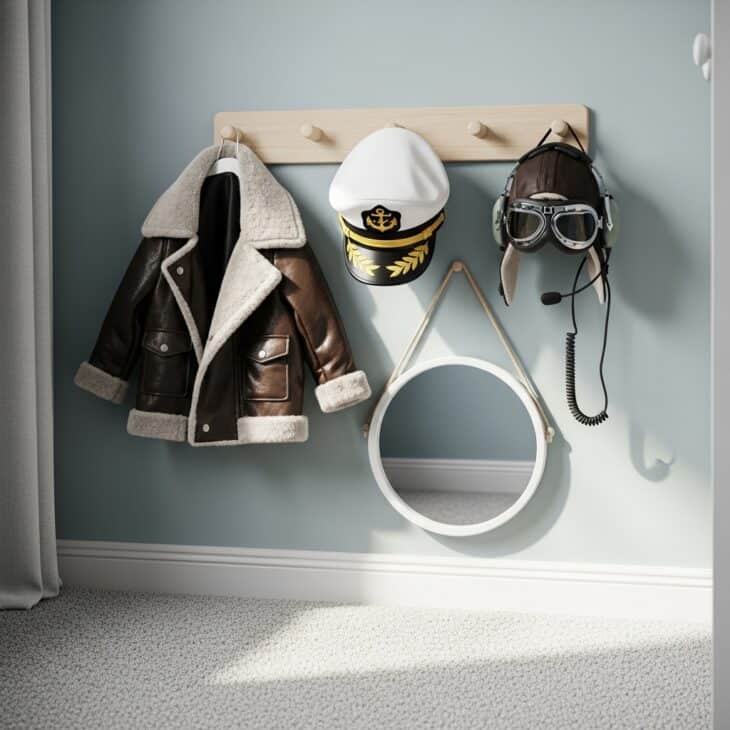
What you see A row of hooks on the wall holds a kid-sized pilot outfit, a little jacket, a captain’s hat, a play headset, and goggles, with a small mirror alongside. It is half decoration and half costume rack, always ready for a child to suit up and take command of the bedroom.
Why it works Dress-up is how young kids try on the world, and hanging a pilot kit within reach turns the theme into something they wear, not just something on the walls. Displayed on hooks the gear looks intentional rather than messy, and a mirror nearby makes the whole corner an invitation to play.
How to get it Mount a row of sturdy hooks at child height and hang a play aviator jacket, a pilot or captain hat, and a toy headset. Add soft, kid-safe goggles rather than anything rigid. Keep a low mirror nearby so they can admire the full effect. Rotate in a hi-vis vest or a flight bag now and then to keep the role-play fresh.
14. Hot Air Balloon String Lights
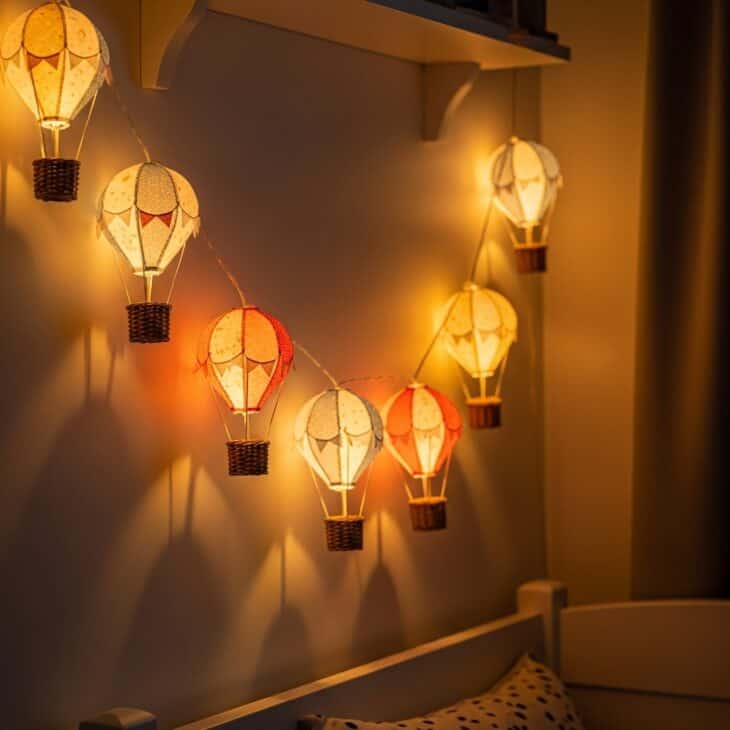
What you see A string of little hot air balloons drapes along the wall and into the ceiling corner, each one glowing softly with a tiny basket hanging below. In the evening they throw a gentle, warm light, and the whole corner feels like a balloon festival drifting through the room.
Why it works Soft lighting makes a bedroom feel cozy at the end of the day, and balloon-shaped lights deliver atmosphere and theme in one cheap, easy string. Balloons are aviation at its friendliest, so they suit younger kids especially well, and a warm glow is far kinder at bedtime than a bright overhead light.
How to get it Choose battery or low-voltage LED string lights shaped like hot air balloons, since LEDs stay cool to the touch. Drape them along a picture rail, around a headboard, or across a ceiling corner with small removable hooks. Keep cords and battery packs tidy and out of reach. Put them on a timer or a remote so lights-out does not mean climbing on furniture.
15. Aviator Homework Desk
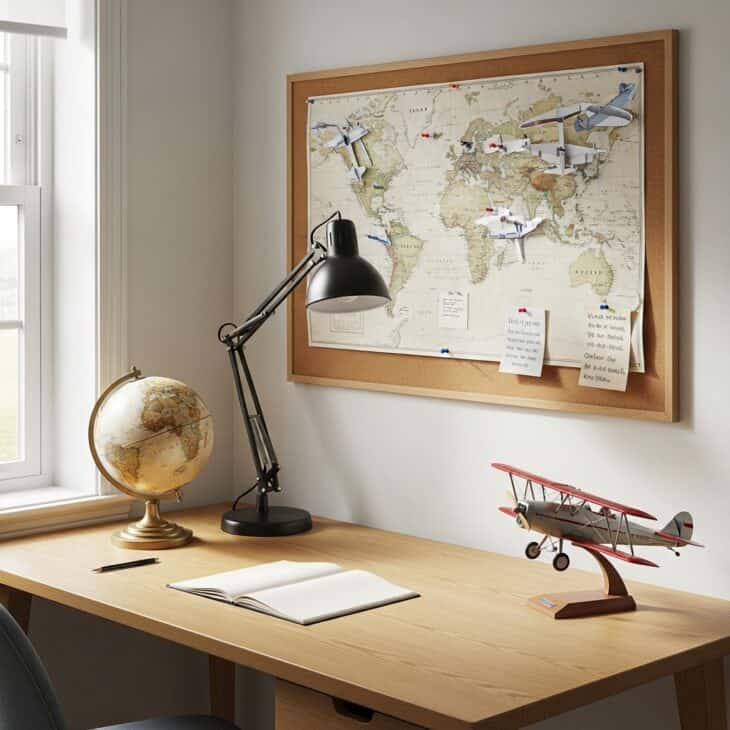
What you see The desk is set up like a young aviator’s workstation, a tidy surface with a globe, an angled lamp, a model plane standing guard, and a pinboard of maps and plane cutouts above it. It is where homework happens, dressed so the everyday grind of school feels a notch more inspiring.
Why it works Once school starts, a kid needs a real place to work, and theming that corner means the most useful part of the room joins the story instead of breaking it. A globe and a pinboard invite the kind of map-gazing curiosity that pairs naturally with aviation, and a defined desk helps focus.
How to get it Start with a solid desk at the right height and a good task lamp, then add aviation touches that do not get in the way of working, a globe, one model, and a corkboard. Keep the surface mostly clear so there is room to spread out. Use a pen pot or drawer organizer styled in metal for a workshop feel. Pin up a world map so daydreams have somewhere to go.
16. Cloud Beanbag Corner
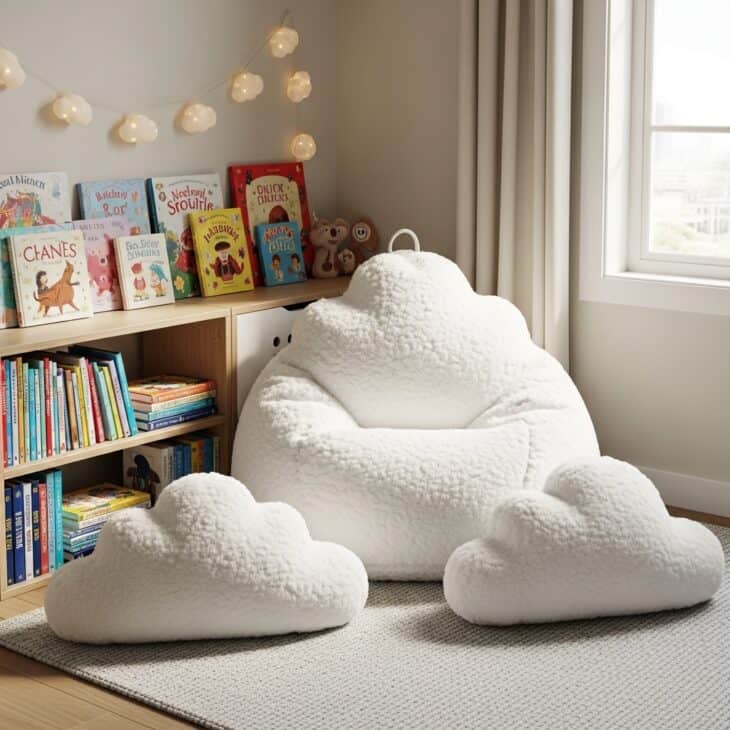
What you see A corner is given over to a big soft cloud, a fluffy white beanbag with a couple of smaller cloud cushions around it and a low shelf of books within reach. It is the room’s soft landing, the spot a kid flops into to read, daydream, or just escape for a while.
Why it works Every kid’s room benefits from a comfy spot that is not the bed, and shaping the seating like clouds keeps the sky theme going right down at floor level. Beanbags are forgiving, move easily, and suit a growing body, and a dedicated reading corner quietly encourages more reading.
How to get it Pick a large cloud-shaped beanbag in a washable cover and add one or two smaller cloud cushions for company. Place it near a window for daylight or beside a lamp for evenings. Put a low, front-facing book ledge within arm’s reach so books are easy to grab and put back. Keep the corner uncluttered so it stays the calm spot it is meant to be.
17. Propeller Ceiling Fan
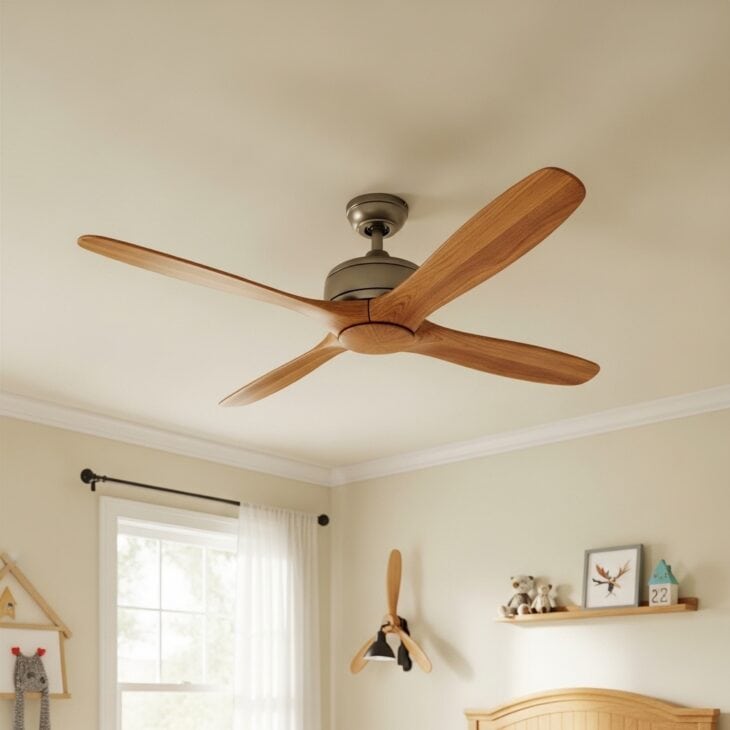
What you see The ceiling fan overhead is shaped like a set of wooden propeller blades, warm wood spinning slowly against a pale ceiling. The thing that keeps the room cool also reads as the front of an aircraft, putting a slow-turning piece of the theme right at the center of the room.
Why it works A fan is genuinely useful in a kid’s room through warm nights, and a propeller-style one lets that practical piece carry the theme instead of clashing with it. It draws the eye upward to meet a sky ceiling or hanging squadron, and the wood tone warms up a room full of painted surfaces.
How to get it Choose a ceiling fan with propeller-styled wood-tone blades that suits any other wood in the room. Have it installed on a properly rated ceiling box, ideally by an electrician, with a remote or wall switch. Run it on a low, quiet setting for steady airflow. If swapping the whole fan is not on, propeller-look blade covers fitted to your existing fan get most of the effect.
18. Cabin Window Decals
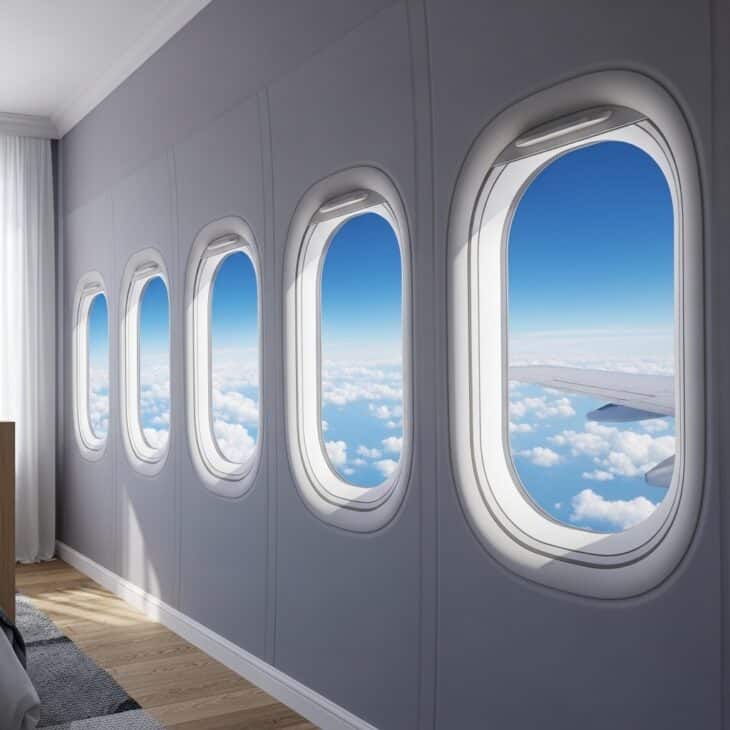
What you see A line of rounded cabin windows seems to open along the wall, each framing bright sky and clouds far below, as if the whole bedroom were cruising at altitude. Lying in bed, a kid gets the window seat they always want on a real flight, stretched right across the room.
Why it works The cabin window is the most recognizable view in all of flying, and a row of them turns a flat wall into the side of an airliner mid-journey. Decals are cheap, renter-friendly, and quick to put up, and the repeated circles make a calm, satisfying rhythm along the wall.
How to get it Use rounded cabin-window wall decals, or frame circular sky prints in white round frames for a more dimensional look. Run them in a straight line along the wall beside the bed at sitting eye level so it reads as a cabin. Choose bright, cheerful sky views to suit a daytime room. Add a thin painted shade line above each one if you want to push the realism.
19. Aviation Neon Sign
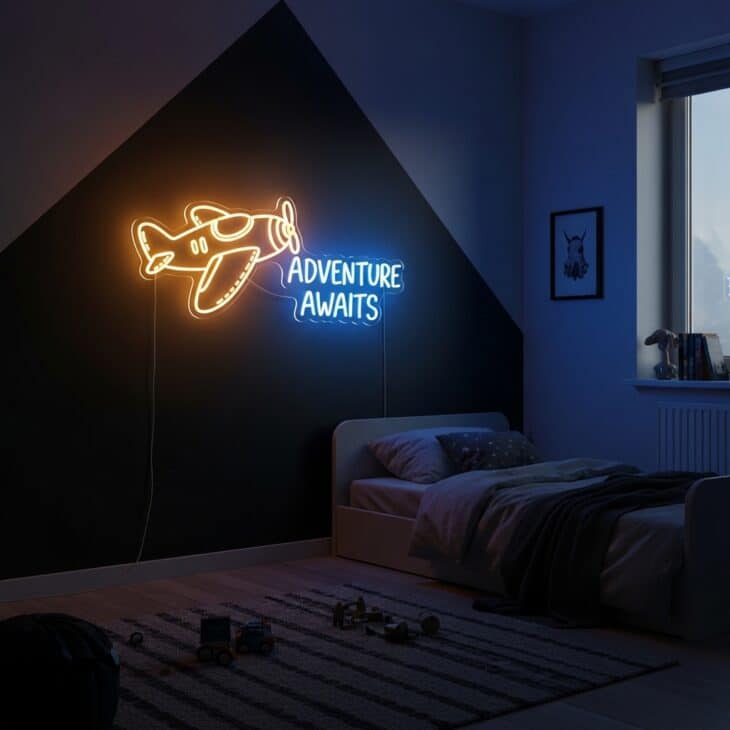
What you see A glowing neon-style sign sits on the feature wall, shaped like a little plane or spelling out a short phrase like Time to Fly. By day it is a clean graphic outline, and at night it lights the room with a soft colored glow that doubles as a gentle night light.
Why it works Neon signs are a current favorite in older kids’ and teens’ rooms, and an aviation one keeps that trend on theme. It gives the space a cool, personal focal point that photographs well and grows up nicely, working just as well for a ten-year-old as it will a few years later.
How to get it Choose a flexible LED neon sign, which is shatterproof and runs cool, rather than real glass neon. Plane shapes and short aviation phrases both work, so pick one that fits the wall. Mount it on a darker feature wall where the glow stands out, and run the cable down to a nearby outlet neatly. A dimmer or remote lets it drop to a soft night-time level.
20. Flight-Path World Map
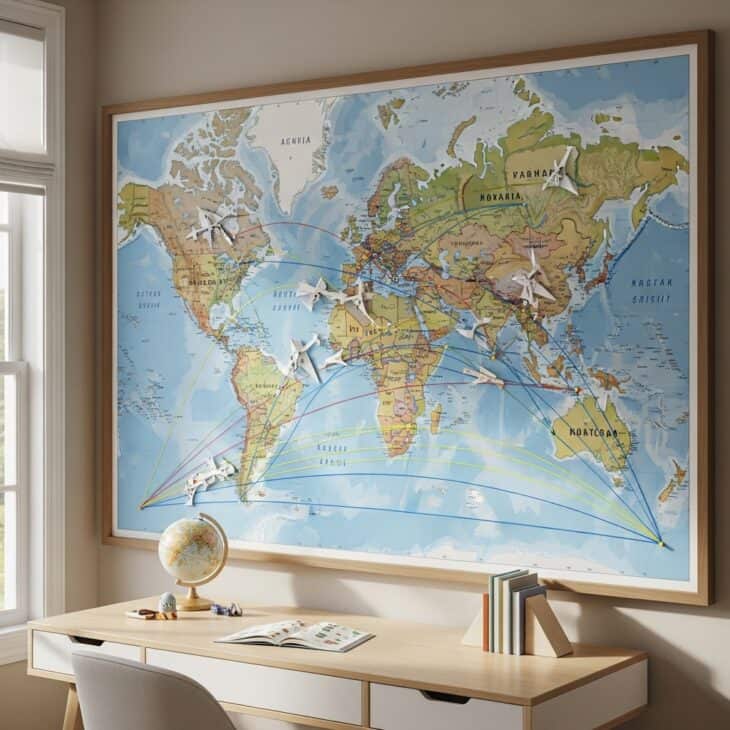
What you see A big framed world map carries arcs of colored string pinned between cities, each one a flight path, with little paper-plane markers riding along the routes. It is a map you can touch and change, a living record of places visited, dreamed about, or just discovered that week.
Why it works Where a plain map mural is decor, a string-and-pin map is a project a kid keeps adding to, which makes it stickier and more personal. It quietly teaches geography and the idea that planes connect distant places, and routes are something a young aviation fan loves to plan and re-plan.
How to get it Mount a large map on a corkboard or foam backing inside a frame so it can take pins. Use push-pins for cities and stretch colored string between them to draw routes. Let your child add a new pin after every trip or every plane they learn about. Keep the pins to a board well above younger siblings, and swap string for stickers if pins feel risky.
One hero, then layer
The best kids’ rooms commit to a single big idea, a plane bed, a painted sky wall, or a hanging squadron, and keep everything else low-key around it. Trying to cram in ten features at once turns a fun room into a busy one. Choose the hero your child loves most, then add a few supporting touches.
21. Control Tower Play Tent
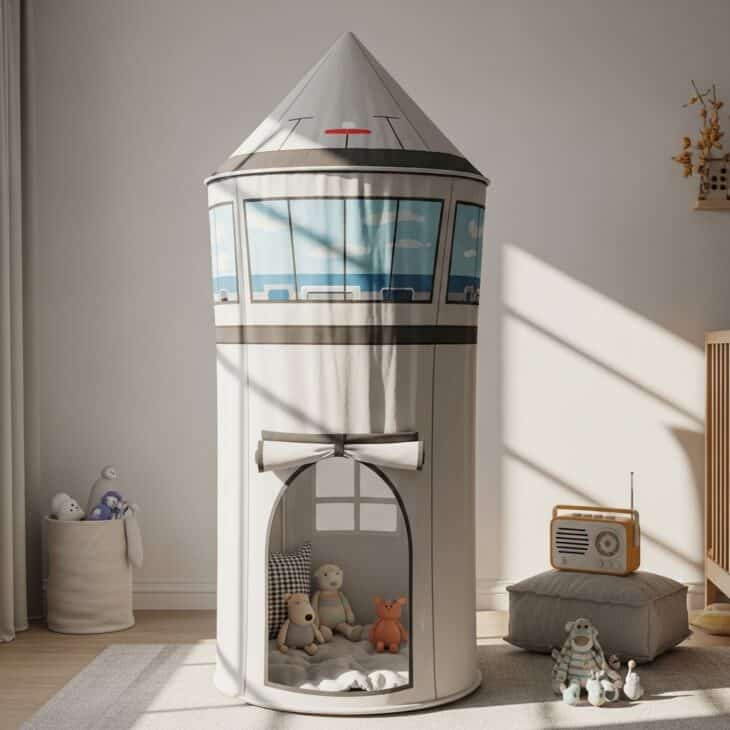
What you see In the corner stands a tall fabric play tent shaped like a control tower, a narrow tower with a peaked cab and printed windows, a little doorway, and a play radio tucked inside. It is a hideaway and a command post at once, the place a kid runs the whole imaginary airport from.
Why it works Kids love a den of their own, a small enclosed space that feels separate from the grown-up world, and shaping it as a control tower folds that instinct straight into the theme. It packs down when not in use, suits a range of ages, and pairs perfectly with a runway rug and toy planes to direct.
How to get it Buy a tower-style play tent or convert a tall pop-up tent with painted-on or stuck-on windows and a cab band near the top. Place it in a corner clear of cords and radiators, on the soft rug. Add a couple of floor cushions and a play headset or radio inside for role-play. Choose a model that folds flat so it can disappear when the room needs the floor back.
22. Squadron Gallery Wall
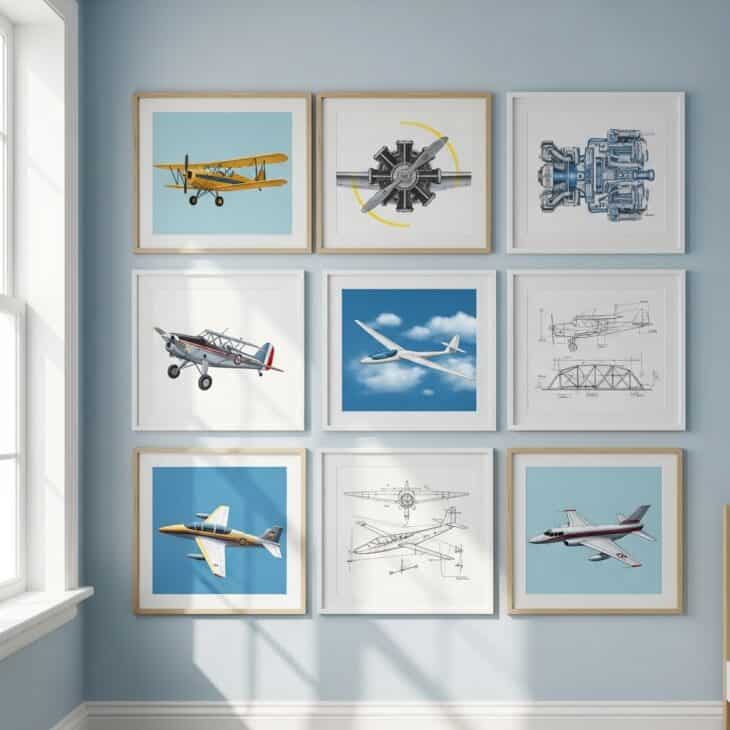
What you see A tidy grid of framed prints covers a stretch of wall, a mix of aircraft through the ages and a couple of blueprint-style diagrams, all in matching frames. Together they read as one confident display, the kind of wall a plane-mad kid stands in front of and explains to anyone who visits.
Why it works A gallery wall is endlessly flexible, easy to expand or rearrange as a kid’s interests sharpen, and it fills a big empty wall with detail at a fraction of the cost of furniture. Blueprint-style prints add a smart, educational edge, and the format grows up easily as cartoon planes give way to real machines. An air show outing is a great place to pick up a print or two.
How to get it Pick five to nine prints that share a palette and style so the wall feels cohesive, mixing aircraft art with a diagram or two. Use matching frames and even spacing for a clean grid, or stagger them slightly for a relaxed look. Lay it out on the floor and cut paper templates before putting holes in the wall. Printable downloads keep this cheap, since you only pay for frames.
23. Glider Wing Shelves
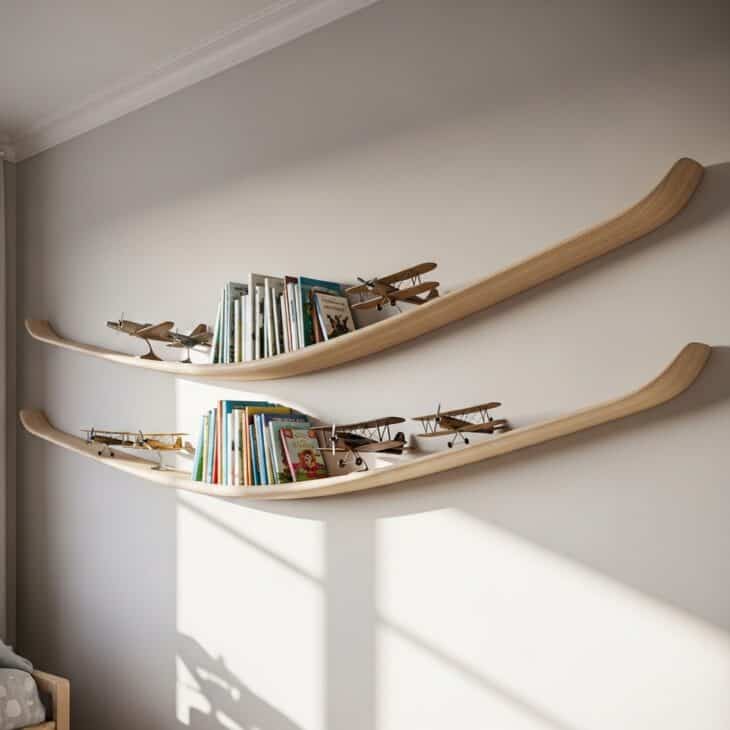
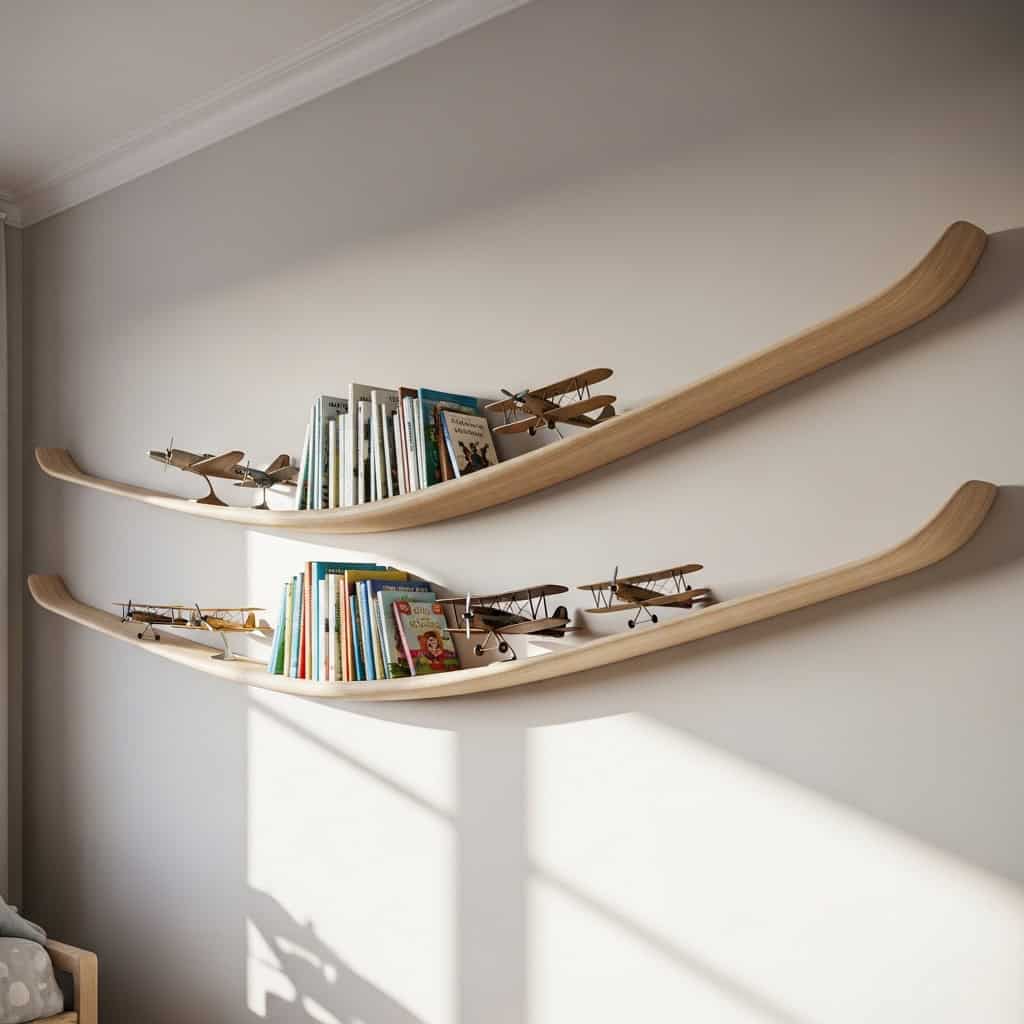
What you see A few long shelves curve along the wall, each shaped like the smooth wing of a glider, pale wood with a soft airfoil profile. They hold books and a couple of models, doing everyday shelf duty while quietly carrying the theme in their shape alone.
Why it works Gliders are the most elegant, graceful side of aviation, all clean lines, which gives a kid’s room a calmer, more designed kind of theme than cartoon planes. Wing-shaped shelves hide the theme in plain sight and add genuinely useful surface area without a bulky bookcase eating the floor.
How to get it Look for shelves with a smooth, tapered wing profile, or shape your own from glued pine and finish them pale and satin-smooth. Use hidden floating brackets so nothing breaks the clean line, anchored firmly into studs. Mount them within a child’s reach but light enough not to overload, and style them sparingly so the wing shape stays the star. Two or three at staggered heights look like wings in flight.
24. Altitude Growth Chart
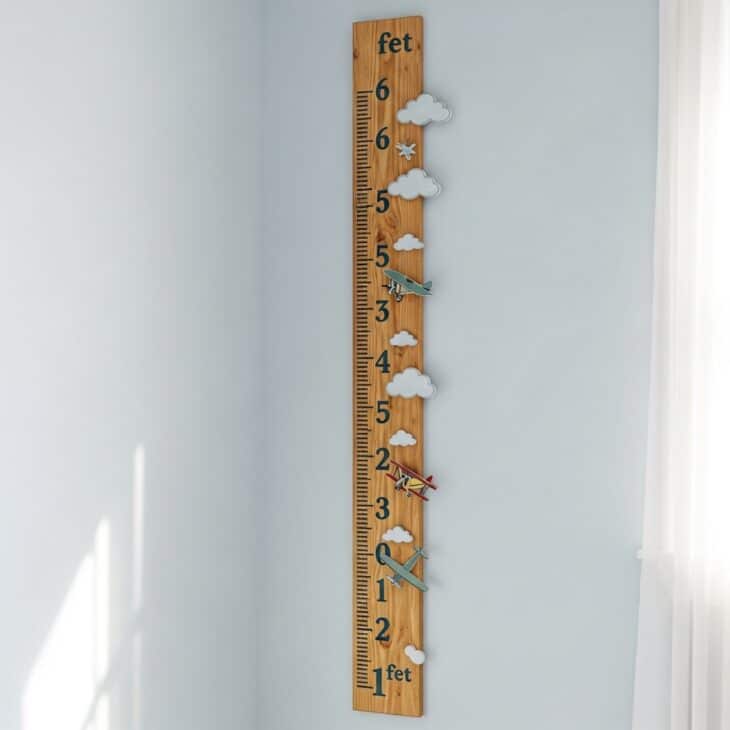
What you see A tall wooden ruler climbs the wall, marked like an altitude scale rather than plain inches, with little planes and clouds rising alongside the numbers. Every time your child grows, they gain a bit more altitude, which is a sweet way to frame getting taller for a kid who is counting.
Why it works A growth chart is one of the few pieces of decor that becomes a keepsake, carrying dated heights for years, and kids love watching their own mark climb. Styling it as an altimeter folds it into the theme, and the tall vertical line adds height to the room while it does its job.
How to get it Use a wooden board or wide plank marked in feet and inches, with small painted plane and cloud icons climbing the scale. Mount it with the bottom at floor level for accurate readings and screw it to the wall rather than relying on tape. Record each height in pencil with the date beside it. A removable fabric or vinyl version rolls up and moves house with you if you might relocate.
25. Personalized Airfield Name Sign
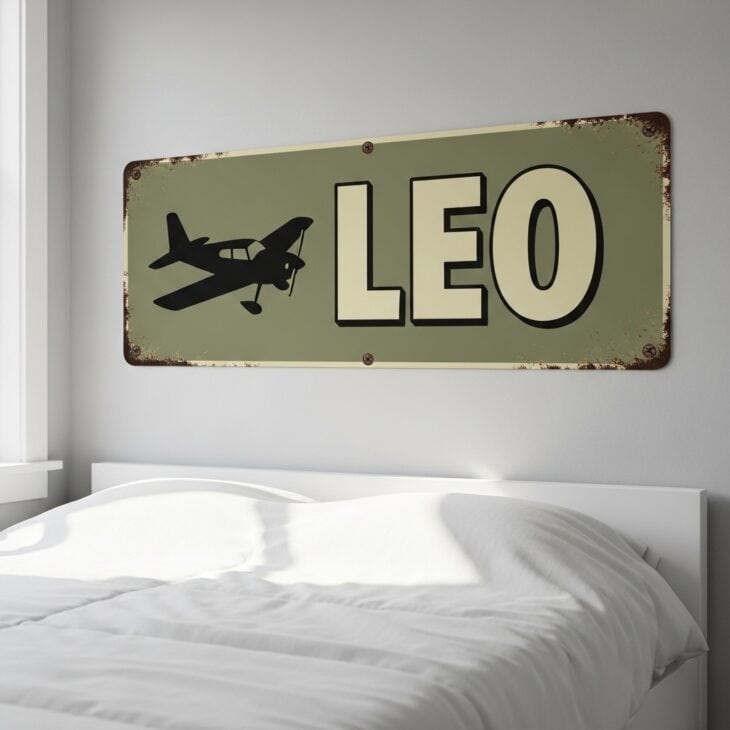
What you see Above the bed hangs a sign styled like an old airfield marker, the child’s name spelled out in bold retro aviation lettering on a weathered metal-look board with a small plane silhouette. It claims the room as theirs and reads like the entrance to their own private airbase.
Why it works Personalization is what makes a themed room feel like a particular kid’s room rather than a showroom, and styling the name after airfield signage ties it straight to the theme. A name sign is the finishing touch that pulls everything together, and it fills the often-awkward space above a headboard with something meaningful.
How to get it Order a custom name sign in a vintage aviation or airfield style, or make one by painting a child’s name onto a distressed wooden board with a stenciled plane. Keep the palette in step with the rest of the room, leaning muted and weathered. Hang it centered above the bed, anchored properly given its weight. A small spotlight or a couple of fairy lights around it make it the room’s signature at night.
However you mix these, the trick is to lead with one idea your child genuinely loves and let the rest support it. Pick the plane bed or the painted sky or the hanging squadron that made them grin, build a little airfield around it, and leave room to add and change things as their obsession grows. And if all this gets the whole family curious about the real machines, reading up on classic small planes together makes a fun next stop after lights-out.
Get the Newsletter
The latest aviation news and stories sent to your inbox.
About the Author

Hanna writes AeroCorner's aviation-lifestyle and decor guides, turning a love of flight into ideas for your home, celebrations, and gift lists.