
Fighter Jets
Mikoyan MIG-31E Foxhound
ICAO: MG31
Soviet swept-wing jet fighter that surprised the West over Korea
Updated: by Tim de Vries

The latest aviation news and stories sent to your inbox.
The Mikoyan-Gurevich MiG-15 is a single-seat, swept-wing jet fighter that entered Soviet service in 1949. It was powered by a Soviet development of the British Rolls-Royce Nene engine and was built to shoot down American heavy bombers such as the B-29. Over Korea it outclassed the straight-wing jets the United Nations fielded in 1950 and forced the United States to rush the F-86 Sabre into combat. NATO called it Fagot.
Live Fleet Activity (MG15)
Fetching live data…

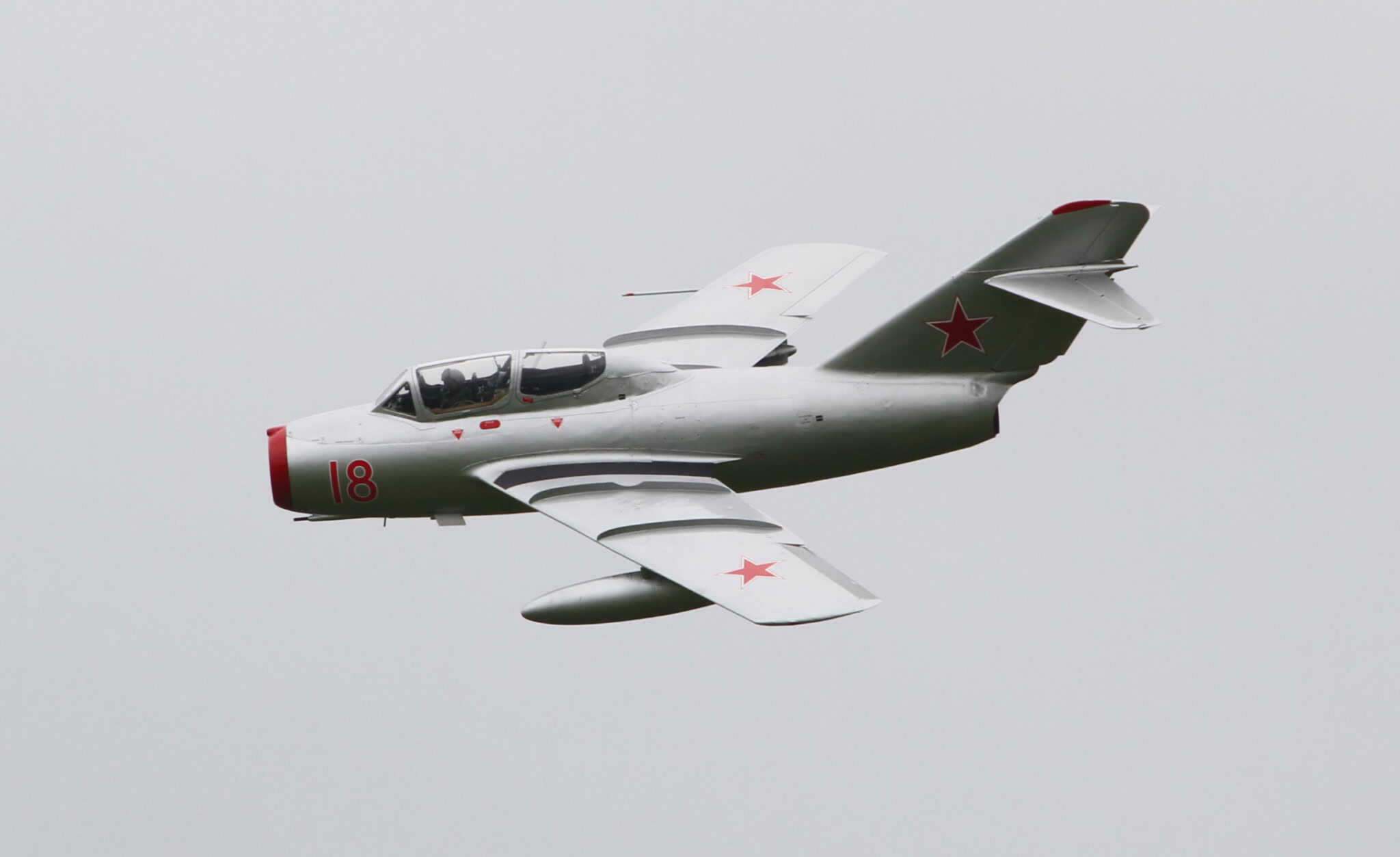


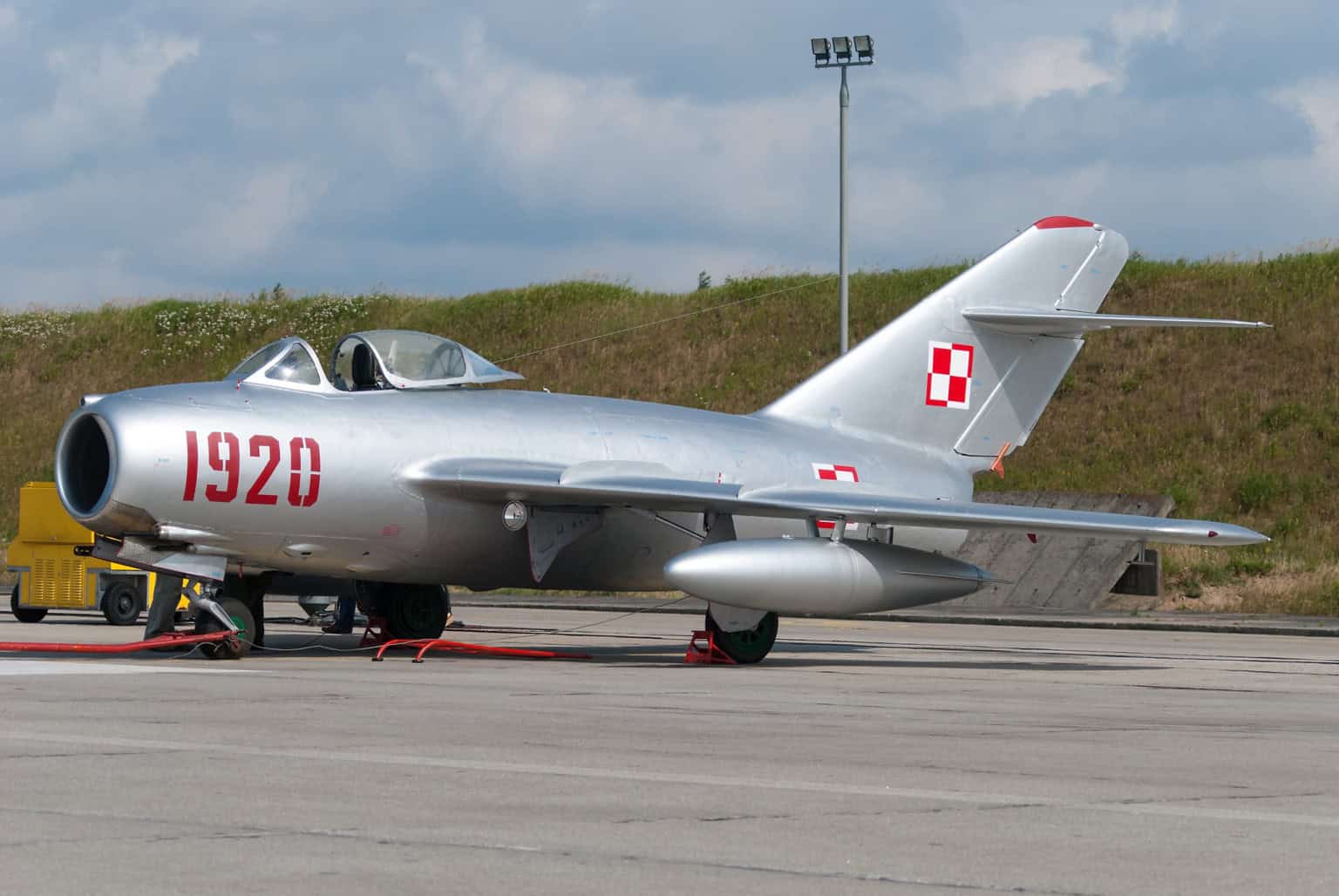


The Mikoyan-Gurevich MiG-15 is the Soviet jet fighter that took the West by surprise over Korea. It was a single-seat, swept-wing design powered by a development of a British engine, and NATO gave it the reporting name Fagot.
It first flew on December 30, 1947, entered Soviet service in 1949 and is believed to be one of the most produced jet aircraft in history. The full specification table for the aircraft is on this page, and the sections below explain what the numbers mean and how the aircraft actually fought.
The MiG-15 exists because of a favor from Britain. In 1946 Soviet engine technology was far behind the West’s, and aviation minister Mikhail Khrunichev and designer Alexander Yakovlev proposed buying British jet engines.
Stalin reportedly replied, “What fool will sell us his secrets?” He approved the request anyway, and Britain’s Labour government was willing to supply technical information and a license for the Rolls-Royce Nene.
Sample engines and blueprints went to Moscow. The Soviets adapted the Nene as the Klimov RD-45, then improved it again as the VK-1.
The Council of Ministers wanted a high-altitude daytime interceptor to destroy American bombers such as the B-29. The Mikoyan-Gurevich design bureau started from its straight-wing MiG-9 and added a 35-degree swept wing and tail, producing the I-310 prototype.
Western analysts later noted a strong resemblance to Kurt Tank’s Focke-Wulf Ta 183 design, which never got beyond the design stage. The prototype’s first flight came on December 30, 1947, and the first production example followed on December 31, 1948.

The first production version, the MiG-15, used the Klimov RD-45F engine. Early examples tended to roll left or right because of manufacturing differences, so ground crews fitted adjustable trimming tabs the Soviets called “knives” and set them until the aircraft flew straight.
The improved MiG-15bis entered service in early 1950 with the VK-1 engine, which used better metallurgy than the RD-45. It became the main fighter version and is the one people usually mean when they say MiG-15.
A two-seat trainer, the MiG-15UTI, followed and proved particularly successful, extending the type’s use in many air forces. The Soviet Union built 3,434 two-seaters, and Czechoslovakia built 2,012 more as the CS-102.

Other versions added a belly-tank rack, an escort-fighter configuration and ground-attack modifications. Fighter-bomber conversions carried unguided rockets or bombs, and about 150 aircraft were upgraded to the SD-21 standard in 1953 and 1954.
The MiG-15bis carries a single Klimov VK-1, a centrifugal-flow turbojet descended from the Rolls-Royce Nene. The engine type and thrust are in the specification table.
The panel’s “Maximum speed” row is the top speed of the MiG-15bis, and it reads 598 kt · 688 mph · 1,107 km/h. That figure applies at 9,843 feet (3,000 m), and the aircraft is slower at sea level.
Normal cruise is far lower. The “Cruise speed” row reads 459 kt · 528 mph · 850 km/h, which is about Mach 0.69. Published cruise speeds vary between sources because they depend on the altitude and power setting used.
The range row reads 1,360 nm · 1,570 mi · 2,520 km. That is a ferry range, flown at high altitude with two external drop tanks, not a combat radius.
The same caveat applies to weight. The maximum takeoff weight of 13,500 lb · 6,100 kg assumes those two drop tanks are fitted.
The ceiling of 50,800 ft · 15,500 m and the climb rate of 10,080 ft/min · 51 m/s were advantages over the American F-86E. A RAND comparison credits the MiG-15bis with better acceleration and a higher ceiling, and its table shows a faster climb as well.

The MiG-15 carries one 37 mm Nudelman N-37 cannon with 40 rounds and two 23 mm Nudelman-Rikhter NR-23 cannons with 80 rounds each. All three sit in the lower fuselage. Two hardpoints carry drop tanks, unguided rockets or light bombs.
The guns reflect the job. RAND notes the MiG-15 was designed as a bomber interceptor and carried heavy cannon armament.
RAND estimated that an NR-23 hit was about six times as destructive as a hit from an American .50 caliber machine gun, and an N-37 hit about 18 times. A postwar USAF study found that an F-86 needed to fire an average of 1,024 rounds from its machine guns to kill a MiG-15.
The airframe helped too. The MiG-15 had self-sealing fuel tanks, rear armor and a thick bulletproof windscreen, and a jet engine was much less vulnerable to damage than the piston engines of World War II.
The MiG-15 was fast and dangerous. It tended to spin after a stall, and the pilot often could not recover. American test pilots said the lack of a noticeable stall warning made this worse.
UN pilots in Korea recorded 56 occasions when a MiG-15 entered a spin in combat. At least 25 of those ended in crashes and ten in ejections. A North Korean pilot later told the Americans that his air force ordered pilots to eject if they could not recover from a spin within three turns.
The aircraft also had a hard speed wall. It lacked an “all-flying” tailplane, so pilots had to stay below Mach 0.92, where the flight controls stopped working properly. A red light on the instrument panel warned when that speed was reached.
American testing after the war found heavy buffeting above Mach 0.92 and a pitch-up at Mach 0.95. In a full-power dive, Chuck Yeager reached Mach 0.98, lost roll control and did not begin to regain it until he reached denser air at 12,000 feet (3,700 m). He called the MiG-15 a “flying booby trap.”

The MiG-15 reached Korea in force in late 1950. The Soviet 50th Fighter Aviation Division joined the war on November 1 with its aircraft in North Korean markings, and the pilots wore North Korean uniforms or civilian clothes to hide their nationality.
That same day came the first jet-versus-jet combat in history. Three MiG-15s met ten F-80 Shooting Stars, and a MiG shot down the F-80C of First Lieutenant Frank Van Sickle, who was killed. The USAF falsely attributed the loss to North Korean anti-aircraft fire.
The MiG-15 clearly outclassed the straight-wing jets the UN fielded at first, including the F-80, the F-84, the Grumman F9F and the Gloster Meteor. To counter it, the United States rushed three squadrons of F-86 Sabres to Korea in December 1950. Our guide to Korean War fighter jets covers the rest of the field.
Chinese and North Korean pilots flew MiG-15s as well. After a brief episode in January 1951, Chinese MiG-15s next engaged Sabres on September 25, 1951, and the North Korean unit got into action a year later, in September 1952.
The F-86 Sabre, which first flew about two months before the MiG-15, was the only close contemporary that could match it. Our F-86 Sabre page has the full details of the American fighter.
RAND’s comparison of the F-86E and the MiG-15bis found the two closely matched. The Sabre had better turn performance and a better gunsight. The MiG had better acceleration, a higher ceiling and much heavier armament.
The kill ratio is where the legend and the record part ways. For decades Western sources claimed F-86 kill ratios as high as 14:1. RAND said research since the fall of the Soviet Union casts doubt on this.
Its briefing says the number of MiG-15s actually shot down was just over 200, against almost 800 claimed by the USAF. It puts the real ratio at about 1.8 to 1 overall, and likely about 1.3 to 1 against MiGs flown by Soviet pilots.
The claims ran both ways. The Soviet 64th Fighter Aviation Corps claimed 1,106 aircraft shot down by MiG-15s, while USAF unit records confirm 139 US aircraft downed by MiGs, with hundreds more listed as missing, lost to unknown causes or classed as “other losses.”
The MiG-15 losses admitted by all sides come to about 659. That includes 335 Soviet-piloted aircraft, 224 Chinese and an estimated 100 North Korean, and counts every cause rather than only air combat.
The United States wanted a MiG-15 to study, and it was willing to pay. Operation Moolah offered any pilot who defected with one political asylum and $100,000.
Polish pilot Franciszek Jarecki flew from Słupsk to the Danish island of Bornholm on March 5, 1953, the day Stalin died, giving Western air experts their first look at the aircraft. Specialists from the United States examined it, and it went back to Poland by ship a few weeks later.
Jarecki received $50,000 for being the first to present a MiG-15 to the Americans, and he became a US citizen. One academic thesis argues that Yugoslavia gave the CIA a flying MiG-15 as early as November 1951.
Four Polish pilots eventually defected in MiG-15s. Three landed on Bornholm and one reached the Swedish coast.
On September 21, 1953, North Korean Lieutenant No Kum-Sok landed his MiG-15 at Kimpo Air Base. He claimed to be unaware of the reward. American test pilots, including Chuck Yeager, flew his aircraft, and it is now on display at the National Museum of the United States Air Force near Dayton, Ohio.
Nobody agrees on a single total. Wikipedia lists 13,130 built in the Soviet Union, made up of 1,344 original MiG-15s, 8,352 MiG-15bis and 3,434 two-seaters, plus at least 4,180 more under license.
Museum totals run lower and higher. The Smithsonian says more than 12,000, March Field says over 12,000 with licensed production perhaps pushing the figure past 18,000, and Ingenium says about 16,000.
Czechoslovakia built the S-102, the S-103 and the CS-102 trainer. Poland built the Lim-1 and Lim-2, and China built the J-2 and the JJ-2 trainer. Polish Lim-2 production ran from 1954 to 1956, and Ingenium dates MiG-15 production overall from 1948 to 1961.
The type served with almost 40 air forces. It evolved into the more advanced MiG-17, which surprised the West again in Vietnam by proving effective against the supersonic F-105 Thunderchief and F-4 Phantom II. Our MiG-17 page covers that successor, and the best Russian fighter jets ranking shows where the lineage went.
Yes, though not widely. As of October 2026, reference works still list the Korean People’s Army Air Force as an operator, flying the type as an advanced trainer. How many are airworthy is not publicly known.
Warbird flying is more certain. The FAA counted 43 privately owned MiG-15s in the United States in 2011, including Chinese and Polish derivatives. As of July 2015, six privately owned MiG-15s were airworthy on the Australian civil register.
Many more sit in museums. The Smithsonian shows a Chinese-built MiG-15bis at the Steven F. Udvar-Hazy Center.
The two were closely matched. RAND found the F-86E had better turn performance and a better gunsight, while the MiG-15bis had better acceleration, a higher ceiling and much heavier armament. The famous Sabre kill ratios were inflated, and RAND puts the real exchange at about 1.8 to 1 overall and 1.3 to 1 against Soviet-flown MiGs.
NATO’s reporting name for the MiG-15 is Fagot. The US Department of Defense also used the designation Type 14.
The closest American equivalent was the North American F-86 Sabre, the only US jet in Korea that could match the MiG-15 in most measures. The F-86 first flew about two months before the MiG-15.
Yes, in its first years. It outclassed every straight-wing jet the UN had in Korea and forced the rapid deployment of the F-86. It also had serious flaws, including a tendency to spin without much stall warning and a handling limit of Mach 0.92.
The MiG-15bis had a top speed of 598 kt · 688 mph · 1,107 km/h at 9,843 feet (3,000 m). It was slower at sea level, and the controls became unreliable above Mach 0.92.
Counts differ by source. Wikipedia gives 13,130 built in the Soviet Union plus at least 4,180 under license, while museum figures run from more than 12,000 to about 16,000 and over 18,000 including licensed production.
It tended to spin after a stall, and American test pilots said it gave little warning first. UN pilots in Korea saw 56 MiG-15 spins in combat, with at least 25 crashes and ten ejections.
Not as a practical matter. Its flight controls became ineffective around Mach 0.92, and Chuck Yeager reached Mach 0.98 in a test dive, lost roll control and found the aircraft would go no faster.
Sources and references used for research and fact-checking.