Fighter Jets
Mikoyan MIG-31E Foxhound
ICAO: MG31
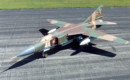
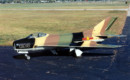
The MiG-27 "Flogger" was the Soviet Union's dedicated swing-wing ground-attack aircraft, a MiG-23 rebuilt for low-level strike, and India flew a licence-built version, the Bahadur.
Updated: by Tim de Vries

The latest aviation news and stories sent to your inbox.
The MiG-27 (NATO name Flogger-D/J) is a single-seat, variable-geometry ground-attack aircraft built by Mikoyan-Gurevich on the MiG-23 airframe. It first flew on 20 August 1970 and entered Soviet frontline service in 1975. Hindustan Aeronautics later built it under licence in India as the Bahadur, and the last Indian squadron retired it in December 2019.
Live Fleet Activity (MG27)
Fetching live data…


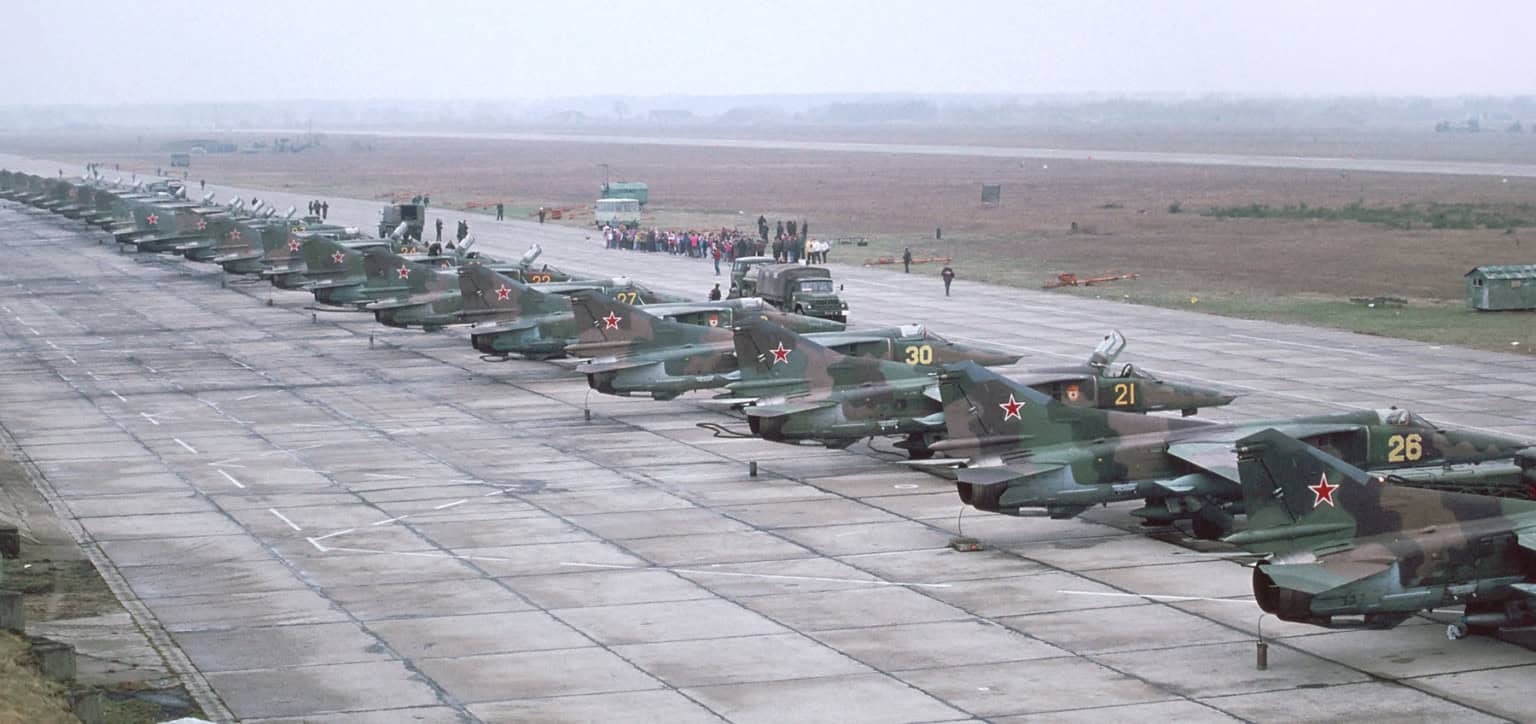

The MiG-27 is a single-seat, swing-wing ground-attack aircraft that the Soviet Union built by reworking the MiG-23 fighter. NATO called it Flogger-D/J. It first flew on 20 August 1970 and reached its first frontline regiment in 1975.
Roughly 1,075 were built, including licence production in India, where Hindustan Aeronautics called it the Bahadur. The last Indian squadron retired its MiG-27s in December 2019.
The full specification table for the aircraft is on this page. The sections below cover what the numbers do not: why the MiG-27 looks the way it does, what its variants changed and how it fought.
The MiG-27 shares most of its airframe with the MiG-23. Mikoyan changed the parts that mattered to a low-level bomber.
The radar was dropped for a sloping, downward-looking nose that gave the pilot a better view of the ground. In its place went a laser rangefinder and a marked-target seeker.
The variable air intakes and exhaust nozzle of the fighter became fixed units. That cut weight and maintenance, and it suited an aircraft that spent its life at low altitude and subsonic or transonic speed. The landing gear was strengthened for rough, poorly surfaced airfields.
Pilots in Soviet service gave it the nicknames “Utkonos” (Platypus) and “Krokodil Gena” because of that drooped nose.

The MiG-27 family is confusing because the Soviet designations and the Indian ones do not line up neatly. The main versions were these.
The MiG-23B and MiG-23BN were the first Flogger attack versions. The BN’s R-29B-300 engine is the one the later MiG-27 kept.
The MiG-27 proper (MiG-23BM, Flogger-D) was the first to carry the GSh-6-30 six-barrel cannon. The MiG-27M (Flogger-J) added a new electronic countermeasures fit and the PrNK-23K navigation and attack system, and about 200 Soviet-built examples were made between 1978 and 1983.
The MiG-27D was an upgrade of 305 MiG-23BM airframes to near-MiG-27M standard. The two are hard to tell apart from the outside.
The MiG-27K (Flogger-J2) was the most advanced Soviet version, with a laser designator and TV-guided weapons. About 200 were built.
India built the export version, the MiG-27L, as the MiG-27ML from 1986 knock-down kits. In 2004 a batch was modernised with French avionics as the MiG-27H, also called the MiG-27UPG.
Like most Soviet strike jets, the MiG-27 had a top speed it rarely used. The figure on the panel is about Mach 1.7 at altitude, but the aircraft lived near the ground, where it manages roughly Mach 1.1.
The range figure on the panel is the ferry range, flown clean with drop tanks. A loaded attack mission is far shorter.
Wikipedia’s MiG-27K data gives a combat range of 485 mi (780 km), which falls to 335 mi (540 km) with two Kh-29 missiles and three drop tanks. With two Kh-29s and no external fuel it is only 140 mi (225 km).
The MiG-27’s main gun is the 30 mm GSh-6-30 six-barrel rotary cannon. Heavy recoil during long bursts often damaged the airframe, so crews fired short ones.
An alternative fit is a 23 mm GSh-23 twin-barrel cannon with 200 rounds. Seven external hardpoints carry up to 4,000 kg of stores: S-5, S-8, S-24 and S-25 rockets, R-60M air-to-air missiles, and Kh-23M, Kh-25ML and Kh-29 air-to-surface missiles.
It could also carry Kh-27PS anti-radiation missiles, KAB-500Kr TV-guided and KAB-500L laser-guided bombs, and a range of free-fall, flare and fuel-air bombs.
Like the MiG-23, it kept a nuclear delivery capability.
The Soviet Union used the MiG-27 in combat only in Afghanistan, in 1988 and 1989. The 134th fighter-bomber regiment deployed to Shindand with MiG-27D and MiG-27M aircraft in October 1988.
A 5,000 m minimum altitude limited them to unguided bombs and rockets. They bombed convoys, scattered mines and dropped flare bombs to light targets. The MiG-27K was not sent because it lacked pilot armour.
India used the type during the 1999 Kargil War. On 27 May 1999 a MiG-27L suffered an engine flameout while firing rockets, and its pilot, Kambampati Nachiketa, was captured by Pakistani forces.
Sri Lanka flew MiG-27s for bombing and close air support in the later phases of its civil war. It lost aircraft to crashes in 2000, 2004 and 2012, and one more on the ground in the July 2001 attack on its air base.

India inducted the type in 1985 and built it locally as the MiG-27ML, which the Indian Air Force called the Bahadur. Sources disagree on how many were built, with figures of 150, 160 and 165 all in print.
The fleet was grounded in February 2010 after a crash near Siliguri. An upgraded batch was retired in December 2017, and the last MiG-27ML squadron stood down on 27 December 2019 at Jodhpur.

The cockpit is typical of 1970s Soviet design, with round analogue dials and no radar scope. The nose carries a laser rangefinder and marked-target seeker instead, and the PrNK-23K navigation and attack system handles the strike run.

No major air force flies the MiG-27 today. Russia inherited most Soviet aircraft, but a decree of 1 July 1993 ordered single-engine attack aircraft phased out. Ukraine and Belarus also retired theirs.
Kazakhstan retired its last 12 MiG-27M aircraft in October 2023 and offered them for auction. A report in April 2024 that the US had bought 81 of them was denied by Kazakhstan’s arms exporter and is widely considered false.
Not with any major air force. India retired its last squadron in December 2019, Russia phased the type out in the 1990s, and Kazakhstan retired its remaining aircraft in 2023.
It was a competent low-level attacker with good ground visibility, a heavy cannon and a wide weapons range. Its weaknesses were short range with a full load, a single engine and heavy recoil from its gun.
They do different jobs. The MiG-21 is a light fighter built for air combat, while the MiG-27 is a ground-attack aircraft with no radar, so it is far better at hitting ground targets and far worse at fighting other aircraft.
Russia ordered single-engine attack aircraft phased out in 1993, and India grounded its fleet in 2010 after a crash near Siliguri before retiring it by 2019. The type was an old design and it was mostly limited to unguided weapons.
The MiG-23 is a radar-equipped fighter with variable intakes and nozzle. The MiG-27 drops the radar, fixes the intakes and nozzle, strengthens the landing gear and carries a six-barrel cannon for ground attack.
Sources and references used for research and fact-checking.