Fighter Jets
Sukhoi Su-27 “Flanker”
ICAO: SU27
Russia's one-off forward-swept wing demonstrator, first flown in 1997 and never put into production
Updated: by Tim de Vries

The latest aviation news and stories sent to your inbox.
The Sukhoi Su-47 Berkut is a Russian experimental fighter famous for its forward-swept wings. Only one was ever built. It first flew on 25 September 1997 as the S-37, tested composite wings, fly-by-wire controls and an internal weapons bay, and never entered service. Its lessons fed the Su-35 and the Su-57.
Live Fleet Activity (S37)
Fetching live data…
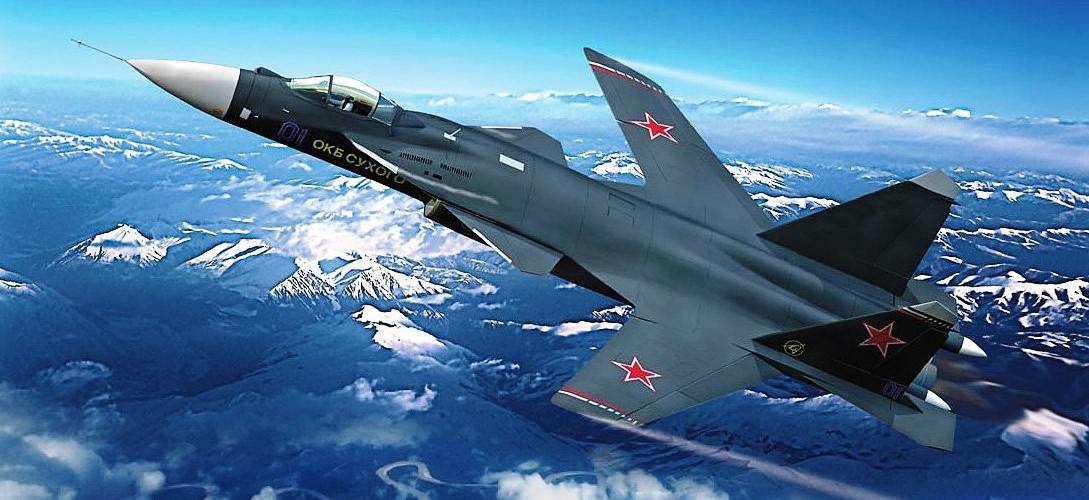


The Sukhoi Su-47 Berkut is a Russian experimental fighter whose wings sweep forward instead of back. It was a technology demonstrator, not a combat aircraft, and Sukhoi built exactly one.
That single airframe first flew on 25 September 1997 under the name S-37. It tested composite wing structures, digital fly-by-wire controls and an internal weapons bay, then passed those lessons on to the Su-35 and the Su-57.
Berkut means golden eagle. NATO gave the aircraft the reporting name “Firkin”.
The programme was launched in 1983 on an order from the Soviet Air Force. Sukhoi and the Irkutsk aircraft plant originally planned to build several experimental S-32 airframes for flight and static testing.
State funding stopped around the time the USSR collapsed in 1991. Sukhoi kept the project alive with its own money, and the plan shrank to one flying aircraft, now called the S-37.
According to the Russian test-flight reference testpilot.ru, the airframe was finished in mid-1996, passed its static tests by the end of that year and completed final assembly in May 1997. In July 1997 it was moved to the Gromov Flight Research Institute at Zhukovsky, outside Moscow.
Test pilot Igor Votintsev took the S-37 up for the first time on 25 September 1997, from Zhukovsky. The first test series ended in spring 1998, and the aircraft went back into the workshop for modifications.
In 1999 the programme was written into the state defence order, and in August that year the Berkut flew an aerobatic display at the MAKS air show. Supersonic testing began in March 2000.
testpilot.ru puts the aircraft’s total at 149 flight hours by the end of that supersonic phase. It also records vibration problems that the test flights never fully solved.
Sukhoi renamed the S-37 as the Su-47 in 2002. The aircraft became a regular at MAKS until 2007, then disappeared from public view for twelve years.

The appeal is control at extreme angles. On a forward-swept wing the inner section generates a large share of the lift, and that lift is not limited by the airflow breaking away at the wingtips.
Because the tips keep flying, the ailerons out there stay effective at the highest angles of attack, even when the airflow has separated from the rest of the wing. The result is a fighter that can change its nose angle and flight path very quickly at subsonic speeds.
The idea was not new in Russia. The TsAGI research institute had studied forward sweep since the 1940s, including the captured German Junkers Ju 287, an experimental jet bomber.
The catch is structural. Under load, a forward-swept wing bends in a way that twists its outer sections to a steeper angle, so the wing sees higher bending loads and tends to fail at a lower speed than a straight or swept-back wing.
The fix is a wing that twists the other way as it bends. That takes composite skins laid up in a specific direction, which is why the Su-47’s wing panels were made almost entirely of composites.
Airforce Technology puts the composite share at nearly 90% of the wing panels, against 13% by weight for the airframe as a whole, which is mostly aluminium and titanium. testpilot.ru says the large, thick-walled wing panels came from the Tekhnologiya research and production enterprise in Obninsk.
To keep costs down, Sukhoi borrowed the forward fuselage, the vertical tails and the landing gear from the Su-27 family. The Su-47 is close in size to the larger Sukhoi fighters of its day.
Like the Su-37 before it, the Berkut has a “tandem triple” layout: canards ahead of the wing, the wing itself, and tailplanes behind it. Two tail booms of unequal length sit outboard of the engine nozzles and carry a rear-facing radar and the brake chute.
Inside, there is an internal weapons bay and space set aside for a radar in the nose. The aircraft itself was never armed for combat.
Airforce Technology reports that the ejection seat is reclined at 60 degrees to help the pilot tolerate high g-loads.
The Su-47 flew on two Aviadvigatel (Soloviev) D-30F11 afterburning turbofans. The D-30F11 is a modified version of the D-30F6 that powers the MiG-31, and some references list the aircraft with the base D-30F6.
testpilot.ru describes the D-30F11 as a temporary installation. The plan was to switch to the more powerful AL-41F with thrust vectoring once it was ready.
Vectoring nozzles of plus or minus 20 degrees, moving at 30 degrees per second in pitch and yaw, were meant to add to the wing’s agility. Published specifications list two-dimensional and three-dimensional vectoring nozzles as planned for testing, and no source checked for this page records the Su-47 flying with them.
The full specification table for the Su-47 is on this page. A few of its figures need context, because this aircraft was a test bed and not a finished fighter.
The top speed of 1,367 mph (2,200 km/h) is the Jane’s figure, equal to Mach 2.21 at altitude. The aircraft was initially limited to Mach 1.6, and no source checked for this page confirms it ever reached its listed maximum.
The max takeoff weight of 75,000 lb (34,000 kg) is one of two weights Jane’s publishes. It also lists a normal takeoff weight of 56,590 lb (25,670 kg), so a Su-47 weight quoted elsewhere can differ by about a quarter depending on which figure it uses.
The range of 1,782 nm (3,300 km) is also the Jane’s figure. Because the aircraft never carried weapons, there is no published combat radius to set beside it.
The main reason is aerodynamic. Forward sweep pays off at transonic speeds, just below and around the speed of sound, but a conventional swept-back wing does better at supersonic speeds.
The structure was the second problem. A forward-swept wing only works if it is built from carefully tailored composites, which National Security Journal describes as expensive to build and hard to manufacture for Russia’s struggling aerospace industry of the 1990s.
The third was timing. In April 2002 the Russian Ministry of Defence chose Sukhoi to lead the new PAK FA fighter programme, and that aircraft, the future Su-57, got a conventional trapezoid wing.
The Su-47 was a test bed, and it did its job. Sukhoi used it to test internal weapons bays for the PAK FA, according to aviation writer Piotr Butowski.
Butowski also reported that the modernised Su-35 would get a flight control system similar to the Berkut’s quadruple digital fly-by-wire SDU-427. The Su-57 first flew on 29 January 2010 and entered service with the Russian Aerospace Forces in December 2020.
For more on how the Berkut fits into the wider family, see our guide to Sukhoi fighter jets.
The closest American equivalent is the Grumman X-29, which first flew on 14 December 1984. Grumman built two, and both have since been retired.
The two programmes solved the same problem the same way. Both needed composite wings to stop the forward sweep from twisting the structure apart, and both saved money by borrowing parts: the X-29 used the forward fuselage of the Northrop F-5A, the Su-47 the front end of the Su-27.
The difference is purpose. The X-29 was a pure research aircraft, while the Su-47 was built to fighter proportions, with an internal weapons bay and space for a combat radar.
The Su-47’s early name, S-37, causes constant confusion with the Su-37. The Su-37 was a separate Su-27 derivative with thrust vectoring that first flew on 2 April 1996.
The Su-37 crashed near Shatura, outside Moscow, on 19 December 2002, after its left tailplane broke off during a high-g manoeuvre. The pilot, Yuri Vashuk, ejected safely. The Su-47 was not involved.
Mikoyan’s rival demonstrator was the MiG 1.44. Funding shortages delayed its first flight until 2000, and the fighter programme it was built for was eventually cancelled.
After twelve years out of sight, the Su-47 reappeared at the MAKS-2019 air show in Zhukovsky. On 26 August 2019 it was towed from storage to the static display area, as The Aviationist reported.
It looked to be in good condition, and a crew member sat in the cockpit during the tow, which suggests it may still have some working flight controls. It did not fly.
As of September 2026, no later public appearance has been reported in the sources checked for this page. It never entered service.

It did not fail as a test aircraft; it was never meant to become a production fighter. The forward-swept wing lost out because it is most efficient at transonic speeds, while a conventional wing does better at supersonic speeds, and it needed expensive composites to avoid structural failure.
The Grumman X-29, a forward-swept wing research aircraft that first flew in 1984. Two were built, and like the Su-47 it depended on composite wings.
No. No flight has been publicly reported since its air show appearances ended in 2007, and at MAKS-2019 it was towed out for static display only.
Yes. The single aircraft was last seen in public at MAKS-2019 in Zhukovsky, where it appeared to be in good condition.
One. Plans for several S-32 test airframes were cut back to a single aircraft when state funding stopped around 1991.
It was designed for it, but the vectoring engines were only planned. The aircraft flew on D-30F11 turbofans without vectoring nozzles, as far as published sources show.
Jane’s gives a top speed of Mach 2.21 at altitude. The aircraft was initially limited to Mach 1.6.
No. The crash often linked to it was the Su-37, a different Sukhoi demonstrator, which went down near Moscow in December 2002.
No. It was a technology demonstrator that tested ideas for one, including the internal weapons bay later used on the Su-57, Russia’s fifth-generation fighter.
Sources and references used for research and fact-checking.