Fighter Jets
Sukhoi Su-27 “Flanker”
ICAO: SU27
Sukhoi's two-seat Flanker, from the 1989 Su-27PU interceptor to the Su-30MKI and Su-30SM multirole fighters.
Updated: by Tim de Vries

The latest aviation news and stories sent to your inbox.
The Sukhoi Su-30 is a two-seat Flanker built for long-range interception and multirole strike. It grew out of the Su-27UB trainer, first flew in December 1989 and now serves in more than a dozen air forces. The Su-30MKI, Su-30MKK and Su-30SM are the best-known versions.
Live Fleet Activity (SU30)
Fetching live data…

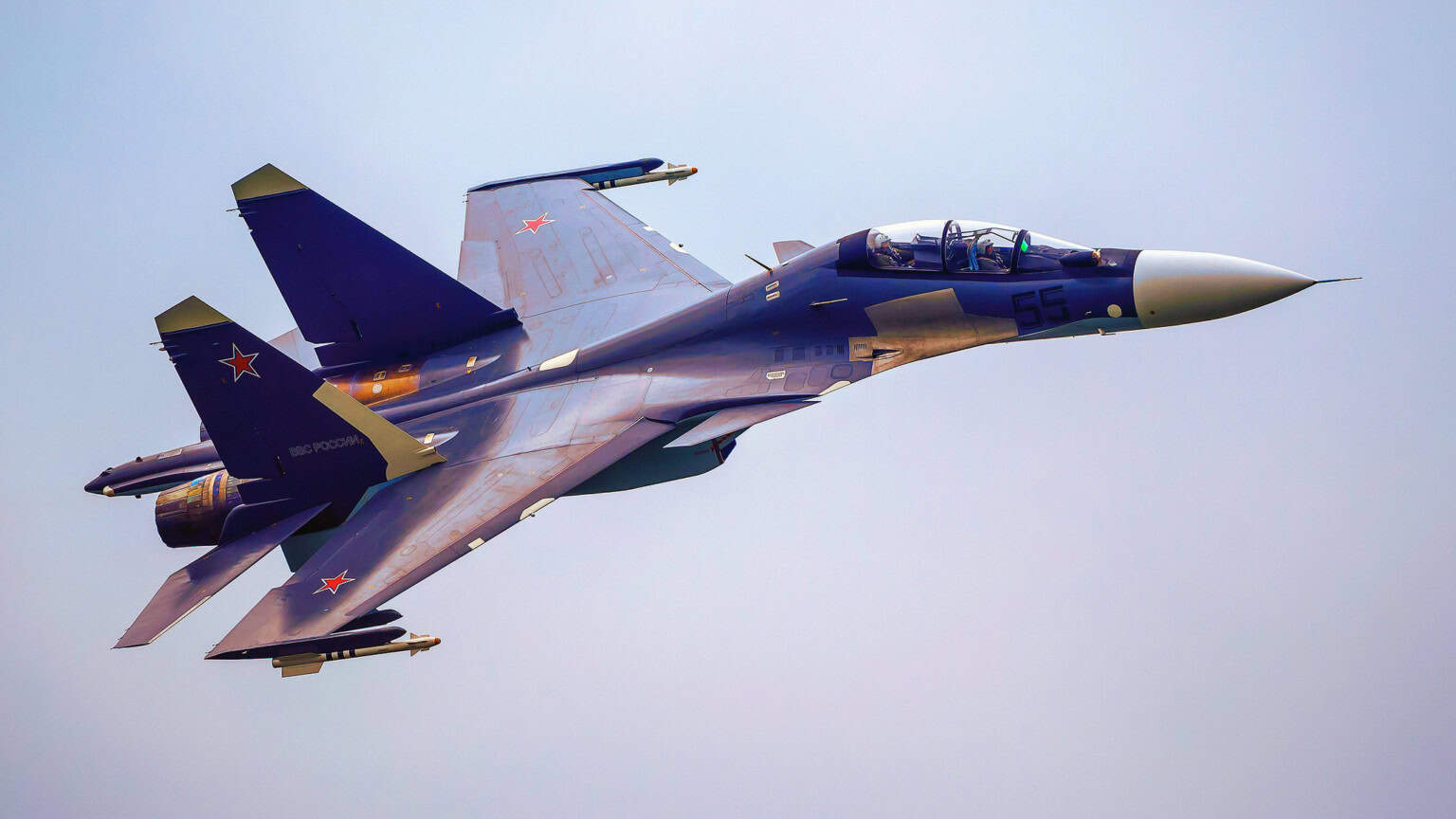


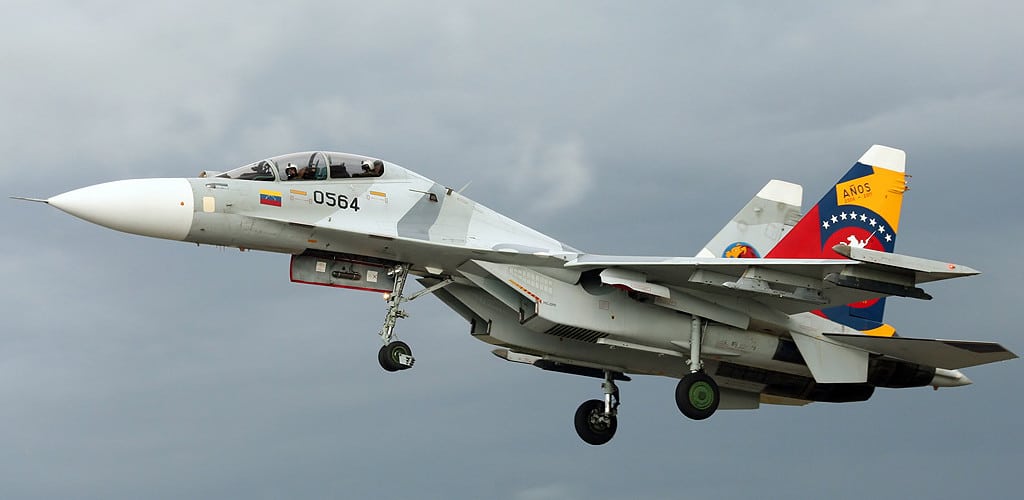
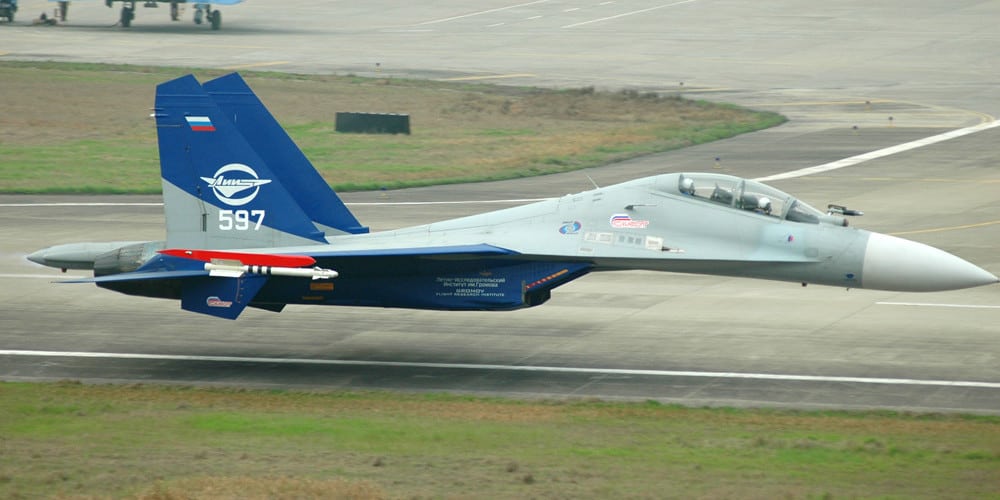


The Sukhoi Su-30 is a two-seat, twin-engine Flanker built for long-range interception and multirole strike. It started life as an air defense interceptor for the Soviet Union and was later exported to more than a dozen air forces.
The first Su-30 flew on 31 December 1989, and at least 630 had been built by 2019. The word “Su-30” now covers several quite different jets, so the first job is to sort them out.

The story begins in 1986. The Soviet Air Defense Forces needed a fighter that could cover the vast expanse of the country, and the Su-27 did not have the range.
Sukhoi took the two-seat Su-27UB trainer as the base, because it flew like the single-seat jet but had room for a second crew member. The result was the Su-27PU, a long-range interceptor that could also act as an airborne command post.
A proof-of-concept demonstrator flew on 6 June 1987. The first true Su-27PU flew at Irkutsk on 31 December 1989, and the first of three pre-production aircraft followed on 14 April 1992.
The Russian Defense Ministry renamed the Su-27PU as the Su-30 in 1996. It bought only five of the original version, delivered between 1994 and 1996 to the 54th Guards Fighter Aviation Regiment at Savasleyka.
The Su-30 name stuck, but the real story is exports. Different customers wanted different jets, and the design split into two branches built by competing Sukhoi group plants, KnAAPO and Irkut.
The first export version, the Su-30K, went to India in 1997. All 18 were later returned to Russia, and 12 were resold to Angola.
NATO gives the family three reporting names. The original Su-30 is the Flanker-C, the Chinese branch is the Flanker-G, and the thrust-vectoring branch is the Flanker-H.
The Su-30MKI, built for India, is the key variant. It was the first Su-30 to get both thrust vectoring and canards, and it carries a multinational avionics suite from Russia, India, France and Israel.
Malaysia (Su-30MKM) and Algeria (Su-30MKA) bought derivatives of the MKI. Russia followed with the Su-30SM, which first flew on 21 September 2012. The Russian Air Force received its first two serial aircraft in November 2012.
The latest Russian version, the Su-30SM2, adds the Irbis-E radar and the more powerful AL-41F1S engine that also powers the Su-35S. The export version of the SM is the Su-30SME.
China signed a US$1.8 billion agreement in 1996 for 38 aircraft based on the original Su-30. That became the Su-30MKK, and the first ten arrived in December 2000.
The Su-30MK2 followed for the Chinese naval air arm, with 24 delivered in 2004. Airforce Technology notes that neither the MKK nor the MK2 has thrust vectoring.

The Su-30 has a digital fly-by-wire system and an airbrake behind the canopy. The thrust-vectoring versions can perform Pugachev’s Cobra and the tailslide, maneuvers that bleed speed so fast that a pursuing fighter overshoots.
On the MKI the AL-31FP engine nozzles are mounted 32 degrees outward and deflect 15 degrees in one plane. Because each nozzle can be vectored differently, the engines can create pitch, yaw and roll moments.
The canards help control airflow at high angles of attack, but they add drag. Published top speeds for the canard versions sit between Mach 1.75 and Mach 1.9, below the Mach 2.0 of the clean Flanker-C.
The MKI carries the NIIP N011M Bars passive electronically scanned array radar. All variants carry a 30 mm GSh-30-1 cannon with 150 rounds.
The full specification table for the aircraft is on this page. A few of those figures need context, because they get quoted against each other.
Start with range. The panel’s 1,620 nm · 1,860 mi · 3,000 km is Sukhoi’s range at altitude. At sea level it drops to about 790 miles (1,270 km), and one aerial refueling stretches it to about 3,200 miles (5,200 km).
With two refuelings Sukhoi quotes about 5,000 miles (8,000 km), and a maximum time aloft of 10 hours. Sukhoi describes that figure as pilot-dependent.
The weights also come with a catch. Maximum takeoff weight is 76,000 lb · 34,500 kg for the standard Su-30MK, but Sukhoi says the reinforced airframe allows takeoff at up to 38,800 kg with full fuel and a full combat load.
That load is up to 17,600 lb · 8,000 kg, spread across 12 hardpoints.
Thrust is 2 × 27,558 lbf · 123 kN with afterburner. Sukhoi’s takeoff run is 1,800 ft · 550 m at normal weight, and the landing run is 2,450 ft · 750 m, but only with the brake parachute.

Speed has two figures too. The jet reaches Mach 2.0 at altitude, which the panel lists as 1,145 kt · 1,318 mph · 2,121 km/h, but only 840 mph (1,350 km/h) near the ground.
The ceiling is 56,759 ft · 17,300 m. Climb rate is 45,275 ft/min · 230 m/s.
India is the biggest operator, with 261 Su-30MKIs as of 2024. Hindustan Aeronautics Limited builds them under license, and 272 had been built by March 2020.
Russia is next, with an estimated 80 Su-30SMs plus 19 Su-30M2s and at least four Su-30SM2s in the Air Force, and more in naval aviation. China operates 73 Su-30MKKs and 24 Su-30MK2s.
Algeria has 59 Su-30MKAs, Vietnam 35 Su-30MK2Vs, Kazakhstan 29 Su-30SMs and Malaysia 18 Su-30MKMs. Smaller users include Venezuela, Indonesia, Angola, Uganda, Myanmar, Armenia, Mongolia, Belarus and Ethiopia. The counts here are Wikipedia’s 2024 figures.

Russia sent Su-30SMs to Syria for the first time in September 2015. By December there were 16 at Khmeimim Air Base, where they escorted attack jets and bombers and provided target illumination for airstrikes.
In Ukraine, Russian Su-30SMs and Su-35s flew air superiority missions, and at least seven air-to-air victories over Ukrainian jets have been confirmed for the two types combined. Russian sources claim a Su-30SM2 downed a Ukrainian Su-27 with an R-37M on 2 February 2025.
The losses are real too. Two Su-30s were lost on 5 March 2022, and satellite imagery showed at least three destroyed at Saky air base in Crimea on 9 August 2022.
Ukraine’s military intelligence agency claimed it shot down a Russian Su-30 with a naval drone on 2 May 2025, and a Su-30SM was shot down by friendly fire over Crimea on 16 October 2025.
The Indian jet has been through its own fights. On 7 May 2025 Su-30MKIs flew air defense cover for Operation Sindoor, and on 10 May they reportedly struck 11 Pakistani air bases with BrahMos missiles.
The MKI flew seven years without a major incident. The first crash came in 2009, and as of March 2026 India had lost 14 Su-30MKIs in crashes.
To replace losses, India signed a contract for 12 more MKIs in December 2024. Business Today reported in August 2026 that HAL plans to deliver them by 2029, with the first due in 2027-28.
The bigger project is the Super Sukhoi, a mid-life upgrade for about 80 to 84 jets. It would add an indigenous AESA radar, new cockpit displays and an upgraded electronic warfare suite, with the aim of keeping the fleet flying beyond 2055.
Reports through August 2026 still describe the upgrade as planned. Wikipedia records that the Cabinet Committee on Security had not yet given final clearance as of February 2026, and I did not find a later confirmation.
The Su-30 family has a maintenance problem. India reportedly decided in 2018 not to order more because upkeep cost far more than on Western jets, though it reversed that in 2020.
In 2018 Malaysia said it had grounded 14 of its 18 Su-30MKMs because of engine problems and a lack of spare parts. The Russian SM relies on French-made avionics, and after sanctions following the 2022 invasion of Ukraine, Russia now relies on a Kazakhstan-based distributor to service them.
The nearest American match is the F-15E Strike Eagle. Airforce Technology describes the Su-30M as broadly comparable to it: a heavy twin-engine, two-seat fighter-bomber.
There is no clean public head-to-head. The best-known data points are Indian exercises with the US Air Force, and they come with heavy caveats.
In Cope India 04, Su-30MKs reportedly won 90 percent of mock combat missions against USAF F-15Cs. But the F-15Cs lacked AESA radar, and at India’s request the sessions ran at 3-to-1 odds without simulated AMRAAM beyond-visual-range shots.
Indian Su-30MKIs reportedly beat USAF F-16s in Cope India 05. Exercises like these depend on the rules, so they tell you little about a real war.
They are different classes of jet. The Su-30 is a heavy, twin-engine, two-seat fighter, while the F-16 is a lighter single-engine fighter.
The only direct evidence is exercise results, such as Cope India 05, and those depend heavily on the rules. There is no verified combat head-to-head between them.
The F-15E Strike Eagle is the closest equivalent. Airforce Technology calls the Su-30M broadly comparable to it, since both are two-seat, twin-engine jets built for strike as well as air combat.
On paper it is a strong one. It has long range, a big weapons load and, on the MKI and SM, thrust vectoring that makes it highly maneuverable.
The weak spots are logistics and cost of ownership. Malaysia grounded most of its fleet in 2018, India has lost 14 MKIs in crashes, and Russia has lost several in Ukraine.
There is no single price. Ukraine’s military intelligence agency estimated a Su-30SM at about $50 million, an estimate from an interested party.
India’s Su-30MKI unit cost was reported at $40 million in 2007 and had risen to $102 million by August 2010 as the order grew more expensive. The flyaway estimate in the spec panel is a rough guide, not a contract price.
The Su-30 reaches Mach 2.0 at altitude, which the panel lists as 1,145 kt · 1,318 mph · 2,121 km/h. The canard-equipped versions are slower, with published top speeds between Mach 1.75 and Mach 1.9.
The MKI was developed for India and is built by HAL under license, with avionics from Russia, India, France and Israel. The SM is a version of the MKI adapted for Russia, with Russian radar, radios, identification system, ejection seats and weapons.
The Su-30 started as a two-seat development of the Su-27, via the Su-27UB trainer, with extra range and mission systems. Later versions add canards, thrust vectoring and strike capability. You can compare the two on our Su-27 page and in our guide to Sukhoi fighter jets.
Yes. Russia took new Su-30SM2 deliveries in mid-2026, and India has ordered 12 more MKIs from HAL.
Sources and references used for research and fact-checking.