

Table of Contents
China’s air force, the People’s Liberation Army Air Force (PLAAF), flies 2,216 aircraft by our count of FlightGlobal’s World Air Forces 2026 directory. Across all its services, China fields 3,529 military aircraft, third in the world behind the United States and Russia.
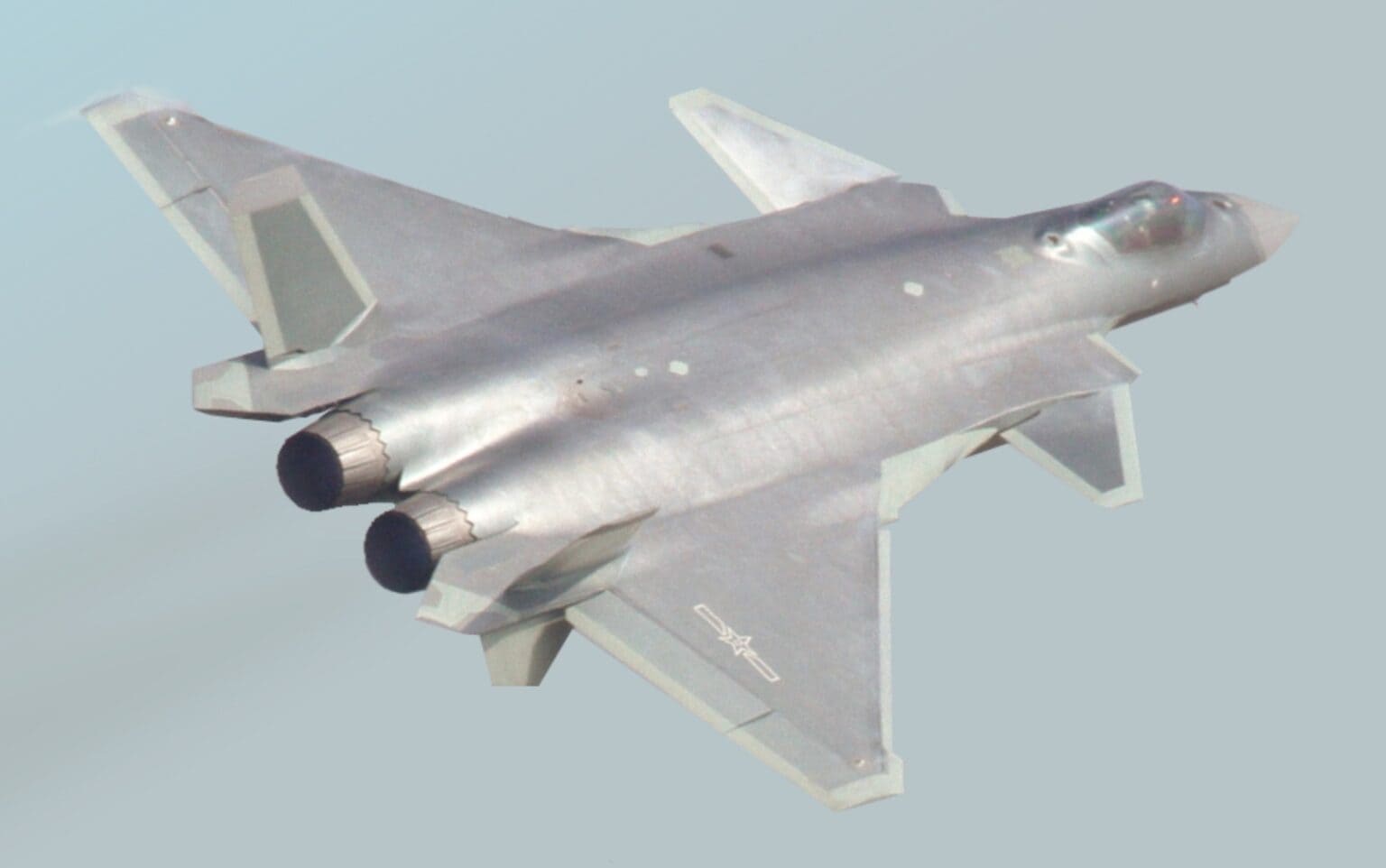
In combat aircraft only America has more: 2,718 to China’s 1,814. The type that is changing the balance is the J-20 stealth fighter. FlightGlobal counts 250 of them, and one analyst who tracks serial numbers estimates about 500 had been delivered by mid-2026.
For scale, the US Air Force received 187 operational F-22s before Lockheed Martin closed the line in 2012.
The most-quoted totals are also out of date. FlightGlobal still lists 387 J-7 fighters, a type China has been retiring since the late 2010s, and lumps every modern Flanker into one line of 319 jets.
This guide ranks each type the PLAAF flies by how many it has, using the newest estimate for each as of October 2026. It then covers the radar planes, tankers, transports and air defenses, and how the force compares with America’s.
| Rank | Aircraft | Role | Best estimate, 2025-26 | FlightGlobal 2026 listing |
|---|---|---|---|---|
| 1 | Chengdu J-10 family | Multirole fighter | About 550 | 243 |
| 2 | Shenyang J-16 and J-16D | Strike fighter, electronic attack | About 450 | In a 319-jet Flanker line |
| 3 | Chengdu J-20, J-20A and J-20S | Stealth fighter | 300 to about 500 | 250 |
| 4 | Shenyang J-11 family | Air superiority fighter | About 440 built | In the Flanker line |
| 5 | Xi’an H-6 family | Bomber | 120, about 20 of them nuclear H-6Ns | 120 |
| 6 | Sukhoi Su-30MKK | Multirole fighter | 76 bought | In the Flanker line |
| 7 | Xi’an JH-7A | Fighter-bomber | 69 | 69 |
| 8 | Sukhoi Su-35 | Air superiority fighter | 24 | In the Flanker line |
| 9 | Shenyang J-35A | Stealth fighter | First batch, number not public | Not listed |
| Legacy | Chengdu J-7 | Light fighter | Retired from front-line units | 387 |
| Legacy | Nanchang Q-5 | Attack jet | Last one built in 2012 | 118 |
| Legacy | Shenyang J-8 | Interceptor | Being replaced | 96 |
How this ranking works
Types are ranked by how many the PLAAF flies, not by how good they are (our ranking of the best Chinese fighters covers that). China publishes no fleet numbers, so every figure is an outside estimate. We use the newest credible one for each type and show FlightGlobal’s directory alongside, because it is the figure most sites repeat. PLA Navy and Army aircraft are excluded unless noted.
1. Chengdu J-10: The Most Numerous Fighter

The single-engine Chengdu J-10 is still the PLAAF’s most common combat jet. Justin Bronk of the UK’s Royal United Services Institute (RUSI) estimates more than 300 of the modern J-10C variant were in service in 2025, with about 250 older J-10A and J-10B jets also still flying.
That is more than twice the 243 J-10s in FlightGlobal’s listing, which has not changed since the 2025 edition. The J-10C began combat duty in April 2018, according to Xinhua, and carries an active radar plus the long-range PL-15 air-to-air missile.
Its only combat so far came in Pakistani hands. In May 2025, Pakistan’s export J-10CEs fired PL-15E missiles at Indian jets.
A Chinese jet's first fight brought down a Rafale
RUSI’s analysis of geolocated wreckage confirms India lost at least one Rafale in the May 2025 clash, plus a MiG-29 and probably a Su-30MKI. RUSI says Indian jets were hit by PL-15E missiles from Pakistani J-10CEs, in the type’s first combat. India’s defense chief admitted losses but gave no number. Pakistan’s claim of six Indian jets remains unverified.
2. Shenyang J-16 and J-16D: The Workhorse
.jpg)
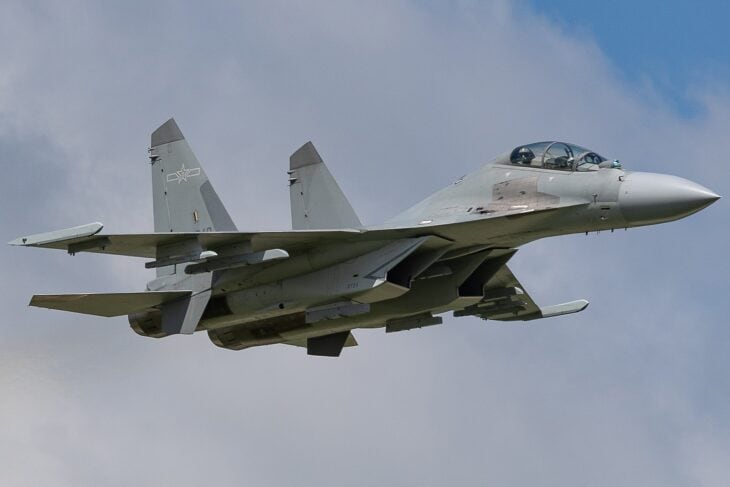
The Shenyang J-16 is a two-seat strike fighter built on the Flanker airframe, with Chinese WS-10 engines and an active radar. The Pentagon counted more than 225 in service in 2023; RUSI puts the total at about 450 by the end of 2025, built at roughly 100 a year.
It is the only jet that carries China’s PL-17, a very-long-range missile built to hit tankers and radar planes. The Pentagon’s 2025 report gives a J-16 with a PL-17 a reach of about 870 miles (1,400 km), its roughly 620-mile (1,000 km) combat radius plus the missile’s range.
The J-16D trades the cannon and infrared sensor for an internal jamming suite and wingtip pods, and RUSI calls it a near-direct counterpart to the US Navy’s EA-18G Growler.
The J-16 has also flown close calls with Western patrol planes: in May 2022 one released flares and chaff ahead of an Australian P-8, and some were sucked into the P-8’s engines.
3. Chengdu J-20: The Stealth Fleet Nobody Can Count
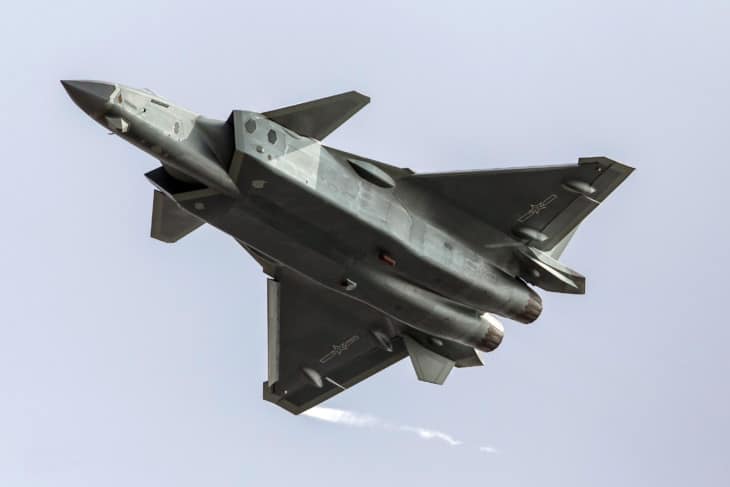
The Chengdu J-20 is a twin-engine stealth fighter, and the estimates of how many China has run from 250 to about 500. FlightGlobal raised its figure from 19 to 250 in the 2026 edition. RUSI put it at about 300 in at least 13 regiments by mid-2025.
The highest estimate comes from Andreas Rupprecht, a long-time PLA aviation analyst, who told TWZ in July 2026 that about 500 had likely been delivered, across 14 front-line units. In September 2025 The Aviationist reported a J-20 at the Changchun air show carrying construction number CB10300, the 300th airframe.
Production explains the spread: RUSI says J-20 output reached about 120 a year in late 2025, and satellite analyst J. Michael Dahm counts five J-20 production lines at Chengdu. RUSI projects about 1,000 J-20s and 900 J-16s by 2030, which would make the stealth jet the backbone of the force.
Three versions flew over Beijing in the September 2025 parade: the original J-20, the re-engined J-20A and the two-seat J-20S, which China calls the world’s only two-seat stealth jet.
Most J-20s still fly on Chinese WS-10C engines; state footage in January 2026 showed signs of the long-awaited WS-15 on J-20As in pre-delivery testing. Our ranking of the best Chinese fighter jets puts it first on capability.
4. Shenyang J-11: The Flanker China Copied

China became the first export customer for the Sukhoi Su-27 Flanker in 1992. In 1996 it signed a $1.2 billion deal to build it under license as the J-11A, then built its own unlicensed copy, the J-11B.
About 440 Shenyang J-11s of all versions had been built by 2024, according to The Aviationist. The number still flying is lower and shrinking, because RUSI says J-16s and J-20s are re-equipping the regiments that flew J-11s and the original Su-27s.
5. Xi’an H-6: A 1950s Bomber With a Nuclear Job
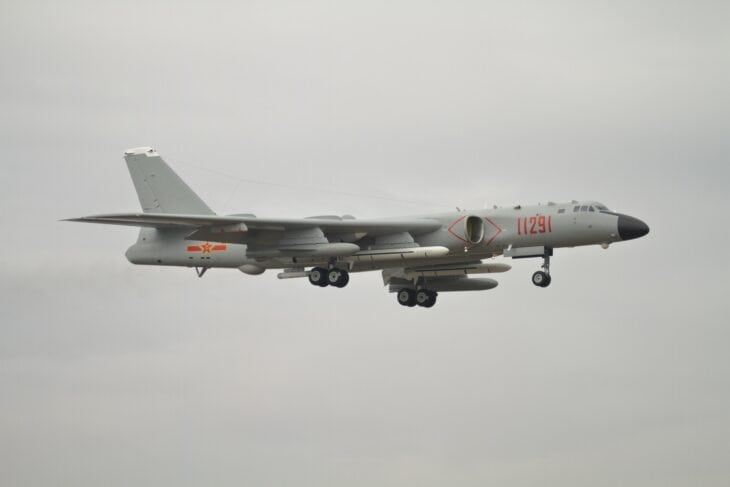

China’s long-range bomber is the Xi’an H-6, a license-built version of the Soviet Tu-16 from the 1950s. FlightGlobal lists 120 with the air force and 30 with the Navy. The modern H-6K has a combat radius of about 2,200 miles (3,500 km), per the Pentagon.
The H-6N, revealed in 2019 and fielded in 2020, can refuel in flight and carries an air-launched ballistic missile that may be nuclear-armed. The Federation of American Scientists estimates about 20 are in service, and notes the airframe lost its bomb bay to make room for the missile.
H-6s now fly regular joint patrols with Russian Tu-95s. On July 24, 2024, NORAD intercepted two H-6s and two Tu-95s in the Alaska air defense zone, the first such flight near Alaska. The 11th joint patrol, on June 27, 2026, took in the Sea of Japan and the western Pacific.
The H-6’s replacement, the Xi’an H-20 stealth bomber, has still not been shown, a decade after the PLAAF announced it in 2016. The Pentagon’s 2024 report gave it a range of more than 6,200 miles (10,000 km).
The Pentagon’s 2025 report does not mention it at all, and the head of US Air Force Global Strike Command said in February 2026 that China is “just not there yet.”
6. Sukhoi Su-30MKK: Still on the Front Line
.jpg)
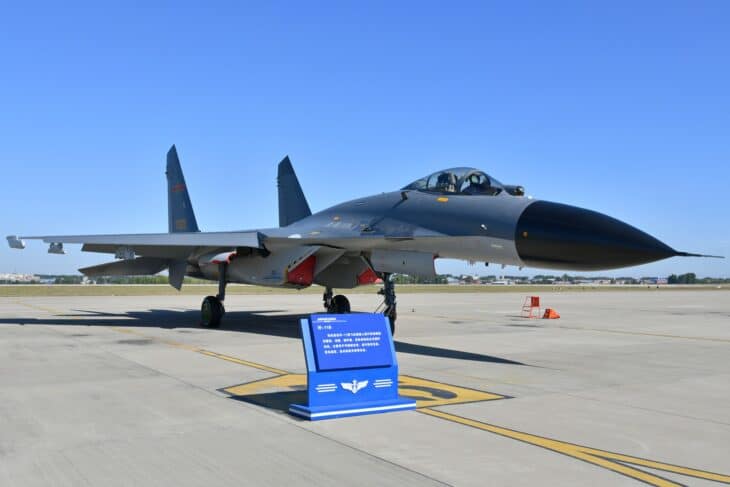
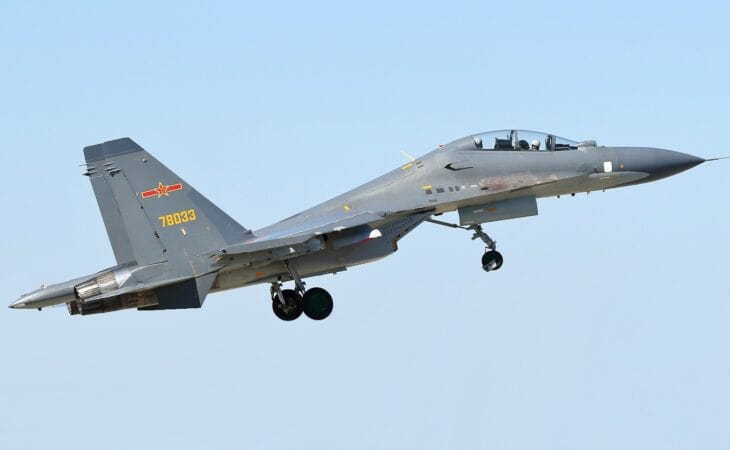
China bought 76 Su-30MKK two-seat strike fighters from Russia in two orders, in 1999 and 2001. The J-16 later borrowed many of its features, and the two now fly side by side.
The type is far from retired. The PLAAF’s own video of the June 2026 joint patrol with Russia showed Su-30MKKs flying alongside J-10Cs, H-6K bombers and a YY-20 tanker.
7. Xi’an JH-7A: The Two-Seat Fighter-Bomber
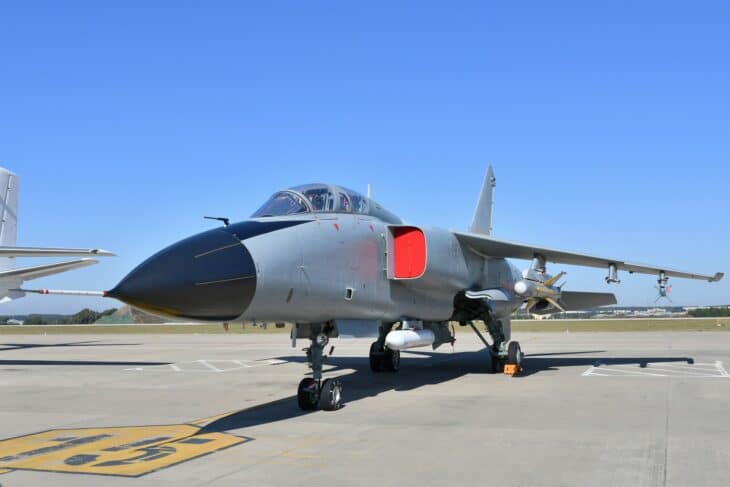

The two-seat Xi’an JH-7A is a twin-engine fighter-bomber that serves with both the air force and the Navy. FlightGlobal lists 69 with the air force and 34 with the Navy.
Treat that split with care. The Pentagon reported that in 2023 much of the Navy’s shore-based combat aviation was transferred to the PLAAF, so the split between the services in older listings may no longer hold.
8. Sukhoi Su-35: 24 Jets, Russian Screens
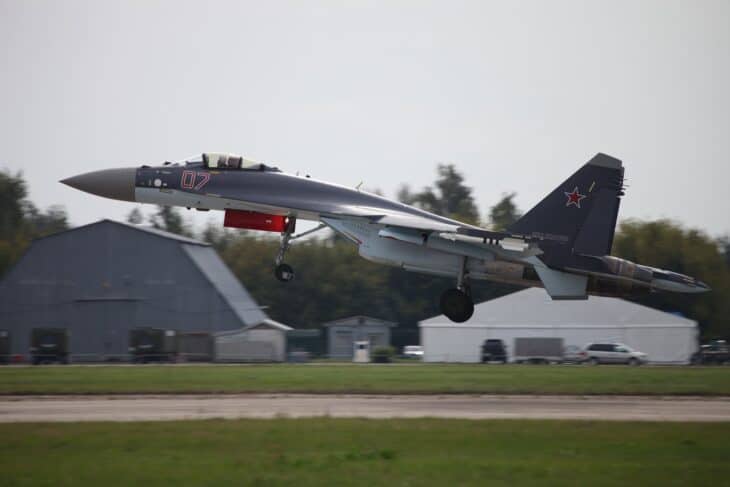

China signed for 24 Sukhoi Su-35s on November 19, 2015, a deal TASS put at more than $2 billion. The first four arrived on December 25, 2016 and the last batch in December 2018, all with the 6th Aviation Brigade in Guangdong.
PLA media said at the time it hoped the Su-35 would be the last combat aircraft China ever imports. One quirk survives: AIN reported the PLAAF kept the original Cyrillic symbols on the cockpit screens rather than translating them.
9. Shenyang J-35A: The Second Stealth Fighter
The Shenyang J-35A is China’s second stealth fighter design, unveiled at the Zhuhai air show in November 2024. China Daily reported a first batch delivered before the September 2025 parade, making China the second country after the US with two stealth fighter families in service.
Nobody outside China knows how many there are. FlightGlobal left the type out of its 2026 directory for lack of confirmed details, and RUSI described it as still in low-rate initial production in late 2025.
Capacity suggests that will change fast. Dahm told FlightGlobal in March 2026 that a new Shenyang plant with more than 370,000 square meters (about 4 million square feet) of floor space is thought to be for the J-35.
The Navy version was on the deck of the carrier Fujian when it was commissioned on November 5, 2025, one of the three carriers China now operates.
The Paper Fleet: Jets That Are Still Counted but Retiring
More than a third of the combat jets in FlightGlobal’s PLAAF table are types China has been retiring for years. Its 2026 listing carries 387 J-7s, 118 Q-5s and 96 J-8s, the same numbers as the 2025 edition.
The Chengdu J-7 is a Chinese MiG-21. Chinese media described its retirement as speeding up in 2017, and state broadcaster CCTV said in early 2023 it would be phased out that year, with J-16s replacing it.
The Q-5 attack jet went into series production in 1968, and the last one was delivered in October 2012. The Shenyang J-8 interceptor is among the types RUSI says J-16s and J-20s are replacing.
So is China's air force bigger or smaller than the headlines say?
Both. FlightGlobal’s 1,602 PLAAF combat aircraft include about 600 J-7s, J-8s and Q-5s, older types that are retiring. It also counts only 243 J-10s and 319 Flankers, where RUSI estimates about 550 J-10s and 450 J-16s alone. The real force has far fewer old jets and far more modern ones than the listing shows.
Radar Planes and Tankers: The Gap China Is Closing
Fighters are only as good as the radar planes that find their targets and the tankers that extend their range. This is where the PLAAF has been weakest, and where it is now growing quickly.
| Aircraft | Role | Number | Source |
|---|---|---|---|
| KJ-500 | Radar plane | 14 listed; about 50 by late 2025 | FlightGlobal; RUSI |
| KJ-2000 | Radar plane | 4 | FlightGlobal |
| KJ-200 | Radar plane | 11 | FlightGlobal |
| Xi’an Y-20 | Heavy transport | 34 listed; 51 by March 2024 | FlightGlobal; Pentagon |
| Xi’an YY-20 (Y-20U) | Tanker | 7 listed; 16 by March 2024 | FlightGlobal; Pentagon |
| Ilyushin Il-78 | Tanker | 2 listed; 3 bought | FlightGlobal; USCC |
| Ilyushin Il-76 | Heavy transport | 27 | FlightGlobal |
| Y-8 and Y-9 | Medium transport | 80 and 24 | FlightGlobal |
| Trainers (151 JL-8s) | Pilot training | 243 | FlightGlobal |
| Helicopters | Transport, rescue | 66 | FlightGlobal |
The workhorse radar plane is the KJ-500, a radar dome on a Y-9 turboprop, first delivered to the PLAAF in 2015. FlightGlobal still lists 14; RUSI puts the fleet at closer to 50 by late 2025. The Pentagon’s 2025 report credits it with improving what the PLAAF can see.
The bigger KJ-2000 exists because of a deal that collapsed. Israel was to fit its Phalcon radar to an Il-76 for China, but the sale was canceled in 2000 under US pressure, so China built its own radar for the airframe.
Its successor, the KJ-3000 on a Y-20 airframe, has been in flight test since late 2024, and the Pentagon says it will probably be the world’s first to use a digital radar.
Tankers are China’s thinnest fleet. The PLAAF first confirmed the YY-20 tanker in July 2022, and the Pentagon counted 16 by March 2024. China also bought three Il-78s from Ukraine in 2011.
In August 2026 a YY-20A refueled an Egyptian Rafale, the first publicly documented time the type has refueled a Western-built fighter. The US advantage here is the subject of our US vs China fighter jet comparison.
Transports: The Y-20 Replaces the Il-76
The four-engine Xi’an Y-20 first flew in January 2013 and entered PLAAF service in July 2016, built to replace China’s small fleet of Russian Il-76 heavy transports. The Pentagon counted 51 Y-20A transports by March 2024.
Early Y-20s flew on Russian engines. The new Y-20B uses the Chinese WS-20, and in April 2026 it made its first trip abroad, to South Korea, escorted by four J-20s. A new four-turboprop medium airlifter, still without an official name, first flew in December 2025 to fill the gap between the Y-9 and the Y-20.
Drones, Trainers and Very Few Helicopters
The PLAAF flies a growing drone fleet that the directories quoted here leave out. From August 6 to September 5, 2025, satellite imagery showed three GJ-11 Sharp Sword stealth combat drones at Shigatse air base in Tibet, which TWZ read as a sign the type may be close to operational.
The strangest is the WZ-8, a rocket-powered spy drone launched from an H-6 bomber. A leaked US assessment in 2023 credited it with Mach 3 at 100,000 feet.
New pilots start on the CJ-6 propeller trainer, then move to the JL-8 and JL-9 jets, according to the US Air Force’s China Aerospace Studies Institute. Since 2020 the JL-10 advanced trainer has let some cadets skip a full year of that ladder.
Helicopters are mostly not the air force’s business. FlightGlobal lists just 66 in the PLAAF, which uses them for its Airborne Corps and for rescue, against 857 aircraft in the PLA Army, nearly all of them helicopters.
Air Defense: The Missiles the Air Force Runs
The PLAAF also runs much of China’s ground-based air defense. The Pentagon says it has “one of the largest forces of advanced long-range SAM systems in the world,” built on the Chinese HQ-9 and HQ-9B and the Russian S-300 family.
China added the Russian S-400, with the first regiment set delivered in April 2018. At the September 2025 parade the air force showed six systems, including the first public outing of the HQ-20, the HQ-22A and the HQ-29, an interceptor Defense One says could hit missiles in mid-flight or satellites in low orbit.
What Comes Next: Two Sixth-Generation Jets
On December 26, 2024, two Chinese companies flew two different tailless prototypes, which the Pentagon calls sixth-generation aircraft. Analysts call them the J-36 (Chengdu) and J-50 (Shenyang); Beijing has confirmed neither name.
The pace has not slowed. The South China Morning Post reported images of what may be a fifth J-36 prototype in July 2026, a month after the PLA released its first official clip of a sixth-generation jet. The Pentagon expects them to be operational by 2035, and our guide to sixth-generation fighter jets covers the rival programs.
Behind them sits the factory base. Dahm estimates China’s fighter makers will be able to build 300 to 400 fourth- and fifth-generation fighters a year from 2027, and says that if they use it China will have the largest fighter force on the planet by 2029.
How Strong Is China’s Air Force, Really?
On raw numbers it is the third-largest military air fleet in the world and the second-largest combat fleet. The Pentagon’s 2025 report estimates the PLAAF and Navy aviation together field 2,200 fighters, counting combat-capable trainers, plus 550 bombers and attack jets. Of those fighters, 850 sit in the Eastern and Southern theater commands, against Taiwan’s 350.
It has shown that mass around Taiwan. During the Joint Sword-2024B drills in October 2024, Taiwan’s defense ministry counted a record 153 Chinese military aircraft in one day.
During Justice Mission 2025, on December 29, 2025, it counted 130 in 24 hours, 90 of them crossing the Taiwan Strait median line. Our guide to Taiwan’s air force covers the other side.
2026 has been quieter. Taiwan’s figures, compiled by George Mason University’s Taiwan Security Monitor, add up to 1,775 sorties from January through August, and August’s 171 was less than a third of either previous year.
Leadership is less settled. Gen. Chang Dingqiu, commander since 2021, was absent from a December 2025 promotion ceremony, and no official explanation for his departure has been given. On July 3, 2026, Chinese state television named Wang Gang as Air Force commander as Xi Jinping promoted him to general.
The force has 403,000 personnel, according to the IISS Military Balance 2025. It was founded on November 11, 1949; only 17 aircraft were available for inspection at the founding ceremony of the People’s Republic six weeks earlier. For where it ranks worldwide, see the largest air forces in the world.
FAQ
Sources and references used for research and fact-checking.
- FlightGlobal, World Air Forces 2026
- US Department of Defense, Military and Security Developments Involving the People's Republic of China 2025
- US Department of Defense, Military and Security Developments Involving the People's Republic of China 2024
- RUSI, The Evolution of Russian and Chinese Air Power Threats
- RUSI, Key Questions about the India-Pakistan Aerial Clashes
- ThePrint, CDS Gen Chauhan admits to losses during Op Sindoor, rejects Pakistan's claim of 6 fighters downed
- Xinhua, China's fighter jet J-10C begins combat duty
- The Aviationist, Shenyang J-16 Qianlong
- TWZ, How Many J-20 Mighty Dragon Fighters Does China Actually Have?
- The Aviationist, China's 300th J-20 Spotted at Changchun Air Show
- FlightGlobal, China surges production capacity for J-20 and J-35 stealth fighters
- South China Morning Post, Are China's J-20A stealth fighters now updated with high-thrust WS-15 engines?
- China Daily, All types of fifth-generation combat planes displayed at V-Day parade
- AirData News, China aims to retire its aging J-7 fighters in 2023
- South China Morning Post, China replacing old J-7 'Flying Leopards' with J-16 multirole jets
- The Paper, J-7 accelerating retirement, PLA Air Force plays a farewell song
- Arms Control Association, China Buying Russian Combat Jets
- TASS, Russia inks contract with China on Su-35 deliveries
- People's Daily, PLA news portal: Su-35 intended to be last type of imported fighter
- AIN, China Accepts Last Batch of Su-35s, Test Fires S-400
- Naval News, Chinese Navy Takes Aircraft Carrier Fujian Into Active Service In Hainan
- Federation of American Scientists, Chinese nuclear weapons, 2025
- RFE/RL, NORAD intercepts Russian and Chinese bombers near Alaska
- China Daily (via Henan Provincial Government), Chinese and Russian air forces carry out joint patrol
- TWZ, China 'Just Not There Yet' On H-20 Stealth Bomber
- 19FortyFive, China Announced the H-20 Stealth Bomber in 2016. A Decade Later, There Is No Confirmed Aircraft
- Airforce Technology, KJ-2000 (Mainring) AEW&C Aircraft
- Johns Hopkins Applied Physics Laboratory, Special Mission Aircraft and Unmanned Systems
- US-China Economic and Security Review Commission, First Modern Tanker Observed at Chinese Airbase
- China Daily, PLA Air Force reveals YY-20 tanker
- The Aviationist, Chinese YY-20A refuels Egyptian Rafale
- AVweb, Chinese-Built Military Transport Enters Service
- The Aviationist, China's Y-20B Airlifter's First Trip to South Korea
- The Aviationist, China's New Medium Airlifter Has Flown
- TWZ, China's Stealth Sharp Sword Unmanned Combat Air Vehicles Deployed To Operational Airbase
- Taiwan News, Leaked US assessment on China's WZ-8 supersonic drone
- China Aerospace Studies Institute, Intermediate Flight Training Shifting to Aviation University
- China Daily, Ground-based air-defense and anti-ballistic missile systems shine at V-Day parade
- CSIS Missile Threat, Russia Delivers S-400 Regiment to China
- Defense One, China's new missiles on parade: showpieces or showstoppers?
- South China Morning Post, New images point to fifth prototype for China's J-36 fighter jet
- USNI News, China Wraps 'Justice Mission' Taiwan Blockade Drills
- NBC News, Taiwan says Chinese military sent record 153 planes near island during war games
- Taiwan Security Monitor, George Mason University, Strait Snapshot: August 2026 Update
- AP via WTOP, China's military promotes 2 new generals after anti-corruption purge thins ranks
- CCTV, Xi Jinping presents promotion orders
- Lianhe Zaobao, Air Force commander absent from promotion ceremony
- NDU Press, Joint Force Quarterly, Rightsizing the PLA Air Force: Revisiting an Analytic Framework
- China Daily, PLA Air Force marks 76th anniversary with intelligent equipment
- Lockheed Martin, Lockheed Martin Delivers Final Historic F-22 Raptor To U.S. Air Force
Get the Newsletter
The latest aviation news and stories sent to your inbox.
About the Author

Tim is the owner and lead editor of AeroCorner since 2019, overseeing aviation content covering aircraft, airlines, airports, and the broader aviation industry. Through years of researching, writing, editing, and publishing aviation-focused content, he has developed extensive practical knowledge of commercial aviation and air travel. Based in Asia and a frequent traveler himself, Tim also brings firsthand passenger experience to AeroCorner’s coverage. Outside of publishing, he has also explored aviation firsthand through hands-on flight training in New Zealand.