Fighter Jets
Shenyang J-16
ICAO: J16
China's second stealth fighter, now launching from Fujian's catapults
Updated: by Tim de Vries
The latest aviation news and stories sent to your inbox.
The Shenyang J-35 is China’s second stealth fighter and its first designed for carrier decks, a single-seat twin-engine aircraft developed from the privately funded FC-31 demonstrator that first flew in 2012. It exists in two forms: the naval J-35, catapult-launched from the carrier Fujian, and the land-based J-35A flown by the People’s Liberation Army Air Force. Chinese state media announced both as part of the fleet on 3 September 2025, and an export version, the J-35AE, was unveiled in May 2026.


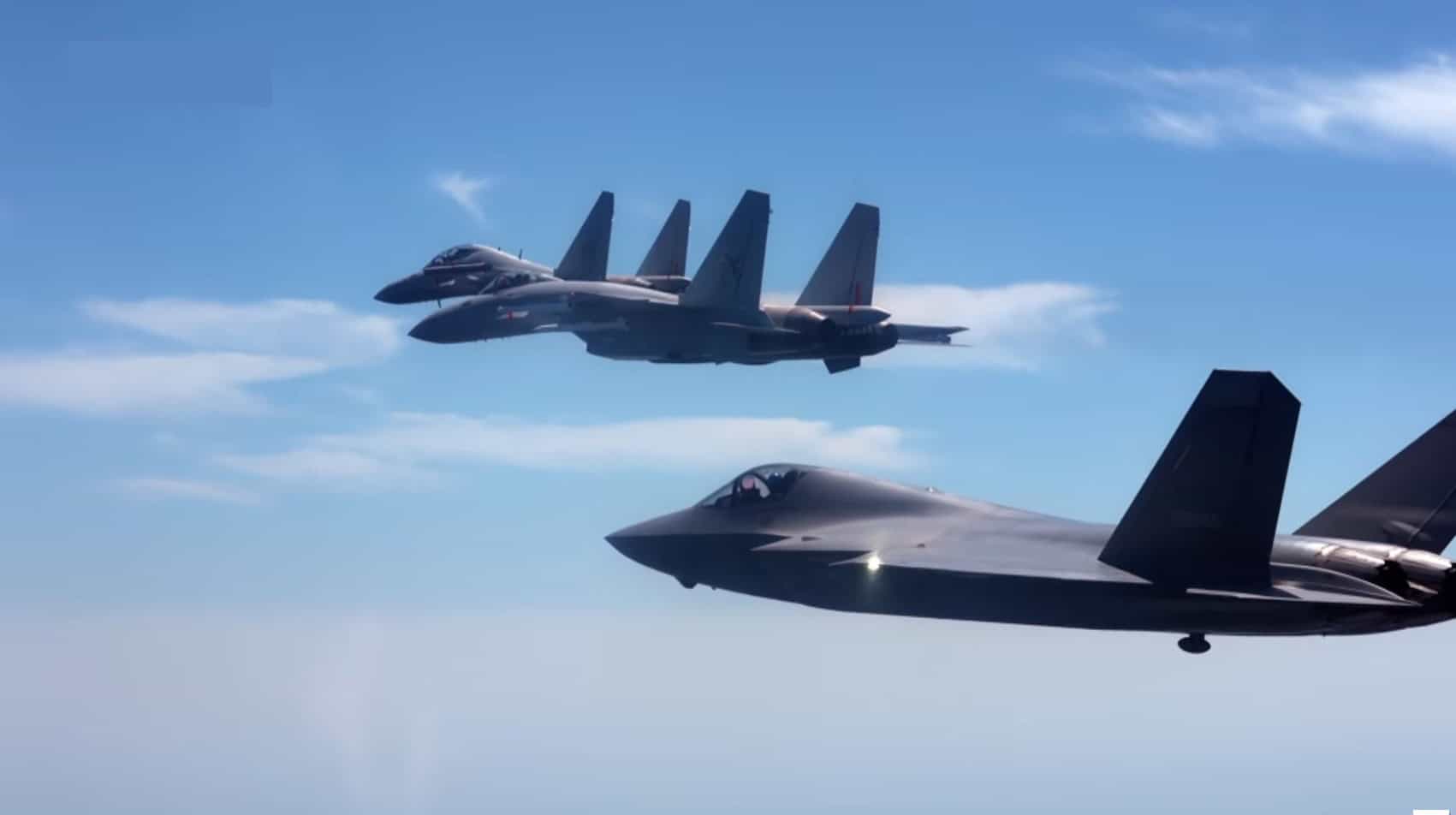


The Shenyang J-35 is a single-seat, twin-engine stealth fighter flown by both Chinese air arms, in a naval version for carrier decks and a land-based version designated J-35A. It is China’s second fifth-generation fighter after the Chengdu J-20.
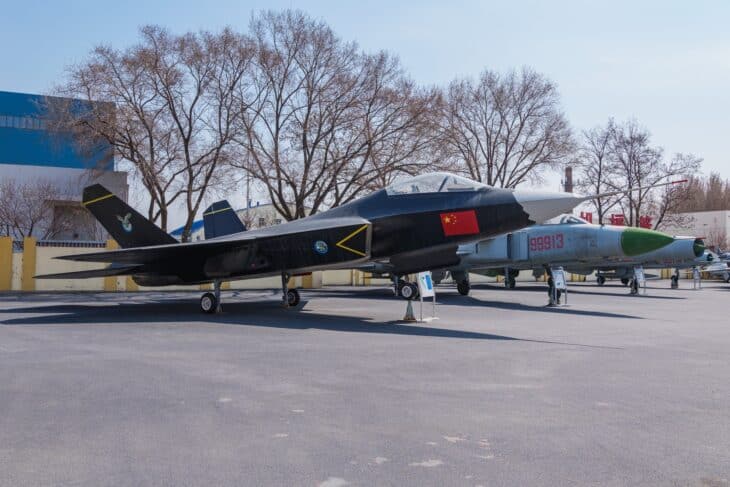
It did not start as a military program. Shenyang Aircraft Corporation lost the J-XX competition that produced the J-20, then kept its own design alive with private funding as an export product called the FC-31 Gyrfalcon.
That prototype, wearing the number 31001, first flew on 31 October 2012 and appeared at the Zhuhai Airshow soon after. Because the airframe carried no military designation at the time, reporters called it the J-31, a name that was never official and still turns up in coverage today.
The People’s Liberation Army Navy took an interest later in the decade, and the program changed character completely once it did. A privately funded demonstrator became a state-backed carrier fighter, then acquired an air force sibling.
A second FC-31 prototype, number 31003, flew on 23 December 2016 with revised shaping, a single-piece canopy and a higher maximum takeoff weight.
The navalized aircraft followed on 29 October 2021. It added a catapult launch bar, folding wings, a larger wing area, a tailhook and a chin-mounted sensor turret, and it was tentatively named J-35 from the start. A second flying J-35 prototype, numbered 350003, joined the test fleet on 22 July 2022.
The land-based variant first flew on 26 September 2023 and was formally named the J-35A ahead of the 2024 Zhuhai Airshow, where it flew in public on 12 November 2024.
On 3 September 2025 the state newspaper China Daily announced both aircraft as part of the navy and air force fleets. An export version of the land-based jet, the J-35AE, was publicly unveiled on 1 May 2026.
The two aircraft share a platform but are built for different jobs, and the differences are visible on the ramp.
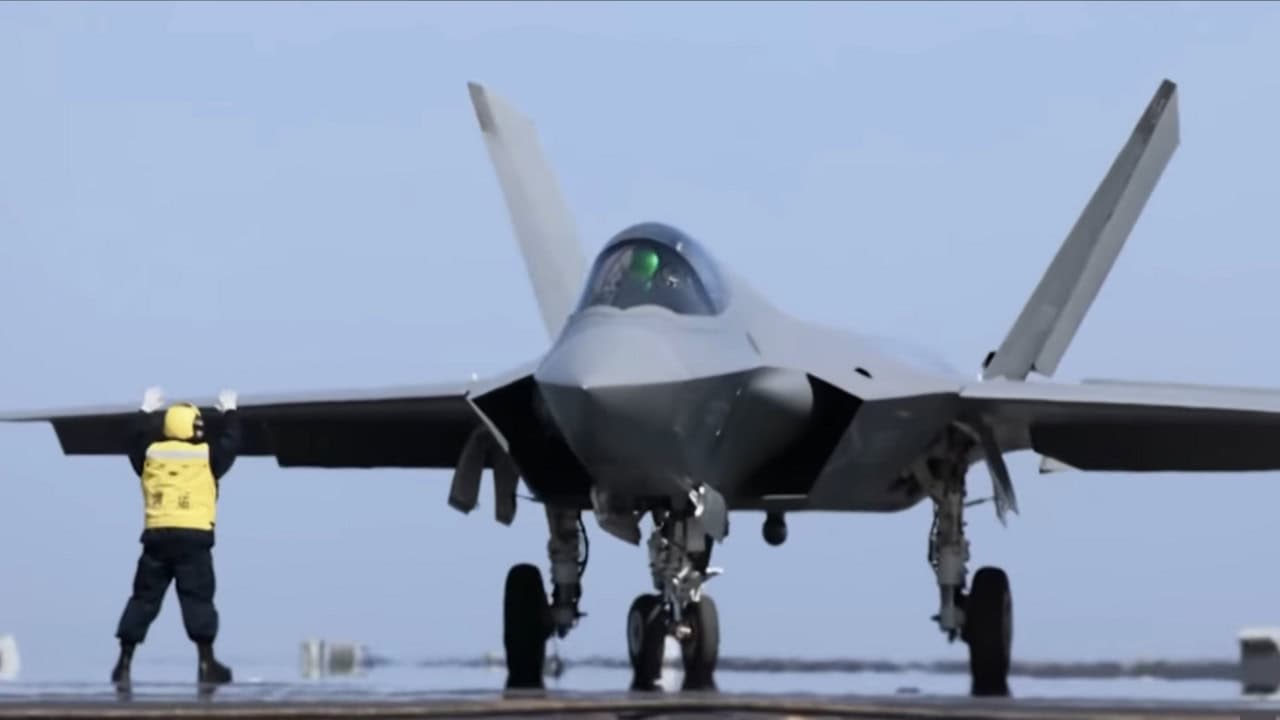
The naval J-35 keeps the twin-wheel nose gear the FC-31 prototype always had, adds a catapult launch bar and a recovery tailhook, and uses folding wings with a larger wing area. It also carries handholds inside the cockpit and full-length rudders.
The J-35A drops all of that. It uses a single-wheel nose gear, a smaller wing area and differently shaped vertical stabilizers, and it has no tailhook or launch bar.
The split runs deeper than structure. AVIC has said the two versions carry different software and avionics tuned to their own service, while the common platform is meant to make joint operations and maintenance easier.
One more difference is reported in the cockpit: the naval jet is described with a center stick and the land-based jet with a side stick. The naval variant is reportedly nicknamed Blue Shark and the air force jet Cloud Dragon, though those names reached the public through Chinese social media rather than an official release.
Engines have shadowed this airframe since 2012. The first FC-31 prototype flew on Russian Klimov RD-93 turbofans, which were widely reported as inefficient for the design.
Later prototypes moved to Chinese powerplants, the WS-13E and then the improved WS-21, which is what the J-35 is generally assessed to be flying on now. Published figures for the WS-21 run from 87.2 to 93.2 kN of afterburning thrust, and the specification panel on this page carries the top of that band.
The intended engine is the Guizhou WS-19, a powerplant in the same class as the F414 or EJ200, rated at 116 kN. With the WS-19 fitted, the J-35 and J-35A are expected to be capable of supercruise, meaning sustained supersonic flight without afterburner.
That is still an expectation. As of September 2026 there is no official statement that production aircraft fly on the WS-19, and analysts reading nozzle imagery have not been able to settle the question from photographs alone.
The gap matters operationally. In February 2026 Defence Blog reported a Chinese naval commentator’s claim that a J-35 on the current engine can hold station for only about seven minutes at 560 miles (900 km) from its carrier, an illustration of how much thrust and fuel burn shape a carrier fighter’s usefulness. That figure is one commentator’s assessment, not a released specification.
The J-35 carries the standard fifth-generation signature features: edge alignment, chines, serrated panel and door edges, diverterless supersonic inlets and serrated engine nozzles that replaced the plain round ones on the first prototype.
AVIC has claimed the design is stealthy against L-band and Ku-band radars and low-observable to many multi-spectrum sensors. Radar-absorbent materials, both structural and applied, are assumed by essentially every outside analyst.
In September 2025, CCTV said the J-35 series has a radar cross-section smaller than a human palm, achieved through fuselage shaping and metamaterials. That is a claim by the manufacturer’s own state broadcaster, not an independently measured figure.
It deserves the same treatment as the American “metal golf ball” description of the F-35: an analogy from an interested party, not a number two aircraft can be ranked by.
The radar advertised for the FC-31 was the NRIET KLJ-7A active electronically scanned array, reportedly comparable to the AN/APG-81. What the production J-35 actually carries has not been disclosed, and The Diplomat’s assessment is that its avionics are more likely to share a generation with the upgraded J-20A.
What is confirmed is the sensor layout: a chin-mounted electro-optical targeting turret and optical apertures distributed around the airframe for spherical infrared coverage, plus a wide-angle head-up display in a glass cockpit.
The full specification table for the aircraft is on this page, and a few of those figures need explaining rather than repeating, because this is an aircraft whose published numbers are estimates rather than released specifications.
Top speed is the one most often mangled. The published limit is Mach 1.8 at altitude, which works out to roughly 1,030 knots, about 1,190 mph (1,910 km/h), and that is the figure the panel carries.
The 2,200 km/h or 1,367 mph often quoted online comes from applying the sea-level speed of sound to a high-altitude Mach limit. The same source that gives Mach 1.8 puts the sea-level maximum far lower, at Mach 1.14, about 870 mph (1,400 km/h).
The range row is blank on purpose. No maximum or ferry range has been published for the J-35; what exists is a combat radius, roughly 780 miles (1,250 km) on internal fuel, about 1,180 miles (1,900 km) with air refueling and about 1,240 miles (2,000 km) with external tanks.
A radius is not a range, and putting one in the other’s place is the most common error in J-35 coverage.
The payload figure is total weapons load across internal and external stations, roughly 4,400 pounds (2,000 kg) internal plus 13,200 pounds (6,000 kg) external. Carrying the external share means hanging stores in the airflow, which is precisely what the internal bay exists to avoid, so the stealth configuration and the maximum-load configuration are two different aircraft.
One figure the panel cannot show is loaded weight, published at 38,581 pounds (17,500 kg), which sits between the empty weight nobody has released and the 61,729-pound (28,000 kg) maximum takeoff weight. Fuel is published as a mass, 15,900 pounds (7,200 kg), which the panel stores as the equivalent volume.
The J-35 is credited with six internal hardpoints inside the ventral weapons bay and six external hardpoints under the wings.
The air-to-air fit runs from the short-range infrared PL-10 to the PL-15 beyond-visual-range missile, with the longer-ranged PL-17 planned and a further missile in development. A folding-fin version of the PL-15E shown at Zhuhai in 2024 matters more than it sounds: folded fins let six fit in a bay that previously held four.
Strike options reported for the type include supersonic land-attack, anti-radiation and anti-ship missiles, along with 1,100-pound (500 kg) class bombs and small-diameter weapons carried internally and externally.
In September 2025 the aircraft’s designers told CCTV that the carrier jet carries up to six missiles. No gun has been confirmed on either variant, though observers have suggested an autocannon sits above the port air intake.
The carrier is the reason the naval J-35 exists in its current form. Fujian, China’s third carrier and its first with catapults, was commissioned on 5 November 2025 at Sanya.
On 22 September 2025, Chinese state media released footage of J-35, J-15T and KJ-600 aircraft launching from Fujian’s electromagnetic catapults and recovering aboard. That made the J-35 the first Chinese fifth-generation fighter launched by an electromagnetic catapult.
The frequently repeated claim that it was a world first does not hold. F-35Cs from the U.S. Navy’s test squadron VX-23 flew EMALS launches and arrested recoveries aboard USS Gerald R. Ford during developmental testing in 2022.
A catapult removes the compromise that defines the ski-jump carriers Liaoning and Shandong, where the J-15 has to trade fuel or weapons for the ability to get airborne at all. Chinese state media has made exactly that argument for the J-35: catapult launch lets it leave the deck with full tanks and a full bay.
Fujian’s planned air wing runs to at least 40 fixed-wing aircraft and a dozen helicopters, mixing J-35s with J-15T fighters, J-15DT electronic warfare jets, KJ-600 early warning aircraft and Z-20 helicopters. For how that compares with other ships, see our roundup of the best aircraft carriers in the world.
The ship was expected to reach full operational readiness before the end of 2026 as aviator qualification continued. As of September 2026 no operational carrier strike group deployment with an embarked J-35 squadron has been documented.
The honest answer is that nobody outside China knows, and the numbers in circulation are estimates built from photographs.
The most-quoted figure is more than 57 aircraft as of October 2025, which traces to a Hong Kong outlet reading fuselage serial numbers off state television footage of the Shenyang production line. It is a reasonable inference, not an official count.
Other markers are firmer. In May 2025 analyst Andreas Rupprecht identified two airframes, 61820 and 61821, whose serials tied them to a PLAAF brigade at Shenyang, suggesting early production and limited service. In July 2025 state media showed several J-35s on the assembly line at once.
At the September 2025 parade, Janes identified three J-35As and at least one naval J-35. Naval airframes photographed since have carried service insignia but no tactical side numbers, which is consistent with aircraft not yet assigned to operational squadrons.
Claims that the type will serve until 2050 should be read with the same caution. No Chinese document in the open press assigns the J-35 a retirement year, and 25 to 30 years is simply what a core fighter type normally gets.
The FC-31 was built to be exported, so the export story is older than the fighter’s military designation. The J-35AE, unveiled in May 2026, is the export version and is based on the land-based J-35A rather than the naval jet.
Pakistan is the customer everyone names. Pakistani media reported in December 2024 that the air force had approved a purchase of 40 aircraft, a Pakistani official told Janes in June 2025 that pilots had begun training in China, and Pakistan’s government announced that same month that it planned to acquire the J-35A with delivery expected within two years.
Then Pakistan’s own defense minister, Khawaja Asif, dismissed the sale reports as speculative in an interview later in June 2025. Subsequent reporting has swung between an accelerated timeline and a delay of several years.
As of September 2026, no contract has been confirmed by either government and no aircraft has been delivered. The Diplomat’s July 2026 assessment was that China is not selling the J-35A to Pakistan yet, whatever the announcements imply.
The resemblance is real and gets noticed immediately: two medium-sized fifth-generation fighters with similar wing and tail layouts and side-mounted inlets. Chinese cyberespionage against the Joint Strike Fighter program is documented, which keeps the copy accusation alive.
The technical case is weaker than the headline. Analysts point out that the twin-engine KF-21 and India’s AMCA converged on much the same configuration without stealing anything, because similar requirements and mature aerodynamics push designers to similar answers. Espionage is more plausible as a shortcut on subsystems and countermeasures than on an airframe’s planform.
The differences are more informative anyway. The F-35 is a single-engine aircraft built in three variants from one production line, with a combat record and more than a dozen operators; Lockheed Martin delivered 191 of them in 2025 alone. The J-35 is twin-engine, split into naval and land-based airframes, and has no combat record at all.
The decisive gaps today are industrial and operational rather than aerodynamic: a production rate still ramping, an engine that is not yet the intended one, and a carrier air arm that is learning the job. Our wider ranking of the best fighter jets in the world and our look at the best Chinese fighter jets put both aircraft in context.
Not on the evidence available. The J-35 is a capable fifth-generation design, but the F-35 has a combat record, a mature production line that delivered 191 aircraft in 2025, more than a dozen operators and a fully worked-out carrier variant.
The J-35 is still flying on an interim engine, its production numbers are estimates, and its naval airframes had not been assigned tactical squadron numbers as of mid-2026. Any comparison of stealth performance rests on claims from the two sides rather than on measured data.
More than 57 airframes as of October 2025 is the most-quoted figure, derived from serial numbers visible in state television footage of the production line rather than from an official count. Janes identified three J-35As and at least one naval J-35 at the September 2025 parade.
It is not a copy, though the resemblance is genuine and Chinese cyberespionage against the F-35 program is documented. Similar mission requirements produced similar layouts on the Korean KF-21 and Indian AMCA as well, and analysts consider stolen data far more likely to have helped with subsystems than with the airframe’s basic shape.
The engine is the main one. Production aircraft are assessed to be flying on the interim WS-21 rather than the intended WS-19, which costs thrust and, by one Chinese commentator’s account, sharply limits loiter time at long range from a carrier.
Beyond that, production is still ramping, the aircraft has no combat record, its combat radius is shorter than the larger J-20’s, and its carrier remains in the process of qualifying its air wing.
The published maximum is Mach 1.8 at altitude, roughly 1,030 knots or 1,190 mph (1,910 km/h), with a sea-level limit of Mach 1.14, about 870 mph (1,400 km/h). Figures around 2,200 km/h come from converting Mach 1.8 at sea-level conditions and overstate the aircraft.
It is a fifth-generation fighter, the second China has fielded after the J-20, which made China the second country after the United States to operate two stealth fighter types. Our explainer on the five generations of fighter planes covers what the label actually requires.
No flyaway price has been published by China or by any export customer, which is why the price row on this page is empty. Figures circulating online are estimates with no primary source behind them, and no J-35AE export contract has been signed to put a real number on the record.
The FC-31 is the privately funded demonstrator that flew in 2012 and 2016; the J-35 is the military aircraft developed from it, with a redesigned airframe, a catapult bar, folding wings and a tailhook. The J-35A is the land-based version for the air force, and the J-35AE is the export model derived from it.
It was the first Chinese one, in September 2025 from the carrier Fujian. American F-35Cs flew electromagnetic catapult launches and arrested recoveries aboard USS Gerald R. Ford during developmental testing in 2022, so the world-first version of the claim is not correct.
Sources and references used for research and fact-checking.