Fighter Jets
China's twin-seat strike fighter built on the Su-30MKK, in full-rate production since 2017
Updated: by Tim de Vries
The latest aviation news and stories sent to your inbox.
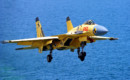
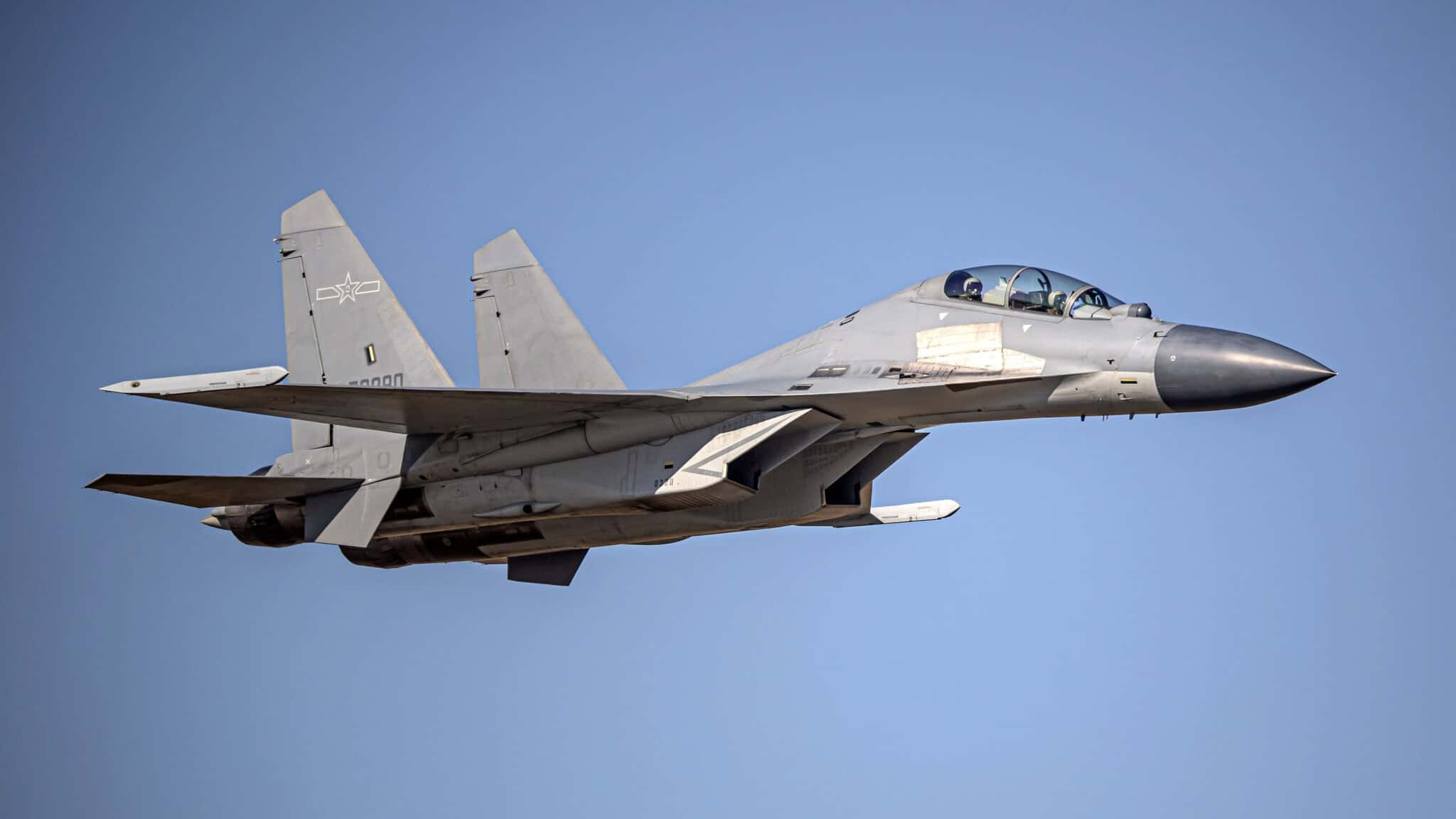
The Shenyang J-16 is a Chinese tandem-seat, twin-engine strike fighter built by Shenyang Aircraft Corporation, developed from the J-11BS airframe with design input from Russia’s Su-30MKK. It is the People’s Liberation Army Air Force’s primary long-range multirole fighter, combining an AESA radar with a large arsenal of Chinese-made air-to-air and strike weapons.
Live Fleet Activity (J16)
Fetching live data…

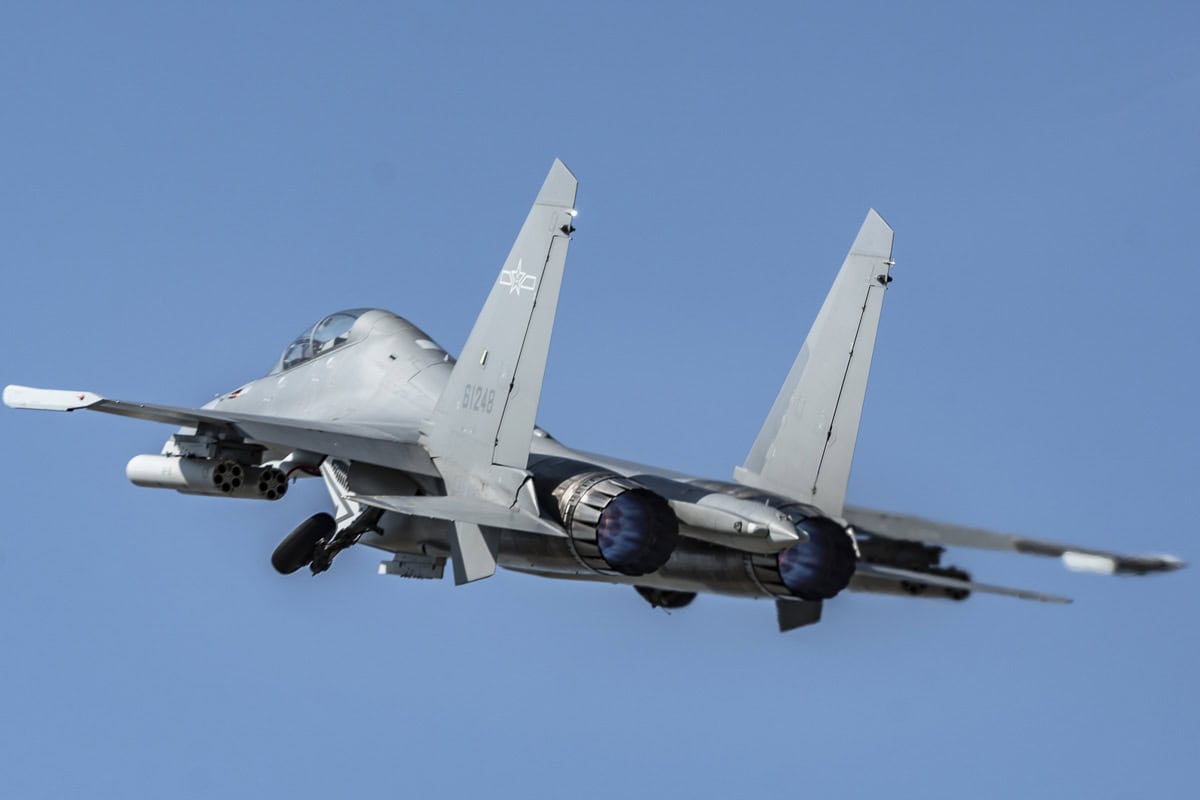


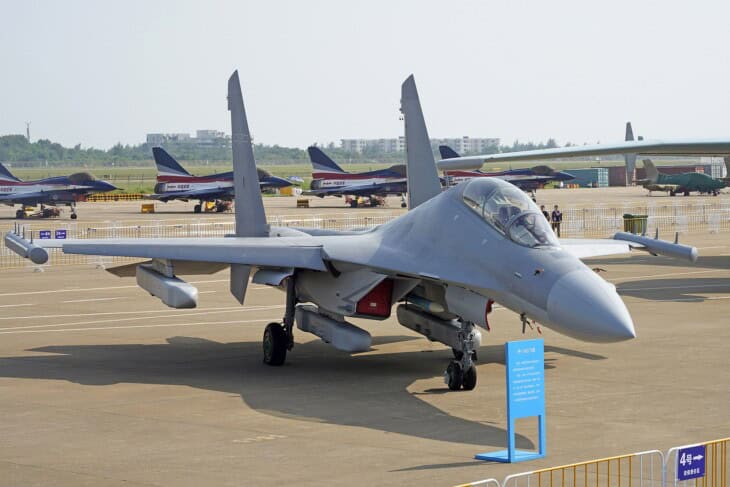
The Shenyang J-16, nicknamed “Qianlong” (Hidden Dragon) and known to NATO as Flanker-N, is China’s twin-seat, twin-engine strike fighter. Built by Shenyang Aircraft Corporation, it pairs a heavily upgraded Flanker airframe with an AESA radar and a large arsenal of Chinese-made weapons.
It is the People’s Liberation Army Air Force’s primary long-range multirole fighter, flying strike, air-to-air, and electronic warfare missions from bases across China. Several hundred are now in service, making it one of the most numerous modern fighters in the PLAAF’s inventory.
China’s air force went into the 2000s needing a true multirole fighter. Its existing strike aircraft, the JH-7, could not hold its own in air-to-air combat, so the PLAAF bought the Russian Su-30MKK to fill the gap.
The J-16 grew out of that purchase. Engineers based the design on the twin-seat Shenyang J-11BS, itself a licensed derivative of the Su-27, then folded in structural and aerodynamic lessons from the imported Su-30MKK.
The first prototype is believed to have flown around 2011 or 2012, with images surfacing on Chinese internet forums in June 2012. The PLAAF received its first regiment in April 2014, and Shenyang moved the type into full-rate production in 2017, the same year it was publicly unveiled at a military parade.
The J-16 seats a pilot and a weapons systems officer in tandem, a layout suited to managing a heavy air-to-ground and electronic warfare load. Extensive use of composite materials trims weight compared with the metal-heavy J-11B it descends from.
An active electronically scanned array (AESA) radar gives it faster target detection and the ability to track multiple threats at once, an upgrade over the mechanically scanned radars on older Shenyang J-15 and J-11 variants. The nose also houses an infrared search and track (IRST) system for detecting targets without emitting a radar signal.
Some J-16s carry a radar-absorbent coating and electronic support pods for suppression of enemy air defense missions, work normally done by dedicated jamming aircraft. Two Shenyang WS-10B turbofans, each producing about 30,000 pounds of thrust with afterburner, power the aircraft, replacing the imported Russian engines used on earlier Flanker variants.
A single 30 mm GSh-30-1 cannon with 150 rounds is built into the fuselage for close-range engagements. Twelve external hardpoints carry the rest of the load.
For air-to-air combat, the J-16 carries PL-9, PL-10, PL-12, PL-15, and reportedly the very-long-range PL-17 missiles. Anti-ship duties fall to the YJ-12 and YJ-83K, while anti-radiation missiles, satellite- and laser-guided bombs, and rocket pods round out its ground-attack options.
The J-16 is 72 feet (21.9 m) long with a 48-foot (14.7 m) wingspan and stands 21 feet (6.36 m) tall. Empty weight is about 41,226 pounds (18,700 kg), rising to a maximum takeoff weight of 77,162 pounds (35,000 kg).
Top speed is roughly Mach 2, about 1,320 mph (2,120 km/h), at altitude. Combat range is around 1,860 miles (3,000 km), extending to roughly 2,500 miles (4,000 km) on a ferry flight with external tanks.
Service ceiling is 56,800 feet (17,300 m), and the aircraft can climb at up to 45,000 feet per minute. Those figures put it in the same performance class as the Su-30MKK it was built from.
Shenyang also builds the J-16D, a dedicated electronic warfare version that reportedly first flew in December 2015. It swaps the internal cannon and IRST sensor for additional jamming equipment and adds large pods at the wingtips instead of missile rails.
The J-16D is built to blind enemy radar and communications ahead of a strike package, a role similar to the U.S. Navy’s EA-18G Growler. The PLA began working the variant into combat training exercises by 2021.
The J-16 is the fighter China dispatches most often on patrols near Taiwan, in part because of its electronic warfare capability. Beijing sent large numbers of them into the area following then-U.S. House Speaker Nancy Pelosi’s 2022 visit to Taiwan.
In May 2022, a J-16 intercepted an Australian P-8 Poseidon surveillance aircraft over the South China Sea, flying alongside it before cutting in front and releasing chaff that Australian officials said damaged the P-8’s engine. Canberra filed a formal protest.
In May 2023, a J-16 flew directly in front of a U.S. RC-135 reconnaissance aircraft in international airspace over the South China Sea, forcing it through turbulent wake. Washington called the maneuver unnecessarily aggressive; Beijing said the American aircraft had entered a Chinese training area.
The Sukhoi Su-35 and J-16 share a Flanker family bloodline but specialize differently. The Su-35 leans toward air superiority, with thrust-vectoring engines built for extreme agility, while the heavier J-16 is optimized as a strike and multirole platform with a bigger, more varied weapons load.
The J-16 is not China’s answer to the Lockheed Martin F-16. That role belongs to the lighter, single-engine Chengdu J-10. The J-16 is closer in size and mission to the U.S. F-15E Strike Eagle, a twin-engine strike fighter built to carry a heavy weapons load over long range.
Neither aircraft is simply “better.” The Su-35 is built for air-to-air combat and outmaneuvers the J-16 thanks to thrust-vectoring engines, while the J-16 carries a heavier and more varied strike load and integrates more modern Chinese sensors and networking.
Estimates put the fleet at roughly 470 to 500 aircraft as of 2026, making the J-16 one of the most numerous fighters in PLAAF service. Production has continued steadily since 2017.
Chinese state broadcaster CCTV aired a 2025 documentary claiming a J-16 achieved a radar lock on two U.S. stealth fighters, reportedly F-22s, over the East China Sea, forcing them to withdraw. Western defense analysts have questioned the account, and it has not been independently confirmed by U.S. officials.
That role belongs to the single-engine Chengdu J-10, not the J-16. The twin-engine J-16 is a heavier strike fighter, closer in size and mission to the U.S. F-15E Strike Eagle.
The J-16 reaches roughly Mach 2, about 1,320 mph (2,120 km/h), at altitude. That top speed matches the Su-30MKK airframe it was developed from.
Sources and references used for research and fact-checking.