

Table of Contents
At about 12:04 p.m. on November 7, 2017, an Icon A5 amphibious airplane flown by retired pitcher Roy Halladay hit the Gulf of Mexico off Florida’s west coast. Halladay, 40, was alone aboard and died. Investigators found no mechanical failure in the airplane or its engine.
Many of the stories still online say the National Transportation Safety Board had stated no cause, because they were written about its April 2020 factual release. The board stated one a month later.
It blamed his “improper decision to perform aggressive, low-altitude maneuvers due to his impairment from the use of multiple psychoactive substances.” This article is built from that document, NTSB Aviation Investigation Final Report ANC18FA007, published May 19, 2020, and its public docket.
October 2017
A new airplane. Halladay takes delivery of A5 N922BA about four weeks before the accident.
October 23, 2017
Icon’s warning. After a fatal A5 crash in California that May, Icon sends owners its Low Altitude Flying Guidelines. They include the line “Do not show off.”
October 26, 2017
The bridge. GPS data shows Halladay flying under Tampa Bay’s Skyway Bridge, which has 180 feet of vertical clearance.
November 7, 11:47 a.m.
Departure. The A5 lifts off Island Ford Lake in Odessa, Florida, climbs to 1,909 feet, then turns west toward the Gulf.
12:01:19 p.m.
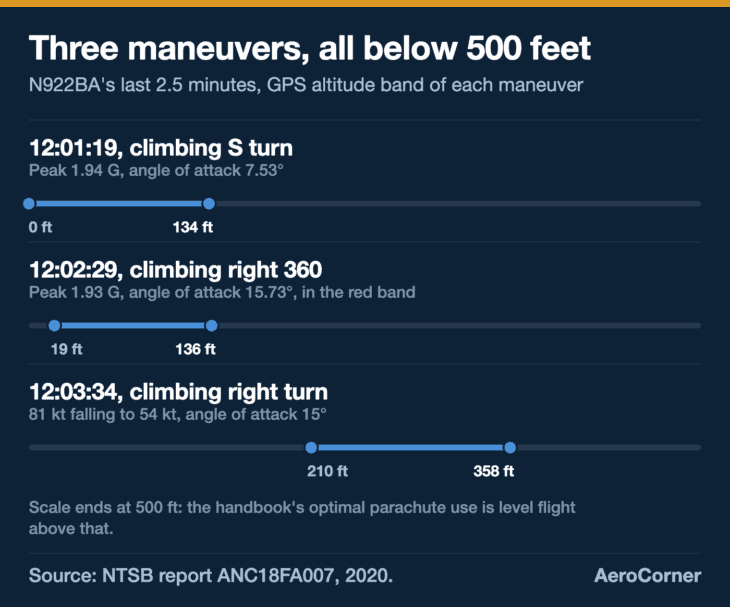
First maneuver. A rapid climbing S turn from the surface to 134 feet, peaking at 1.94 G.
12:02:29 p.m.
Second maneuver. A climbing 360-degree right turn to 136 feet. Angle of attack reaches 15.73 degrees, inside the red band on the cockpit gauge.
12:03:34 p.m.
Final maneuver. A climbing right turn from 210 feet at 81 knots. About three seconds in, the throttle comes back from 99% to 27%.
About 12:04 p.m.
The accident. The airplane tops out at 358 feet and 54 knots, then descends nose low and wings level into about 4 feet of water.
April 15, 2020
The docket opens. The NTSB releases 18 factual items. Coverage that week reports that no cause has been stated yet.
May 19, 2020
The final report. ANC18FA007 is published with the probable cause.
What happened
Halladay was an eight-time All-Star and two-time Cy Young winner, elected to the Hall of Fame in 2019. He was also a real pilot: a private certificate with single-engine, multi-engine and instrument ratings, and 721.5 hours in his logbook.


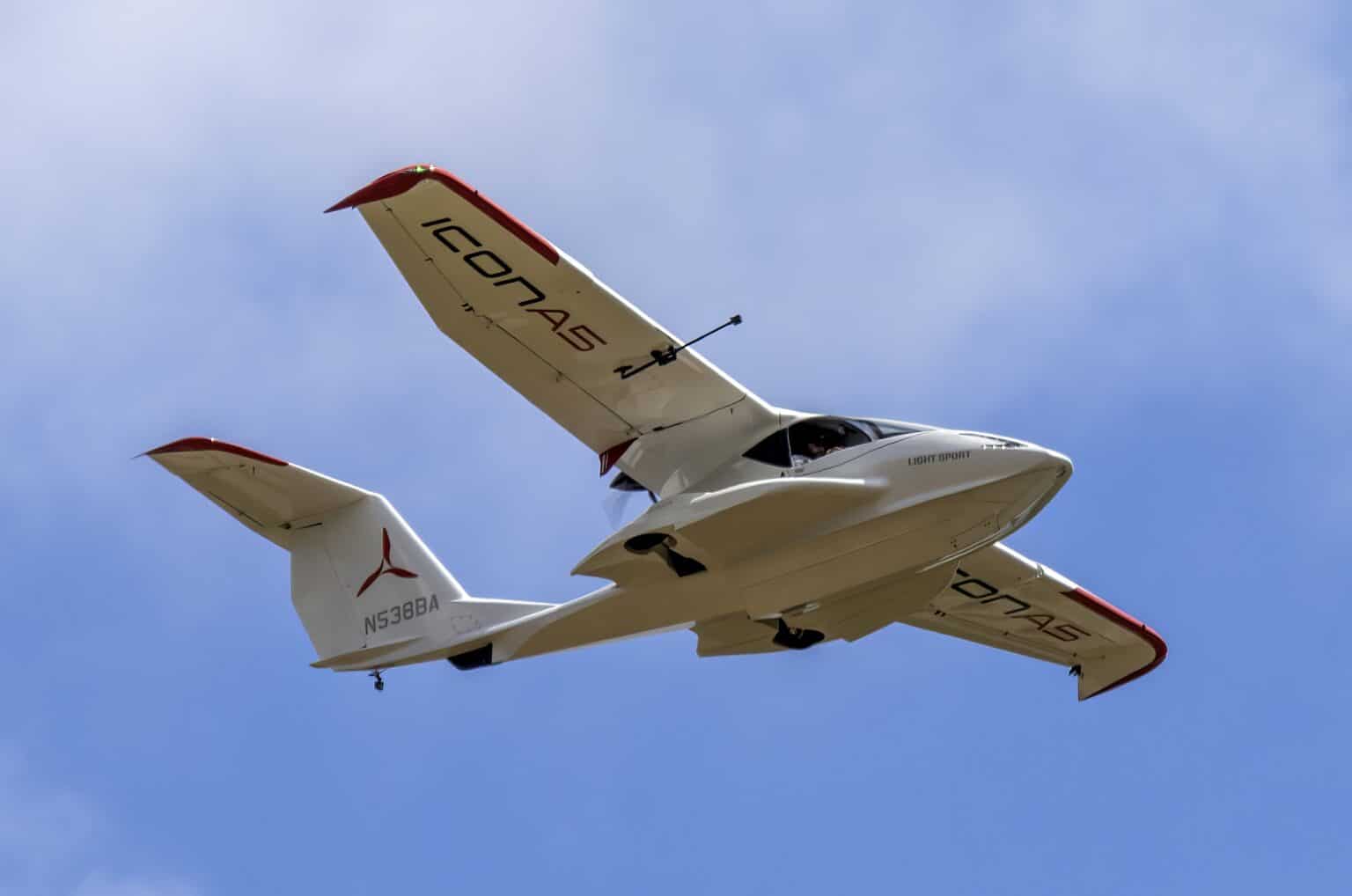
The Icon A5 is a two-seat amphibious light sport aircraft with a 100-horsepower Rotax 912iS engine and a maximum weight of 1,510 pounds (685 kg). His was serial number 22, built in 2017, with 46.5 hours on the airframe. He had 51.7 hours in A5s and 14.5 in this one.
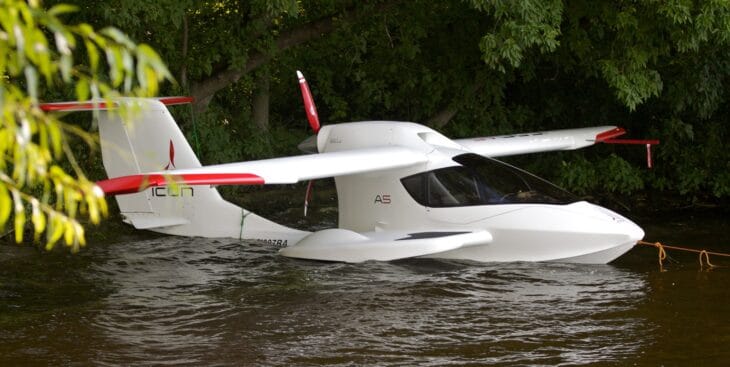

It was a personal flight in clear daylight, with 10 miles of visibility reported at a nearby airport. After 10 nautical miles at about 600 feet, he descended over the Gulf and turned south along the shoreline.
Witnesses saw the airplane between 5 and 300 feet over the water, making steep turns and high-pitch climbs. One commercial fisherman said it passed over his vessel below 300 feet. Another said it flew “really close” to houses, then entered a steep climb.
That second fisherman, about 900 feet from the accident site, watched the airplane come down in a steep nose-down attitude and reach the water about 45 degrees nose down with its wings level.
The NTSB files the accident under Clearwater, but its coordinates, 28.218 N and 82.769 W, sit well north of that city, off the New Port Richey area. ESPN’s account places it in Sand Bay.
What the NTSB found
The board ruled out the airplane first. Flight controls had continuity, the engine turned with compression on every cylinder, and it found no pre-accident problem with either. Feathers in the wreckage held no bird DNA, and the data showed the power drop came from the pilot moving the throttle.
The probable cause, in the report’s words, was “the pilot’s improper decision to perform aggressive, low-altitude maneuvers due to his impairment from the use of multiple psychoactive substances, which resulted in a loss of control.”
Toxicology found five substances the board treated as impairing or potentially impairing: amphetamine, zolpidem, morphine, fluoxetine and baclofen. The report says their combined effect has not been studied, and that some levels may have shifted after death.
Even so, it found all five were at or above levels that affect judgment, attention and psychomotor skills. The board concluded they “most likely resulted in significant impairment” that contributed to his decision to fly those maneuvers.
It also recorded a medical history of substance abuse with inpatient rehabilitation twice between 2013 and early 2015, plus chronic back pain, insomnia and depression, all treated with prescribed medications. His records for 2016 and 2017 were not available.
Headlines at the time said “stunts.” The report’s word is “aggressive,” and it is specific about what that means: no design limit was exceeded, but the flying used up the margin the airplane had left.
What most accounts get wrong
The cause is not unknown. Coverage from April 2020 says no cause had been stated, and that was true for about a month: the final report followed on May 19, 2020. The report also stops short of the claim that he stalled. AOPA wrote that the airplane exceeded a stall-inducing angle of attack, but the NTSB says it only might have stalled momentarily and that unreliable end-of-flight data prevents a determination. The AP’s speed of about 85 mph matches the last data point, 75 knots, not the low point: speed bottomed at 54 knots (62 mph). The crash was in the Gulf of Mexico, not Tampa Bay, as the AP and an ESPN caption had it. And the Skyway Bridge flight came 12 days before the crash, not about a week.
The aviation behind it: why low and slow leaves no room
The recorded data shows three maneuvers in the last 2.5 minutes, and all three stayed well under 500 feet. None broke the airplane’s design limits of +4 and -2 G. The trouble was the energy left over, not the load on the structure.
Height and speed are a pilot’s two energy reserves. Icon’s own operations manual, quoted in the report, spells out the catch: “At low altitude the throttle is our only tool for maintaining or adding energy to our airplane.”
On the final climb, the throttle came back to 27%. Airspeed fell from 81 knots to 54 at the top. The manual warns that “much below 60 KIAS we find ourselves at relatively low energy.” The computed bank passed 50 degrees and the pitch passed 30.
A wing stalls at a critical angle of attack, not at a set speed, and stall speed rises with G-load. The A5’s gauge turns red at 15.6 degrees. The final maneuver reached 15 degrees in the performance study and 16 in the report’s flight history.
The A5 is known for its stall and spin resistance, but the handbook limits the promise: it says the airplane stays controllable “up to 30° bank angles, even when fully stalled.” The final turn went well past that bank, with only 358 feet to work with.
The A5 also carries a ballistic parachute for the whole airplane, as the Cirrus SR22 does. The handbook’s first step for a loss of control is to pull its handle hard, and the cockpit checklist has the pilot remove a safety pin so the handle works.
Investigators found the pin still installed, so the board said he could not have deployed it. It did not say the parachute would have saved him: the altitude and attitude were “not consistent with optimal” use, though the handbook sets no restrictions.
What changed after the Halladay crash
Officially, very little. The final report’s findings and text carry no safety recommendations, and every cause it lists concerns the pilot and how the airplane was flown. The most relevant safety document had already been written.
On May 8, 2017, A5 designer Jon Karkow and a passenger died at Lake Berryessa, California, in a crash the NTSB blamed on failure to keep clear of terrain at low altitude. Icon issued its low-altitude guidelines in response on October 23, 15 days before Halladay’s accident.
Those guidelines admit that general aviation training “does little to prepare pilots for the unique challenges of low altitude flying.” Below a soft deck of about 300 feet, they suggest 45 degrees of bank and 10 of pitch, and 60 and 30 above it. Icon’s chief executive at the time said he “was certain” Halladay had reviewed them.
The report also quotes the federal minimum altitude rule, 14 CFR 91.119, which over open water bars flying closer than 500 feet to any person, vessel, vehicle or structure. It sets that beside the witness accounts but lists no violation among its findings.
For Icon, AOPA reported that a run of accidents hurt the A5’s image. The company filed for Chapter 11 bankruptcy on April 4, 2024, and its assets went to SG Investment America. In July 2026 AVweb reported plans to restart production in 2027, with a new safety system aimed at landing-gear errors.
After the April 2020 docket release, his widow, Brandy Halladay, said it had made the family “relive the worst day of our lives.” She added: “We respectfully ask that you not make assumptions or pass judgement.”
FAQ
Sources and references used for research and fact-checking.
- National Transportation Safety Board, Aviation Investigation Final Report ANC18FA007: Icon Aircraft A5, N922BA, Clearwater, Florida, November 7, 2017
- National Transportation Safety Board, Public docket for ANC18FA007
- National Transportation Safety Board, Aviation accident database (avall), event 20171107X60614
- CBS News (AP), April 15, 2020, MLB Hall of Famer Roy Halladay was on drugs and did stunts when plane crashed in 2017, NTSB say
- ESPN, 2020, NTSB: Roy Halladay was doing stunts when plane crashed, had amphetamines in system
- AOPA, April 16, 2020, Report on Halladay crash paints sad picture
- Plane & Pilot, April 16, 2020, Disturbing NTSB Report On Crash Of Pitcher Roy Halladay
- AOPA, April 4, 2024, Icon Aircraft files for bankruptcy, seeking buyer
- AVweb, July 23, 2026, ICON Aircraft To Resume A5 Production In 2027 With New Safety Technology
Get the Newsletter
The latest aviation news and stories sent to your inbox.
About the Author

Tim is the owner and lead editor of AeroCorner since 2019, overseeing aviation content covering aircraft, airlines, airports, and the broader aviation industry. Through years of researching, writing, editing, and publishing aviation-focused content, he has developed extensive practical knowledge of commercial aviation and air travel. Based in Asia and a frequent traveler himself, Tim also brings firsthand passenger experience to AeroCorner’s coverage. Outside of publishing, he has also explored aviation firsthand through hands-on flight training in New Zealand.