

Table of Contents
The day after a Learjet 60 came down along Military Trail near Greenacres, Florida, on November 1, 2026, NTSB Member Tom Chapman told reporters: “We do have some evidence that there was some breakup of the aircraft before impact.”
Investigator Timothy Monville said the debris field measured about half a mile by four-tenths of a mile (0.8 by 0.6 km), across ball fields, businesses and homes.
That careful wording matters. The NTSB has not said the jet did break up, or why, and the crash itself is covered in our live report on the Greenacres Learjet crash.
What the remark raises is a different question, and a much older one. How can anyone look at twisted metal spread across a neighborhood, or a seabed, and know which pieces came off in the air? The answer is a set of methods built up over decades, and they read like detective work.
How Do Investigators Tell a Plane Broke Up in Flight?
They look for three things that agree with each other: where each piece landed along the flight path, what the broken edges of each piece look like, and what radar recorded in the seconds after the airplane’s transponder went silent.
An airplane that hits the ground in one piece leaves its parts in one place, damaged by that impact. An airplane that comes apart in the air leaves a trail, and the order of that trail is the order in which it came apart.
The evidence at a glance
Where it landed: pieces that left first come down farthest back along the flight path. What the edges show: fractures made while panels were still aligned came before fractures made after they twisted apart. What radar saw: clusters of primary returns, falling objects with no transponder, where one airplane used to be. No single clue settles it. Investigators want all three to tell the same story.
The Wreckage Map Is a Timeline
The core idea is simple physics. A piece that separates from an airplane stops being an airplane and becomes a falling object, and the moment it does, it starts dropping behind whatever is still flying.
So the first pieces to leave come down farthest back along the route. Whatever holds together keeps flying, in a crippled way, and comes down farther ahead. Read from back to front, the debris trail is the breakup sequence laid out on the ground.
The textbook case is TWA Flight 800, the Boeing 747-131 that broke up off East Moriches, New York, on July 17, 1996. Its wreckage lay along a path about 4 miles long by 3.5 miles wide (6.4 by 5.6 km) in the Atlantic, and investigators eventually recovered more than 95 percent of the airplane.
They sorted the seabed into three debris fields, named the red, yellow and green zones from west to east. The red zone, farthest west and closest to JFK, held pieces of the fuel tank area and a ring of fuselage from just ahead of the wing. That made them the first parts to leave.
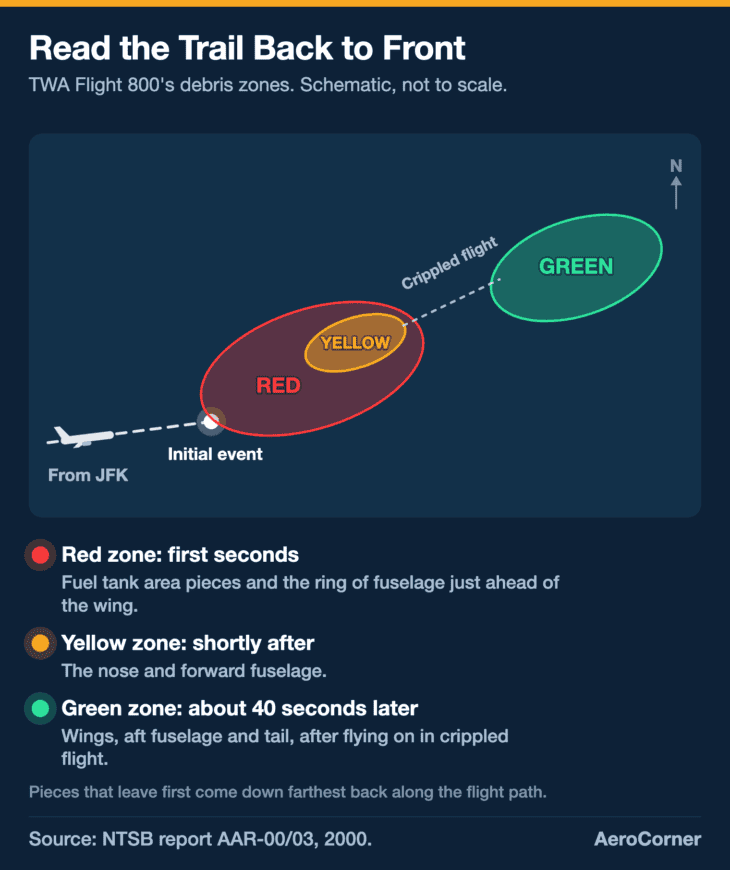
The yellow zone, inside the red zone on its northeast side, held the nose and forward fuselage. The green zone held most of the rest: the wings, the aft fuselage and the tail. The NTSB concluded that this main section flew on in crippled flight for about 40 seconds before it, too, came apart.
Why Light Pieces and Heavy Pieces Land in Different Places
Falling debris does not drop straight down. Each piece has a ballistic coefficient, its weight divided by its drag coefficient times its area, and that number decides how far it travels.
The TWA 800 report explains it with two balls. A foam ball falls slowly and drifts almost entirely with the wind. A bowling ball falls fast and barely drifts at all, carrying on along its original heading.
Investigators turn that into math. Using the winds aloft and each piece’s weight and shape, the NTSB’s computer program, called BREAKUP, started every piece at the airplane’s last recorded altitude and speed and predicted where it would land. Matching predicted and actual landing spots tells investigators roughly when each piece let go.
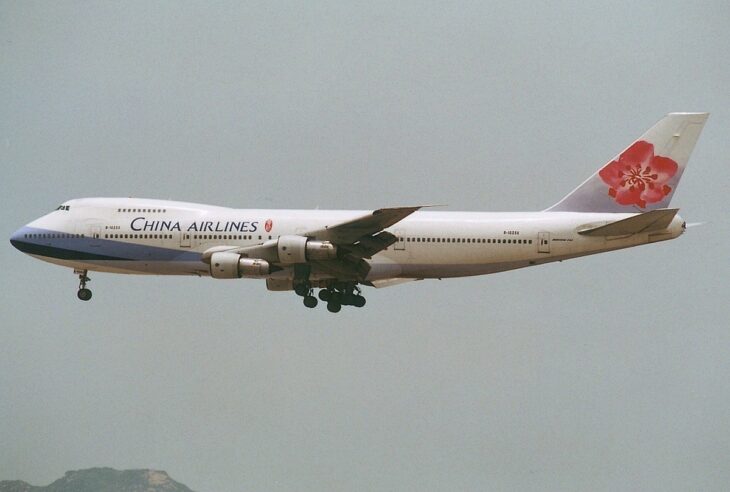
Taiwan’s Aviation Safety Council used the same NTSB program on China Airlines Flight 611, a Boeing 747-200 that broke up at 34,900 feet over the Taiwan Strait on May 25, 2002. Its computed trajectories matched the recovered wreckage with an average error under 1,000 feet (300 m).

Four engines, one nautical mile away
On China Airlines 611, the forward fuselage and wings lay together in one main debris field, so investigators concluded they were still attached when they hit the water. All four engines were found about one nautical mile to the southwest. Heavy, dense and compact, they had separated at altitude and carried on along their own ballistic paths.
What the Broken Edges Say
The wreckage map says roughly when each piece left. The fracture surfaces say how. Metallurgists examine broken edges under magnification, at up to 30 times on TWA 800, and at up to 1,000 times plus a scanning electron microscope on China Airlines 611.
A crack leaves a direction behind it. Chevron marks and “river patterns”, tiny steps across a fracture, point the way the crack ran. Between rivet holes, a short crack usually starts ahead of the main one and turns to meet it, so the longer leg shows which way the tear was traveling.
Bending adds the order. On TWA 800, the NTSB classed skin fractures with no out-of-plane bending as early, because the panels must still have been lined up when they tore. Fractures with bending or twisting came later, after pieces were already out of alignment.
Only a few early-type fractures turned up, all of them on red zone pieces. They showed the first fracturing in the lower fuselage, starting at the front spar of the wing center section.
Fatigue or overload
The edges also show what kind of failure it was. Overload is a sudden break when the load is more than the metal can carry. Fatigue is slow: a crack that grows a little with each repeated load, flight after flight.
On China Airlines 611, investigators found a 15.1-inch (38 cm) fatigue crack running through the full thickness of the aft lower fuselage skin. Smaller fatigue cracks beside it brought the total to 25.4 inches (65 cm). The fatigue areas had a flat profile, and from each end of the main crack an overstress fracture ran on.
That pattern told the story: a crack grew slowly for years, then the remaining metal tore all at once. Most of the cracks had started from scratches left by a 1980 tailstrike, under a repair doubler that did not extend far enough past the damaged area.
Witness marks, crushing and soot
Parts that hit each other on the way apart leave witness marks. On China Airlines 611, the leading edge of the vertical fin had taken a heavy blow from debris on its right side, and stringer fragments from the fuselage section ahead of it were found stuck in the fin.
Crushing works the other way, because it records the final impact. On TWA 800, the nose and the aft fuselage showed severe upward crushing on their undersides from hitting the water.
Where that crushing sat even showed the nose was rolled about 45 degrees to the right when it hit. No red zone piece showed crushing that severe, which fits parts that left the airplane early and came down separately.
Soot dates the fire. On TWA 800, red and yellow zone pieces carried at most light soot and no fire damage, while parts of the main wreckage, such as the aft keel beam, carried heavy soot.
Some of that green zone soot came from fuel burning on the water afterward, so investigators compare pieces that were once joined. Soot on a fracture surface means the fire burned after the break, and clean edges beside sooted ones show which pieces had already gone.
Rebuilding the Airplane
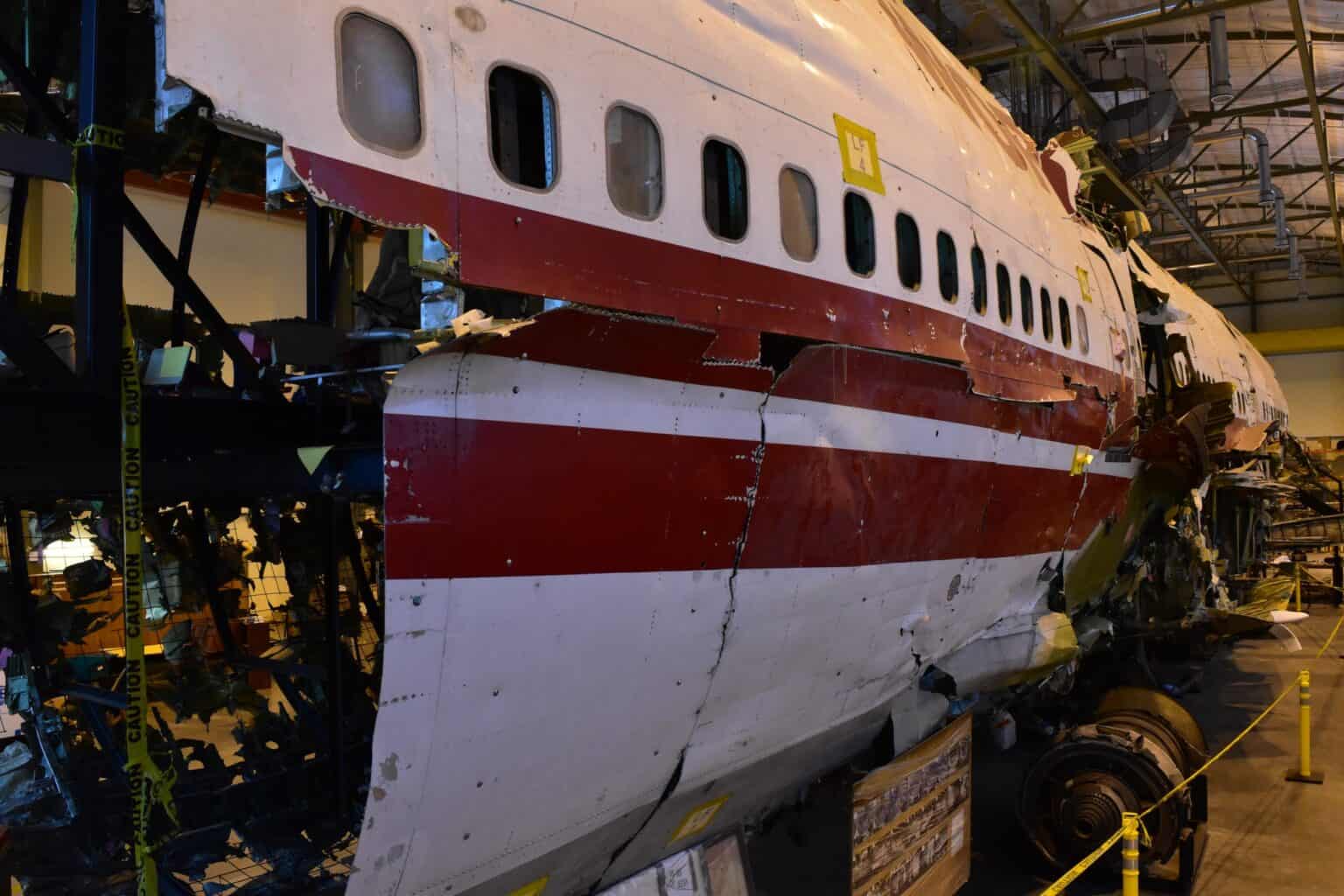
Each recovered piece is tagged with where it was found. On TWA 800, that tags database held recovery positions for thousands of parts, and pieces went by boat and truck to a leased hangar at the former Grumman facility in Calverton, New York.
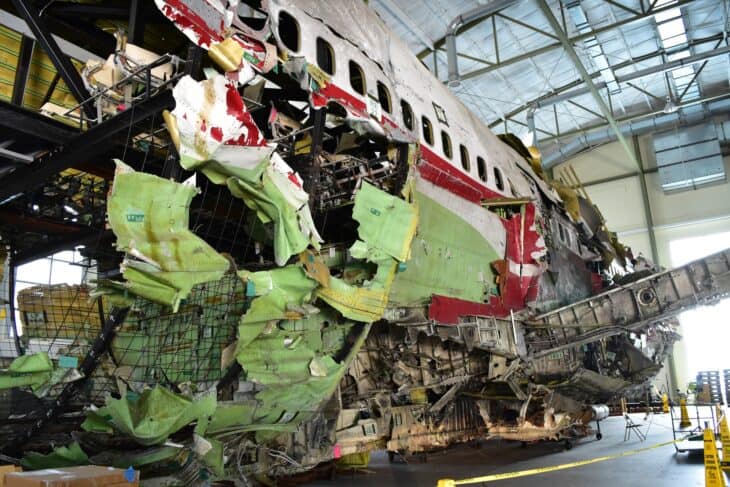

There, investigators first laid parts out on two-dimensional grids marked on the floor, matched to Boeing’s drawings. Then, in the spring of 1997, they built a 93-foot (28 m) three-dimensional reconstruction of the center fuselage on a steel framework.
A reconstruction shows what is missing as well as what is there. Around the center fuel tank, the largest unrecovered patch of fuselage was about 1 square foot, and the frames and stringers underneath it showed no hole punched through.
What Radar Sees When a Plane Comes Apart
Air traffic radar records two kinds of returns. A secondary return comes from the airplane’s transponder and carries its identity and altitude. A primary return is just an echo off a surface, with no identity and usually no altitude.
A breakup can cut an airplane’s electrical power, silencing the transponder and the flight recorders. On TWA 800, the recorder cutoff was consistent with a loss of power, and on China Airlines 611 both recorders stopped at the same second. What radar still sees after that are primary echoes from the falling pieces.
On China Airlines 611, primary radar picked up four groups of returns, and the wreckage on the seabed lay in a pattern that matched those four groups. The tail section and the forward fuselage were 1.5 nautical miles apart, and the farthest-east section, recovered from under water, lay 3 nautical miles from the tail.
Radar has limits, and the reports say so. Primary returns can also come from boats, birds, weather and ground clutter. On TWA 800, the one radar that could estimate the height of primary targets had a published accuracy of plus or minus 3,000 feet, too coarse to settle whether the airplane climbed after its nose came off.
The Myth: A Breakup Means a Bomb
The myth
If a plane came apart in the air, something must have blown it up. Breakups are so sudden and violent that a bomb or a missile feels like the only explanation.
TWA 800 is the strongest answer to that. The NTSB report itself says the sudden, catastrophic breakup, an international flight and the 1996 Olympics fed speculation about a bomb or a missile.
Fire, explosives and metallurgy experts from the NTSB, the FBI, the ATF, the Defense Department and the FAA examined every recovered piece for the damage a bomb or warhead leaves: pitting, petalling, hot-gas erosion, heavy fragmentation, holes punched from outside in. They found none.
Instead, the sequencing study found the first failure was inside the center wing fuel tank, where an overpressure broke the weakest internal beam. China Airlines 611 had no explosion at all, just a crack that had been growing since 1980.
A breakup can also follow loads that exceed what the structure was built for. That is one reason investigators look so hard at speed and maneuvering when an airplane exceeds its limits, as in a jet overspeed. Which of these, if any, applies to a given crash is exactly what the evidence above is gathered to decide.
That is also why early statements are hedged. A debris field can be wide because an airplane came apart, or because a high-energy impact flung parts outward, and only the map, the edges and the radar together tell those apart.
So when the NTSB says it has “some evidence” of a breakup, it is describing the start of that work, not the end. The final report, months away at the earliest, is where the trail of parts gets read back to front and turned into a sequence, and only then into a cause.
Sources and references used for research and fact-checking.
- National Transportation Safety Board, In-flight Breakup Over the Atlantic Ocean, Trans World Airlines Flight 800, Boeing 747-131, N93119 (NTSB/AAR-00/03)
- Aviation Safety Council, Taiwan, Aviation Occurrence Report: In-Flight Breakup Over the Taiwan Strait, China Airlines Flight CI611, Boeing 747-200, B-18255 (ASC-AOR-05-02-001)
- CBS12, NTSB: Learjet crew reported ice, turbulence before deadly Greenacres crash
Get the Newsletter
The latest aviation news and stories sent to your inbox.
About the Author

Tim is the owner and lead editor of AeroCorner since 2019, overseeing aviation content covering aircraft, airlines, airports, and the broader aviation industry. Through years of researching, writing, editing, and publishing aviation-focused content, he has developed extensive practical knowledge of commercial aviation and air travel. Based in Asia and a frequent traveler himself, Tim also brings firsthand passenger experience to AeroCorner’s coverage. Outside of publishing, he has also explored aviation firsthand through hands-on flight training in New Zealand.