

Table of Contents
On Sunday, November 1, 2026, a Learjet 60 came down along Military Trail near Greenacres, Florida, and all nine people aboard were killed. The NTSB is investigating and has not determined a cause.
The people next door had nothing to do with the flight. About 600 residents of 77 mobile homes beside the wreckage were displaced, County Commissioner Joel Flores told NBC News, possibly for up to two weeks, according to our running coverage of the Greenacres crash.
Which raises a question almost nobody thinks about until it happens: who pays for the hotel, the ruined roof and the weeks away from home? The answer runs through your own insurance policy, a few unusually strict state laws, a federal statute, and an insurance limit that is often smaller than people assume.
Who Pays When a Plane Crashes Into Your Home?
In practice, your own property insurer usually pays first. A standard homeowner’s policy treats aircraft damage as a covered loss, and the insurer can then go after whoever was responsible to get its money back.
Who is ultimately responsible depends on where you live. Most states require proof that someone was negligent, a few hold the aircraft’s owner liable no matter what, and federal law shields owners who were not in control of the flight. Behind all of it sits the operator’s liability insurance, whose limit decides how much money there actually is.
The money trail at a glance
1. Your homeowner’s, renter’s or manufactured-home insurer pays your covered losses. 2. It recovers what it paid from the party at fault (subrogation). 3. That party is usually the operator, not a passive owner. 4. The operator’s aviation liability policy pays, up to its limit. 5. Anything beyond the limit is a claim against the operator itself.
Your Own Policy Is the First Check You See
Aircraft are a named peril in the standard homeowner’s form. A USAA HO-3 policy on file with Oklahoma regulators lists “Aircraft, including self-propelled missiles and spacecraft” among the causes of loss it covers for your belongings, while the house itself is covered against any sudden, accidental physical loss the policy does not exclude.
The same form pays additional living expenses, the hotel and meals, while a covered loss leaves your home unlivable. That is the part of the policy most families lean on first after a crash.
The surprise is what happens when your house is untouched but you still cannot go home. That form’s “Prohibited Use” clause pays living expenses when a civil authority bars you from your home because a covered loss damaged an adjacent property, but only for “not more than two weeks.”
The two-week clock
Under the Prohibited Use clause in that HO-3 form, an evacuation ordered because of damage next door is covered for no more than two weeks, and only when the damaged property is adjacent to yours. Policies differ, so the wording in your own declarations and form is what counts.
Once your insurer pays, it steps into your shoes. The policy lets it require an assignment of your rights of recovery, then pursue the responsible party for what it paid, a process called subrogation.
Renters and manufactured-home owners carry their own policy types, and coverage varies more there than on a standard HO-3. Without a policy at all, the only route is a claim against the people responsible for the aircraft.
Fault or No Fault Depends on Your State
When an aircraft damages property on the ground, the question of whether anyone has to be proven careless is decided by state law, and the states split.
Most follow ordinary negligence. The leading case is Crosby v. Cox Aircraft, decided by the Washington Supreme Court in 1987, after a plane ran out of fuel over the Olympic Peninsula and crash-landed on the roof of Douglas Crosby’s garage in West Seattle.
Crosby argued for strict liability under section 520A of the Restatement (Second) of Torts, a model rule that treats ground damage from aircraft as a no-fault case. The court refused, holding that aviation is no longer an “abnormally dangerous activity” and that owners and operators answer for ground damage only when negligence is shown.
A handful of states still say the opposite. Minnesota, New Jersey and South Carolina all make the owner of an aircraft flying over the state “absolutely liable” for injury or damage on the ground, whether or not the owner was negligent.
Those statutes cover harm from the aircraft’s climb, descent or flight and from anything that falls off it. They reduce the owner’s liability when the injured person’s own negligence contributed, make a lessee liable alongside the owner, and give the victim a lien on the aircraft itself.
Florida is not on that list. We found no Florida statute imposing absolute liability for ground damage, and the state’s owner-liability rule, the “dangerous instrumentality” doctrine its courts apply to aircraft, runs into a federal wall when the harm is on the ground.
The Owner on the Registration Is Often Not the One Who Pays
The name on the FAA registry is frequently a company set up just to hold the aircraft, which is why so many private jets are owned by an LLC. Federal law makes that owner a poor target for ground damage.
Under 49 U.S.C. 44112, an owner, a lessor leasing for at least 30 days, or a lender holding a security interest is liable for injury, death or property damage only when the aircraft is in its “actual possession or operational control.” Congress added the word “operational” in 2018.
In Vreeland v. Ferrer (2011), the Florida Supreme Court read the statute, as then written, to cover harm on the surface of the earth. For a crash into a neighborhood, that means Florida’s dangerous instrumentality doctrine cannot reach an owner who was not in control.
Liability therefore tends to land on whoever was actually flying or running the flight: the pilot, an employer, or a charter operator holding operational control. Claims against a manufacturer or a maintenance shop are a separate track, and they depend on what the investigation eventually finds.
How Much Insurance Is Actually Behind the Aircraft
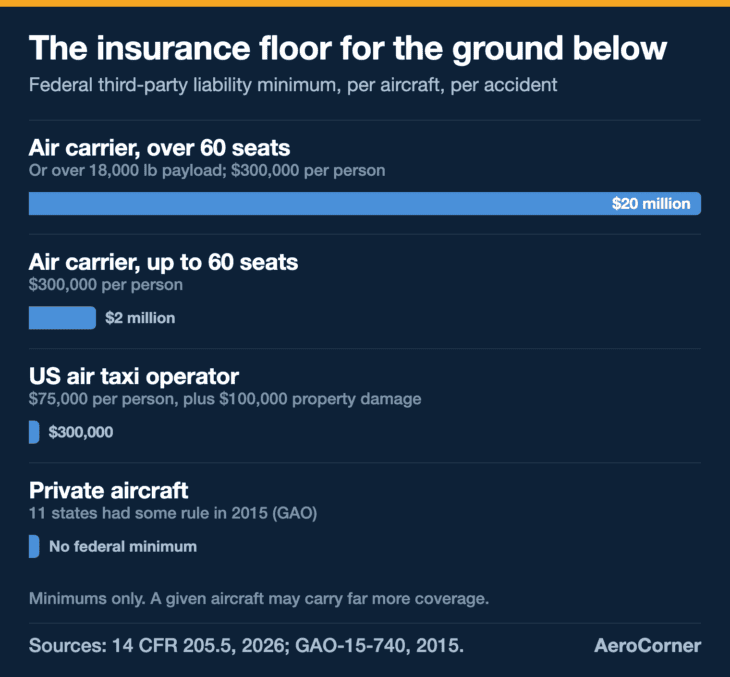
The federal government sets liability insurance minimums only for commercial operators, in 14 CFR Part 205. The floors for people and property on the ground are lower than most people would guess, especially for on-demand air taxis.
| Operator | Third-party minimum per person | Third-party minimum per aircraft, per accident |
|---|---|---|
| Air carrier, more than 60 seats or 18,000 lb payload | $300,000 | $20,000,000 |
| Air carrier, up to 60 seats or 18,000 lb payload | $300,000 | $2,000,000 |
| US air taxi operator | $75,000 | $300,000, plus $100,000 for property damage |
| Private (non-commercial) aircraft | No federal minimum | No federal minimum |
Private flying has no federal requirement at all. A 2015 GAO report found that 11 states had some form of liability insurance or financial-responsibility rule for general aviation, and that Minnesota was the only one covering nearly all aircraft owners.
Most owners buy coverage anyway, and GAO found two policy types dominate: $1 million per accident with a $100,000 cap per passenger, or $1 million per accident with no per-passenger cap. Policies with higher limits were not common.
One pot of money for everyone
On a typical $1 million policy, the per-passenger cap does not apply to victims on the ground, but the $1 million total does. Passengers’ families and the neighbors whose homes were hit all draw from the same limit, and once it is spent, what remains is a claim against the operator personally.
Those are minimums and typical figures, not what any particular aircraft carries. A given aircraft may be insured for much more, and its actual limit normally comes out only through the claims process.
The Myth: The NTSB Report Will Decide Who Pays
The NTSB does not assign blame
Federal rules say NTSB investigations are not conducted to determine the rights, liabilities or blame of any person, and federal law bars the Board’s accident reports from being admitted as evidence in a lawsuit for damages.
Many people assume the National Transportation Safety Board will settle the question. Its job is to find out what happened so it does not happen again, and 49 CFR 831.4 says plainly that its investigations are “not adjudicatory proceedings.”
Under 49 U.S.C. 1154(b), no part of a Board report about an accident may be admitted into evidence in a civil action for damages. Fault is argued separately, by insurers and lawyers, with their own experts.
Other countries handle foreign aircraft differently. The 1952 Rome Convention makes the operator of a foreign-registered aircraft liable for surface damage regardless of fault, within set limits; it entered into force in 1958 and had 51 parties as of 2018, but the United States never ratified it.
It would not reach most US crashes anyway, since it covers only aircraft registered in one member state causing damage in another.
What Residents Usually Do First
The first call is to your own insurer, even if the house looks fine, because an evacuation order alone can trigger living-expense coverage. Keep every hotel, meal and mileage receipt, and photograph the property as soon as you are allowed back.
Ask the insurer which clause it is paying under, and how long that clause runs. A claim against the operator’s aviation insurer can follow, usually after the insurers have sorted out whose policy sits where.
This is general information, not legal advice. Deadlines and rules differ by state, and a lawyer licensed where the crash happened is the right person to read a release before anyone signs it.
So the next time a crash makes the news and the cameras show the houses next door, the money question has a shape. Your own policy pays first, state law decides whether fault must be proven, federal law steers the claim away from passive owners, and the operator’s insurance limit decides how far the money goes.
Sources and references used for research and fact-checking.
- AeroCorner, All Nine Aboard Killed as Learjet 60 Crashes Near Greenacres, Florida
- Cornell Legal Information Institute, 49 U.S. Code § 44112, Limitation of liability
- Cornell Legal Information Institute, 14 CFR § 205.5, Minimum coverage
- US Government Accountability Office, General Aviation: Observations Related to Liability Insurance Requirements and Coverage for Aircraft Owners (GAO-15-740)
- Minnesota Office of the Revisor of Statutes, Minnesota Statutes § 360.012, Aircraft; liability
- FindLaw, N.J.S.A. 6:2-7
- South Carolina Legislature, South Carolina Code of Laws, Title 55 Chapter 3
- LexPlug, Crosby v. Cox Aircraft Co., 109 Wn.2d 581 (1987)
- Holland & Knight, Florida Supreme Court Finds No Federal Preemption Over Claims Against Aircraft Lessors
- Oklahoma Insurance Department, USAA Homeowners Policy HO-3R(02)
- Cornell Legal Information Institute, 49 CFR § 831.4, Nature of investigation
- Cornell Legal Information Institute, 49 U.S. Code § 1154
- Wikipedia, Rome Convention on Damage Caused by Foreign Aircraft to Third Parties on the Surface
- ICAO, The Rome Convention and its Modernization
- Business Insurance, Consensus grows on liability limits for some terrorism losses
Get the Newsletter
The latest aviation news and stories sent to your inbox.
About the Author

Tim is the owner and lead editor of AeroCorner since 2019, overseeing aviation content covering aircraft, airlines, airports, and the broader aviation industry. Through years of researching, writing, editing, and publishing aviation-focused content, he has developed extensive practical knowledge of commercial aviation and air travel. Based in Asia and a frequent traveler himself, Tim also brings firsthand passenger experience to AeroCorner’s coverage. Outside of publishing, he has also explored aviation firsthand through hands-on flight training in New Zealand.