

Table of Contents
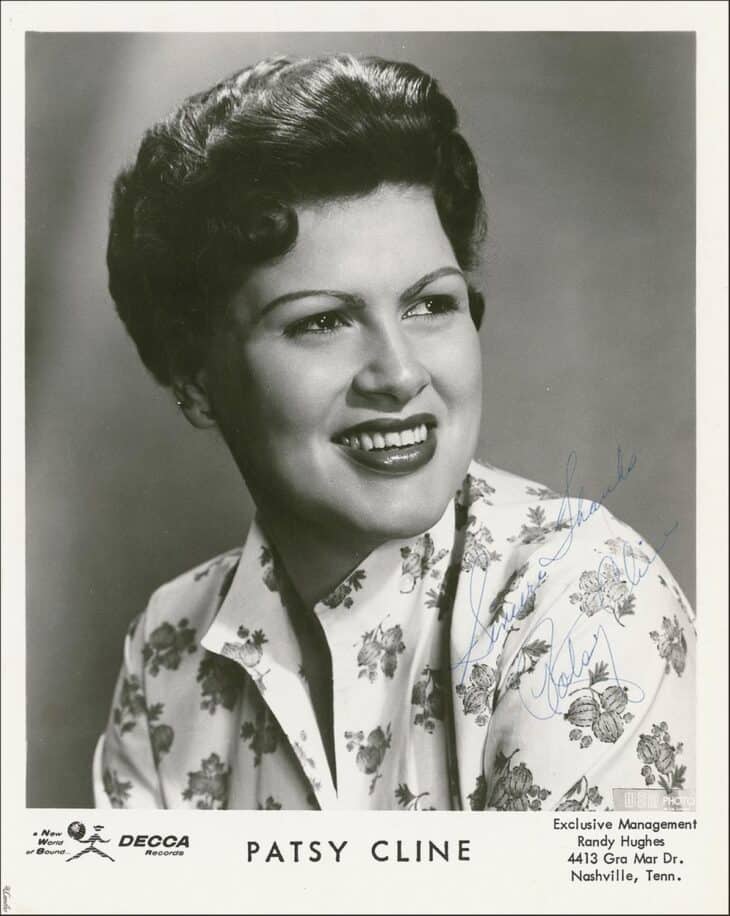
On the evening of March 5, 1963, a single-engine Piper Comanche carrying Patsy Cline crashed in woods about 5 miles west of Camden, Tennessee, roughly 90 miles short of Nashville. Cline, 30, died with fellow country stars Cowboy Copas, 49, and Hawkshaw Hawkins, 41, and the pilot, her manager Randy Hughes, 34.

The crash is often blamed on a storm the plane could not escape, or on a pilot with “only 117 hours”. The record is more specific.
Hughes had 160 hours in all and just over 3 hours of instrument flying, he was told before takeoff that Nashville was below the minimums for visual flight, and the engine was still producing power when the airplane hit the trees.
This article is built from the accident report that Civil Aeronautics Board investigator George J. Green signed on March 7, 1963. The National Archives holds it as an exhibit in an insurance lawsuit over the crash. It also draws on a transcription of the CAB’s accident brief, file 2-1324, and on the FAA registration record for the airplane, N7000P.
March 3, 1963
The benefit show. Cline, Copas and Hawkins play a benefit in Kansas City, Kansas, for the family of disc jockey “Cactus” Jack Call.
March 4
Fogged in. Fog at Fairfax Airport keeps the Comanche on the ground for a day.
March 5, afternoon
Departure. Hughes leaves Kansas City for Nashville under visual flight rules, with a fuel stop in Rogers, Arkansas.
5:05 p.m.
Dyersburg. Hughes lands at Dyersburg, Tennessee, for a weather briefing. He is told the en route weather is unfavorable and Nashville is below VFR minimums.
6:07 p.m.
Takeoff. N7000P leaves Dyersburg after dark. There is no further radio contact.
About 6:30 p.m.
Loss of control. A witness near Camden, a pilot himself, sees the airplane come out of the low overcast in a steep dive. The report logs the accident at 6:29 p.m. Central.
Dawn, March 6
The wreckage is found in woodland about 5 miles west of Camden. All four aboard had died.
March 7, 1963
The report. CAB investigator George J. Green signs the accident report and marks it a detailed investigation.
What happened
On Sunday, March 3, 1963, Cline, Copas and Hawkins played a benefit at Memorial Hall in Kansas City, Kansas, for the family of “Cactus” Jack Call, a disc jockey who had died in a car crash. Cline performed all three shows despite a cold.
Fog kept the group in Kansas City on Monday. Dottie West, who was driving back to Nashville with her husband, offered Cline a ride. Cline turned it down.
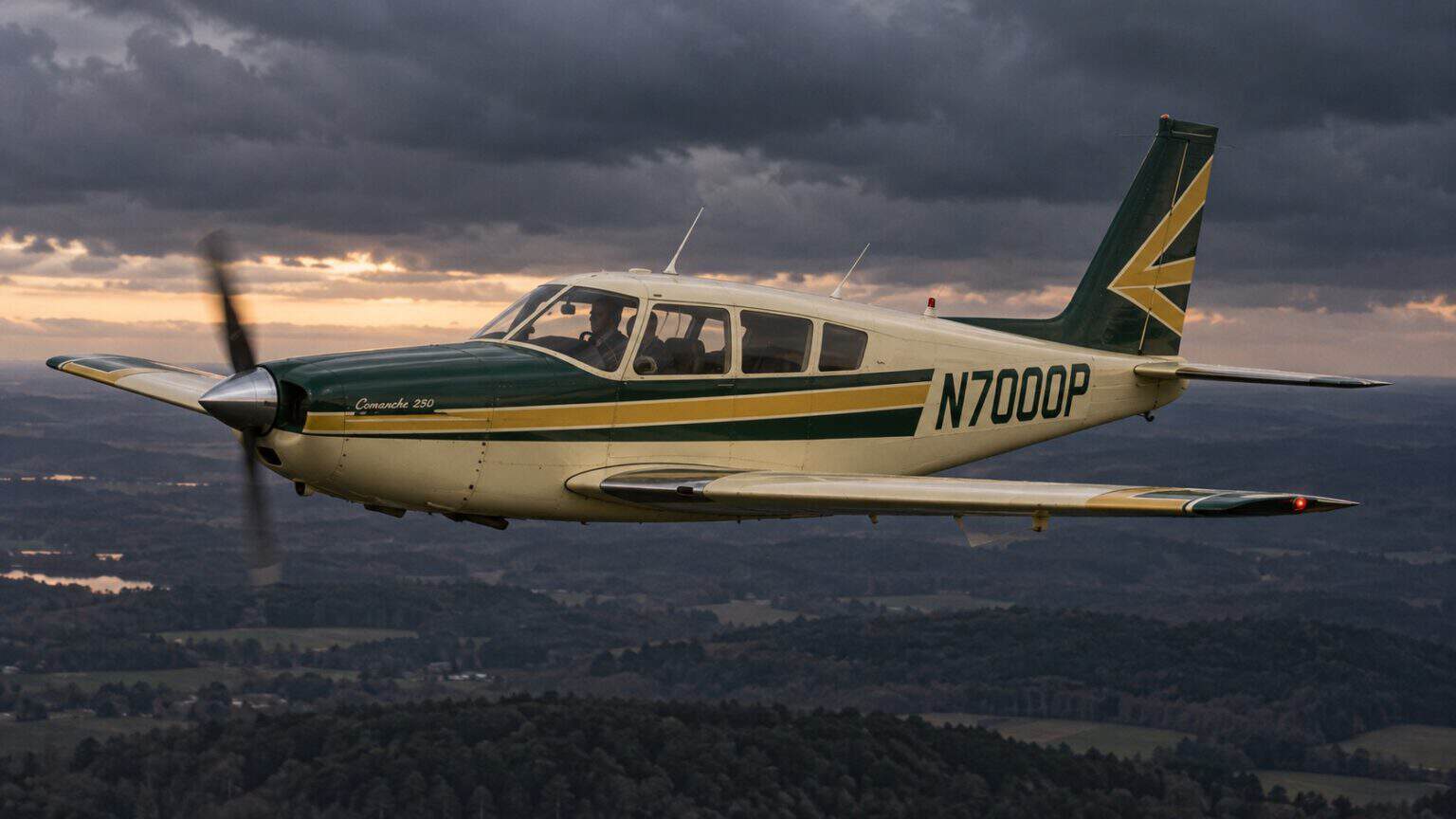
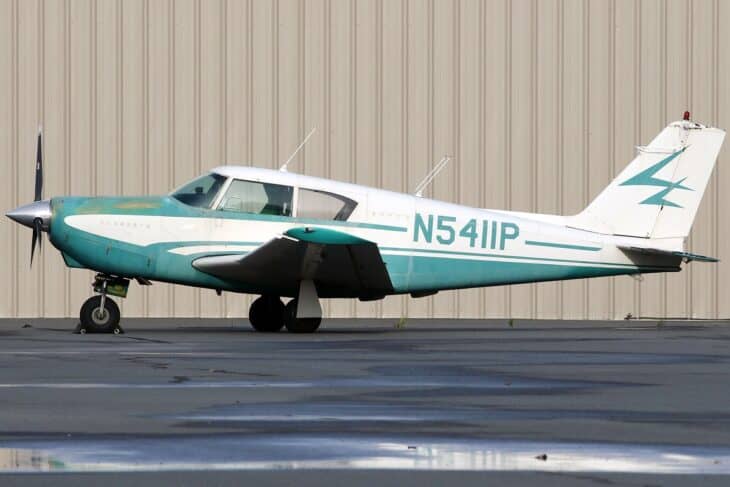
The airplane was a 1960 Piper PA-24-250 Comanche, serial 24-2144, with a 250-horsepower Lycoming O-540 engine. The FAA’s records list it under the Randy Hughes Agency of Nashville. Hughes was Cline’s manager and Copas’s son-in-law, and the report gives the flight’s purpose as business.

On Tuesday afternoon the four left Kansas City and stopped for fuel in Rogers, Arkansas. At 5:05 p.m., Hughes landed at Dyersburg, Tennessee, specifically to get weather for the rest of the trip.
According to the CAB brief, he received a thorough briefing. He was told the en route weather was unfavorable, that Nashville was below VFR minimums, and that it would get worse before it got better.
Hughes then phoned his wife in Nashville, who told him the sun was shining there. He said he would continue and turn back if he had to. The tower gave him the weather again as he taxied, and he took off at 6:07 p.m., after sunset.
Nobody heard from N7000P again. At about 6:30 p.m., a witness near Camden heard an airplane flying low, then saw it descend out of the low overcast in an estimated 45-degree nose-down dive. Searchers, among them Roger Miller, reached the woods the next morning.
What the CAB found
In 1963 the Civil Aeronautics Board investigated accidents. The NTSB did not exist until 1967. Green’s report is Form FAA-2400, a one-page Pilot/Operator Aircraft Accident Report that he completed and signed two days after the crash.
The probable cause in the CAB brief reads: “Non-instrument pilot attempted visual flight in adverse weather conditions, resulting in a loss of control.” A second factor follows it: “Judgement of the pilot in initiating flight in the existing conditions.”
The brief rules out the alternatives. The airplane was intact before it hit the trees, and the engine was developing substantial power at impact. There was no evidence of any failure or malfunction before the crash, and the post-mortem examination of the pilot found nothing that could have been a factor.
The form records the weather near Camden as a 500-foot ceiling, 5 miles of visibility and 43°F (6°C), with a gusty, turbulent 20 mph west wind and cloud. It also notes that the crash happened at night.
Its pilot section is the heart of the file. Hughes held a private certificate for single-engine land airplanes and a third-class medical, and he had no instrument rating. He passed the flight test for that certificate on September 11, 1962, less than six months before the crash.
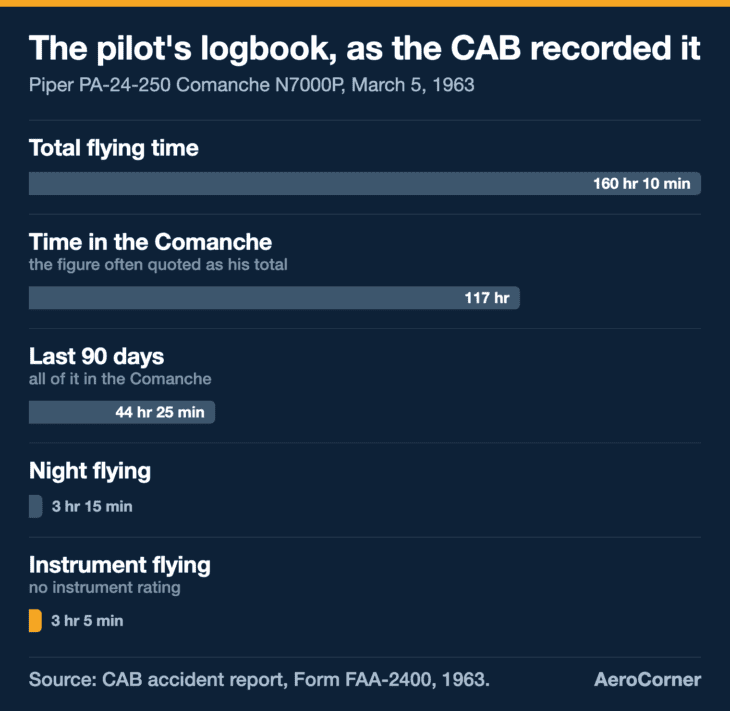
His logbook, as the form records it, showed 160 hours 10 minutes in total, 117 of them in the Comanche. He had 3 hours 15 minutes of night flying and 3 hours 5 minutes of instrument flying, and none of the instrument time came in the previous 90 days.
What most accounts get wrong
The crash is usually told as a plane caught by a storm, or flown by a pilot with 117 hours in his logbook. The CAB report says otherwise. The 117 hours were his time in the Comanche; his total was 160 hours 10 minutes, and the 44 hours 25 minutes some accounts give as his Comanche time is his flying in the last 90 days. Nor was the weather a surprise or the airplane at fault. Hughes landed at Dyersburg to get a briefing, was told Nashville was below visual minimums, and took off into the dark anyway, and the investigators found the engine still developing power at impact.
Why a pilot without instrument training loses control in cloud
A private pilot without an instrument rating flies by looking outside, and this is where spatial disorientation begins. The horizon tells him which way is up. In cloud, or on a dark night under a 500-foot overcast, that reference disappears and the body takes over, and the body is wrong.
The FAA’s Civil Aerospace Medical Institute explains why in its spatial disorientation brochure. The inner ear’s semicircular canals sense a turn only while it is starting. Hold a steady bank for about 20 seconds and the fluid in the canals catches up, so the pilot feels level while the airplane is still turning.
That sets up what the FAA calls the graveyard spiral. When the pilot levels the wings, it feels like a bank the other way, so he rolls back into the original turn. The nose drops and the airplane loses height, and pulling back on the yoke only tightens the turn.
The brochure says 5 to 10% of general aviation accidents can be attributed to spatial disorientation, and 90% of those are fatal. The CAB did not use the term; it wrote “loss of control”. But a VFR pilot in cloud at night, followed by a steep descent out of the overcast, is the situation the brochure warns about.
How quickly it happens was measured nine years before the crash. In a 1954 University of Illinois study, 20 pilots with no instrument training flew a Bonanza into simulated instrument conditions. Every one went into a graveyard spiral or a stall, after 20 to 480 seconds, with an average of 178.
Four years earlier, the Buddy Holly plane crash had followed the same pattern: a Bonanza at night, flown by a pilot not qualified for instrument flight, lost minutes after takeoff. That pilot was given a seriously deficient weather briefing. Hughes was given a thorough one and flew anyway.
What changed
We could find no rule or recommendation that traces back to this crash. The CAB’s finding named a pilot decision, not a defect in the airplane or the system, so there was nothing new for regulators to fix.
The JFK Jr. plane crash in 1999 is the best-known later case. A non-instrument-rated pilot took a Piper over dark water at night in haze, and the NTSB found spatial disorientation.
Training is the part that looks different today. Under 14 CFR 61.109, a private pilot applicant must now log at least 3 hours of training on flying an airplane solely by reference to instruments, including recovery from unusual attitudes. That is about what Hughes had in total, and it is meant to get a pilot out of cloud, not to let him fly in it.
The music outlived the flight. Hawkins’s “Lonesome 7-7203”, on the country chart when he died, went on to spend four weeks at No. 1. In 1973, Cline became the first female performer inducted into the Country Music Hall of Fame, and a memorial now marks the crash site near Camden.
The registration has its own afterlife. The FAA did not cancel N7000P under the Randy Hughes Agency until December 2014, and in September 2026 it issued the number again, under an individual’s name. A registry search for N7000P today returns that 2026 record, not the 1963 one.
FAQ
Sources and references used for research and fact-checking.
- National Archives at Atlanta, Aircraft Accident Report (Pilot/Operator Aircraft Accident Report, Form FAA-2400, Piper PA-24/250 N-7000P, Camden, Tenn., March 5, 1963), exhibit in Stuyvesant Insurance Company v. Katha Loma Hughes et al., Civil Action No. 3547
- Angelfire (fan archive, via Internet Archive), Patsy Cline: The NTSB Report (transcription of CAB accident brief, file 2-1324)
- Federal Aviation Administration, Releasable Aircraft Database (MASTER and deregistered files), N7000P
- FAA Civil Aerospace Medical Institute, Spatial Disorientation: Why You Shouldn't Fly By the Seat of Your Pants (AM-400-03/1)
- AOPA, The lost lessons of '178 seconds to live'
- eCFR, 14 CFR 61.109, Aeronautical experience
- Wikipedia, 1963 Camden PA-24 crash
- Wikipedia, Patsy Cline
- Wikipedia, Cowboy Copas
- Wikipedia, Hawkshaw Hawkins
- Grunge, Things Found At Patsy Cline's Death Scene
Get the Newsletter
The latest aviation news and stories sent to your inbox.
About the Author

Tim is the owner and lead editor of AeroCorner since 2019, overseeing aviation content covering aircraft, airlines, airports, and the broader aviation industry. Through years of researching, writing, editing, and publishing aviation-focused content, he has developed extensive practical knowledge of commercial aviation and air travel. Based in Asia and a frequent traveler himself, Tim also brings firsthand passenger experience to AeroCorner’s coverage. Outside of publishing, he has also explored aviation firsthand through hands-on flight training in New Zealand.