

Table of Contents
On July 16, 1999, at about 9:41 p.m., the Piper Saratoga flown by John F. Kennedy Jr. went into the Atlantic Ocean about 7.5 miles (12 km) southwest of Gay Head, Martha’s Vineyard. Kennedy, 38, died with his wife, Carolyn Bessette Kennedy, 33, and her sister, Lauren Bessette, 34.
It is usually told as a bad-weather crash. It was not one. The flight was legal under visual flight rules the whole way, no weather warning was in force on the route, and Martha’s Vineyard was reporting clear skies. What the haze took away was the horizon, and Kennedy was not yet trained to fly without one.
This article is built from the National Transportation Safety Board’s final report on accident NYC99MA178, first published on July 6, 2000. Every time, altitude and finding below comes from that report unless another source is named.
April 22, 1998
Private pilot certificate. Kennedy passes his checkride after training at FlightSafety in Vero Beach, Florida. The certificate covers single-engine land airplanes. He holds no instrument rating.
April 1999
A new airplane and an instrument course. He buys Saratoga N9253N on April 28. At FlightSafety he completes 12 of the 25 lessons of an instrument rating course and last leaves on April 24.
June 1, 1999
A broken ankle. He fractures his left ankle in a hang gliding accident and has surgery the next day. The walking boot comes off on July 15.
July 16, 6:34 p.m.
The weather check. Someone using his account requests an online route briefing. It shows no cloud below 20,000 feet and visibility from 4 miles in haze to 10 miles.
8:38 p.m.
Takeoff from Caldwell, New Jersey. The Essex County tower clears N9253N for takeoff. It is the last time the pilot talks to any controller.
9:33 p.m.
The descent begins. About 34 miles west of Martha’s Vineyard, over open water, the airplane starts down from 5,500 feet at 400 to 800 feet per minute.
9:38 p.m.
Turns that were not on the route. A right turn, a climb back to 2,500 feet, then a left turn and a descent of about 900 feet per minute.
9:40:15 p.m.
The final turn. A right turn begins. Bank, airspeed and descent rate all keep increasing until the descent exceeds 4,700 feet per minute.
July 20-21
Found and recovered. Navy divers locate the wreckage in 120 feet of water on July 20. The three victims are recovered on July 21.
July 6, 2000
The final report. The NTSB rules the probable cause a loss of control from spatial disorientation, with haze and the dark night as factors.
What happened
The plan was simple. Kennedy would fly from Essex County Airport in Caldwell, New Jersey, drop Lauren Bessette at Martha’s Vineyard, then continue to Hyannis with Carolyn for the wedding of his cousin Rory Kennedy.
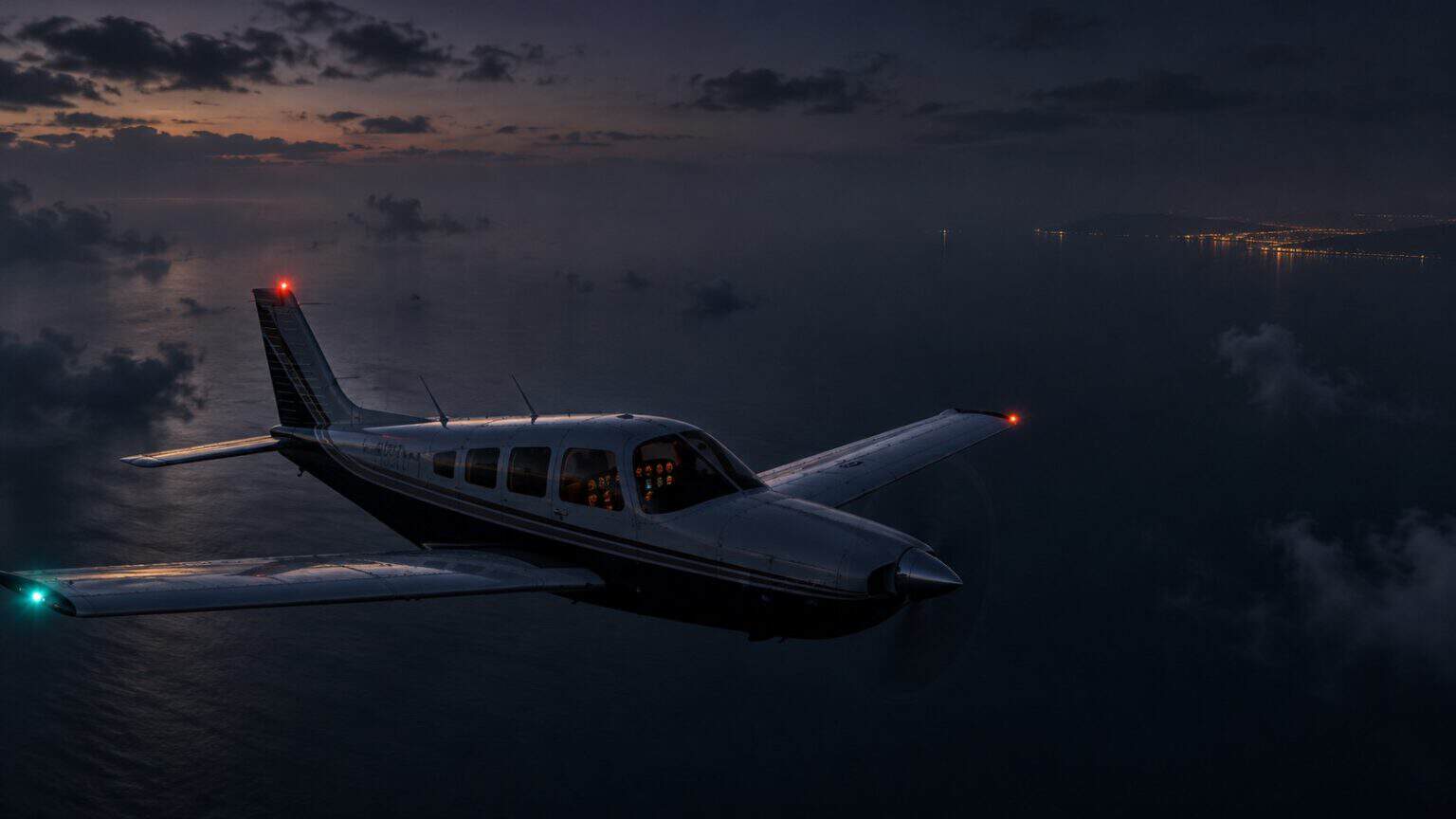
The airplane was a 1995 Piper Saratoga II, registration N9253N, a six-seat single with retractable landing gear and a 300-horsepower Lycoming engine. He had owned it for 11 weeks.

Lauren Bessette was a vice president of investment banking at Morgan Stanley. Carolyn Bessette Kennedy had worked in publicity at Calvin Klein before her 1996 marriage.
Kennedy had told the airport around 1 p.m. that he would arrive between 5:30 and 6 p.m. Witnesses saw him on crutches that evening, loading luggage. An instructor who often flew with him had offered to come along. According to the instructor, Kennedy replied that “he wanted to do it alone.”
He was cleared for takeoff at 8:38 p.m., 24 minutes after sunset. He flew under visual flight rules with no flight plan, which is legal and common. A VFR pilot who stays clear of busy-airport airspace does not have to talk to air traffic control, and after Caldwell he did not.
Near White Plains, New York, his climbing Saratoga set off a collision-avoidance resolution advisory in an American Airlines Fokker 100 on approach. Its crew called the traffic a single-engine Piper, and radar later matched the target to N9253N. The encounter was outside the busy-airport airspace, and no corrective action was reported.
He leveled at 5,500 feet (1,680 m) and flew a course of about 100 degrees, along the Connecticut and Rhode Island shoreline. Past Point Judith, the route left the coast for a 30-mile (48 km) crossing of open water.


By 9:28 p.m. even nautical twilight was over. A moon about 19 percent lit hung low in the western sky, behind an eastbound airplane. About five minutes later the descent began, and about seven minutes after that the radar track ended.
What the NTSB found
The probable cause, in the Board’s words: “The pilot’s failure to maintain control of the airplane during a descent over water at night, which was a result of spatial disorientation. Factors in the accident were haze, and the dark night.”
Nothing on the airplane failed. Investigators examined the airframe, flight controls, engine, propeller, autopilot and avionics, and found no evidence of a mechanical malfunction before impact. The engine was producing high power when it hit the water.
The pilot’s record explains the rest. The Board estimated about 310 hours of total flying, 55 of them at night. Only about 36 hours were in the Saratoga, and only about 3 of those without an instructor aboard. Just 0.8 hour of that time without an instructor was at night.
His instructors did not describe a careless pilot. One called him methodical and cautious, and said he was capable of the night flight to Martha’s Vineyard as long as a visible horizon existed. Another said he could fly without a horizon but might struggle to do anything else at the same time, and was not ready for his instrument check ride.
Toxicology was negative for alcohol and drugs. All three occupants died of multiple injuries in the crash.
What most accounts get wrong
This was not a flight into bad weather. No weather advisory was in force along the route, the online briefing showed no low cloud, and Martha’s Vineyard reported 10 miles visibility minutes after the crash. A widely read 1999 account called it a nasty night and said he held an instrument certificate; he held none. Nor did he radio the Martha’s Vineyard tower: its tape shows no contact attempted. The danger was a legal haze that erased the horizon over dark water.
That 1999 account, in The Guardian, still sits near the top of Google for this crash. Even Wikipedia’s biography of Kennedy says he checked in with the Martha’s Vineyard tower. The report says no record exists of him contacting any facility after Caldwell.
Another story from that week holds up only halfway. A Caldwell pilot told reporters he had cancelled the same trip because of “poor” weather. His written statement to investigators gave three reasons: the hazy weather at Caldwell, friends who would not come, and saving the cost of a hotel by flying the next day.
The ankle is the third myth. His surgeon told investigators he could press as hard with that foot as an emergency stop in a car requires, and an FAA doctor said the injury would not normally need a medical examiner’s approval. The Board did not list it as a cause or a factor.
Why a clear night can still take away the horizon
Pilots who flew the same water that night described it in the report. One, descending toward Nantucket, said: “There was no horizon and no light.” Another, bound for Martha’s Vineyard at 7,500 feet, could see lights straight down over land but said that over the water there was no horizon to reference.
Without that line, a pilot’s sense of balance takes over, and in an airplane it lies. The inner ear senses changes in motion, not steady states, so a slow bank stops registering. A pilot who rolls level again can feel he is banking the other way. This is spatial disorientation, and the only cure is to trust the instruments over every physical sensation.
The report quotes the FAA’s description of the deadliest version, the graveyard spiral. In a long, steady turn the sensation of turning fades. The pilot sees altitude unwinding, feels wings level, and pulls back on the yoke. In a bank, that tightens the turn and steepens the dive.
The Board’s performance study fits that pattern. From 9:40:15 p.m. the bank angle grew at a nearly constant rate. It passed 45 degrees within 10 seconds while the airspeed went through 180 knots. The last radar return came 19 seconds after the turn began, at 1,100 feet (335 m).
Time is the trap. The FAA advisory circular cited by the Board says tests with qualified instrument pilots showed it can take as long as 35 seconds to establish full control by instruments after losing outside visual references. Kennedy’s training had covered unusual-attitude recovery, but the attitude indicator only helps a pilot who has learned to believe it.
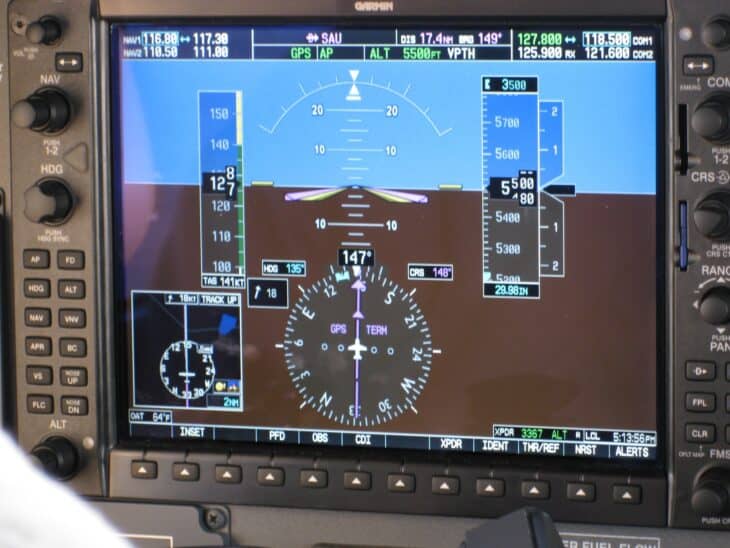

That is what an instrument rating buys. It is not mainly about flying in cloud. It is dozens of hours of practice at ignoring your body and flying the gauges, which is exactly what a hazy night over water demands.
What changed
The honest answer is that the rules did not. The final report itself contains no safety recommendations. It noted that the pilot certification rules in Part 61 set no specific training requirement for spatial disorientation.
Today, the VFR minimums require only 3 statute miles of visibility at night below 10,000 feet in the airspace Kennedy crossed. A private pilot without an instrument rating can legally make the same flight tonight, on the same kind of night.
Training requires some instrument time. To get a private pilot certificate, the FAA requires 3 hours of flight training solely by reference to instruments, including recovery from unusual attitudes. That is a survival skill for an inadvertent encounter, not a qualification to cross dark water.
What has changed is the airplane. Modern light-aircraft autopilots such as Garmin’s GFC 500 and GFC 600 carry a dedicated level button. Garmin says pressing it engages the autopilot and returns the airplane to straight-and-level flight, with spatial disorientation named among the scenarios it targets.
The lesson has not changed either. Spatial disorientation killed Kobe Bryant and eight others in a helicopter that flew into cloud over Calabasas two decades later. The Kennedy accident is the clearer teaching case, because his flight broke no weather rule.
FAQ
Sources and references used for research and fact-checking.
- National Transportation Safety Board, Aviation Investigation Final Report, NYC99MA178, Piper PA-32R-301 N9253N, Vineyard Haven, Massachusetts, July 16, 1999
- National Transportation Safety Board (via FAA NASDAC), NTSB Brief Report, NYC99MA178
- Electronic Code of Federal Regulations, 14 CFR 91.155, Basic VFR weather minimums
- Electronic Code of Federal Regulations, 14 CFR 61.109, Aeronautical experience
- Garmin, The Blue Button: Helping Keep the Blue Side Up
- Wikipedia, John F. Kennedy Jr.
- Wikipedia, Carolyn Bessette Kennedy
- Wikipedia, Lauren Bessette
- The Guardian, Why John Kennedy crashed
Get the Newsletter
The latest aviation news and stories sent to your inbox.
About the Author

Tim is the owner and lead editor of AeroCorner since 2019, overseeing aviation content covering aircraft, airlines, airports, and the broader aviation industry. Through years of researching, writing, editing, and publishing aviation-focused content, he has developed extensive practical knowledge of commercial aviation and air travel. Based in Asia and a frequent traveler himself, Tim also brings firsthand passenger experience to AeroCorner’s coverage. Outside of publishing, he has also explored aviation firsthand through hands-on flight training in New Zealand.