

Table of Contents
On October 12, 1997, shortly after 5:28 p.m., John Denver’s Long-EZ dove into Monterey Bay about 150 yards off Point Pinos in Pacific Grove, California. He was 53 and the only person aboard, and he did not survive. He had owned the airplane for 15 days.
Most people remember one of two versions: he ran out of gas, or he had been drinking. Neither is what the investigators found. Toxicology was negative, several gallons of fuel were still aboard by the Board’s own estimates, and the crash came from a loss of control while he twisted around to reach a fuel valve the builder had moved behind his left shoulder.
This article is built from the National Transportation Safety Board’s final report on accident LAX98FA008, first published on January 26, 1999. Every time, quantity and finding below comes from that report unless another source is named.
Sept. 27, 1997
Denver buys the airplane. It is a used, amateur-built Long-EZ, built from plans in 1987. While it is repainted at Santa Maria, he has it reregistered as N555JD.
Oct. 11, 1997
A half-hour checkout. Another Long-EZ pilot flies with him at Santa Maria. Denver needs a cushion behind his back to reach the rudder pedals, and with it in place he struggles to reach the fuel selector handle.
Oct. 11, 1997
The flight home. He flies about an hour to Monterey with roughly 12.5 gallons in the right tank and 6.5 in the left, selector set to the right tank. The airplane is not refueled at Monterey.
Oct. 12, before 5:02 p.m.
Preflight. A maintenance technician estimates the left tank at less than a quarter full and the right at less than half. Denver declines fuel, saying he will fly for about an hour.
5:12 p.m.
Cleared for takeoff. After an engine start that quits and a restart, he departs runway 28 at Monterey Peninsula Airport and flies three touch-and-go landings.
About 5:27 p.m.
Leaving the pattern. He departs straight out to the west. The controller asks him to recycle his transponder code, and he does.
5:28:06 p.m.
Last radio transmission. NTSB audio analysis of the background sound puts the engine at about 2,200 rpm. There is no distress call.
Moments later
Loss of control. Witnesses see the airplane level at 350 to 500 feet over a residential area, hear a pop and a drop in engine noise, then watch it pitch up, bank sharply right and descend nose first into the ocean.
What happened
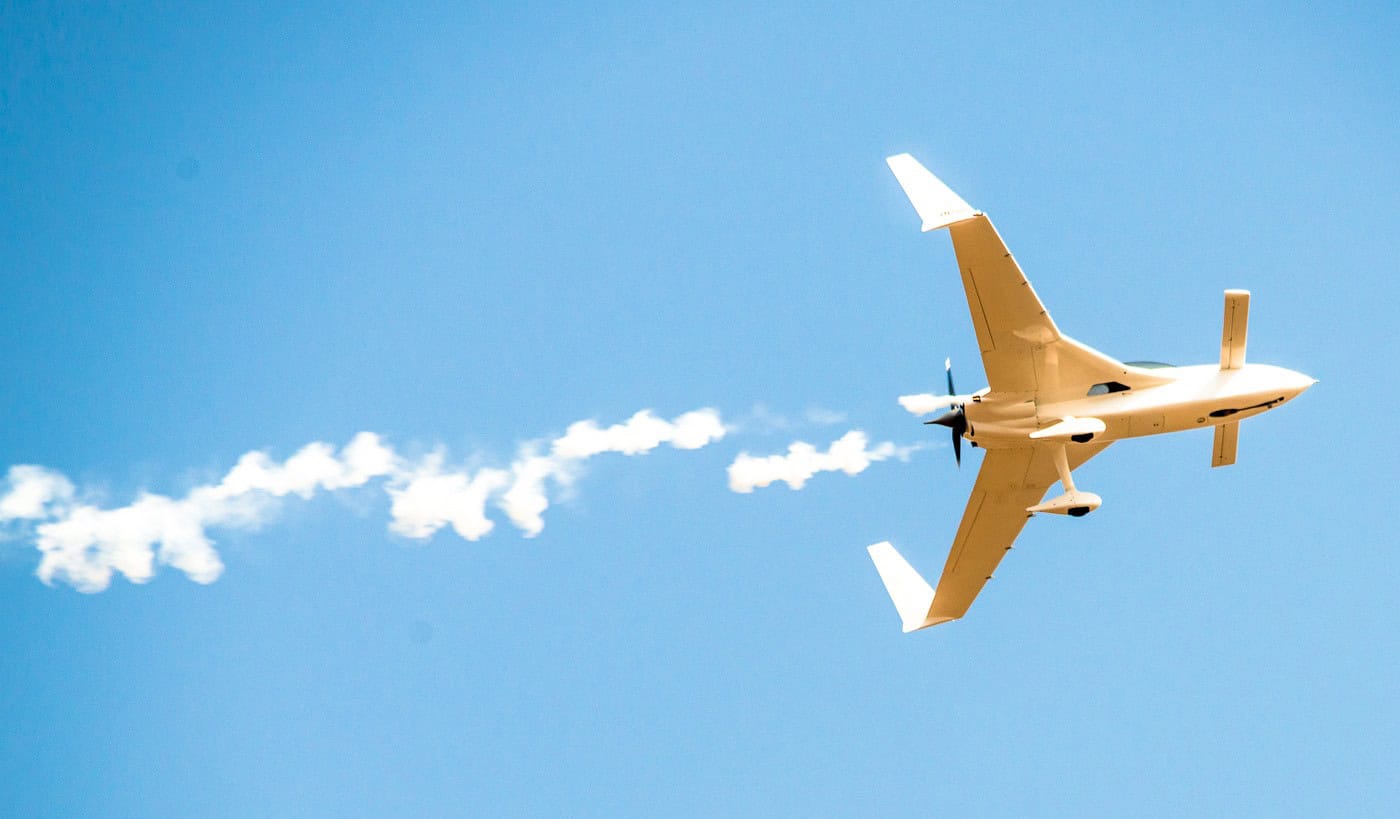
The Long-EZ is Burt Rutan’s two-seat canard design, sold as plans to home builders. The engine and propeller sit at the back, the small forward wing provides pitch control, and the two fuel tanks live in the wing roots, each holding 26 gallons (98 liters).

Denver’s example had been built from those plans by Adrian D. Davis Jr. and certificated as an experimental amateur-built aircraft in June 1987. It had about 850 hours on it and a fresh condition inspection, completed on September 20, 1997.
It was not quite the airplane on the plans. The builder had installed a 150-horsepower Lycoming O-320, where the operator’s manual called for a 100- or 115-horsepower engine. More important, he had moved the fuel selector handle.
Rutan’s drawings put the selector just aft of the nose-wheel window, between the pilot’s legs. This builder mounted the handle on the bulkhead behind the pilot’s left shoulder and connected it to a valve inside the engine firewall, 45 inches (114 cm) farther back, through steel and aluminum tubing and a universal joint.
He later told the next owner he did not want fuel in the cockpit.
The handle had no markings. Up was off, down was the right tank and to the right was the left tank, which is not an order anyone would guess. The fuel sight gauges were unmarked too, and they sat in the rear cockpit where the front-seat pilot could not see them.
Everyone involved knew the handle was a problem. On the day of the crash, Denver and the technician tried to extend it with a pair of vise-grip pliers, and he still could not reach it.
He said he would use the autopilot to hold the wings level if he needed to switch tanks in flight. The technician handed him an inspection mirror so he could read the gauges over his shoulder.
The checkout pilot had already arranged to relocate the handle while Denver was away on tour. That work never happened.
The flight itself was routine for 15 minutes. Three touch-and-goes, a straight-out departure, a transponder request answered. Then, over the shoreline at a few hundred feet, the engine lost power and the airplane rolled right into the water.
What the NTSB found
The probable cause, in the Board’s words, was “the pilot’s diversion of attention from the operation of the airplane and his inadvertent application of right rudder that resulted in the loss of airplane control while attempting to manipulate the fuel selector handle.”
The Board also found his “inadequate preflight planning and preparation, specifically his failure to refuel the airplane” causal. It named four contributing factors: the builder’s decision to put an unmarked handle in a hard-to-reach position, the unmarked fuel gauges, inadequate transition training and his lack of experience in the type.
Divers recovered the fuel valve. It was frozen in an intermediate position, between a third and a half open to the right tank and 2 to 4 percent open to the left, the tank the technician had read as less than a quarter full.
In an engine test cell, a Lycoming O-320 ran at full power with the valve set that way. When investigators uncapped the left-tank port to simulate an empty left tank drawing air, fuel pressure fell below half and the engine quit within seconds.
Investigators then sat in another Long-EZ to see what switching tanks demanded. It took four actions: take the right hand off the side stick, loosen the shoulder harness, rotate the upper body hard left, and turn an unmarked handle. Every time an investigator turned in the seat, his right foot pushed on the right rudder pedal to brace his body.
The wreckage showed no part failure before impact. The engine had no defects, the control linkages broke in overload, and feathers found in the debris matched a torn goose-down seat cushion, ruling out a bird strike.
The report also calculated the center of gravity at about 103.6 inches, slightly behind the published aft limit of 103 inches. Rutan’s company told the Board the prototype had been tested at 104 inches and flown at 106 with no adverse handling, and the CG does not appear among the causes or factors.
What most accounts get wrong
He did not simply run out of gas, and he was not drunk. The toxicology screen was negative for alcohol and every drug tested. By the NTSB’s fuel estimates several gallons were still aboard; its tests showed that a selector left partly open to an empty tank was enough to starve the engine, and the airplane was lost while he turned to fix it. He was also not a novice: he held an instrument rating and a Learjet type rating and reported 2,750 hours. He had about 2 hours in this airplane.
One part of the popular story is true. The report reproduces FAA letters showing the agency had found him not qualified for any class of medical certificate, because his certification had been conditional on total abstinence from alcohol. A November 1996 letter came back unclaimed, and a second went out in March 1997.
That part of the record is real, and the report lists his medical status as “unknown.” But it is not among the probable causes or contributing factors, and the toxicology rules out the drunk-pilot version entirely.
Why a few seconds of reaching back was enough
A Long-EZ does not handle like the trainers most pilots learn in. Its rudders only move outward, so pressing the right pedal swings the right rudder out like a drag brake. Scaled Composites told the Board the rudders are very effective, and that because the drag acts above the center of gravity, a push on the pedal pitches the nose up as well as yawing it.
Add a very strong spiral tendency and a side stick so sensitive that one eighth of an inch of movement starts a roll. A pilot turned 90 degrees in his seat, right foot braced on the pedal, has just commanded nose up and a roll to the right. That is exactly what the witnesses saw.
Time and height made it worse. When Scaled ran a tank dry on purpose, power took 6 to 8 seconds to come back after the switch. At 350 to 500 feet there is not much room for 8 seconds of distraction, and none for a spiral.
Experience does not transfer cleanly across that gap. Denver’s 2,750 hours were real, but in this airplane he had about 2 hours, after a half-hour checkout.
The NTSB’s term for what he lacked is transition training: specific instruction in an unfamiliar type’s systems and handling, as opposed to general flying skill. The same idea runs through our list of celebrity pilots, where holding a certificate and knowing a particular airplane are two different claims.
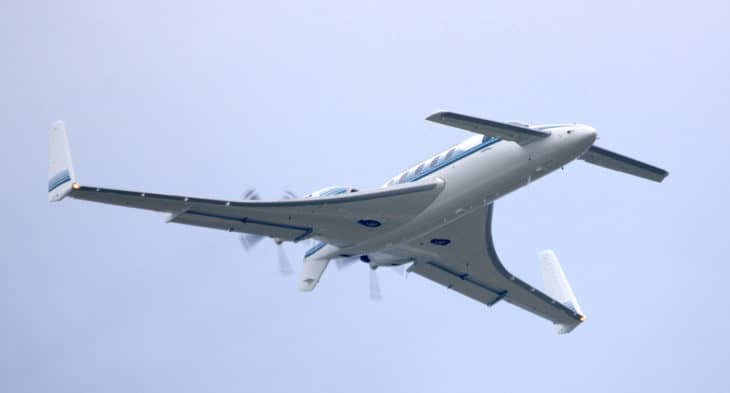
Rutan kept refining the canard layout. His company, Scaled Composites, built the 85-percent-scale proof-of-concept airplane for the Beechcraft Starship, a business turboprop built around the same canard layout.
What changed
Less than you might expect. The report notes that moving the selector “did not require FAA approval, nor did it require a placard” telling the next owner the airplane differed from the plans. That freedom is the point of the experimental amateur-built category, and it is also how a used airplane can reach a buyer with controls in places no manual describes.
The same pattern was still showing up 15 years later. In its 2012 safety study of experimental amateur-built aircraft, the NTSB found that 125 of the 227 such aircraft in 2011 accidents, 55 percent, had been bought used. Investigators found evidence of transition training for only 19 of those 227 pilots, a figure the Board said may understate the real number but called strikingly low.
The study’s recommendations to the FAA aimed at that gap. A-12-36 asked for transition training resources and incentives for buyers of used homebuilts to take it. A-12-37 asked the FAA to review an aircraft’s operating limitations and supporting documents whenever a homebuilt is registered or reregistered to a new owner.
The FAA’s own guidance, Advisory Circular 90-109, first issued in 2011 and revised as 90-109A in June 2015, now lays out how a pilot should transition to an unfamiliar or experimental airplane. It is advice, not a rule. Small airplanes remain where most of the risk sits, which is why most plane crash deaths in America happen outside the airlines.
FAQ
Sources and references used for research and fact-checking.
- National Transportation Safety Board, Aviation Investigation Final Report, LAX98FA008, Adrian Davis Long-EZ N555JD, Pacific Grove, California, October 12, 1997
- National Transportation Safety Board, Safety Recommendation letter A-12-28 through A-12-39, The Safety of Experimental Amateur-Built Aircraft
- National Transportation Safety Board, The Safety of Experimental Amateur-Built Aircraft (NTSB/SS-12/01)
- Federal Aviation Administration, Advisory Circular 90-109A, Transition to Unfamiliar Aircraft
- Wikipedia, Beechcraft Starship
Get the Newsletter
The latest aviation news and stories sent to your inbox.
About the Author

Tim is the owner and lead editor of AeroCorner since 2019, overseeing aviation content covering aircraft, airlines, airports, and the broader aviation industry. Through years of researching, writing, editing, and publishing aviation-focused content, he has developed extensive practical knowledge of commercial aviation and air travel. Based in Asia and a frequent traveler himself, Tim also brings firsthand passenger experience to AeroCorner’s coverage. Outside of publishing, he has also explored aviation firsthand through hands-on flight training in New Zealand.