

Table of Contents
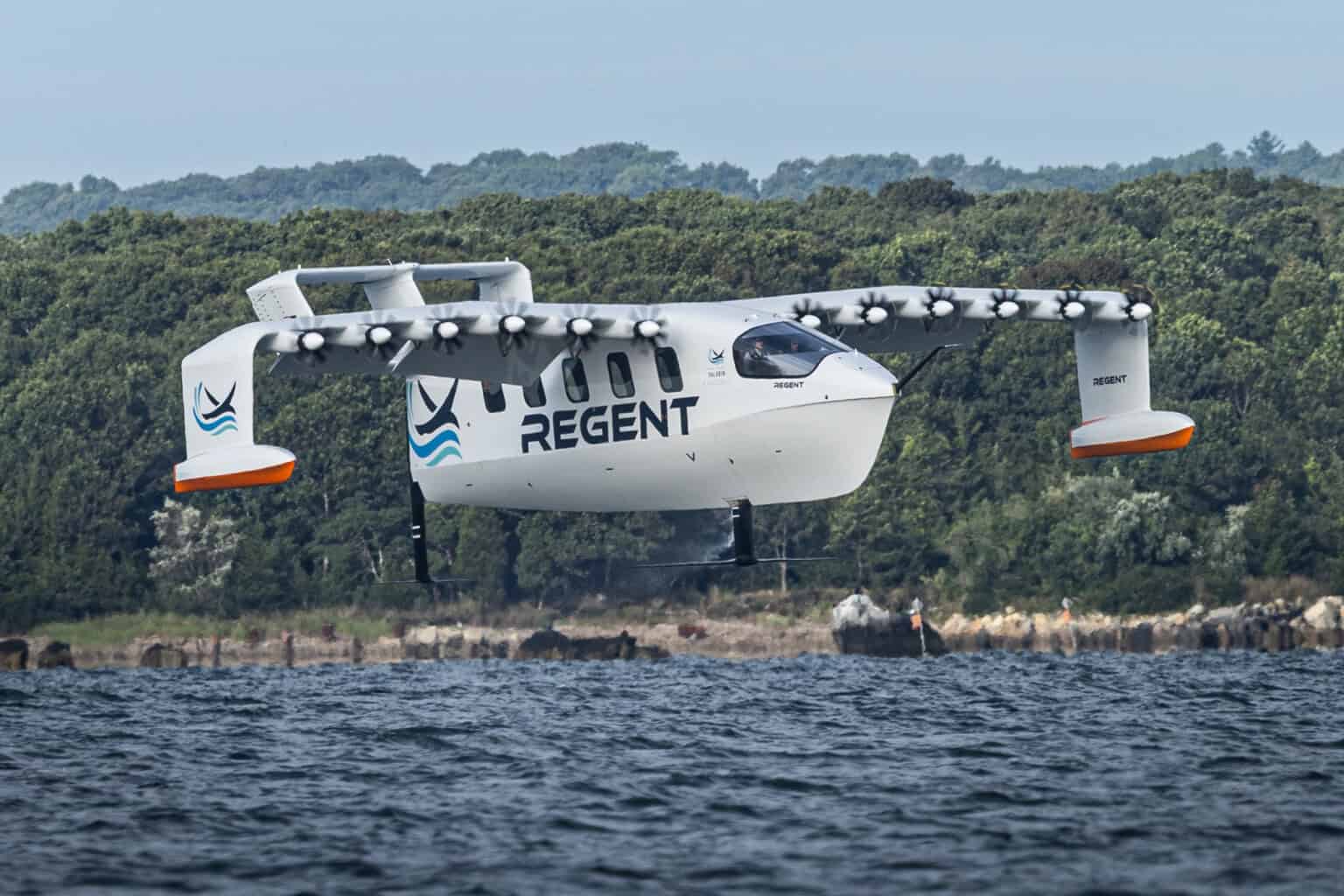
On September 2, 2026, a white, low-winged craft accelerated across Narragansett Bay in Rhode Island, rose onto a set of hydrofoils, and then lifted clear of the water. It flew for about 30 seconds, covering 1,956 feet (596 m) at a height of 33 feet (10 m).
The two people at the controls of REGENT’s Viceroy on that first crewed flight were not airline pilots. They were certified mariners, and the agency that cleared the test program was not the FAA but the U.S. Coast Guard.
That sounds like a branding trick. It is actually the newest chapter of an engineering and legal puzzle that goes back to a 302-foot Soviet giant Western analysts called the Caspian Sea Monster. Here is how these machines fly, why they disappeared, and why the law still has not fully decided what they are.
What Is an Ekranoplan?
An ekranoplan is a craft built to fly just above the water, usually within one wingspan of the surface, where a wing gets more lift for less drag than it does at altitude. The Soviet name stuck in popular use; regulators call the same idea a wing-in-ground-effect (WIG) craft, and REGENT markets its version as a seaglider.
The legal answer is shorter than you might expect. In the United States, a WIG craft is defined in law as a vessel, and one carrying a paying passenger is regulated by the Coast Guard as a small passenger vessel. The International Maritime Organization treats most of them as ships too.
But the popular line that a seaglider is legally not an aircraft goes too far. The federal definition of an aircraft is broad enough to cover it, the Coast Guard says its own authority is not exclusive, and Congress has ordered the FAA and the Coast Guard to put in writing who does what.
The answer at a glance
An ekranoplan, or WIG craft, flies in ground effect, usually within one wingspan of the water. US law defines it as a vessel and the Coast Guard leads its oversight, which is why the REGENT Viceroy is crewed by mariners. The federal definition of an aircraft still fits it, so Congress has told the FAA and the Coast Guard to split the job.
How Ground Effect Turns a Wing Into a Cushion
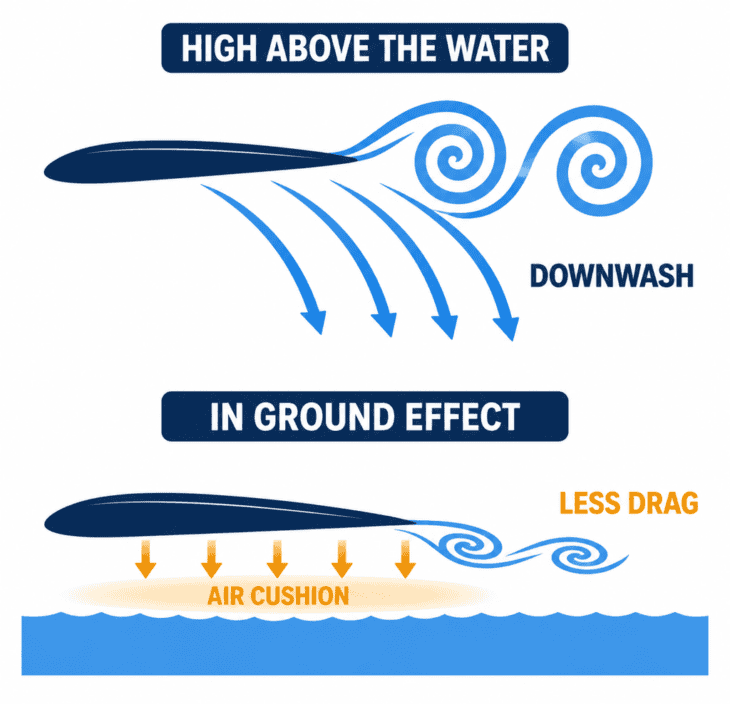
Every wing that makes lift also makes drag. Air spills around the wingtips from the high-pressure underside to the low-pressure top, forming swirling vortices and pushing the air behind the wing downward.
That downwash tilts the wing’s lift slightly backward, and the backward part is what engineers call induced drag. It is the price a wing pays for lifting anything at all.
Bring the wing close to a flat surface and the surface gets in the way. The tip vortices cannot fully form and the water pushes back against the downwash, so induced drag falls. The effect is similar to giving the wing a longer, slimmer shape, the high-aspect-ratio design that gliders and long-range wings use for the same reason.
The catch is how quickly the benefit fades with height. The FAA’s Pilot’s Handbook of Aeronautical Knowledge puts numbers on it: with the wing at a height equal to its span, induced drag drops by only 1.4 percent.
At a quarter of the span, the reduction is 23.5 percent. At a tenth of the span, it is 47.6 percent, nearly half the induced drag gone.
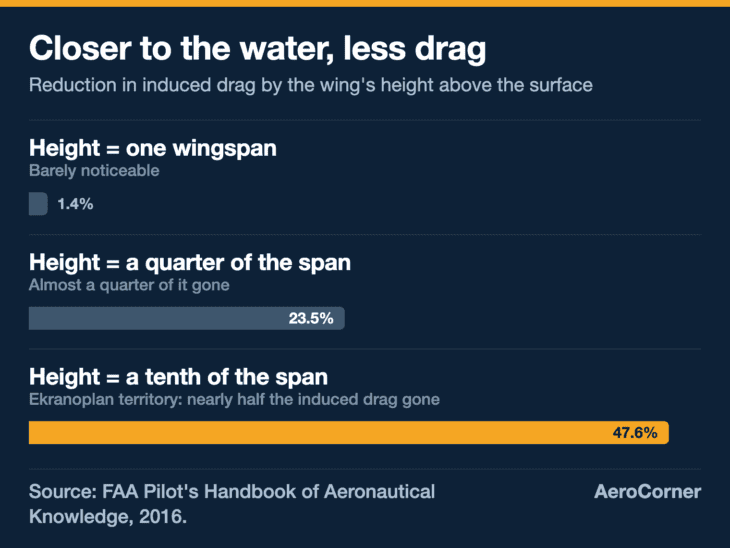
That is why pilots of ordinary airplanes only notice ground effect in the last few feet before touchdown, as a floating feeling in the flare. An ekranoplan is designed to live permanently inside that thin layer.
The Viceroy’s 65-foot (20 m) wing made its first crewed hop at 33 feet, about half its span. The Caspian Sea Monster, with a 123-foot (37.6 m) span, cruised as low as 13 feet (4 m), close to the one-tenth mark where the saving is biggest.
The Caspian Sea Monster, the Ship Nobody Could Classify
The idea’s great champion was Rostislav Alexeyev, a hydrofoil designer at the Central Hydrofoil Design Bureau in Gorky, today’s Nizhny Novgorod. His biggest creation, the KM, first flew on October 16, 1966, with Alexeyev himself at the controls.
The numbers were enormous for the era. The KM was 302 feet (92 m) long, weighed up to 1.2 million pounds (544,000 kg) at takeoff, and carried ten turbojets, eight mounted up front and two on the tail.
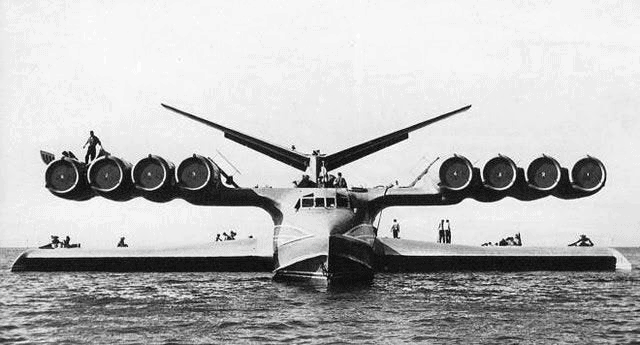
It cruised at 267 mph (430 km/h) at 13 to 46 feet (4 to 14 m) above the Caspian Sea. When CIA analysts found it in satellite photos in the late 1960s, they could not match it to any known aircraft or ship, and the nickname Caspian Sea Monster stuck.
The Soviets had already answered the classification question. KM stood for Korabl-Maket, roughly “ship prototype.” The craft belonged to the Soviet Navy as a vessel, and it was christened with champagne like one.
Two production designs followed. The A-90 Orlyonok, a troop carrier able to lift 150 soldiers, served with the Navy from 1979 to 1993, and only four were built, one of them for static testing.
The Lun-class MD-160 entered service in 1987 as a 242-foot (74 m) missile carrier armed with six P-270 Moskit anti-ship missile launchers. It cruised at 280 mph (450 km/h) about 8 feet (2.5 m) above the water, and it was the only one of its class ever completed.
October 16, 1966
The KM flies. Rostislav Alexeyev pilots the 302-foot prototype on its first flight.
1979
The Orlyonok enters service. The Soviet Navy’s troop-carrying ekranoplan; only four are built.
1980
The KM is lost. Pilot error puts it into the Caspian Sea. No one dies, and it is never recovered.
1984
The money stops. Defense minister Dmitriy Ustinov dies and his successor cancels the program’s funding.
1987
The Lun enters service. The only completed missile-carrying ekranoplan joins the Caspian Flotilla.
2018
IMO guidelines. The International Maritime Organization issues its WIG craft guidelines, replacing interim rules from 2002.
May 16, 2024
Congress steps in. The FAA Reauthorization Act gives the FAA and Coast Guard 24 months to divide oversight of WIG craft.
September 2, 2026
The Viceroy flies with crew. REGENT’s electric seaglider makes a 30-second hop over Narragansett Bay.
Why the Ekranoplans Died Out
Money was the immediate cause. Soviet defense minister Dmitriy Ustinov died in 1984, and his successor cut the program’s funding.
The engineering problems ran deeper. The two big ones were poor pitch stability and the need for reliable navigation at a height that leaves no margin for error.
A wing in ground effect changes its lift sharply as its height changes, so the nose wants to pitch every time the craft rises or sinks. The Soviet answer was a large tail mounted high, out of ground effect, working against the low main wing to hold the craft level.
Waves were the other enemy. Like a seaplane, a WIG craft has to get up on the step and race across the water to flying speed, and in a strong wind it must take off into the wind, pounding across one line of waves after another.
The KM was lost in 1980 when pilot error put it into the sea. The lone Lun left service in the late 1990s and, after a troubled tow from Kaspiysk, was hauled ashore near Derbent, Dagestan, on December 30, 2021, to become a museum piece.
What REGENT Changed
REGENT, whose name stands for Regional Electric Ground Effect Nautical Transport, goes after the old failure points one at a time. The Viceroy does not charge across the waves on its hull.
Instead it floats in the harbor, rises onto retractable hydrofoils as it speeds up, and only then lifts into ground effect. REGENT’s shorthand for the sequence is float, foil, fly.
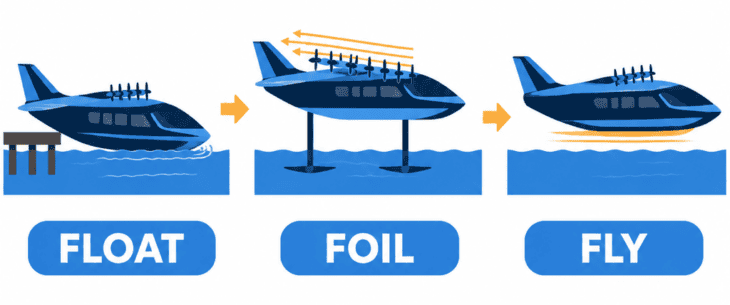
Hydrofoils have a limit of their own: run them too fast and bubbles form, cutting their lift. REGENT’s fix is a blown wing, a row of about a dozen electric motors along the leading edge that drive extra air over the wing so it makes lift while the craft is still moving slowly.
The stability problem goes to software. A triple-redundant fly-by-wire system controls pitch, roll and height automatically, instead of leaving it all to the crew and a giant tail.
The result is a far smaller machine. The Viceroy carries 12 passengers and two crew, and REGENT quotes a cruise of 180 mph (290 km/h) and a range of 180 miles (290 km). A 100-seat model, the Monarch, is in development.
REGENT is targeting its first commercial deliveries for 2027. Its customers include the U.S. Marine Corps Warfighting Lab, under a $15 million contract.
So Is a Seaglider a Boat or an Aircraft?
Start with U.S. law. Title 46 of the U.S. Code defines a wing-in-ground craft as a vessel that can operate completely above the water on an air cushion created by ground effect.
The same statute makes any WIG craft carrying even one passenger for hire a small passenger vessel, regardless of tonnage. That puts it under Coast Guard inspection, like any other small boat that carries paying passengers.
The navigation rules agree. They define a vessel as every description of water craft, “including non-displacement craft, WIG craft and seaplanes,” and they require a WIG craft taking off, landing or flying near the surface to show a high-intensity, flashing red all-round light.
Internationally, the IMO sorts WIG craft into three types. The line that matters is how high each one is allowed to climb.
| IMO type | What it is certified to do | Rules that apply |
|---|---|---|
| Type A | Operate only in ground effect | Maritime |
| Type B | Operate mainly in ground effect, climbing briefly to no more than 490 feet (150 m) for emergencies or obstacles | Maritime |
| Type C | As Type B, plus limited flight above 490 feet (150 m) for emergencies or obstacles | Maritime, plus ICAO aviation rules when flying as an aircraft |
REGENT keeps its seagliders within one wingspan of the water, which puts them on the maritime side of that line. In the U.S., the company says, they are run by licensed mariners who earn a seaglider-specific type rating, not by pilots.
Now the complication. Title 49, the aviation half of the code, defines an aircraft as “any contrivance invented, used, or designed to navigate, or fly in, the air.” A seaglider plainly flies in the air.
The Coast Guard has acknowledged the overlap. In a 2022 request for public comment on WIG craft, it wrote that its authority “is not exclusive” and does not stop the FAA from regulating these craft where FAA jurisdiction applies.
In July 2023, FlightGlobal reported that the FAA was still undecided on whether WIG craft count as aircraft. Congress then wrote Section 1114 into the FAA Reauthorization Act of 2024, signed on May 16, 2024.
It gave the FAA and the Coast Guard 24 months to sign a memorandum of understanding dividing the approval of designs, operations, crew training and certification, pilotage, inspection and maintenance. It covers WIG craft that can operate only in water or in ground effect over water, and only over U.S. waters.
That deadline fell in May 2026. We could not find a published copy of the agreement, and REGENT’s September 2026 flight announcement still names the Coast Guard as its U.S. regulator.
The Myth vs. the Reality
Myth: the Coast Guard has certified the seaglider as a boat
Not yet. In August 2024 the Coast Guard approved REGENT’s navigational safety risk assessment, which cleared crewed prototype testing on Narragansett Bay and Rhode Island Sound. Certification as a small passenger vessel is the path REGENT is on, with deliveries targeted for 2027.
The headline version also flattens the law. It is accurate to say US law defines a seaglider as a vessel and that the Coast Guard leads its oversight.
It is not accurate to say it is legally not an aircraft, full stop. A seaplane on the water is a vessel under the same navigation rules, and nobody thinks it has stopped being an airplane.
The better reading is that a WIG craft is both, and the law picks the regime that fits how it is used. Stay in ground effect over water and the maritime rules lead; climb out and fly like an airplane and aviation rules follow, which is exactly the split the IMO and ICAO agreed on.
The Soviets reached the same compromise 60 years ago. They built a 1.2-million-pound flying machine, called it a ship prototype, and handed it to the Navy.
So the next time you see footage of the Viceroy skimming Narragansett Bay, look at the height. Those 33 feet are not a limit the designers are apologizing for.
They are the whole trick: the layer where a wing sheds its drag, and the legal line that keeps a mariner, not a pilot, in the captain’s seat.
Sources and references used for research and fact-checking.
- REGENT, The future of maritime mobility takes flight: REGENT announces world's first human-crewed Seaglider flight
- New Atlas, REGENT Viceroy Seaglider achieves first crewed wing-in-ground effect flight
- REGENT, REGENT Frequently Asked Questions
- REGENT, Viceroy Seaglider
- AeroTime, Floating, foiling and flying: How does REGENT's electric seaglider work?
- REGENT, REGENT Receives U.S. Coast Guard Approval for Seaglider Prototype Testing
- Aviation International News, Regent Submits Seaglider Approval Plan to U.S. Coast Guard as Sea Trials Start
- Federal Aviation Administration, Pilot's Handbook of Aeronautical Knowledge, Chapter 5: Aerodynamics of Flight
- Wikipedia, Ground-effect vehicle
- Wikipedia, Caspian Sea Monster
- MiGFlug Afterburner, The Caspian Sea Monster That Spooked the CIA
- Wikipedia, Lun-class ekranoplan
- Wikipedia, A-90 Orlyonok
- Legal Information Institute, Cornell Law School, 46 U.S. Code 2101: General definitions
- Legal Information Institute, Cornell Law School, 49 U.S. Code 40102: Definitions
- Legal Information Institute, Cornell Law School, 33 CFR 83.03: Definitions (Rule 3)
- Legal Information Institute, Cornell Law School, 33 CFR 83.23: Power-driven vessels underway (Rule 23)
- U.S. Coast Guard, Federal Register, Use of Wing-in-Ground Craft in Logistical Support of Offshore Platform Operations
- U.S. Government Publishing Office, FAA Reauthorization Act of 2024 (Public Law 118-63), Section 1114
- U.S. Government Accountability Office, Federal Aviation Administration: Key Provisions in the 2024 Reauthorization Act and Related GAO Work
- FlightGlobal, But is it an aircraft? FAA undecided on critical question as Regent seeks seaglider guidance
- International Maritime Organization, Wing-in-Ground (WIG) craft
Get the Newsletter
The latest aviation news and stories sent to your inbox.
About the Author

Tim is the owner and lead editor of AeroCorner since 2019, overseeing aviation content covering aircraft, airlines, airports, and the broader aviation industry. Through years of researching, writing, editing, and publishing aviation-focused content, he has developed extensive practical knowledge of commercial aviation and air travel. Based in Asia and a frequent traveler himself, Tim also brings firsthand passenger experience to AeroCorner’s coverage. Outside of publishing, he has also explored aviation firsthand through hands-on flight training in New Zealand.