

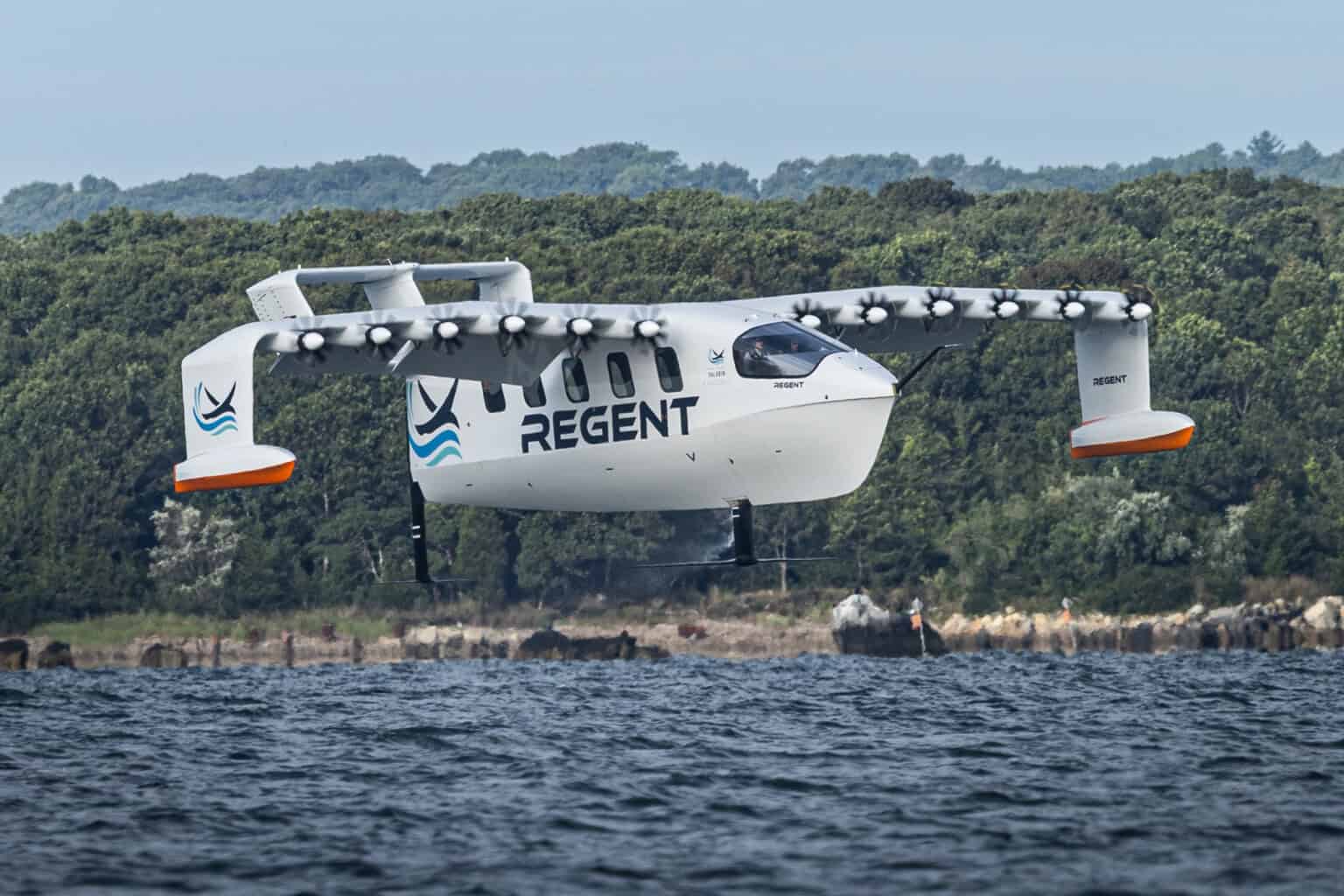
On September 2, 2026, REGENT flew its full-scale Viceroy seaglider with two people on board for the first time, a roughly 30-second hop covering 1,956 feet at about 33 feet (10 m) above Narragansett Bay in Rhode Island.
The Craft That Flew
The Viceroy is an all-electric vehicle built to carry 12 passengers and two crew, with about a dozen electric motors along its wing’s leading edge. REGENT says it works in three modes: floating on its hull at low speed, rising onto hydrofoils to clear waves, then lifting a wingspan above the water to fly.
The hop was short by design. REGENT wanted to show that the Viceroy could move cleanly from floating to foiling to flight with a crew managing it, then settle back onto the water.
The prototype flew under a triple-redundant digital fly-by-wire system that controls pitch, roll and altitude, according to reporting by New Atlas. Chief executive Billy Thalheimer called the flight “the moment we have been envisioning,” saying REGENT had proven “safe, efficient ground-effect flight.”
REGENT describes the flight as the final stage of the Viceroy prototype’s sea trials, with commercial deliveries targeted for 2027. The company demonstrated a quarter-scale seaglider on the same bay in 2022 and finished a 255,000-square-foot production plant in Quonset, Rhode Island, in June 2026.
Regulated as a Boat, Not an Aircraft
A seaglider never climbs more than a wingspan above the surface, so it rides on ground effect, a cushion of higher-pressure air trapped between a low wing and the water. That makes it far more efficient than free flight, but it also ties the vehicle to flat, open water.
Staying in ground effect lets an electric craft travel farther on a given battery than it could in normal flight, which is central to REGENT’s pitch. The trade-off is that a seaglider cannot fly over land or climb to cross terrain, so its usefulness depends on where the water routes are.
Because it stays that low, the Viceroy is treated as a maritime vessel rather than an aircraft. REGENT says it is regulated by the US Coast Guard, not the FAA, and is operated by licensed mariners who earn a type rating, a point emphasized in coverage by FlyingMag.
That sets the Viceroy apart from the vertical-takeoff air taxis several companies are racing to certify, and from the battery-powered aircraft now appearing at airshows, which take off and climb like conventional planes.
REGENT is aiming the Viceroy at short coastal routes, the sort of city-to-city water hops that seaplanes serve today, working from a harbor terminal rather than an airport.
The company reports a substantial order book. Its first US launch operator, The Twenty Five, has reserved up to 60 Viceroys, and REGENT holds a $15 million US Marine Corps Warfighting Lab contract and a research agreement with US Special Operations Command.
Still far from a ticket you can buy
A 30-second flight in ground effect is a long way from carrying paying passengers. The Viceroy’s 180-mile range and 180-mph cruise are design targets, no commercial route has been approved, and the 2027 service date is REGENT’s own projection.
Sources and references used for research and fact-checking.
Get the Newsletter
The latest aviation news and stories sent to your inbox.
About the Author

Tim is the owner and lead editor of AeroCorner since 2019, overseeing aviation content covering aircraft, airlines, airports, and the broader aviation industry. Through years of researching, writing, editing, and publishing aviation-focused content, he has developed extensive practical knowledge of commercial aviation and air travel. Based in Asia and a frequent traveler himself, Tim also brings firsthand passenger experience to AeroCorner’s coverage. Outside of publishing, he has also explored aviation firsthand through hands-on flight training in New Zealand.