

Table of Contents
The smallest plane ever flown is the Starr Bumble Bee II, a homebuilt biplane with a wingspan of 5 feet 6 inches (1.68 m) and a length of 8 feet 10 inches (2.69 m). Guinness World Records still lists it as the smallest aircraft to fly, even though it was destroyed in a crash in 1988.
Its wing is narrower than most adults are tall. The man who built and flew it, Robert H. Starr, had first flown a record-holding tiny plane 36 years earlier, and he flew four of the five smallest planes on this list.
This list ranks crewed airplanes by wingspan, the measure Guinness uses, as of September 2026. The first five were built for one purpose: being the smallest. The rest are the smallest planes that do a real job, from a twin-engine homebuilt to a jet fighter designed to ride inside a bomber.
| Rank | Aircraft | Wingspan | First flew | Known for |
|---|---|---|---|---|
| 1 | Starr Bumble Bee II | 5 ft 6 in (1.68 m) | 1988 | Guinness smallest aircraft to fly |
| 2 | Stits DS-1 Baby Bird | 6 ft 3 in (1.91 m) | 1984 | Guinness smallest monoplane |
| 3 | Starr Bumble Bee I | 6 ft 6 in (1.98 m) | 1984 | Smallest aircraft record, January to August 1984 |
| 4 | Stits SA-2A Sky Baby | 7 ft 2 in (2.2 m) | 1952 | Held the record for 32 years |
| 5 | Stits SA-1A Junior | About 8 ft 10 in (2.7 m) | Late 1940s | The first Stits record-chaser |
| 6 | Colomban Cri-Cri | About 16 ft (4.9 m) | 1973 | Smallest twin-engine crewed plane |
| 7 | Pitts Special S-1 | 16 ft 10 in to 17 ft 4 in (5.1 to 5.3 m) | 1944 to 1945 | Aerobatic champion |
| 8 | Bede BD-5J Microjet | 17 ft (5.2 m) | 1971 (BD-5) | Guinness smallest jet |
| 9 | McDonnell XF-85 Goblin | 21 ft 1 in (6.43 m) | 1948 | Jet fighter designed to ride inside a bomber |
| 10 | Folland Gnat F.1 | 22 ft 2 in (6.76 m) | 1955 | Lightweight fighter that saw combat |
| 11 | Douglas A-4 Skyhawk | 26 ft 6 in (8.08 m) | 1954 | Carrier jet too small to need folding wings |
How this ranking works
The measure is wingspan, the figure Guinness uses for its smallest-aircraft records. To qualify, a plane had to carry a pilot and actually fly: drones, models and paper designs are out, and so are helicopters. Past the record-chasers, this list takes only the smallest notable plane in each role (twin, aerobatic, jet, fighter, carrier jet) rather than every tiny homebuilt ever registered. Where a type came in versions of different sizes, the smallest documented flying example sets its place.
1. Starr Bumble Bee II
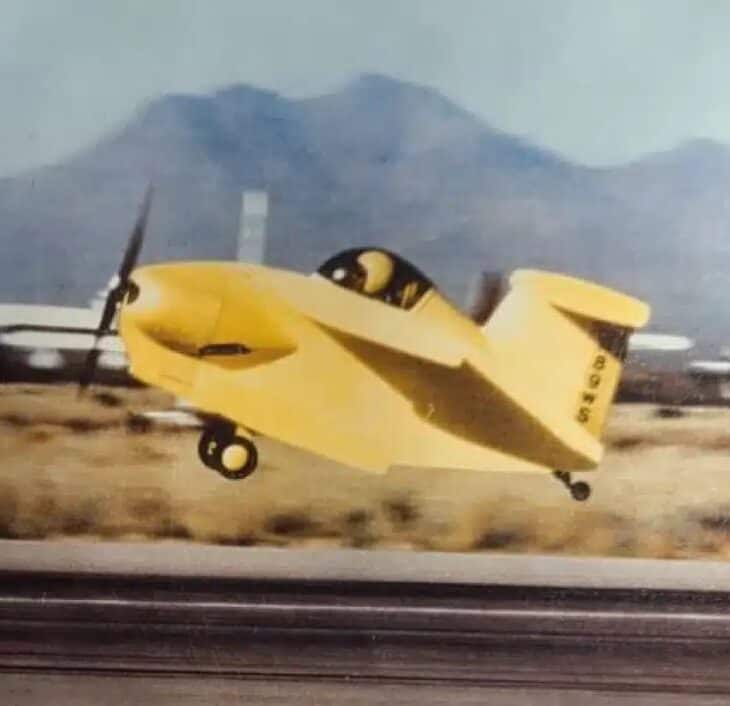
The Bumble Bee II is the smallest aircraft ever to fly, and Guinness says it “remains the smallest crewed aircraft by dimensions.” Its wingspan was 5 feet 6 inches (1.68 m), its length 8 feet 10 inches (2.69 m), and it stood 3 feet 11 inches (1.2 m) high.
It weighed 396 pounds (180 kg) empty and 573 pounds (260 kg) with Starr and fuel aboard. An 85-hp engine pulled it.
Starr first flew it on April 2, 1988, at Marana Airpark near Tucson, Arizona. Guinness calls it “extremely aerodynamically unstable,” and on May 5, 1988, it crashed, severely injuring Starr and destroying the airframe. Secondary accounts put the cause at an engine failure about 400 feet (120 m) up, on only its third flight.
The same pilot, 36 years apart
Robert Starr flew Ray Stits’s Junior at air shows and made the first flight of the Sky Baby, the plane that held the smallest-aircraft record from 1952. In the 1980s he built the Bumble Bee I and Bumble Bee II to take the title back, and flew both himself. Four of the five record-chasers on this list were flown by one man.
2. Stits DS-1 Baby Bird
_(7-29-2023).jpg)
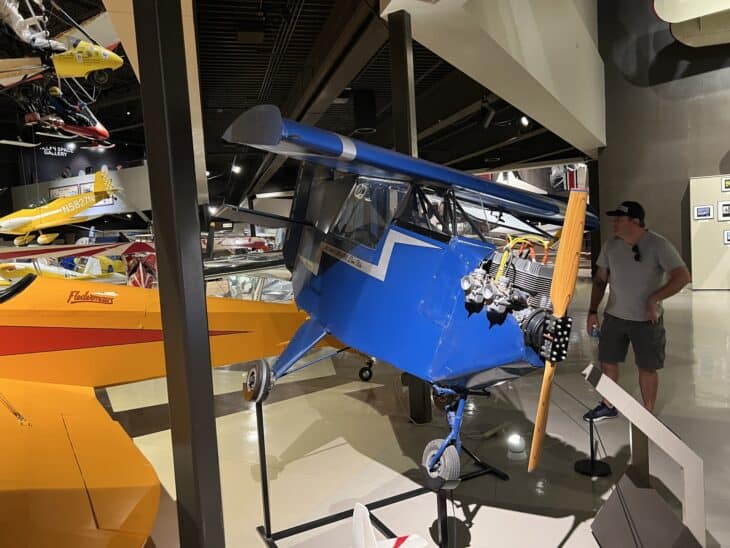
The Baby Bird is the smallest monoplane ever flown, a separate Guinness record it has held since 1984. Its wing spans 6 feet 3 inches (1.91 m), and at 11 feet (3.35 m) it is actually longer than both Bumble Bees.
Where it wins is weight. Guinness gives an empty weight of just 252 pounds (114.3 kg), and the EAA Museum lists a gross weight of 425 pounds (193 kg), so Guinness credits it as the smallest by takeoff weight among its record holders.
Donald R. Stits designed it in 1980. Retired Navy pilot Harold Nemer, whom the EAA describes as “of appropriate stature,” flew it in August 1984 at Camarillo, California, on a 55-hp two-cylinder Hirth engine.
Nemer made some 35 flights in it, and Stits donated it to the EAA museum in Oshkosh, Wisconsin, in 1989.
3. Starr Bumble Bee I
.jpg)
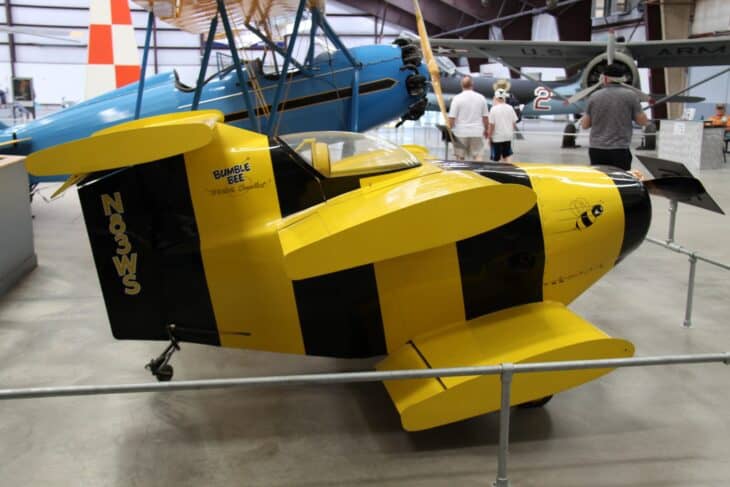
The first Bumble Bee flew on January 28, 1984, at Marana, Arizona, and Guinness credited it as the smallest aircraft ever flown. It held that title only until August, when the Baby Bird flew.
Rather than pick a winner, the record was split: Starr kept the smallest biplane and the Baby Bird took the smallest monoplane. That split explains why different websites name different “smallest planes.”
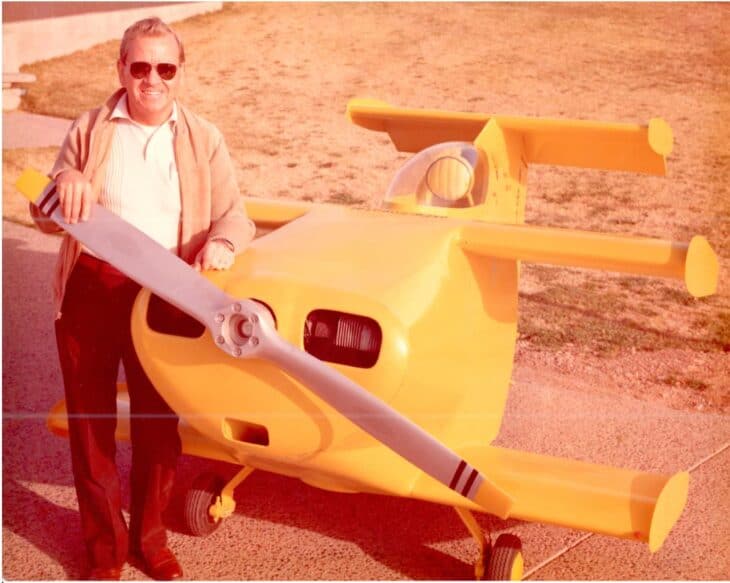
The Bumble Bee I has a 6 ft 6 in (1.98 m) wingspan, a 9 ft 4 in (2.84 m) length and an 85-hp Continental C-85, and the Pima Air & Space Museum lists its top speed as 180 mph (290 km/h). Starr donated it to the museum in Tucson in 1990, where it is still on display.
4. Stits SA-2A Sky Baby
.jpg)
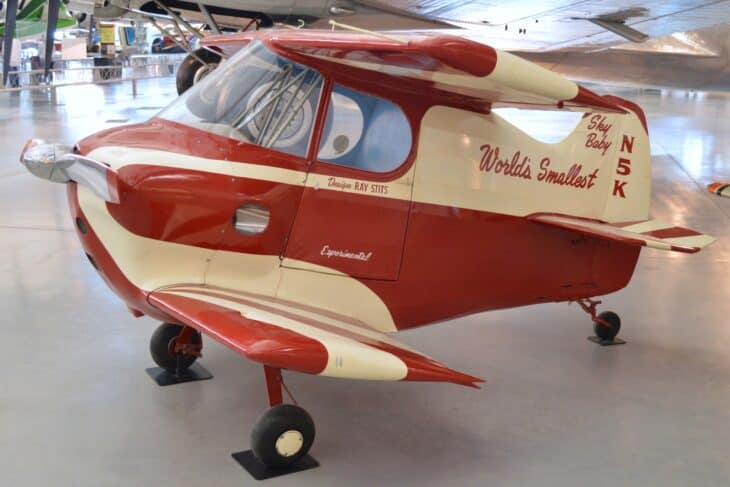
Ray Stits built the Sky Baby in 1952, and Robert Starr took it up on its first flight that spring. With a 7 ft 2 in (2.2 m) wingspan and a 9 ft 10 in (3.0 m) length, it held the record for the smallest aircraft flown from 1952 until 1984.
That is 32 years at the top, longer than any other record holder on this list. The Smithsonian notes that “no one disputed Stits’s claim until the 1980s.”
The Smithsonian gives an empty weight of 452 pounds (205.5 kg) and an 85-hp Continental engine. Stits donated it in 1972, and it is now on display at the Steven F. Udvar-Hazy Center in Chantilly, Virginia.
5. Stits SA-1A Junior
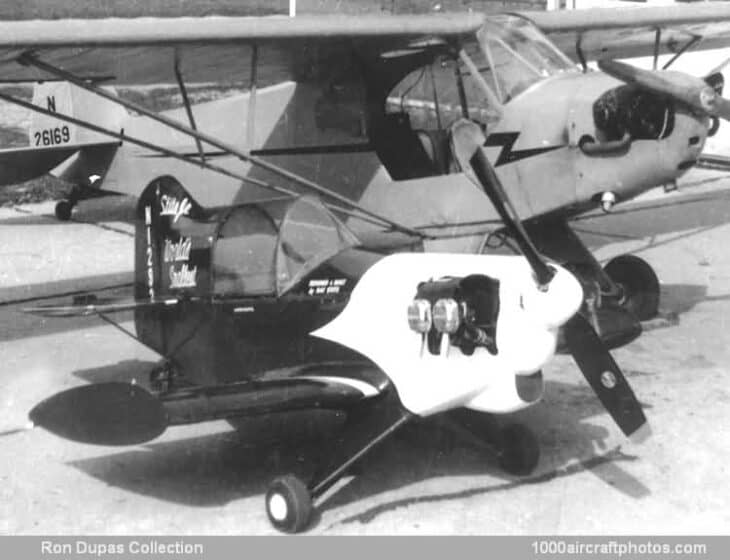
The Junior was Ray Stits’s first attempt at the world’s smallest plane, flown by Bob Starr and a hit at air shows in 1950. It is the least documented plane on this list, so treat its figures as approximate.
Stits reportedly shortened its wings to 8 ft 10 in (2.7 m) after early crashes, and other accounts give a span of between 8.8 and 9.3 feet. What happened to it afterward is unknown, and it may have been scrapped.
6. Colomban Cri-Cri
.jpg)
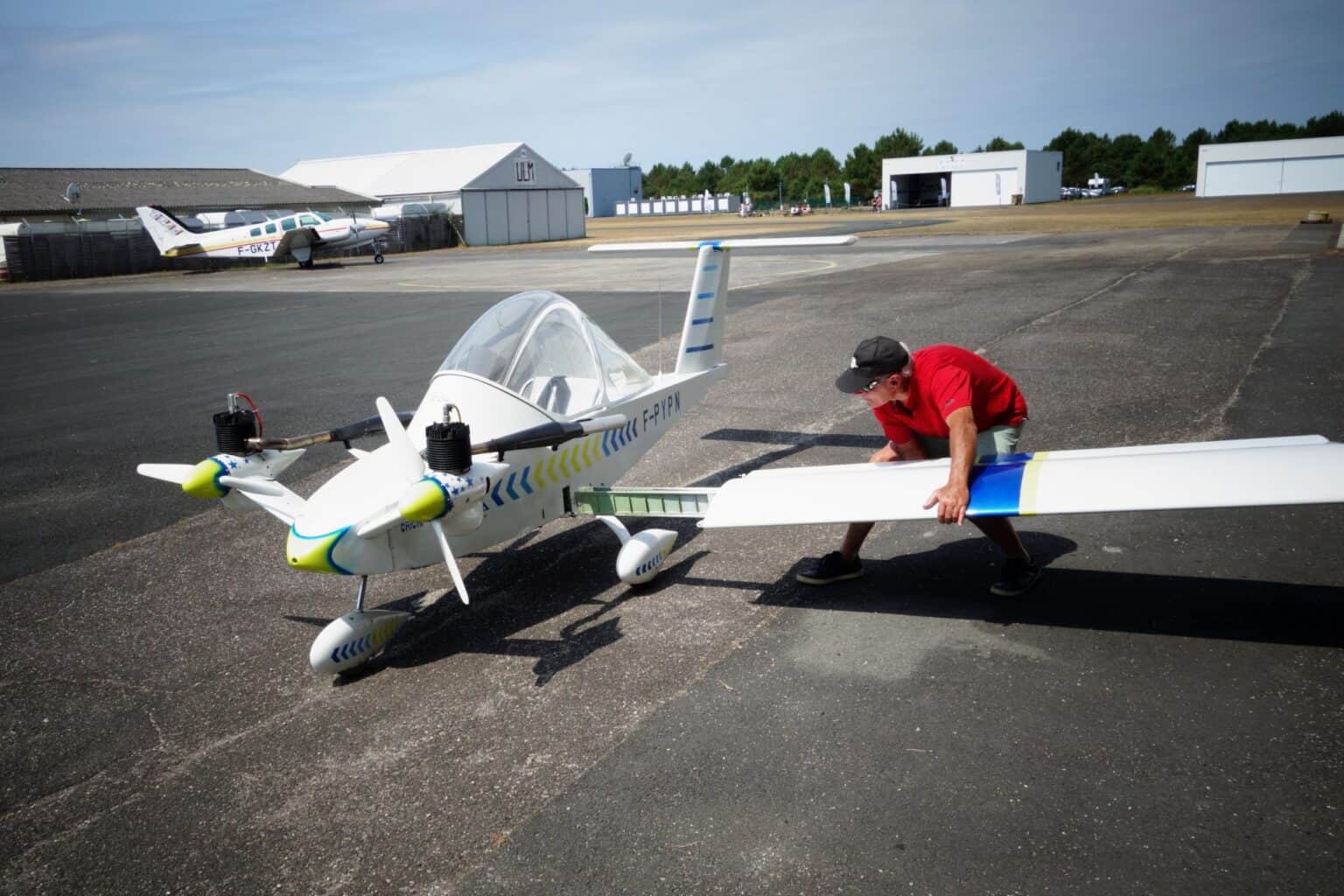
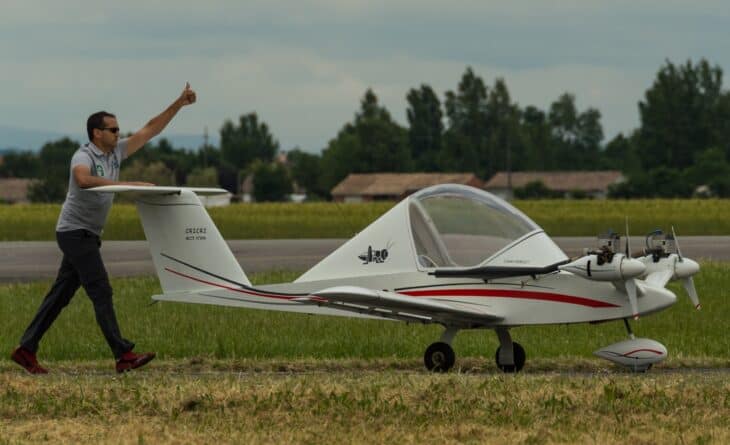
The Cri-Cri is widely described as the smallest twin-engine crewed aircraft in the world. French engineer Michel Colomban designed it in the early 1970s, and it first flew on July 19, 1973.
Its wing spans about 16 feet (4.9 m) and it is 12 ft 10 in (3.9 m) long. Two 15-hp single-cylinder engines sit on a short boom across the nose, just ahead of the canopy, and the Planes of Fame museum lists a top speed of 140 mph (225 km/h).
Colomban has sold several hundred sets of plans. Builders have since flown it on electric motors (an EADS demonstrator in September 2010) and on two small turbojets, a version Pilot magazine calls the world’s smallest twin-jet.
Nearly three times wider, and lighter
The Cri-Cri’s wing is almost three times the width of the Bumble Bee II’s, yet its maximum takeoff weight is only 375 pounds (170 kg). That is lighter than the Bumble Bee II empty, and lighter than the Baby Bird’s 425-pound gross weight.
7. Pitts Special S-1
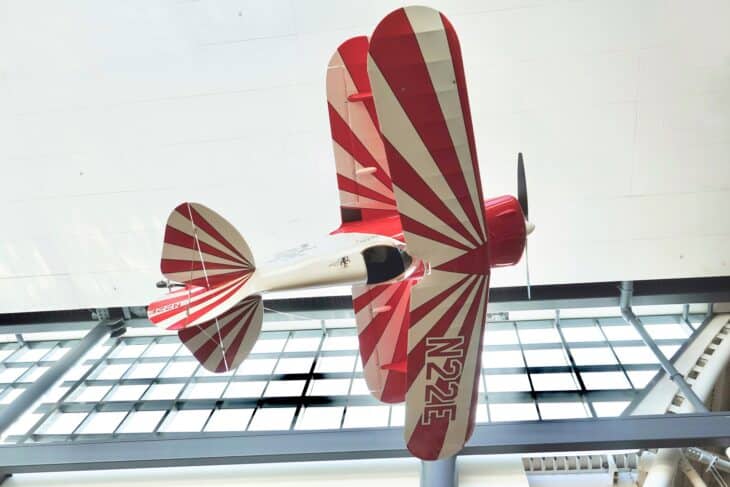

The Pitts Special S-1 is probably the smallest airplane most people have ever seen fly, because it is an air show regular. Curtis Pitts built the first one in 1944 and 1945, and the single-seat biplane became one of the best-known aerobatic planes in the world.
The oldest surviving Pitts, the second one Curtis Pitts built, is Betty Skelton’s “Little Stinker,” with a 16 ft 10 in (5.13 m) wingspan and an empty weight of 568 pounds (257 kg). Skelton won the 1949 and 1950 International Feminine Aerobatic Championships in it, and it is now displayed at the Smithsonian’s Udvar-Hazy Center.
The factory-built S-1S is slightly larger, with a 17 ft 4 in (5.3 m) upper wing and an empty weight of 720 pounds (326 kg), according to the Smithsonian.
8. Bede BD-5J Microjet
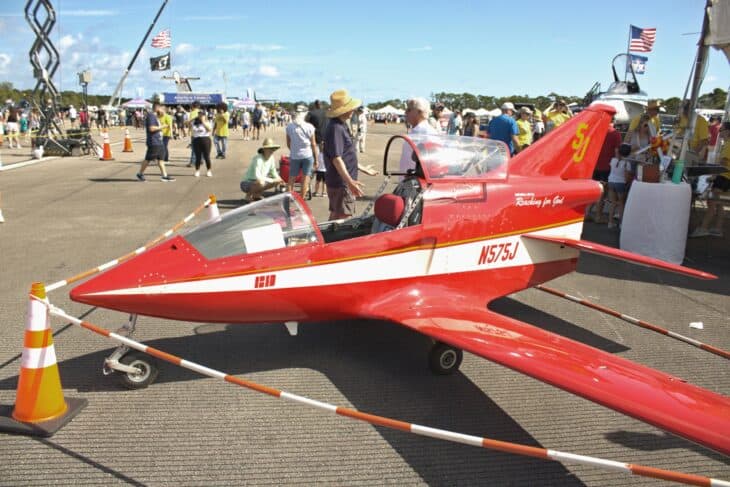
_(11-9-2024).jpg)
The BD-5J is the smallest jet aircraft in the world, according to Guinness. The record-holding example, a homebuilt owned by Juan Jimenez of San Juan, Puerto Rico, weighs 358 pounds (162 kg), is 12 feet (3.7 m) long and reaches 300 mph (483 km/h).
The wingspan is 17 feet (5.2 m). The Guinness page prints it as “5.7 m (17 ft),” but 17 feet is 5.2 meters, which is the figure the Museum of Flying and AOPA also give.
The jet grew out of Jim Bede’s propeller-driven BD-5 kit, which first flew on September 12, 1971. Bede sold the first kits for $2,100 and took orders for 4,000 by the end of that year, but his company went bankrupt in 1979, and the Smithsonian counts only about 150 BD-5s flying by 2002.
The BD-5 is one of the best-known kit planes ever sold. For how a kit plane differs from an ultralight, see our guide to ultralight vs kit aircraft.
You have probably seen one fly. In the opening of the 1983 James Bond film Octopussy, pilot J.W. “Corkey” Fornof flew a BD-5J through a hangar as Roger Moore’s double, and Bob Bishop later flew BD-5Js on the Coors Silver Bullet air show team.
9. McDonnell XF-85 Goblin
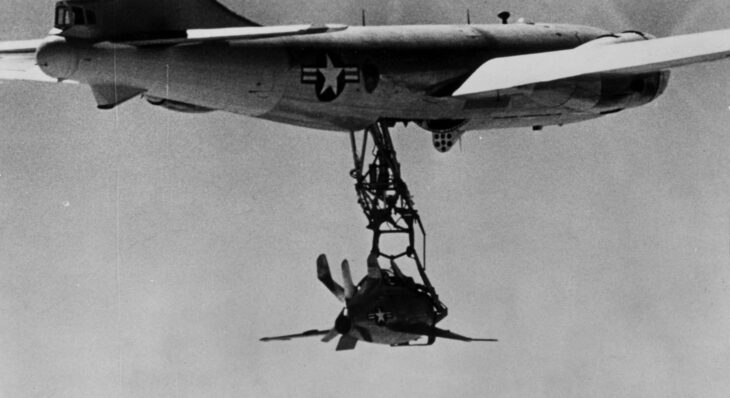

The XF-85 Goblin was a jet fighter designed to ride inside a Convair B-36 bomber’s bomb bay and drop out to defend it. That job set its size: a 21 ft 1 in (6.43 m) wingspan with wings that folded up, a length of 14 ft 10 in (4.52 m), and a loaded weight of 4,550 pounds (2,064 kg).
It had no landing gear at all, because it was meant to hook back onto its parent aircraft in flight. Test pilot Edwin Schoch made the first free flight on August 23, 1948, released from a modified B-29, and the Air Force claimed a top speed of 650 mph (1,046 km/h) from its 3,000-pound-thrust Westinghouse XJ34.
Hooking back on proved the problem. Only three of seven free flights ended with a successful hookup, and the National Museum of the US Air Force says about half of all Goblin flights ended in emergency landings on the ground.
No Goblin was ever carried by a B-36. The program ended in late 1949 after a total of two hours and 19 minutes in the air, and both prototypes survive: one at the Strategic Air Command museum in Ashland, Nebraska, the other at the Air Force museum in Dayton, Ohio.
10. Folland Gnat F.1
.jpg)
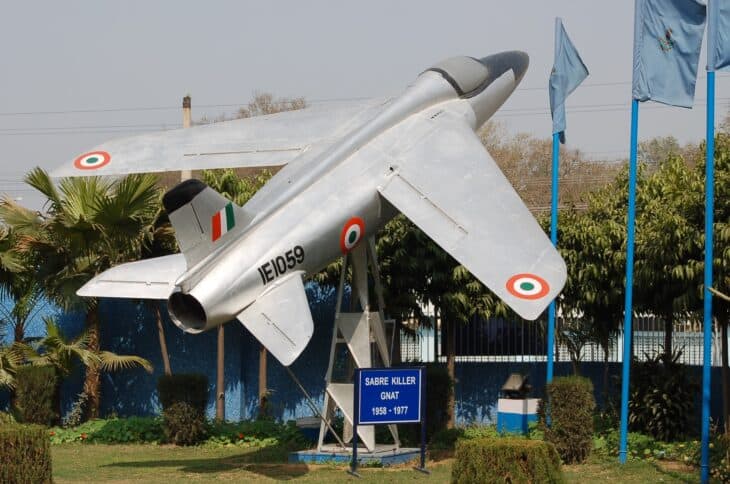
The Folland Gnat is a small fighter that actually fought. The single-seat Gnat F.1 first flew on July 18, 1955, with a 22 ft 2 in (6.76 m) wingspan and an empty weight of about 4,800 pounds (2,177 kg).
India flew it hardest. The Indian Air Force had five Gnat squadrons in the 1965 war with Pakistan and eight by 1971, and its clashes with Pakistan’s F-86 Sabres earned it the nickname “Sabre Slayer.”
The nickname runs ahead of the record: the independent history site IAF History judges six of India’s ten Sabre kill claims to be confirmed. In Britain, the RAF flew a slightly larger two-seat trainer, the Gnat T.1, and the Red Arrows flew red Gnats from 1965 until the end of the 1979 season.
Like most small fighters, it had a single engine; our list of single-engine fighter jets covers the ones flying today.
11. Douglas A-4 Skyhawk

The Douglas A-4 Skyhawk is the rare carrier jet small enough to skip folding wings. The Smithsonian gives its wingspan as 26 ft 6 in (8.08 m), and notes that “unlike most other carrier-based aircraft, the A-4, with its relatively small wingspan, does not have folding wings.”
Designer Ed Heinemann worked to the motto “simplicate and add lightness,” and the jet was sometimes called “Heinemann’s Hotrod.” It first flew on June 22, 1954.
It is the largest plane on this list, and it earns its place anyway. Its small delta wing eliminated the need for a heavy wing-folding mechanism, something most other carrier jets had to carry.
Can you see the world's smallest plane?
No. The Bumble Bee II was destroyed in its May 1988 crash, and no part of it is known to survive. The tiny biplane at the Pima Air & Space Museum in Tucson is its predecessor, the Bumble Bee I, which is a foot wider. The three smallest survivors are the Baby Bird at the EAA Museum in Oshkosh, the Bumble Bee I at Pima, and the Sky Baby at the Smithsonian’s Udvar-Hazy Center.
The Smallest Plane You Can Fly Without a License
None of the planes above can be flown legally without a pilot certificate. In the US, the smallest aircraft anyone can fly without one is an ultralight under FAA Part 103.
To qualify, it must carry a single occupant, weigh less than 254 pounds empty, hold no more than 5 US gallons of fuel, fly no faster than 55 knots at full power and stall at no more than 24 knots. The rule says operators need no “airman or medical certificates” and no minimum age or experience.
By empty weight alone, the 252-pound Baby Bird and the Cri-Cri would squeeze under that limit, but both fly far faster than 55 knots, so neither counts. Before buying one, check where ultralight aircraft can fly, because Part 103 also limits where they may go.
If you want something small with a proper cabin instead, our ranking of the smallest private jets covers the tiniest jets you can charter or buy.
FAQ
Sources and references used for research and fact-checking.
- Guinness World Records, Smallest aircraft to fly
- Guinness World Records, Smallest aircraft, monoplane
- Guinness World Records, Smallest aircraft, jet aircraft
- Pima Air & Space Museum, Starr Bumble Bee
- EAA Aviation Museum, 1983 Stits DS-1 Baby Bird, N4453H
- Smithsonian National Air and Space Museum, Stits SA-2A Sky Baby
- Wikipedia, Stits SA-1A Junior
- Aerospaceweb, What is the smallest airplane ever built?
- Planes of Fame Air Museum, Colomban MC-12 Cri-Cri
- Wikipedia, Colomban Cri-cri
- Pilot, Flight test: Colomban Jet Cri-Cri
- General Aviation News, All-electric Cri-Cri has maiden flight
- Smithsonian National Air and Space Museum, Pitts S-1C Special, Little Stinker
- Smithsonian National Air and Space Museum, Pitts S-1S Special
- Smithsonian National Air and Space Museum, Bede BD-5B
- Museum of Flying, BD-5J Microjet
- AOPA, James Bond jet takes on U.S. Air Force mission
- Air & Space/Smithsonian, The thrill of flying the world's smallest jet
- National Museum of the United States Air Force, McDonnell XF-85 Goblin
- Strategic Air Command & Aerospace Museum, XF-85 Goblin
- Air Force Test Center, August 23, 1948: XF-85 Goblin aircraft debuts
- Defense Media Network, The XF-85 Goblin: the parasite fighter that didn't work
- Newark Air Museum, Folland Gnat T.1 XR534
- Wikipedia, Folland Gnat
- Royal Air Force Museum, Hawker Siddeley Gnat T1
- IAF History, Sabre Slayer: the myth and reality of the Gnat
- Smithsonian National Air and Space Museum, Douglas A4D-2N (A-4C) Skyhawk
- eCFR, 14 CFR 103.1, Applicability
- eCFR, 14 CFR 103.7, Certification and registration
- Airbus, A318 Aircraft Characteristics
- Airbus, Airbus introduces A318 Elite
- Wikipedia, Airbus A318
Get the Newsletter
The latest aviation news and stories sent to your inbox.
About the Author

Tim is the owner and lead editor of AeroCorner since 2019, overseeing aviation content covering aircraft, airlines, airports, and the broader aviation industry. Through years of researching, writing, editing, and publishing aviation-focused content, he has developed extensive practical knowledge of commercial aviation and air travel. Based in Asia and a frequent traveler himself, Tim also brings firsthand passenger experience to AeroCorner’s coverage. Outside of publishing, he has also explored aviation firsthand through hands-on flight training in New Zealand.