

Table of Contents
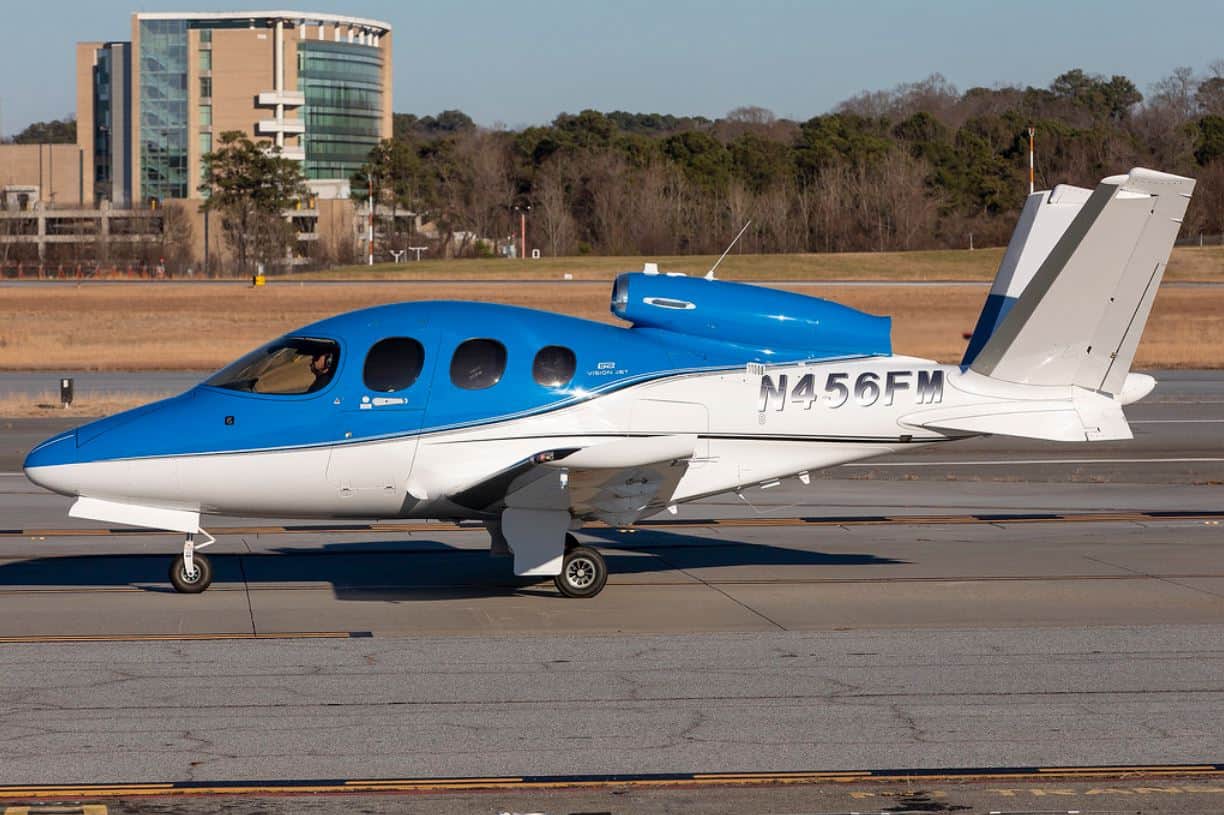
The smallest private jet you can buy is the Cirrus Vision Jet. It is 30.7 feet (9.4 m) long, weighs no more than 6,000 pounds (2,722 kg) at takeoff, and flies on a single engine.
Second is the twin-engine Eclipse 500 and its successor, the Eclipse 550, at 33 ft 5 in (10.2 m). After those two, there is a gap of more than 7 feet before the next jet, the Cessna Citation Mustang.
This list ranks certified private jets that were actually delivered to customers, shortest first, using the length on each jet’s type certificate or the maker’s spec sheet. Figures are current as of October 2026.
| Rank | Jet | Length | Max takeoff weight | Max occupants | Status |
|---|---|---|---|---|---|
| 1 | Cirrus Vision Jet G3 | 30.7 ft (9.36 m) | 6,000 lb (2,722 kg) | 7 | In production |
| 2 | Eclipse 500 / 550 | 33 ft 5 in (10.19 m) | 6,000 lb (2,722 kg) | 6 | 550 status unclear |
| 3 | Cessna Citation Mustang | 40 ft 7 in (12.37 m) | 8,645 lb (3,921 kg) | 6 | Ended 2017 |
| 4 | Embraer Phenom 100EX | 42 ft 1 in (12.82 m) | 10,703 lb (4,855 kg) | 8 | In production |
| 5 | Cessna Citation M2 Gen2 | 42 ft 7 in (12.98 m) | 10,700 lb (4,853 kg) | 7 to 8 | In production |
| 6 | HondaJet Elite II | 42 ft 7 in (12.99 m) | 11,100 lb (5,035 kg) | 8 | In production |
| 7 | Beechcraft Premier IA | 46 ft 0 in (14.02 m) | 12,500 lb (5,670 kg) | 8 | Ended early 2010s |
How this ranking works
Length is the measure, because it is what people mean by small and it is printed on every type certificate. Only jets that were certified and delivered to customers qualify. Where two jets tie on length, the lighter one ranks first. Prototypes, kit-built homebuilts and the light jets often mislabeled as small are covered separately below the ranking.
1. Cirrus Vision Jet: 30.7 feet

The Cirrus Vision Jet is the shortest certified private jet in service. Cirrus lists it at 30.7 feet (9.4 m) long with a 38.7-foot (11.8 m) wingspan, and its maximum takeoff weight is 6,000 pounds (2,722 kg).
It is also the only jet in this ranking with a single engine, a Williams FJ33 mounted on top of the rear fuselage. Cirrus calls it the “world’s first single engine Personal Jet”, and the program won the 2017 Collier Trophy.
The current G3 version, launched in February 2026, cruises at up to 317 knots (365 mph) and reaches 31,000 feet. Cirrus quotes a maximum range of 1,275 nautical miles (1,467 miles), though it does not publish the load behind that figure.
Small does not mean bare. A new third-row bench brings the cabin to seven seats, for six adults and a child, and every G3 carries both the Cirrus Airframe Parachute System and Safe Return Autoland, which can land the jet on its own if the pilot is incapacitated.
It has sold accordingly. Cirrus says it has delivered more than 700, and Aerotime put the G3’s base price at about $3.6 million at launch.
2. Eclipse 500 and 550: 33 feet 5 inches

The Eclipse 500 is the shortest twin-engine jet delivered to customers this century. It is 33 ft 5 in (10.2 m) long with a 37 ft 11 in (11.6 m) wingspan, and the Eclipse 550 that followed it uses the same airframe.
Its maximum takeoff weight is 6,000 pounds, exactly the Vision Jet’s, yet it carries two Pratt & Whitney Canada PW610F engines of 900 pounds of thrust each. The cabin is 50 inches high and 56 inches wide, and there is no lavatory.
The 550 cruises at up to 375 knots (432 mph). With four people aboard and standard NBAA IFR fuel reserves, Eclipse quotes a range of 1,125 nautical miles (1,295 miles). The jet seats six, counting the pilot.
The company behind it has had a rough ride. Eclipse Aviation halted production in October 2008 after building 260 EA500s, the program changed hands several times, and AML Global has owned it since late 2020.
In 2026, the fleet’s sole structural-parts supplier announced it was closing. General Aviation News counts about 200 EA500s and about 30 Eclipse 550s still flying, and whether new 550s are still being built is unclear.
3. Cessna Citation Mustang: 40 feet 7 inches


The Citation Mustang is Cessna’s entry to this list, and it is 40 ft 7 in (12.4 m) long with a 43 ft 2 in (13.2 m) wingspan. Its maximum takeoff weight is 8,645 pounds (3,921 kg).
It seats two crew and four passengers, and it is certified for a single pilot. Cessna quoted a maximum cruise of 340 knots (391 mph) and a range of 1,150 nautical miles (1,323 miles) with NBAA IFR reserves.
For a toilet, the Mustang has a chemical, non-flushing unit housed in a side cabinet, according to Business Jet Traveler. Cessna built about 475 before ending production in May 2017, so every Mustang today is a used aircraft.
Only three of these seven are very light jets
The National Business Aviation Association defines a very light jet as one weighing 10,000 pounds or less and certified for a single pilot. Only the Vision Jet, the Eclipse and the Mustang meet that line. The Phenom 100EX, Citation M2 and HondaJet all weigh 10,700 pounds or more at takeoff, so they count as light jets despite being among the smallest jets flying.
4. Embraer Phenom 100EX: 42 feet 1 inch

The Embraer Phenom 100 has been sold in four versions, the 100, 100E, 100EV and today’s 100EX. All of them share the same 42 ft 1 in (12.8 m) fuselage and a 40 ft 4 in (12.3 m) wingspan, according to its EASA type certificate.
The 100EX’s maximum takeoff weight is 10,703 pounds (4,855 kg), which puts it just over the very light jet line. Embraer quotes a cruise speed of 406 knots (467 mph) and a range of 1,178 nautical miles (1,356 miles) with four occupants and NBAA IFR reserves.
The cabin is 4 ft 11 in high and 5 ft 1 in wide, and Embraer lists up to eight occupants. A side-facing seat and a belted lavatory are part of the cabin layout.
5. Cessna Citation M2 Gen2: 42 feet 7 inches

The Citation M2 is the smallest Citation in Cessna’s current lineup. The Gen2 is 42 ft 7 in (13.0 m) long with a 47 ft 3 in (14.4 m) wingspan, the widest wing of any jet in this ranking.
It ties the HondaJet on length to within a fraction of an inch, so it takes fifth place on weight: 10,700 pounds (4,853 kg) at takeoff against the HondaJet’s 11,100 pounds. Cessna quotes a cruise of 404 knots (465 mph) and a ferry range of 1,550 nautical miles (1,784 miles).
The cabin is 57 inches high and 58 inches wide, a little smaller in both directions than the Phenom 100EX’s. Cessna’s own spec pages list seven or eight occupants, depending on which one you read.
6. HondaJet Elite II: 42 feet 7 inches

The HondaJet Elite II is 42.62 feet (13.0 m) long with a 39.76-foot (12.1 m) wingspan. At 11,100 pounds (5,035 kg), it is the heaviest of the jets that share that 42-foot class.
It is also the fastest of the first six jets in this ranking. Honda quotes 422 knots (486 mph) at 43,000 feet and a range of 1,547 nautical miles (1,780 miles) with four occupants and NBAA IFR reserves.
Its biggest small-jet selling point is in the back. Honda’s brochure describes a fully enclosed lavatory with ceiling skylights, something none of the three very light jets above offer. It seats up to eight, with one pilot and seven passengers.
7. Beechcraft Premier IA: 46 feet

The Beechcraft Premier IA is 46 ft 0 in (14.0 m) long with a 44 ft 6 in (13.6 m) wingspan. Its maximum takeoff weight is 12,500 pounds (5,670 kg), exactly the FAA’s upper limit for a small aircraft.
It is also the fastest jet in this ranking, with a high-speed cruise of 451 knots (519 mph) at 33,000 feet. Hawker Beechcraft quoted a range of 1,195 nautical miles (1,375 miles) with four passengers and NBAA IFR reserves.
Production ended when Hawker Beechcraft went through bankruptcy in the early 2010s, after fewer than 300 Premiers were built. That makes it the largest jet here and the one that sits closest to the light-jet class above.
Light jets that get called small, but are not
Plenty of lists of small private jets include aircraft that are a full size class bigger. Past about 50 feet, jets grow into a heavier, longer-range class, explained in our guide to the types of private jets.
The Citation CJ3 Gen2, at 51 ft 2 in (15.6 m) and 13,870 pounds (6,291 kg), is the shortest of them. The three below appeared in older versions of this article, and none of them is small.
Embraer Phenom 300E: 51 feet 4 inches
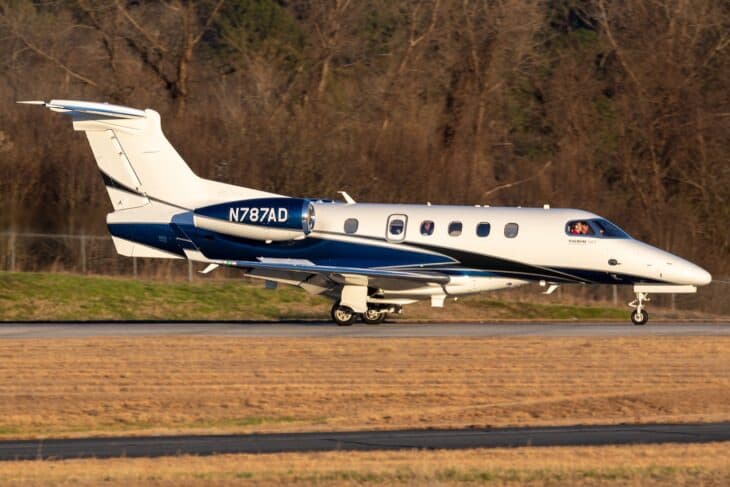
The Phenom 300E is 51 ft 4 in (15.7 m) long and weighs up to 18,551 pounds (8,415 kg), three times the Vision Jet. It cruises at 464 knots (534 mph) and flies 2,010 nautical miles (2,313 miles) with five occupants.
Cessna Citation CJ4 Gen2: 53 feet 4 inches

The Citation CJ4 is 53 ft 4 in (16.3 m) long, with a maximum takeoff weight of 17,110 pounds (7,761 kg) and up to 10 passengers. Cessna quotes 451 knots (519 mph) and a ferry range of 2,165 nautical miles (2,491 miles).
Bombardier Learjet 45XR: 58 feet 4 inches

The Learjet 45XR is 58 ft 4 in (17.8 m) long on its type certificate and weighs up to 21,500 pounds (9,752 kg). It also needs two pilots, which puts it in a different market from the owner-flown jets above.
Bombardier delivered the last Learjet of any model in March 2022. The first Learjet, the 1963 Learjet 23, was 43 ft 3 in (13.2 m) long, and no later Learjet was shorter.
Smaller jets that never reached customers
Several companies tried to build a private jet smaller or cheaper than the Vision Jet and Eclipse. None of these was ever certified, so none can be bought new.
Stratos 714 and 716X

Stratos Aircraft of Redmond, Oregon, first flew its single-engine 714 prototype on November 21, 2016. It was 35 ft 10 in (10.9 m) long, between the Eclipse and the Mustang in size.
Stratos then stretched the cabin by 31 inches (79 cm) for the six-seat 716X, which first flew on July 2, 2020. The design remains uncertified, and public news of the program dried up after 2021.
Eclipse 700

The Eclipse 700 was One Aviation’s planned follow-up to the 550, with a fuselage stretched by 14 inches (36 cm) and a longer wing. The new wing flew on a modified Eclipse 550 in 2017.
One Aviation filed for Chapter 11 bankruptcy in October 2018, still promising to develop the 700, and the case was converted to liquidation in 2021. The jet was never certified.
Diamond D-Jet and Piper Altaire
The single-engine Diamond D-Jet first flew in 2006 and measured 35 ft 1 in (10.7 m). Diamond suspended the program for lack of funding in 2013, and it has never been certified.
Piper’s single-engine PiperJet first flew in 2008 and was redesigned as the Altaire in 2010. Piper suspended it indefinitely in October 2011, saying the market for light jets was not recovering.
What about the BD-5J, the world's smallest jet?
The Guinness record for the smallest jet aircraft belongs to the Bede BD-5J Microjet, a single-seat kit-built jet about 12 feet (3.7 m) long that weighs 358 pounds (162 kg). Guinness measures the record by weight, not length. It is a homebuilt sport plane with room only for the pilot, not a private jet you can charter or buy new, which is why it sits outside this ranking.
The BD-5J and other record-setting tiny aircraft are ranked in our list of the smallest planes in the world. For the other end of the scale, see the biggest private jets.
Which small private jet is right for what
If shortest is the goal, the Vision Jet wins outright, and it is the only jet in this ranking with a whole-airframe parachute. If you want two engines in the smallest package, that is the Eclipse, though its parts supply is now the real question for any buyer.
If a proper bathroom matters, the HondaJet’s fully enclosed lavatory is the one to look at. If price matters most, our list of the least expensive private jets compares what each costs to buy.
FAQ
Sources and references used for research and fact-checking.
- Cirrus Aircraft, Vision Jet
- EASA, Type Certificate Data Sheet IM.A.615, Cirrus SF50
- Aerotime, Cirrus Vision Jet G3 launch
- Eclipse Aerospace, Eclipse 550 specifications
- EASA, Type Certificate Data Sheet IM.A.171, Eclipse 500
- General Aviation News, Eclipse jet parts supplier closing
- AIN, Smoother sailing for Eclipse with AML at the helm
- Wikipedia, Eclipse 500
- EASA, Type Certificate Data Sheet IM.A.502, Cessna 510
- Airframer, Textron Citation Mustang release, 2010
- Business Jet Traveler, Cessna Citation Mustang
- Embraer, Phenom 100EX brochure
- EASA, Type Certificate Data Sheet IM.A.157, Embraer EMB-500
- Textron Aviation, Citation M2
- Honda, HondaJet performance and specifications
- Honda Aircraft Company, HondaJet Elite II brochure
- EASA, Type Certificate Data Sheet IM.A.352, HondaJet HA-420
- EASA, Type Certificate Data Sheet IM.A.073, Beechcraft 390
- Hawker Beechcraft, Premier IA performance
- AIN, Legacy tails: the Premier stands outside its time
- Textron Aviation, Citation CJ3 Gen2
- Textron Aviation, Citation CJ4 Gen2
- Embraer, Phenom 300E brochure
- EASA, Type Certificate Data Sheet IM.A.282, Embraer EMB-505
- EASA, Type Certificate Data Sheet IM.A.020, Learjet 45
- AIN, Bombardier delivers final production Learjet
- This Day in Aviation, Learjet 23
- NBAA, VLJ training guidelines
- Cornell Legal Information Institute, 14 CFR 1.1, General definitions
- Wikipedia, Stratos 714
- AOPA, Stratos 716X light jet: a roomier 714
- Flying, Stratos Aircraft debuts 716X
- AVweb, Eclipse EA700 first flight
- AOPA, Eclipse wing passes flight test
- AIN, One Aviation enters Chapter 11 restructuring
- Wikipedia, Eclipse 550
- Wikipedia, Diamond D-Jet
- AIN, Diamond Aircraft restructures, suspends D-Jet again
- Wikipedia, Piper PA-47 PiperJet
- AOPA, Piper suspends Altaire jet program
- Guinness World Records, Smallest aircraft (jet)
Get the Newsletter
The latest aviation news and stories sent to your inbox.
About the Author

Tim is the owner and lead editor of AeroCorner since 2019, overseeing aviation content covering aircraft, airlines, airports, and the broader aviation industry. Through years of researching, writing, editing, and publishing aviation-focused content, he has developed extensive practical knowledge of commercial aviation and air travel. Based in Asia and a frequent traveler himself, Tim also brings firsthand passenger experience to AeroCorner’s coverage. Outside of publishing, he has also explored aviation firsthand through hands-on flight training in New Zealand.