


Table of Contents
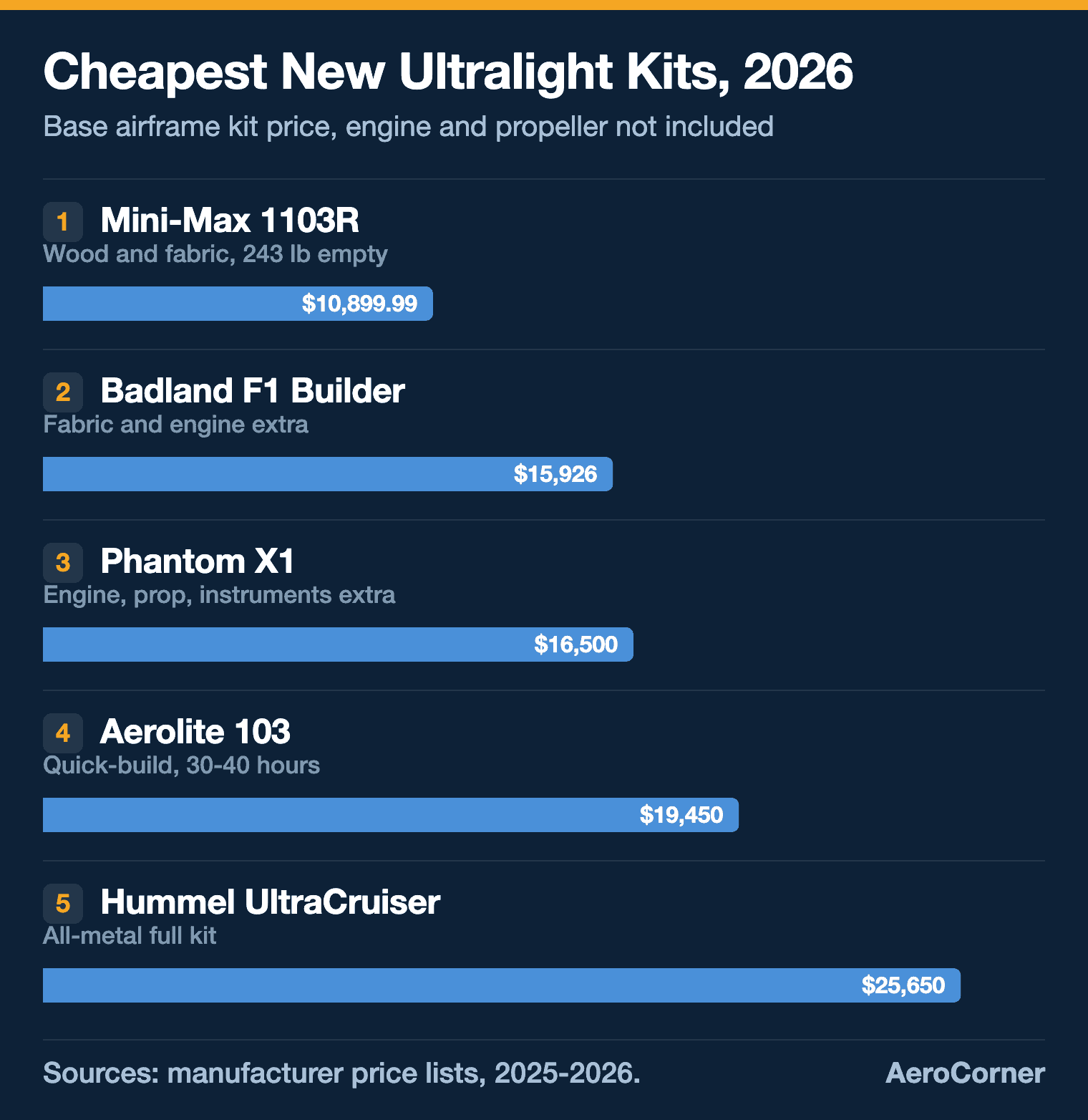
The cheapest new ultralight aircraft in 2026 is the Mini-Max 1103R, a single-seat wood-and-fabric kit that Mini-Max USA lists at $10,899.99 for the airframe. Its maker puts a finished, ready-to-fly example at about $22,500.
This list ranks five kits that are sold new today, are marketed as FAA Part 103 ultralights or can be built as one, and publish a price. The measure is the base airframe kit price, because it is the one figure every maker states the same way. Prices were checked on the manufacturers’ own pages on October 21, 2026.
The headline price is never the whole ultralight plane price. An engine, propeller and instruments add thousands, so each entry below also gives the cheapest published route to a flying aircraft.
| Rank | Aircraft | Base kit price | Getting it flying | Empty weight |
|---|---|---|---|---|
| 1 | Mini-Max 1103R | $10,899.99 | About $22,500 ready to fly (maker’s estimate) | 243 lb (110 kg) |
| 2 | Badland F1 Builder | $15,926 | Add $2,000 to $6,500 for engine parts, plus fabric | 254 lb (115 kg) |
| 3 | Phantom X1 | $16,500 | Factory quote for a complete aircraft | 254 to 350 lb (115 to 159 kg) |
| 4 | Aerolite 103 | $19,450 | $26,854 with the Hirth F-33 engine package, before the propeller | 235 lb (107 kg) |
| 5 | Hummel UltraCruiser | $25,650 | About $30,000 all in, owner’s estimate | 252 lb (114 kg) |
How this ranking works
Ranked by the published price of the base airframe kit, new, in US dollars, as listed on October 21, 2026. Only single-seat aircraft marketed as FAA Part 103 ultralights, or buildable as one, qualify. Makers that quote prices only on request, kits whose price is being reworked, and prices last posted years ago are covered below the ranking instead of inside it.
What makes an aircraft an ultralight (and why it keeps prices low)
An ultralight is defined by 14 CFR Part 103, a short FAA rule with hard limits. A powered ultralight carries one person, for sport or recreation only, and weighs less than 254 pounds (115 kg) empty, not counting floats or a ballistic parachute.
It can hold no more than 5 US gallons (19 liters) of fuel. It cannot be capable of more than 55 knots, about 63 mph (102 km/h), at full power in level flight, and its power-off stall speed cannot exceed 24 knots.
Stay inside those limits and Part 103 asks for no pilot certificate, no medical, no registration and no airworthiness certificate. That is why an ultralight costs a fraction of a certified airplane: there is no certification bill to pay.
The trade-off is where you can fly. Ultralights fly between sunrise and sunset, never over congested areas, and need ATC permission for controlled airspace around airports, all covered in our guide to where ultralight aircraft can fly.
1. Mini-Max 1103R: $10,899.99
The 1103R is the cheapest new Part 103 kit with a current, published price. Mini-Max USA, which builds in Niles, Michigan, lists the base kit at $10,899.99, with plans alone at $299.99 for builders who want to make their own parts.


It is an open-cockpit, mid-wing single-seater built from wood and fabric. Mini-Max lists a 243-pound (110 kg) empty weight, a 5-gallon tank, a 55 mph cruise and a 26 mph clean stall speed.
The catch is time. The base kit takes 250 to 300 hours to build, and prefabricated wing ribs and metal parts raise the kit to $11,899.99 while cutting the build to 175 to 225 hours.
Engines are extra. The options are the Hirth F-33, the Polini Thor 202, 260 and 303 and the Simonini Mini 3, and Mini-Max USA sells the Polini Thor 202 at a $3,459.99 sale price as of October 2026.
Mini-Max’s own ready-to-fly estimate for the 1103R is $22,499.99. Its siblings cost a little more: the 1030R MAX-103 kit is $11,499.99 and the high-wing 1703R Hi-Max Ultralight is $12,499.99.
The weight limit is checked on the finished aircraft
Mini-Max says Part 103 eligibility depends on the completed weight, equipment and workmanship, and that each finished aircraft must be weighed. The 1703R Hi-Max is listed at 253 pounds empty, one pound under the limit, so a heavy paint job or an extra instrument can turn an ultralight into an aircraft that needs registration and a pilot certificate.
2. Badland F1 Builder: $15,926
Badland Aircraft sells one airframe in five levels of completion, and the F1 Builder is the cheapest. It starts at $15,926, with the firewall-forward parts and fabric not included, and takes about 375 hours to build.

Badland’s FAQ says to budget another $2,000 to $6,500 for the engine and propeller. Its spec sheet lists a 39 hp Polini Thor 303, a 254-pound (115 kg) standard empty weight without the rescue parachute and a 54 mph cruise at 75 percent power.
Paying more buys back build time. The F2 Quick Build is $18,531 and about 250 hours, the F3 Almost Ready to Fly starts at $26,271 and about 80 hours, and the ready-to-fly F4 Flyer starts at $35,925.
Badland’s wings fold, which matters for anyone who plans to keep the aircraft in a garage or trailer rather than pay for a hangar. The company runs a production waitlist, so ask about delivery time before you budget around a date.
3. Phantom X1: $16,500
The Phantom X1 is a high-wing single-seater built in Three Rivers, Michigan, since the 1980s. Phantom’s May 2025 price sheet lists the airframe kit at $16,500, and Pilot Institute puts typical assembly at about 40 hours.
Phantom Aeronautics says its kit pricing covers the airframe only, everything but the engine, instruments and propeller, and quotes complete aircraft on request.
Only the lightest build is an ultralight. Phantom lists the X1 at 254 to 350 pounds empty and says it can be built as an ultralight, a light-sport aircraft or an experimental amateur-built aircraft, so a Part 103 X1 needs a light engine and few options.
Check the engine before you buy. Phantom says new Rotax 447 and 503 engines are no longer available, and it now points builders to Hirth engines instead, which changes the price of the finished aircraft.
4. Aerolite 103: $19,450
The Aerolite 103 is among the quickest kits on this list to finish. U-Fly-It sells the complete quick-build airframe for $19,450, and says a first-time builder needs about 30 to 40 hours.


Engine packages are priced separately, from $7,404 for the 28 hp Hirth F-33 to $16,623 for the 50 hp Hirth F-23. With the cheapest package, the kit costs $26,854 before the propeller, instruments and shipping.
U-Fly-It lists the Part 103 configuration at 235 pounds (107 kg) empty, with a 5-gallon tank and a 63 mph top speed. A dealer will assemble the kit for $4,000 if you would rather not build it yourself.
There is also an electric version, the Aerolite EV-103, with 20 to 40 minutes of flight depending on how many battery packs are fitted. U-Fly-It does not publish its price.
5. Hummel UltraCruiser: $25,650
The UltraCruiser is the only all-metal airplane on this list, and it looks like a small conventional airplane rather than an open frame. Hummel Aircraft sells the full kit for $25,650, or the Lightning Build Kit, about 90 percent complete, for $35,650 without an engine.
Hummel also lets you spread the cost. Plans are $410, and the kit can be bought as four modules priced from $7,050 to $10,220 each, so the cost is spread over the build.
Engines are a half-VW of 37 to 45 hp or a Clarus V-twin, and Hummel quotes a 63 mph cruise. Hummel lists it as Part 103 at 252 pounds (114 kg) empty, and with the optional canopy it stays legal only “depending on weight.”
At EAA AirVenture 2026, the company told EAA a builder can finish an entire UltraCruiser, engine, propeller and instruments included, for around $30,000. Pilot Institute lists a factory-built one at $49,400.
Price on request: Kolb FireFly and Zigolo MG12
Two well-known ultralights are still in production but do not publish a price you can rank. Kolb calls the FireFly its “103 Legal Ultralight,” lists it at 254 pounds with a 40 hp engine and calls it fully Part 103 compliant, but publishes no price.


Kolb moved to Keavy, Kentucky, after storm damage at its old base at London-Corbin Airport. Used FireFlys give a sense of the value: two were advertised on Barnstormers in September 2026 at $23,000 and $32,000.
The Zigolo MG12 from Aviad in Spain is the lightest aircraft here, at about 198 pounds (90 kg) empty with a 25 hp Vittorazi engine. Aviad says it meets Part 103, and that it flies about 2 hours and over 62 miles (100 km) on its standard 3.2-gallon (12-liter) tank.

The old full kit is no longer the production model. Aviad is reintroducing the Zigolo as plans plus a basic structural kit, and its price page still reads “in progress.” An electric version flies 45 to 50 minutes, according to the company.
The cheapest way in: a used ultralight
If your budget is under $9,000, you are shopping used. On Barnstormers on October 21, 2026, complete used ultralights were advertised from about $6,500 to $32,000.
Examples that day included a Lazair II twin-engine single-seater at $6,500, a Legal Eagle XL with a half-VW engine and 41 hours at $10,500, and a nearly new Aerolite 103 at $22,000. Unfinished projects started under $3,000.
A seller’s “Part 103 legal” is a claim, not a guarantee. Weigh the aircraft yourself, confirm the fuel tank holds no more than 5 gallons, and have someone experienced inspect the engine, fabric and fittings before money changes hands.
If you would rather build than buy, our comparison of ultralight vs kit aircraft explains where Part 103 ends and the experimental amateur-built category begins.
Why the old bargain prices no longer hold
Older lists, including the earlier version of this one, quoted ultralights at $7,000 to $14,000 that you cannot buy at those prices today. Some of those prices are years old, some aircraft are out of production, and some were never Part 103 aircraft at all.
Jordan Lake Aero still shows its Part 103 Air-Bike 103 airframe kit at $6,995, less engine, propeller and paint. That is the lowest kit price we found, but the site says it was last updated in March 2020, so confirm the price and availability before planning around it.
The better-known Air-Bike LS, at $7,495, is not an ultralight. Its listed empty weight of 265 to 320 pounds is over the 254-pound limit, so it flies as an experimental aircraft.

The same goes for the old Team Mini-Max site, which still shows a $6,690 1100R kit under a banner saying its prices are current for 2021. Mini-Max USA now sells the line from a new site, where the cheapest ultralight kit is the $10,899.99 1103R.
The Carlson Sparrow, a Part 103 single-seater from 1987, is out of production. The CGS Hawk Ultra no longer appears in the CGS Aviation lineup, whose current single-seat Hawks list 310 pounds or more empty and are priced on request.

The Aventura UL amphibian is harder to place. Its maker’s old web address now hosts an unrelated site, and we found no current price, so we have left it off.


For the aircraft owners actually fly most, rather than the cheapest, see our list of the most popular ultralight aircraft.
What about two-seat ultralights?
There is no such thing as a legal two-seat ultralight
Part 103 allows a single occupant. Two-seat ultralight trainers flew for years under FAA exemptions held by EAA, USUA and Aero Sports Connection, and those exemptions expired on January 31, 2008. A two-seat aircraft sold as an ultralight today flies as a light-sport or experimental aircraft, which needs registration and a pilot certificate.
That matters because “2 seat ultralight for sale” is a common search around this topic. The FAA timed that expiry to the 2004 sport pilot rule’s transition deadline, so two-place trainers would move into the light-sport aircraft category.

Quicksilver, for example, sells its Sport 2S as a side-by-side trainer, not an ultralight. Flying one requires at least a sport pilot certificate.
The FAA’s 2025 MOSAIC rule widened what sport pilots can fly, but it did not amend Part 103. The ultralight rules are the same in 2026 as they were before it.
No license does not mean no training. EAA strongly recommends dual instruction from a qualified instructor in a two-seat aircraft before you fly an ultralight solo.
FAQ
Sources and references used for research and fact-checking.
- eCFR, 14 CFR Part 103, Ultralight Vehicles
- FAA, AC 103-7, The Ultralight Vehicle
- Federal Register, Certification of Aircraft and Airmen for the Operation of Light-Sport Aircraft
- Federal Register, Modernization of Special Airworthiness Certification (MOSAIC) final rule
- FAA, MOSAIC
- EAA, Training Guide for Fixed-Wing Ultralights
- Mini-Max USA, Ultralight Aircraft Kits
- Mini-Max USA, 1103R Mini-Max Ultralight
- Mini-Max USA, Polini Thor 202
- Badland Aircraft, F-Series
- Badland Aircraft, Frequently Asked Questions
- Badland Aircraft, Specs
- Pilot Institute, Flying Without a License: Part 103 Ultralights
- Phantom Aeronautics, Phantom X1
- U-Fly-It, Aerolite 103 Prices
- U-Fly-It, Aerolite 103 Specifications
- U-Fly-It, Aerolite EV-103
- Hummel Aircraft, Shop UltraCruiser
- Hummel Aircraft, UltraCruiser
- EAA, Hummel Aircraft showcases new MultiCruiser, builds UltraCruiser during AirVenture
- Kolb Aircraft, FireFly
- Aviad, Zigolo MG12 technical information
- Aviad, Zigolo MG12 FAQs
- Aviad, Zigolo MG12 price
- Barnstormers, Ultralight classifieds
- Jordan Lake Aero, Air-Bike 103
- Jordan Lake Aero, Air-Bike LS
- CGS Aviation, CGS Aviation
- Wikipedia, Carlson Sparrow
- Wikipedia, Rotax 447
- Quicksilver Aircraft, Quicksilver Sport 2S
- Mini-Max USA, Mini-Max USA
- Kolb Aircraft, Kolb Aircraft
- Aviad, Aviad Zigolo
- Team Mini-Max, Aircraft Kits (archived 2021 price list)
Get the Newsletter
The latest aviation news and stories sent to your inbox.
About the Author

Salomon has been interested in aviation ever since his parents took him on a Boeing 720 to see his relatives. When he’s not writing his latest aviation article, he can be found planespotting, reading up on on aviation news or in the cockpit of his favorite aircraft!