


Table of Contents
At 8:16 p.m. on January 21, 2019, a Piper Malibu carrying Emiliano Sala from Nantes to Cardiff vanished from radar over the English Channel, 22 nautical miles north-northwest of Guernsey. Sala, 28, had signed for Cardiff City two days earlier. He died with his pilot, David Ibbotson, 59, whose body has never been found.
The crash is usually remembered as carbon monoxide poisoning, or as a light plane that fell into the sea. The investigators found something more specific: the pilot lost control in a hand-flown turn at night, then pulled up at a speed so far above the airplane’s limits that its tail and wings failed in flight.
This article is built from the UK Air Accidents Investigation Branch’s final report, AAR 1/2020, published on March 13, 2020 and corrected in February 2022. Facts from the criminal trial, the inquest and the FAA aircraft registry are named as they come.
January 19, 2019
The outbound flight. Ibbotson flies Sala from Cardiff to Nantes in N264DB, with the return set for January 21. Cardiff City unveils its new striker the same weekend.
January 20
A night return. The flight plan has been refiled several times. Emails show the pilot knew by that afternoon that the trip home would be flown in the dark.
January 21, 7:10 p.m.
A message from the ground. Sala’s last WhatsApp voice message reaches the network while the airplane is still taxiing. It takes off from Runway 03 at 7:15 p.m. and climbs to 5,500 feet.
8:02 p.m.
Dodging weather. South of Guernsey, the pilot asks to descend to stay clear of cloud, then reports he has “just avoided a patch.”
8:12 p.m.
Last radio call. Eleven nautical miles north of Guernsey, he asks for a further descent. Ninety seconds of erratic climbs, dives and steep turns follow.
8:16:34 p.m.
Last secondary radar return. After a final descending right turn, the transponder reports 2,300 feet for the last time.
February 3, 2019
Wreckage found. A survey vessel hired for Sala’s family finds N264DB 223 feet (68 m) down. Sala’s body is recovered on February 6. The pilot is not found.
August 14, 2019
An early warning. AAIB Special Bulletin S2/2019 publishes the medical findings ahead of the final report, to alert other light-aircraft pilots.
March 13, 2020
Final report. The AAIB publishes AAR 1/2020 with three causal factors and five safety recommendations.
October-November 2021
A conviction. Aircraft operator David Henderson is found guilty of endangering the safety of an aircraft and jailed for 18 months.
March 17, 2022
The inquest. A jury in Bournemouth finds Sala was probably deeply unconscious from carbon monoxide when the airplane hit the sea.
What happened
Sala, an Argentine striker, was moving from FC Nantes to Cardiff City, then in the Premier League, for a £15 million fee. He flew back to Nantes on Saturday, January 19, and the same small airplane was to bring him to Cardiff on Monday night.


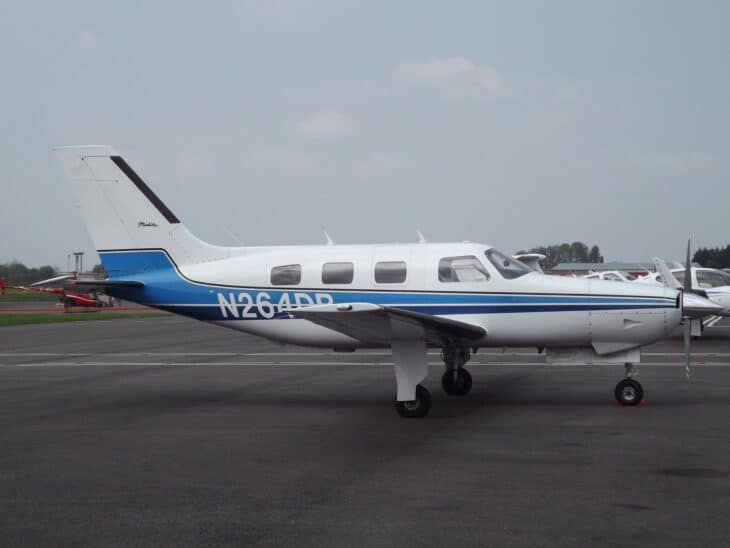
The aircraft was N264DB, a 1984 Piper PA-46-310P Malibu: a pressurized single with one turbocharged 310 hp Continental engine. It sat on the US register through a trust company, Southern Aircraft Consultancy Inc., which held title for a UK company. That arrangement let it fly in Europe under the FAA’s private-flying rules, Part 91.

Ibbotson had about 3,500 flying hours, most of them dropping parachutists, and about 30 hours in the Malibu. Sala sat in a rear, forward-facing seat. The two men shared no common language, so the safety brief was given in gestures.
The weather on the route was poor for a dark night. A cold front was coming in from the northwest, with layers of cloud down to 1,000 feet and bands of showers, some heavy. High cloud hid the full moon, and over the open Channel there would have been almost no lights below and little visible horizon.
The flight ran normally for about 45 minutes on its planned track toward Cardiff. Near Guernsey the pilot began descending and turning to stay out of cloud. North of the island, after his last radio call, the flight path turned unstable: bank angles up to 56 degrees, climbs and descents of up to 5,000 feet per minute.
Then came a final turn to the right. Two independent radars, at Guernsey and Jersey, recorded the airplane dropping from 4,100 feet to 1,600 feet in 28 seconds. The pilot made no distress call.
Air traffic control alerted the Guernsey Coastguard eight minutes later. Lifeboats, three coastguard helicopters and French aircraft searched about 1,800 square miles before the search was suspended on January 24. The wreckage was found 10 days later, after a privately funded search arranged for Sala’s family.
What the AAIB found
The NTSB, representing the country of registration, handed the investigation to the AAIB the day after the crash. The AAIB named three causal factors.
First, “the pilot lost control of the aircraft during a manually-flown turn, which was probably initiated to remain in or regain Visual Meteorological Conditions.” Second, the airplane “suffered an in-flight break-up while manoeuvring at an airspeed significantly in excess of its design manoeuvring speed.” Third, “the pilot was probably affected by carbon monoxide (CO) poisoning.”
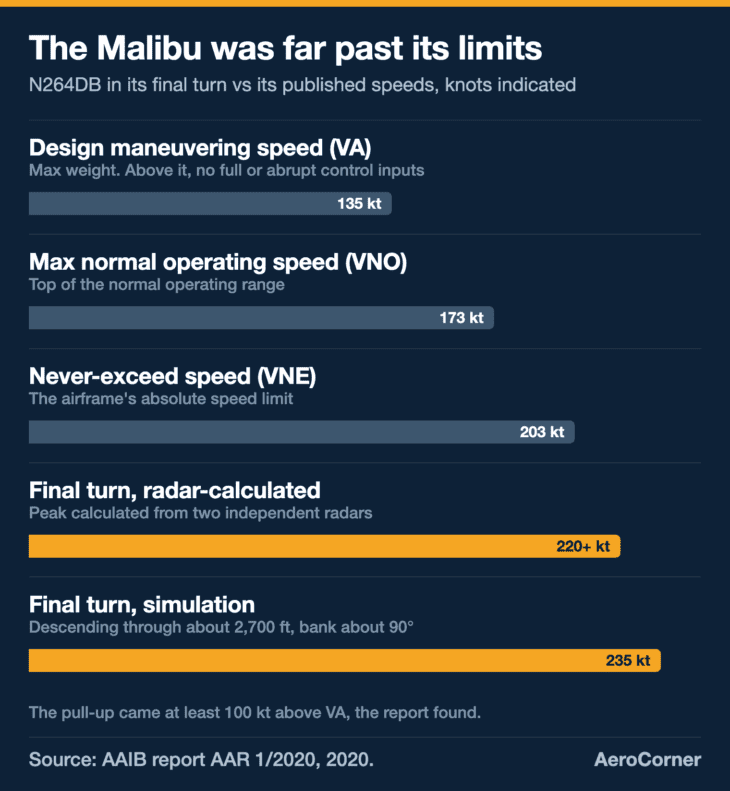
The reconstruction is precise. As the airplane descended through about 2,700 feet in the final turn, it was banked about 90 degrees and doing an estimated 235 knots, 32 knots above its never-exceed speed of 203. Then the control wheel was pulled sharply back, at least 100 knots above the speed at which abrupt inputs are allowed.
That pull-up overloaded the elevator and horizontal stabilizer, which failed. With the tail gone, the nose pitched violently down and both wings broke at their splice joints, the same failure points seen in five earlier PA-46 in-flight breakups the NTSB studied in the early 1990s.
Sala’s toxicology showed a carboxyhemoglobin level of 58%, enough that he was almost certainly deeply unconscious at the end. The pilot, in the same cabin, was likely affected too. But the AAIB also found that the final pull-up needed a hard pull on the control wheel, so “the pilot probably retained some level of function at this time.”
The most likely source of the gas was a failure in the exhaust tailpipe where it runs through the heater muff, the jacket that warms outside air for the cabin heat. The airplane had passed its annual inspection seven weeks and 11 flying hours before.
After evidence emerged at the inquest stage, the AAIB corrected its report in 2022: there was no record that the heater muff had been pressure-tested at either of the last two annual inspections.
The report’s first contributory factor goes back to how the flight was set up. It was a paid trip run outside commercial safety standards, flown under visual rules at night in poor weather “despite the pilot having no training in night flying and a lack of recent practice in instrument flying.”
What most accounts get wrong
The plane did not simply fall into the Channel. The AAIB concluded it probably broke up in flight, after a pull-up at more than 230 knots, and the wreckage lay within 330 feet (100 m) of the last radar return. Carbon monoxide was one of three causes, not the whole story: the pilot was probably still able to move the controls at the end. And Sala’s famous last voice message was not sent from the air. The network received it at 7:10 p.m., while the airplane was still taxiing at Nantes.
The license question: he had one, just not the right ones
Headlines called Ibbotson an unlicensed pilot. That is not quite what the record shows. He held a UK-issued EASA private pilot license, an FAA private license issued on the back of it, and a valid UK Instrument Rating (Restricted).
What he lacked mattered more. A private license does not allow a pilot to carry passengers for pay, and he was to be paid for this flight.
He also had no night rating. And the single-engine piston rating on his EASA license had expired in November 2018, which also undercut the FAA license that depended on it.
The AAIB’s conclusion, after legal advice from both the CAA and EASA, was blunt: “he was not qualified to fly the aircraft at the time of the accident.” An instructor had wrongly signed his logbook for the Malibu by day and night, which may have led him to think otherwise.
The instrument rating mattered less than it sounds. It was last renewed in May 2017, and every flight he logged after that was flown under visual rules. The report calls instrument flying “a perishable skill.”
Why a dark night over water is so dangerous
A pilot flying by sight keeps the wings level by watching the horizon. Take it away, and the inner ear takes over, and the inner ear is easily fooled: a slow, steady roll feels like straight and level flight. This is spatial disorientation, and the only defense is to trust the instruments over every bodily sensation.
That is what night and instrument training teach, and why the rules separate them from basic flying. The mechanism is the same one behind John F. Kennedy Jr.’s 1999 crash off Martha’s Vineyard: a dark night over water, no visible horizon and a pilot without an instrument rating.
The second mechanism is speed. Design maneuvering speed, known as VA, is the speed above which a full or abrupt control input can overstress the structure before the wing stalls and sheds the load. For the Malibu at maximum weight it is 135 knots.
A pilot recovering from a steep dive pulls back. At 235 knots, an abrupt pull was enough to break this airplane.
Carbon monoxide made both worse. The gas has no color, smell or taste, and the FAA’s own table links levels of 30 to 40% with impaired judgment and blurred vision. A pilot fighting disorientation while slowly poisoned has two problems at once, and the Malibu had no detector with an active alarm to warn him.
What changed
A court decided what an accident report cannot. David Henderson, who arranged the aircraft’s flights, pilots and maintenance, was convicted in October 2021 of endangering the safety of an aircraft by a 10 to 2 majority at Cardiff Crown Court. He had also admitted trying to carry a passenger without valid permission, and was jailed for 18 months.
The AAIB asked the FAA, EASA and the UK CAA to require carbon monoxide detectors with an active warning. The FAA and EASA declined to mandate them, and the AAIB rated both responses “Not Adequate.” The CAA went further: Safety Directive SD-2024/001 requires a working active detector from January 2025 in specified piston aircraft carrying passengers who are not pilots.
Piper revised its maintenance manual in April 2021 to add a 100-hour inspection of the exhaust heater muff on the PA-46-310P and PA-46-350P. The CAA, for its part, launched a campaign against “grey” charters: private aircraft and pilots taking paid passengers they are not licensed to carry.
The football side is still in court. The Court of Arbitration for Sport confirmed that Cardiff owed Nantes the first €6 million of the €17 million fee. In March 2026, a Nantes commercial court dismissed Cardiff’s claim for more than €120 million in damages from Nantes, and the BBC reported in July 2026 that Cardiff had lodged an appeal.
FAQ
Sources and references used for research and fact-checking.
- Air Accidents Investigation Branch, Aircraft Accident Report AAR 1/2020, Piper PA-46-310P Malibu, N264DB, 22 nm north-north-west of Guernsey, 21 January 2019 (corrected February 2022)
- Air Accidents Investigation Branch, N264DB Safety Recommendation Document (updated 30 January 2025)
- Federal Aviation Administration, FAA Aircraft Registry releasable database, deregistered aircraft file (N264DB)
- Sky Sports, Emiliano Sala flight organiser David Henderson sentenced to 18 months in prison
- Euronews, Emiliano Sala: Argentine footballer died from trauma injuries in plane crash, inquest finds
- BBC Sport, Cardiff to appeal against dismissed £100m Sala claim
- Soccerway (Reuters), Cardiff City lose CAS appeal over late Emiliano Sala transfer fee
- CBS News, Soccer star Emiliano Sala's audio message from missing plane
Get the Newsletter
The latest aviation news and stories sent to your inbox.
About the Author

Tim is the owner and lead editor of AeroCorner since 2019, overseeing aviation content covering aircraft, airlines, airports, and the broader aviation industry. Through years of researching, writing, editing, and publishing aviation-focused content, he has developed extensive practical knowledge of commercial aviation and air travel. Based in Asia and a frequent traveler himself, Tim also brings firsthand passenger experience to AeroCorner’s coverage. Outside of publishing, he has also explored aviation firsthand through hands-on flight training in New Zealand.