

Table of Contents
At about 10:22 a.m. on October 25, 2002, a chartered King Air A100 crashed in woods about 2 miles (3.3 km) short of the runway at Eveleth, Minnesota. U.S. Senator Paul Wellstone died with his wife Sheila, their daughter Marcia, three campaign staff members and the two pilots. Eight people were aboard and none survived.
The crash was first told as an icing story, and later as a conspiracy. The record supports neither. Both engines were working and the ice was not a factor. The airplane slowed to about 50 knots below its approach speed on final, stalled, and the crew never went around.
This article is built from the National Transportation Safety Board’s final report, NTSB/AAR-03/03, adopted November 18, 2003. Facts from other sources are named as they come.
7:16 a.m.
The briefing. The captain calls flight service. AIRMETs for icing and low cloud cover the whole route to Eveleth. Three minutes later he tells the briefer he doesn’t think he will take the flight.
About 8:00 a.m.
The weather improves. The captain tells the campaign scheduler the ceiling has come up, and they agree to fly as planned.
9:37 a.m.
Departure. King Air A100 N41BE leaves St. Paul Downtown Airport, cleared direct to Eveleth at 13,000 feet.
10:18 a.m.
Cleared for the approach. Duluth approach clears the flight for the VOR runway 27 approach. The airplane turns late and overshoots the final course by almost 1 nautical mile.
10:19 a.m.
Last radio call. The copilot acknowledges a switch to the airport’s advisory frequency. It is the last transmission ATC receives.
10:21:42 a.m.
Last radar return. The airplane is at about 1,800 feet and about 76 knots, the speed at which it would stall in that configuration.
About 10:22 a.m.
The crash. The King Air strikes the ground about 1.8 nautical miles southeast of the runway. All eight aboard die.
November 18, 2003
The final report. The NTSB adopts AAR-03/03 and its probable cause: the crew’s failure to maintain adequate airspeed.
What happened
Wellstone was 11 days from the November 5 election. The trip was a charter from St. Paul to Eveleth, on Minnesota’s Iron Range, and the crew planned to drop the passengers off and reposition the airplane to Duluth.
Six passengers flew: the senator, 58; Sheila Wellstone; their daughter Marcia Wellstone Markuson, 33; and campaign staff members Mary McEvoy, Tom Lapic and Will McLaughlin. The captain was Richard Conry, 55, and the first officer was Michael Guess, 30.
The airplane was a 1979 Beechcraft King Air A100, registration N41BE, a twin-turboprop operated by Aviation Charter Inc. of Eden Prairie under Part 135 charter rules. It belongs to the same family as today’s King Air C90GTi, and the NTSB ran its simulator tests in a C90B because no A100 simulator exists.


The morning was gray and cold across northern Minnesota. At 7:19 a.m. the captain told the flight service briefer, “you know what[,] I don’t think I’m going to take this flight.” He called the company to delay the trip, then learned the ceiling had improved, and the flight went ahead on schedule.
The en route flight was routine. Eveleth was reporting 2 1/2 statute miles visibility in light snow and an overcast at 700 feet, above the 1-mile minimum for the approach the crew asked for.
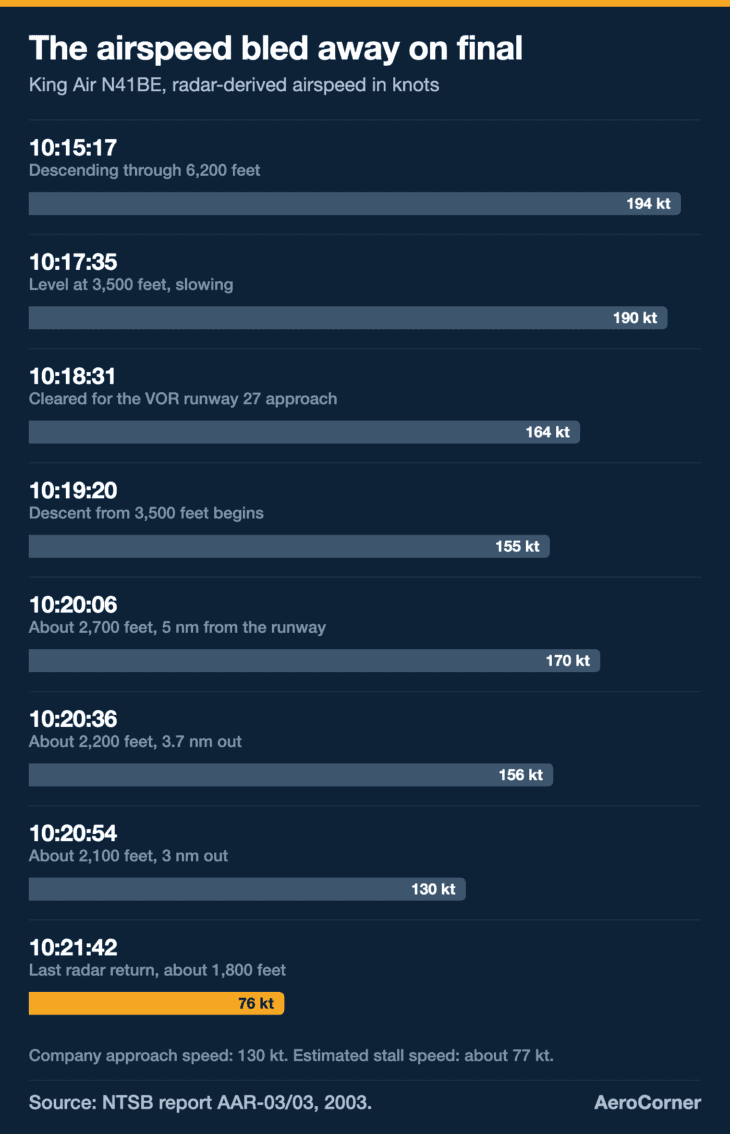
Duluth approach vectored the King Air onto the VOR runway 27 approach and cleared it at 10:18. The airplane was still doing about 164 knots and turned late, overshooting the final course by almost a nautical mile. It then descended from 3,500 feet while it was still fast, with the speed rising to about 170 knots.
From there the speed bled away. At 3 nautical miles from the runway it was at 130 knots, the company’s approach speed, and still falling. The last radar return showed about 76 knots at about 1,800 feet, close to the 1,840-foot minimum descent altitude (radar altitudes carry a margin of 50 feet either way).
What the NTSB found
The probable cause, in the report’s words, was “the flight crew’s failure to maintain adequate airspeed, which led to an aerodynamic stall from which they did not recover.”
The Board found the crew flew below the approach speed for about 50 seconds, dropping as low as about 50 knots under it.
It also found the crew did not configure the airplane properly at the start of the approach, so the later stages became harder. Either the low airspeed or the full deflection of the course needle should have prompted a go-around.
Everything mechanical checked out. Both engines were running normally at low power, just above flight idle, and the Board found no preexisting failure of the engines, systems or structure. The airplane was within its weight and balance limits, and toxicology on both pilots was negative.
The report widened the frame past the cockpit. Colleagues had raised concerns about both pilots’ flying before the accident, and the Board found both had shown “potentially serious performance deficiencies.” The NTSB could not tell which of the two was flying, because the airplane carried no cockpit voice recorder and was not required to.
The company was named too. Aviation Charter had no in-range checklist, no adequate stall recovery guidance and inconsistent de-icing guidance, and it was not teaching crew resource management as its own FAA-approved training module required. FAA surveillance met its guidelines but did not catch any of it.
What most accounts get wrong
Icing was the first explanation, widely reported in the days after the crash, and it is still repeated. The NTSB rejected it. The King Air spent only about 2 1/2 minutes in the band of moderate icing, any ice was likely shedding below 5,000 feet, and the airplane held high speeds where ice would have built and lost speed lower down, where it would have been shedding. Finding 10 of the report is one line: icing did not affect the airplane’s performance during the descent. The Eveleth VOR, found out of tolerance in flight checks after the crash, was ruled out as well (finding 12).
The VOR is the subtler half of that correction. Post-crash flight checks found the signal bent by up to 4.1 degrees, against a 3.5-degree limit, between 5 and 10 nautical miles out. But the airplane was converging on the course through that zone, and the Board concluded the bends played no role.
The conspiracy versions grew from the timing, a senator dying days before an election. A 2004 book by James Fetzer and Don “Four Arrows” Jacobs called it an assassination. The FBI looked into possible foul play and concluded within days that the crash was an accident, and the NTSB found normal engines and no system or structural failure.
Why an airplane can stall with its engines running
A stall has nothing to do with the engines. It happens when the wing meets the air at too steep an angle and the airflow over the top breaks away, so the wing stops lifting. Slow down while holding altitude and the nose has to come up, which raises that angle until it passes the limit.
That is why the NTSB’s numbers line up so neatly. With gear down, approach flaps and power at flight idle, the A100’s stall speed at that weight was about 77 knots. The last radar return showed 76.
Approach speeds exist to hold a margin above that number. Aviation Charter’s chief pilot taught 130 knots on a nonprecision approach until the runway was in sight, and the company’s procedures demanded a go-around if the speed strayed more than 10 knots from target below 500 feet above the ground.
The Board said that with its procedures and crew coordination working, at least one pilot should have been watching the airspeed indicator, and neither was.
A stall warning horn is meant to sound 5 to 8 knots above the stall. The NTSB’s simulations triggered it between 81 and 84 knots, but with no voice recorder it could not say whether the horn sounded on N41BE. That gap is why the report went further and asked for a separate low-airspeed alert.
The same day of the year holds another accident with a very different mechanism. On October 25, 1999, Payne Stewart’s Learjet lost cabin pressure and flew on with everyone aboard unconscious.
What changed
The report made four recommendations to the FAA. It asked for en route inspections at on-demand charter operators (A-03-51), crew resource management training for every Part 135 operator that flies two pilots (A-03-52), and a panel on low-airspeed alerts, with rules to follow if they proved feasible (A-03-53 and A-03-54).
The CRM recommendation became law. The FAA’s final rule on crew resource management training for Part 135 operations, effective March 22, 2011, cites A-03-52 and goes further, covering single-pilot operations too. Operators had two years to put initial and recurrent CRM training in place.
Aviation Charter changed before the report was out. It wrote standard operating procedures into its operations manual, added random line checks, hired a director of safety and began sending all of its pilots to full-motion simulator training.
The recorder gap was older than this crash. The report noted the NTSB’s earlier call, A-99-60, for crash-protected video recorders on turbine-powered charter aircraft, still classed “Open, Unacceptable Response” at the time.
FAQ
Sources and references used for research and fact-checking.
- National Transportation Safety Board, Loss of Control and Impact With Terrain, Aviation Charter, Inc., Raytheon (Beechcraft) King Air A100, N41BE, Eveleth, Minnesota, October 25, 2002 (NTSB/AAR-03/03)
- Federal Register via GovInfo, Crew Resource Management Training for Crewmembers in Part 135 Operations (final rule, 76 FR 3831)
- CBS News, Pilots Blamed For Senator's Crash
- Wikipedia, Paul Wellstone
- AVweb, NTSB Probes Wellstone Crash
Get the Newsletter
The latest aviation news and stories sent to your inbox.
About the Author

Tim is the owner and lead editor of AeroCorner since 2019, overseeing aviation content covering aircraft, airlines, airports, and the broader aviation industry. Through years of researching, writing, editing, and publishing aviation-focused content, he has developed extensive practical knowledge of commercial aviation and air travel. Based in Asia and a frequent traveler himself, Tim also brings firsthand passenger experience to AeroCorner’s coverage. Outside of publishing, he has also explored aviation firsthand through hands-on flight training in New Zealand.