

Table of Contents
At about 4:02 p.m. on August 2, 1979, a Cessna Citation flown by New York Yankees captain Thurman Munson touched down 870 feet (265 m) short of Runway 19 at Akron-Canton Airport in Ohio. Munson, 32, was its owner and pilot. He died, and his two passengers, David Hall and Jerry Anderson, escaped with serious burns.
The crash is still told as a power failure, a fire in the air, or a pilot who skipped his seat belt.
The record says otherwise: both engines were producing considerable power at impact, the fire started after the jet stopped, and his lap belt was fastened. What went wrong was simpler. He flew the last approach with the flaps up, at a speed meant for flaps down.
This article is built from the National Transportation Safety Board’s full investigation, Aircraft Accident Report NTSB-AAR-80-2, adopted on April 16, 1980. Accounts from news coverage and the later lawsuits are named as they come.
July 6, 1979
A new jet. Munson takes delivery of Citation N15NY, 16 months after his first flying lesson. He has about 480 hours in his logbook, most of them in twin-engine propeller airplanes.
July 17, 1979
Type rating. After ground school, 21.7 hours in the jet and four hours in a FlightSafety simulator, he passes his Citation checkride. His instructor rates him well above average.
August 2, 2:30 p.m.
An off-day flight. With the Yankees off, Munson invites two pilot friends to fly with him. Neither has flown a jet before.
3:41 p.m.
Cleared for takeoff. N15NY departs Runway 23 for practice landings. Three touch-and-goes follow, all in left-hand patterns.
Fourth takeoff
A new runway. Because of other traffic, the tower sends the jet to a right-hand pattern for Runway 19. It enters downwind at 3,500 feet and 200 knots.
3:59:55 p.m.
Base turn. After a one-mile extension, the controller clears the turn to base “anytime now.” The gear and flaps are still up.
Final approach
A reminder. At about 1,700 feet on the altimeter, Hall points out that the gear is up, and Munson lowers it. The flaps stay up, and the jet sinks below the VASI glide path.
About 4:02 p.m.
Short of the runway. The Citation touches down 870 feet short, slides through small trees, hits a stump and stops on a road. Fire breaks out as it comes to rest.
April 16, 1980
The report. The NTSB adopts AAR-80-2. It finds no mechanical failure, issues no safety recommendations, and one Board member dissents in part.
What happened
August 2, 1979 was an off day for the Yankees, and Munson was home in Canton. That afternoon’s flight was not a trip anywhere: it was local practice, takeoffs and landings at Akron-Canton.
The jet was a Cessna CE-501 Citation, the single-pilot version of the original Citation 500, serial 501-0110, with 43.1 hours on it since new. AeroCorner’s database has its stretched successor, the Cessna Citation II, but not the original model.
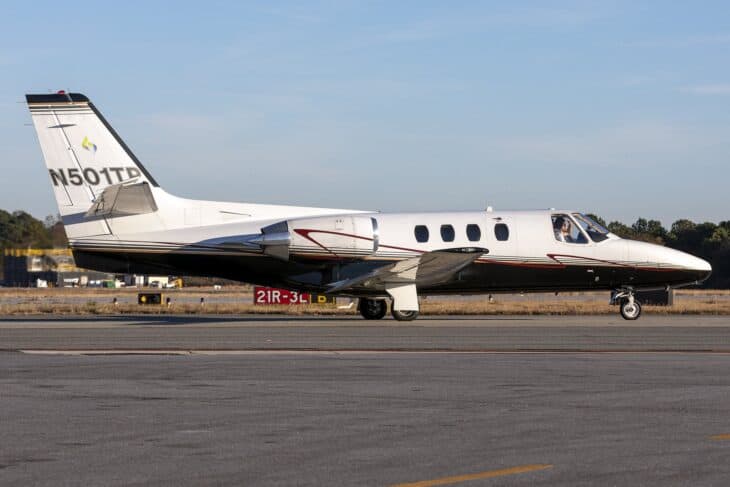
In the right seat sat David Hall, 32, an airline transport pilot and flight instructor who had taught Munson in a Beech Duke. Jerry Anderson, 31, a private pilot, rode in the cabin. Hall had never flown a Citation, and the report says he was aboard only as an observer.
The first three touch-and-go landings on Runway 23 went normally, though none followed the recommended pattern speeds or heights. On the third, Munson let Hall fly a no-flap approach, and the jet landed long. Hall told investigators the speed was “considerably faster than the reference speed.”
Then the tower switched the jet to Runway 19 with a right-hand pattern, which is harder to judge from the left seat. Munson came onto downwind at 3,500 feet and 200 knots, pulled the throttles nearly to idle to lose height and speed, and silenced the landing gear warning horn.
He did not lower the gear or flaps on downwind, as he had on the earlier circuits.
Hall reminded him about the gear on the turn to final, and Munson lowered it. Nobody mentioned the flaps.
The jet settled below the two-bar VASI, Hall said “we’re sinking,” and Munson began easing the throttles forward. He pushed them fully forward only moments before the Citation hit the ground.
It rolled about 150 feet on its wheels, lost its nose gear in a 2.5-foot ditch, passed through a stand of small trees and struck a large stump. It spun around and stopped on Greenburg Road, about 600 feet from the runway threshold.
What the NTSB found
The Board ruled out the airplane first. The flaps were found up and the speed brakes stowed, with no sign of a flap or control failure. Both Pratt & Whitney Canada JT15D engines had wood debris drawn deep into them, which the Board said would not happen at low power.
The probable cause, in the report’s words, was “the pilot’s failure to recognize the need for, and to take action to maintain, sufficient airspeed to prevent a stall into the ground during an attempted landing.” He also failed to add “timely and sufficient power” during “an approach conducted inadvertently without flaps extended.”
Contributing, the Board found, were his failure to use the checklist and “his nonstandard pattern procedures which resulted in an abnormal approach profile.” Weather was ruled out: 10 miles of visibility and a light wind.
The numbers explain the sink. Munson had set his airspeed bug at 93 knots, a speed for a flaps-down landing, and Hall said he held it “nailed right on the bug.” With the flaps up, the flight manual called for 115.5 knots, and buffet began at 92.
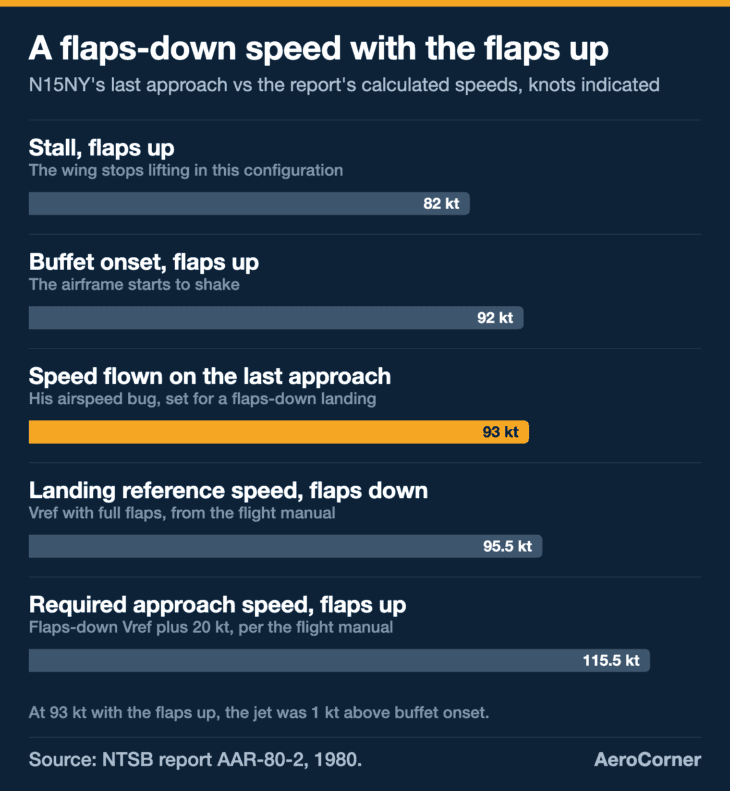
The report’s findings put the gap at about 24 knots below the proper no-flap speed.
His angle-of-attack indicator, which Hall saw sitting in the yellow caution band, was showing him he was slow. The Board could not say why he did not act on it, and suggested he had not yet learned to include it in his scan.
Munson survived the impact but was trapped by his injuries. Hall and Anderson tried several times to pull him free before smoke and fire forced them out of the right-side emergency exit.
The main cabin door had jammed. The report found he died from the effects of the fire.
What most accounts get wrong
There was no engine failure. Newsday in 2009 reported that an NTSB investigator had blamed a power failure, and SABR’s game account says loss of power was the initial cause, but the final report found both engines developing considerable power at impact. The jet did not catch fire in the air: the report says the fire erupted after it came to rest. The New York Times wrote in 2018 that Munson did not fasten his seat belt, but his lap belt was found buckled; it was the shoulder harness he did not wear. The engines did not stall either. The wing did, because the flaps were up and the speed was too low.
The aviation behind it: why jets punish a slow approach
Flaps let a wing make the same lift at a lower speed. Retract them and every speed on the approach moves up: on N15NY, the stall rose from 74 knots with full flaps to 82 knots with none. That is why the Citation’s flight manual adds 20 knots for a no-flap approach.
Flying below that speed put the jet on what pilots call the back side of the power curve, which the report names “the area of reverse command.” Down there, raising the nose to stop a descent adds more drag than lift, so the airplane sinks faster unless the pilot adds a lot of power.
The engines made that harder. A jet engine makes most of its thrust at the top of its rpm range and responds more slowly than a piston engine. A propeller airplane answers more evenly, and its propwash blows over the wing.
The Board said Munson’s habit of “inching the throttles forward” was a propeller pilot’s technique, and in a jet it produced almost nothing until it was too late.
His logbook shows how fast he moved. He went from a Cessna 150 to a business jet in 16 months, and most of his time was in piston and turboprop twins.
| Date | Milestone | Total hours |
|---|---|---|
| February 27, 1978 | First lesson, Cessna 150 | 0 |
| June 11, 1978 | Private pilot certificate | About 90 |
| June 15, 1978 | Multiengine rating, Beech Duke | 97.2 |
| February 10, 1979 | Buys a Beech King Air E90 | 330 |
| July 6, 1979 | Takes delivery of Citation N15NY | About 480 |
| July 17, 1979 | Citation type rating | About 505 |
| August 2, 1979 | Day of the accident | 516.2 (33.8 in the Citation) |
That is enough for a type rating, and the Board stressed that he had more training than the rules required. It concluded that “the manner in which the pilot conducted this flight,” not his training or experience, set off the accident.
Board member Francis McAdams disagreed in part. He wrote that the pilot “lacked sufficient flight experience in the aircraft,” having logged only the minimum, about 30 hours. With more time in the jet, he believed, Munson would have added thrust immediately.
What changed after the Munson crash
Very little, officially. The report lists “Safety Recommendations: None.” The Board found the airplane sound and the pilot properly trained and certificated, so there was no rule to point at.
McAdams’s dissent went further than the majority. He noted that all of Munson’s checkrides were given by FAA-designated examiners, not FAA inspectors, and that in 1978 designated examiners failed 6% of applicants, against 28% for FAA inspectors.
He wanted the FAA to review how examiners were designated. The Board did not adopt it.
The report did record what hurt the survivors. Munson had not briefed his passengers on the harnesses, the exits or the door, as the rules required, and neither cockpit occupant wore a shoulder harness.
His seat tore loose when the floor beneath it buckled on the stump, so his lap belt held him to a seat that was no longer attached.
The aftermath played out in court. Munson’s widow, Diana, sued Cessna and FlightSafety International for $42 million. The case went to trial in May 1984 and settled within days on undisclosed terms.
A separate Yankees suit over his contract was dismissed before trial.
Depositions from those suits, reported by The New York Times in 2018, added a fatigue theory from an expert witness. That was deposition testimony, not an investigative finding. The NTSB report makes no finding of fatigue and found no medical problem that would have affected the flight.
FAQ
Sources and references used for research and fact-checking.
- National Transportation Safety Board, Aircraft Accident Report NTSB-AAR-80-2: Thurman L. Munson, Cessna Citation 501, N15NY, near Canton, Ohio, August 2, 1979
- The New York Times News Service (via The Bulletin), 2018, Revisiting files from death of Yankee great
- Newsday (via Honolulu Advertiser), 2009, Book recalls occurrences around tragic death of Thurman Munson
- SABR Games Project, August 3, 1979: Somebody's missing: Heartbroken Yankees play first game after Thurman Munson's death
Get the Newsletter
The latest aviation news and stories sent to your inbox.
About the Author

Tim is the owner and lead editor of AeroCorner since 2019, overseeing aviation content covering aircraft, airlines, airports, and the broader aviation industry. Through years of researching, writing, editing, and publishing aviation-focused content, he has developed extensive practical knowledge of commercial aviation and air travel. Based in Asia and a frequent traveler himself, Tim also brings firsthand passenger experience to AeroCorner’s coverage. Outside of publishing, he has also explored aviation firsthand through hands-on flight training in New Zealand.