

Light Business Jets
Cessna Citation Encore
ICAO: C560
The stretched, straight-wing Citation that Cessna built in three generations from 1978 to 2006
Updated: by Tim de Vries

The latest aviation news and stories sent to your inbox.
The Cessna Citation II (Model 550) is a light business jet that stretched the original Citation I, added a longer wing, more fuel and stronger JT15D-4 engines, and fixed that aircraft’s biggest weakness: its slow cruise. Cessna built 1,184 jets across the 550 family, counting the II, the single-pilot II/SP, the S/II and the Citation Bravo, before production ended in 2006.
Live Fleet Activity (C550)
Fetching live data…
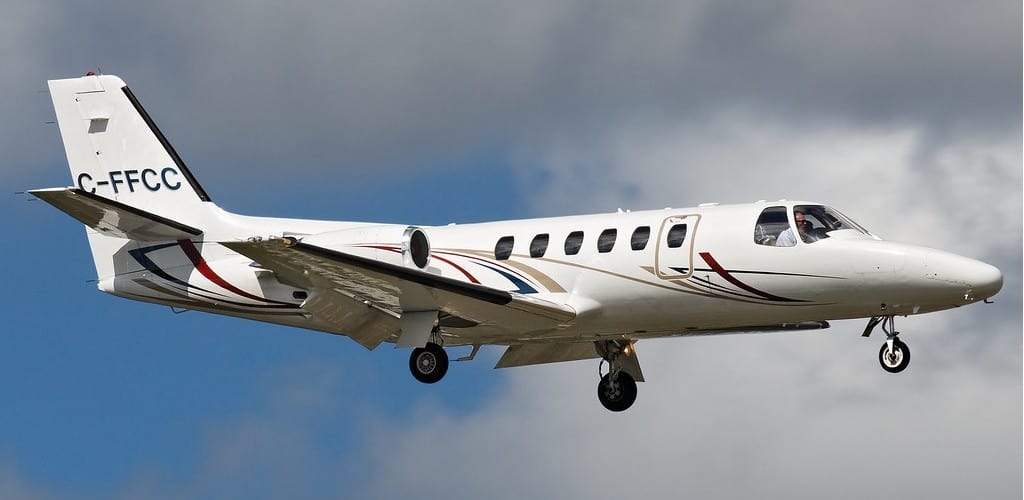


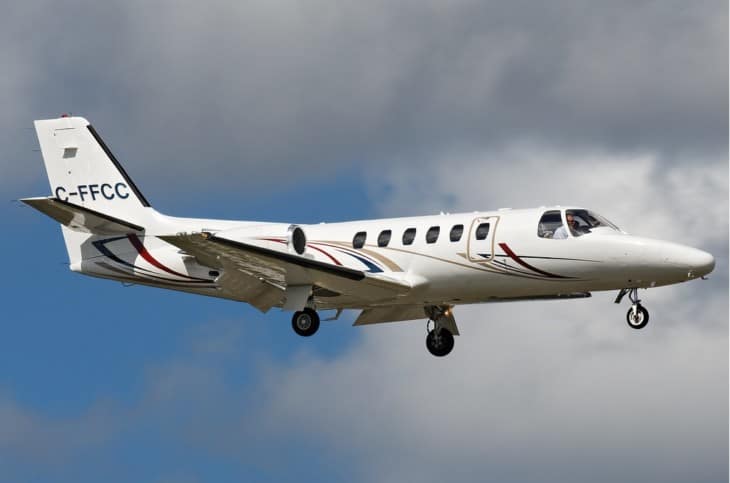
The Cessna Citation II, Model 550 on its type certificate and C550 in flight plans, is the stretched version of the original Citation, a light business jet that Cessna gave a longer cabin, a longer wing, more fuel and stronger engines. Those changes addressed the Citation I’s main criticism: its slow cruise.
It flew for the first time on January 31, 1977, and grew into a family that Cessna kept building until 2006. Counting every version, from the single-pilot II/SP to the Citation Bravo, 1,184 of them were delivered.
Many spec sheets for the “Citation II” online quote a cruise speed of 403 kt and a range close to 2,000 nm. Those figures belong to the Citation S/II (Model S550), the aerodynamically improved version introduced in 1984 and the variant Wikipedia’s specification table describes, not to the Model 550 itself.
AOPA’s buyer guide gives the 550 a 375 kt cruise and a maximum range of 1,200 nm with NBAA IFR fuel reserves. It gives the S/II a claimed 403-knot maximum cruise and “nearly 2,000 nm” of range, thanks to its extra fuel and reworked wing.
The specification panel on this page describes the Model 550 Citation II. The S/II, the II/SP and the Bravo differ in engines, fuel, weights and wing, and those differences are covered variant by variant below.
The Citation I sold on docile handling and short-field ability, but its cruise of around 350 kt at altitude drew criticism. The Citation II was Cessna’s answer, announced in September 1976 and certified by the FAA in March 1978.
Cessna stretched the Citation I fuselage by 3 ft 9 in (1.14 m), which raised seating to ten, two pilots and eight passengers. The wingspan grew by 5.1 ft (1.6 m), fuel capacity rose by about a third, and the cabin gained 5 in (13 cm) of headroom.
The engines were Pratt & Whitney Canada JT15D-4 turbofans of 2,500 lbf each. According to AOPA, that was a 600-pound thrust gain per engine over the Citation I’s JT15D-1, and it is what bought the higher cruise speed.

The Citation II keeps the straight, unswept wing of the Citation I. Cessna developed it to offer the same docile low-speed handling and good short-field performance as its predecessor while fixing the older jet’s slow cruise.
The Model 550 is certified under FAR Part 25, the transport-category standard, rather than the lighter Part 23 rules for small aircraft. Its type certificate allows up to 13 people on board, two pilots plus as many as 11 passengers, although eight passenger seats is the usual layout.
Weight limits depend on the serial number. Early aircraft (S/N 550-0001 to 550-0626) are certified at 13,300 lb for takeoff, while later Citation IIs (S/N 550-0627 to 550-0800) are certified at 14,100 lb, the figure in the panel.
The full specification table for the aircraft is on this page, so this section only covers the figures that need context.
The 1,200 nm range is AOPA’s figure with NBAA IFR fuel reserves, a conservative planning standard for business jets that holds fuel back for a diversion and holding.
The 385 kt maximum speed comes from TU Delft, which flies a Citation II as a research aircraft and publishes that figure as the jet’s top cruising speed in true airspeed. At high altitude, the type certificate limits the jet to Mach 0.70.
The 43,000 ft ceiling is the maximum operating altitude on the type certificate, the same limit the S/II carries.
The II/SP is the single-pilot version, built to FAR Part 23 rules instead of Part 25. That caps its maximum takeoff weight at 12,500 lb, which often forces owners to trade fuel for passengers on longer trips.
Cessna counts the II and the II/SP together: 688 of the two were delivered.
The S/II was announced in October 1983, first flew on February 14, 1984, and was certified that July. It added a supercritical airfoil with swept wing roots, sealed aileron and flap gaps, and fluid deicing in place of the earlier pneumatic boots.
Fuel capacity rose by 120 US gal (450 L), and JT15D-4B engines with higher-temperature parts held their thrust better at altitude. The result was a 403 kt cruise, past the 400-knot mark that Cessna saw as an important marketing benchmark.
Range figures for the S/II vary by source, from 1,378 nm with a 45-minute reserve in Szurovy’s history to AOPA’s 2,000 nm figure with NBAA IFR reserves. Either way, it outranges the standard 550.
The S/II replaced the II in production from 1984, but some buyers balked at its price of $3.3 million against $2.6 million for the II. Cessna brought the II back in late 1985 and built both until the Bravo arrived, delivering 160 S/IIs in all.
The U.S. Navy bought fifteen T-47As in 1984 to train radar intercept officers. The type had a 5 ft (1.5 m) shorter wingspan, hydraulically boosted ailerons, JT15D-5 engines of 2,900 lbf each, a cockpit roof window and the AN/APQ-167 radar.
The fleet was flown on civil registrations by Training Air Squadron VT-86 at NAS Pensacola. On July 20, 1993, a roofing contractor accidentally set fire to a hangar at Forbes Field in Topeka where Cessna was storing the aircraft, and ten of the fifteen were destroyed.
The Bravo is the last of the line. It first flew on April 25, 1995, was certified in August 1996, and reached its first customer in February 1997.
Based on the S/II, it swapped in Pratt & Whitney Canada PW530A turbofans with 15% more takeoff thrust and 23% more at altitude. It also added Honeywell Primus EFIS avionics, a Citation Ultra-style interior and trailing-link main landing gear.
Production ended in late 2006 after 336 Bravos. Cessna’s replacement in that slot was the Citation CJ3.
Not by default. The Model 550’s type certificate sets a minimum flight crew of two, a pilot and a copilot, for all flights.
The II/SP was the version built for one pilot. Both the II and the II/SP need special training before a single pilot can fly them, and AOPA notes that single-pilot authorization can be earned at training organizations such as FlightSafety International.
The distinction matters. In the NTSB’s preliminary report on the 2025 Statesville crash, the captain was licensed to fly the Citation with a second-in-command on board, but the person in the right seat was not qualified to act as one.
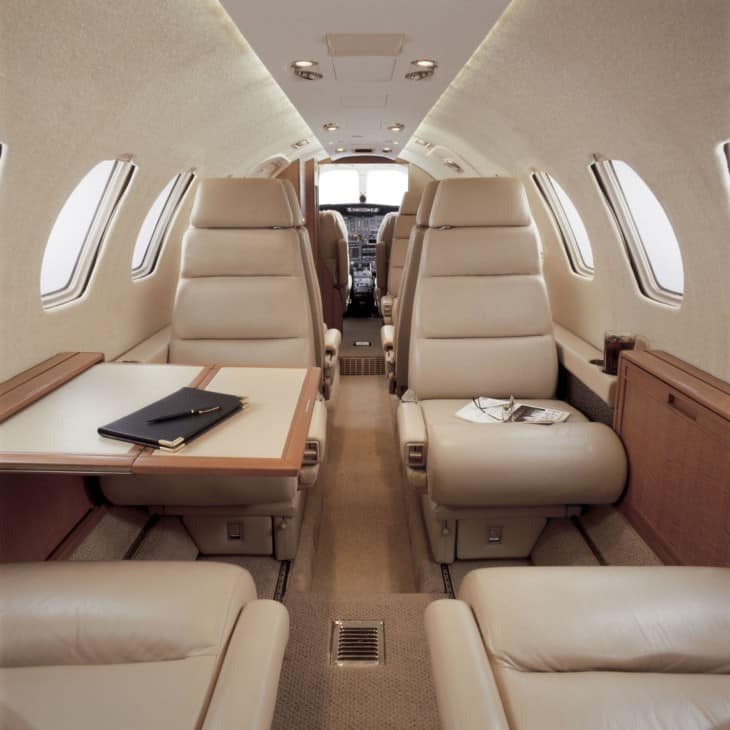
The cabin is 4 ft 7 in (1.40 m) high, so passengers stoop rather than stand. A common layout centers on a four-seat club section like the one pictured below.
Baggage goes in a nose compartment and in the aft cabin. The type certificate caps the nose bay at 350 lb (159 kg).
Cockpits vary widely because of retrofits. One Citation II listed on Controller.com in September 2026 carried a Garmin G600 flight deck and dual Garmin GTN 750 navigators.
Beyond private owners and charter operators, the Citation II found a long list of government users. Military operators include the Spanish Air Force and Navy, the Swedish and Turkish Air Forces, the Colombian Air Force and Argentine Army Aviation.
U.S. Customs and Border Protection bought ten Citation IIs fitted with fire-control radar, first the F-16’s AN/APG-66(V) and later the Selex ES Vixen 500E. They have been used in Panama, Honduras, Colombia, Peru, Venezuela, Mexico and Aruba.

Air ambulance services use the type too, among them Tyrol Air Ambulance in Austria. In research, PH-LAB is a Citation II owned and operated jointly by Delft University of Technology and the Dutch aerospace laboratory NLR.
PH-LAB has been rebuilt as a flying laboratory for testing flight displays and control laws, and for parabolic flights that give experiments short spells of microgravity.

New, the Citation II cost about $2.6 million in the mid-1980s. Used prices today depend heavily on the variant.
In September 2026, Controller.com listed 57 Citation 550 aircraft at asking prices from $499,000 to $2.65 million. That spread covers everything from early IIs to late Bravos and re-engined conversions, so the variant matters more than the year.
For comparison, AOPA put Citation II prices at $760,000 to $1.7 million in 2011. The S/II has long sold for more than the standard II because of its better performance and small production run.
Purchase price is only part of the bill. For the Bravo, Business & Commercial Aviation put the engine overhaul, due every 4,000 hours, at about $1 million.
Two firms developed Williams FJ44 re-engine programs for the type. Sierra Industries received its FAA supplemental type certificate in September 2008 for the Super II, and by June 2012 it had re-engined 59 Citations.
Flying magazine reported the converted 550 as 25% more fuel efficient than the JT15D-powered original at the same speed. The conversion cost about $1.9 million in 2009.
On December 18, 2025, a 1981 Citation II, N257BW, crashed while returning to Statesville Regional Airport in North Carolina shortly after takeoff. All seven people on board were killed, including the jet’s owner, NASCAR driver Greg Biffle, his wife Cristina and their two children.
The NTSB released its preliminary report on January 30, 2026. It describes a left engine that failed to start on the first attempt, a discussion of a thrust reverser indicator, and a final approach in which airspeed and altitude kept decreasing before the jet struck approach lights about 1,380 feet short of the runway.
A preliminary report does not determine a cause, and as of September 2026 the NTSB lists the investigation as ongoing. More on the sport’s aviation ties is in our look at NASCAR drivers’ private jets.
Two other recent accidents involved the II/SP. In September 2022, a Cessna 551 bound from Jerez, Spain, to Cologne flew past its destination and crashed into the Baltic Sea off Ventspils, Latvia, after running out of fuel. On May 22, 2025, a 1985 Cessna 551 flying from Teterboro to San Diego crashed into military housing in San Diego’s Murphy Canyon neighborhood.
Used Citation 550s were listed on Controller.com from $499,000 to $2.65 million in September 2026. Early Citation IIs sit at the bottom of that range, while late Citation Bravos and re-engined Super IIs sit at the top.
The standard Model 550 is certified for a minimum crew of two pilots. The II/SP (Model 551) was built for single-pilot operation, and both versions require special training before one pilot can fly them alone.
AOPA called the Citation II “an instant hit,” and Cessna designed it to keep the Citation I’s docile low-speed handling and short-field performance. The trade-offs are the upkeep of an airframe that is now decades old and JT15D engines that burn more fuel than newer turbofans: a re-engined 550 is reported as 25% more fuel efficient.
The Model 550 has a maximum speed of 385 kt and a typical cruise of about 375 kt, according to TU Delft and AOPA. The faster S/II is quoted at 403 kt.
AOPA gives the Model 550 a maximum range of 1,200 nm with NBAA IFR fuel reserves. Figures near 2,000 nm that circulate online belong to the S/II, which carries more fuel.
Cessna delivered 1,184 aircraft in the 550 family: 688 Citation II and II/SP, 160 S/II and 336 Citation Bravo. Production ran from 1978 to 2006.
The Bravo is the final Model 550, delivered from 1997. It replaced the II’s JT15D engines with Pratt & Whitney Canada PW530A turbofans and added Honeywell Primus EFIS avionics and trailing-link main landing gear.
Sources and references used for research and fact-checking.


