

Table of Contents
On November 1, 2026, a Learjet 60 bound for the Bahamas fell from about 35,000 feet and crashed beside Military Trail in Palm Beach County, Florida, killing all nine people aboard. Within hours, the National Transportation Safety Board had a go-team on the way. Within days, the questions had narrowed to one: why?
The first written answer from the NTSB will be a preliminary report. If the Greenacres Learjet investigation follows the agency’s usual pattern, that report will appear roughly a month after the crash, around the start of December. Headlines will say “NTSB releases report on Florida jet crash,” and many readers will expect it to explain what happened.
It won’t, and that is deliberate. Here is what a preliminary report contains, what it is forbidden to say, and the long road from that first document to the probable cause.
What Is an NTSB Preliminary Report?
An NTSB preliminary report is the first public document in an accident investigation. The NTSB’s own guidance for reporters says it is issued roughly a month after an accident and “will contain only factual information collected on scene.” It “will not contain analysis or contain a finding of probable cause.”
Think of it as a snapshot of the evidence on the day the field work wound down. It tells you what investigators saw. It does not tell you what they think it means.
The preliminary report at a glance
When: roughly a month after the accident, sometimes sooner. What: the sequence of the flight, the aircraft, and what investigators found at the scene and in early lab work. What it leaves out: analysis, conclusions and the probable cause. Where: the NTSB’s CAROL database. Status: marked subject to change, with errors corrected in the final report.
What Goes In, and What Stays Out
A preliminary report reads like a careful incident log. It typically walks through the flight from departure to impact, identifies the aircraft and its operator, and describes the wreckage. The NTSB even holds back the registration number until investigators have verified it against the wreckage itself.
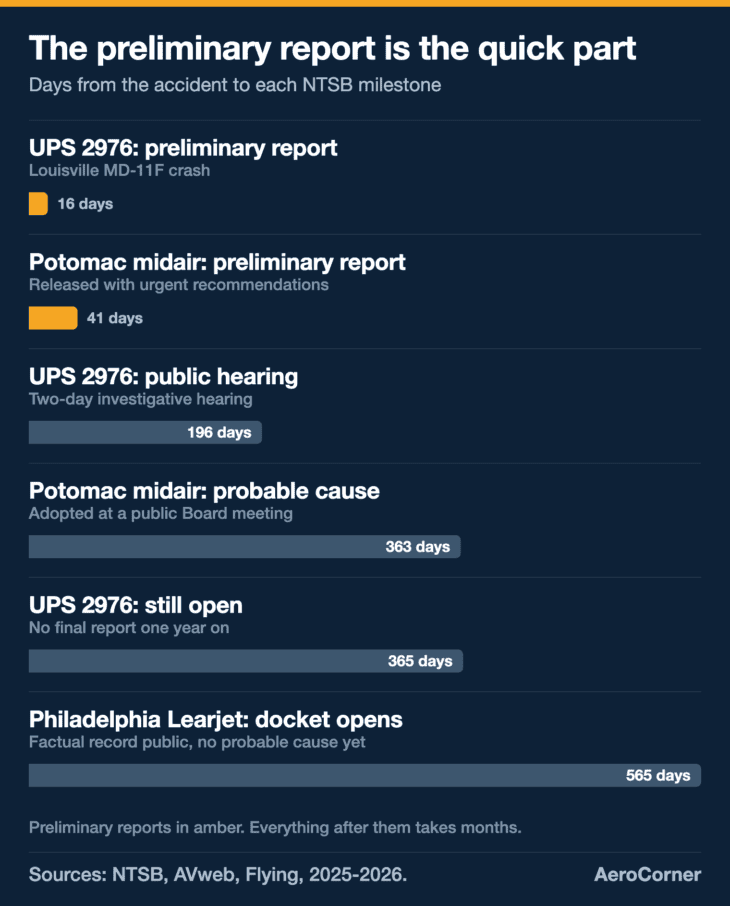
The UPS Flight 2976 crash at Louisville on November 4, 2025, shows how much fact a preliminary report can carry. The report, released 16 days after the MD-11 freighter went down and killed 14 people, said the left engine and its pylon separated from the wing moments after rotation. Lab work had already found fatigue cracking on multiple fracture surfaces of the pylon’s aft mount.
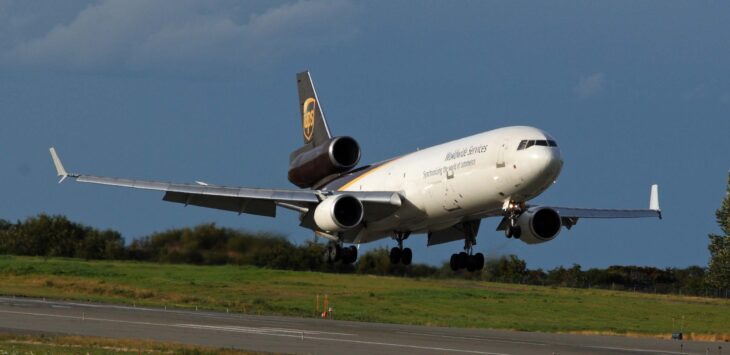

That sounds like a cause. The NTSB did not call it one. Investigators were still working out the extent and origin of the cracking, and the report stated no cause at all.
| In a preliminary report | Not in a preliminary report |
|---|---|
| The sequence of the flight, as far as it is known | Why the sequence happened |
| The aircraft, registration and operator | Any finding of fault or blame |
| What was found at the scene and in early lab work | Analysis of what those findings mean |
| Facts gathered in the first weeks | The probable cause and contributing factors |
| A “subject to change” warning | Most safety recommendations (those usually come with the final report) |
Why the NTSB Won’t Name a Cause Early
The main reason is that a month is not enough time to know. The NTSB’s guidance says the preliminary report holds “only a portion of the factual evidence to be gathered in the investigation,” and it asks journalists not to use it to speculate about the cause. Maintenance records, recorder data, simulations and lab tests are often still weeks or months away.
The agency is also blunt about the report’s reliability. Its information quality policy says preliminary reports are not covered by its quality guidelines, are “subject to change,” and “may contain errors,” which “will be corrected when the final report has been completed.”
The second reason is the law. Under 49 CFR 831.4, NTSB investigations are “fact-finding proceedings with no adverse parties,” and they are not conducted to determine “the rights, liabilities, or blame of any person or entity.” A preliminary report that hinted at a cause would be a verdict without the evidence to support it.
From Preliminary Report to Probable Cause
The preliminary report is one stop on a much longer road. The NTSB says it tries to complete an investigation within 12 to 24 months, and its media guidance warns that a cause “may not be determined for one to two years after the accident.” The stages overlap rather than running strictly in order.
On scene. A go-team led by an investigator-in-charge, a senior career investigator, documents the wreckage and collects evidence. A Board member often travels with the team as spokesperson, but the NTSB stresses that “board members are not investigators and do not lead the investigation.”
The party system. The NTSB names outside organizations as parties to supply technical experts, such as the aircraft manufacturer and the operator. Under 49 CFR 831.11, only organizations whose people, activities or products were involved can be parties, and the FAA is automatically one in every aviation investigation. Party representatives who release investigative information without permission risk removal from the process.
Investigative updates and hearings. In big cases, the NTSB may publish interim updates and hold a public hearing to gather testimony. The UPS 2976 investigation got an investigative update on January 14, 2026, and a two-day hearing on May 19 and 20, 2026.
The public docket. Once fact-gathering ends, the NTSB opens a docket: the factual record, including interviews, data, photos and specialist reports. For the January 2025 Learjet 55 medevac crash in Philadelphia, the docket opened on August 19, 2026, with no probable cause yet.
The final report. The NTSB alone analyzes the facts and writes the findings, probable cause and recommendations. The report is adopted either by the director of the relevant NTSB office under delegated authority or by the five-member Board, sometimes in a public meeting in Washington.
Not every accident gets that full treatment. The NTSB sorts aviation investigations into four classes, and the smallest, Class 4, is “limited in scope and of the shortest duration,” generally conducted remotely, with a final report due within six months. That tiered approach is how the agency gets through roughly 1,200 aviation accidents and incidents a year.
Safety Fixes Don’t Wait for the Final Report
The one thing that can move faster than the paperwork is a safety recommendation. The NTSB says urgent recommendations “may be issued at any point in the investigation,” even though most arrive with the final report.
The January 29, 2025, midair collision between an Army Black Hawk and a PSA Airlines regional jet near Reagan National Airport killed 67 people. On March 11, 2025, the same day it released the preliminary report, the NTSB urged the FAA to bar helicopter operations near the airport whenever runways 15 and 33 were in use, calling the mix “an intolerable risk to aviation safety.”
The probable cause came much later, at a public Board meeting on January 27, 2026, two days short of a year after the crash. The Board cited the placement of a helicopter route close to the runway approach path, among other factors.
The report a court can't see
Federal law (49 U.S.C. 1154(b)) says no part of an NTSB report on an accident may be admitted into evidence or used in a civil lawsuit for damages. The NTSB’s own rules draw a line: the Board’s report with the probable cause is barred, but the agency does not object to the factual accident report being used in litigation. The facts are open; the conclusions are not.
The Myth: “The Preliminary Report Points to the Cause”
Myth
A preliminary report is an early draft of the verdict, so whatever it highlights is what went wrong.
Preliminary reports often contain one striking fact, and that fact becomes the story. Sometimes the final report confirms that it mattered. Sometimes the fact turns out to be a consequence of the accident rather than its cause, or one link in a chain that runs back through maintenance, training, design or regulation.
The NTSB builds that distinction into the document on purpose. Fatigue cracks in a pylon, ice reported by a crew, or a recorder that was not working are facts. Whether they caused the crash is the question the next 12 to 24 months exist to answer.
The same caution applies to everything said on scene. The NTSB “will not announce the cause of an accident while on scene,” and it insists that “only the NTSB may release information about the investigation.” A party, an operator or a lawyer quoted in the news is not speaking for the investigation.
Where to Find and How to Read One
Preliminary and final reports live in CAROL, the NTSB’s Case Analysis and Reporting Online database, which holds aviation investigation records from 1962 to the present. It has a dedicated aviation search, and results download as CSV or JSON. Dockets are not in CAROL yet; they have their own docket search.
Read a preliminary report the way investigators wrote it. Note what is stated as fact, note the things that are conspicuously absent, and treat every number as provisional. If you want the agency itself, rather than its reports, our guide to the NTSB covers what it is and how it differs from the FAA.
Recorders are a common gap in early reports, because their data takes time to download and analyze, and some aircraft do not carry them at all. Whether a given jet needs one depends on its seats and its rulebook, which is why not every private jet has a black box.
So when the Greenacres preliminary report lands, expect a careful account of the flight’s final minutes and of what the wreckage showed. Do not expect a reason. The NTSB has not found a cause, and the preliminary report is the one document built to make sure it doesn’t pretend to.
Sources and references used for research and fact-checking.
- National Transportation Safety Board, Media Resources
- National Transportation Safety Board, The Investigative Process
- National Transportation Safety Board, Aviation Investigation Classification
- National Transportation Safety Board, Quality of Information
- National Transportation Safety Board, CAROL
- Legal Information Institute, Cornell Law School, 49 CFR 831.4, Nature of investigation
- Legal Information Institute, Cornell Law School, 49 CFR 831.11, Parties to the investigation
- Legal Information Institute, Cornell Law School, 49 U.S.C. 1154, Discovery and use of cockpit and surface vehicle recordings and transcripts
- Legal Information Institute, Cornell Law School, 49 CFR 835.2, Definitions
- National Transportation Safety Board, UPS Flight 2976 investigation page (DCA26MA024)
- AVweb, NTSB: UPS MD-11F Preliminary Report
- National Transportation Safety Board, NTSB Makes Urgent Recommendations on Helicopter Traffic Near Reagan National Airport
- Flying, NTSB Cites Multiple Factors Behind Washington Midair Collision
Get the Newsletter
The latest aviation news and stories sent to your inbox.
About the Author

Tim is the owner and lead editor of AeroCorner since 2019, overseeing aviation content covering aircraft, airlines, airports, and the broader aviation industry. Through years of researching, writing, editing, and publishing aviation-focused content, he has developed extensive practical knowledge of commercial aviation and air travel. Based in Asia and a frequent traveler himself, Tim also brings firsthand passenger experience to AeroCorner’s coverage. Outside of publishing, he has also explored aviation firsthand through hands-on flight training in New Zealand.