

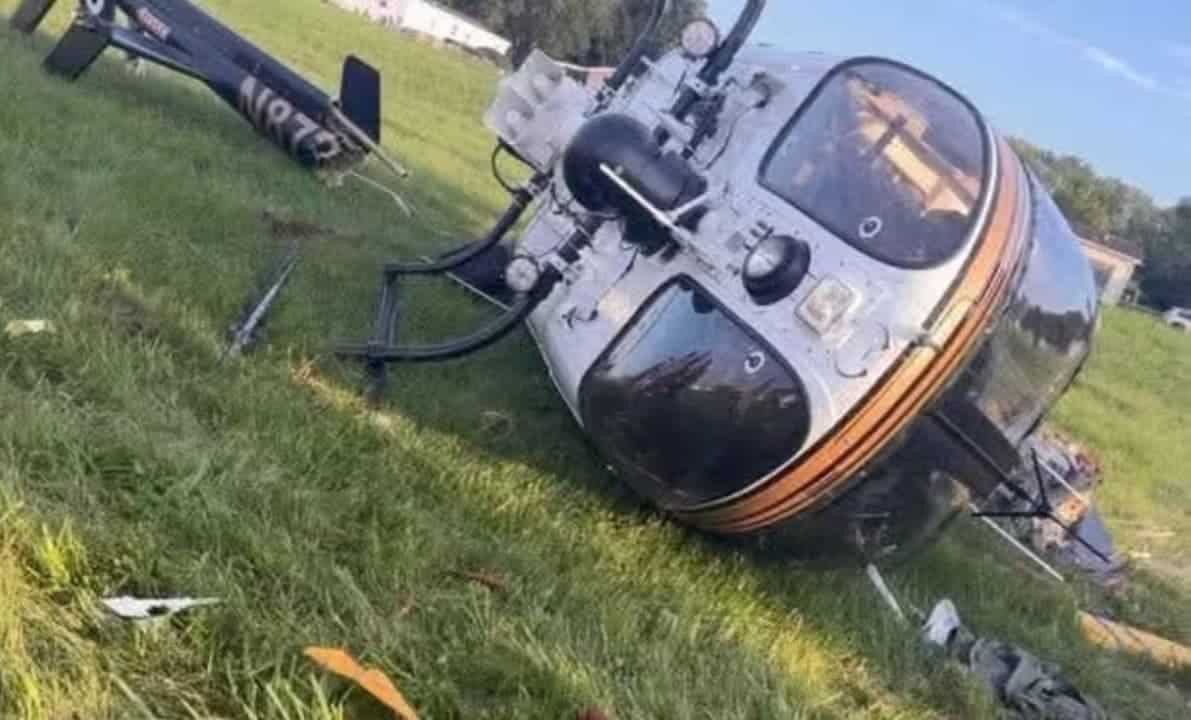
On September 2, 2026, the National Transportation Safety Board released its preliminary report on the August 19 midair collision at Carlisle Regional Airport in Pennsylvania. The crash killed the pilot of a Cessna 150, Dr. Paul Sokoloski, and injured the two-trooper crew of a Pennsylvania State Police helicopter.
The report lays out a second-by-second sequence built from airport surveillance video, the surviving crew’s account, and a witness who monitored the radio frequency. It does not say why the collision happened.
What the Report Describes
According to the NTSB, the police helicopter landed on runway 28 at about 6:51 p.m., rolled roughly 1,800 feet down the 4,008-foot runway, then turned north and moved over a grass field beside it. Sokoloski’s Cessna 150 was behind it, set up to land on the same runway.
The helicopter’s flight instructor told the Cessna to extend its downwind leg, the standard way to open up spacing behind traffic at an airport with no tower. Sokoloski acknowledged, later asked whether he should extend farther, was told yes, and reported that he was second in line to land.
Airport video showed the Cessna cross the runway threshold about 30 seconds after the helicopter did. It never landed. The report describes the airplane flying low along the runway with its wings rocking, then pitching up to about one wingspan above the surface before the right wing dropped and it turned right.
It struck the rear of the Bell 407, which was hovering about 50 feet north of the runway, roughly eight seconds after the helicopter left the pavement. The troopers told investigators they never saw the airplane, which came at them from behind.
The Cessna broke into four major pieces and the helicopter lost its main rotor blades and tail boom. Investigators found no sign of a mechanical failure on either aircraft before impact, and noted that the Cessna’s wing flaps were retracted.
What a Preliminary Report Is For
A preliminary report is a factual snapshot, not a conclusion. The NTSB publishes one within about 30 days of an accident to put the basic sequence on the public record. It carries no analysis, assigns no fault, and names no probable cause.
That leaves the central question exactly where it was in the first days after the crash. An airplane that had been told to extend its approach, and had acknowledged the instruction, ended up fast and low over the runway with its flaps up and its wings rocking, on a flight path that never resembled a landing.
The NTSB has said it is running weather and aircraft performance studies, including one on whether the helicopter’s rotor downwash disturbed the light Cessna. A hovering helicopter drives a fast sheet of air outward across the ground, and a 1,600-pound (730 kg) trainer on short final has little energy to spare.
Still not a finding
A preliminary report records facts only. The NTSB has not determined a probable cause, has ruled nothing in or out, and has cautioned that it is too early to attribute the Cessna’s behavior to rotor wash or anything else. A final report on a fatal general aviation accident usually takes a year or more.
The full account was first published by NBC10 Philadelphia and corroborated by WFMZ. The NTSB is tracking the investigation as case ERA26FA309.
Sources and references used for research and fact-checking.
Get the Newsletter
The latest aviation news and stories sent to your inbox.
About the Author

Tim is the owner and lead editor of AeroCorner since 2019, overseeing aviation content covering aircraft, airlines, airports, and the broader aviation industry. Through years of researching, writing, editing, and publishing aviation-focused content, he has developed extensive practical knowledge of commercial aviation and air travel. Based in Asia and a frequent traveler himself, Tim also brings firsthand passenger experience to AeroCorner’s coverage. Outside of publishing, he has also explored aviation firsthand through hands-on flight training in New Zealand.