

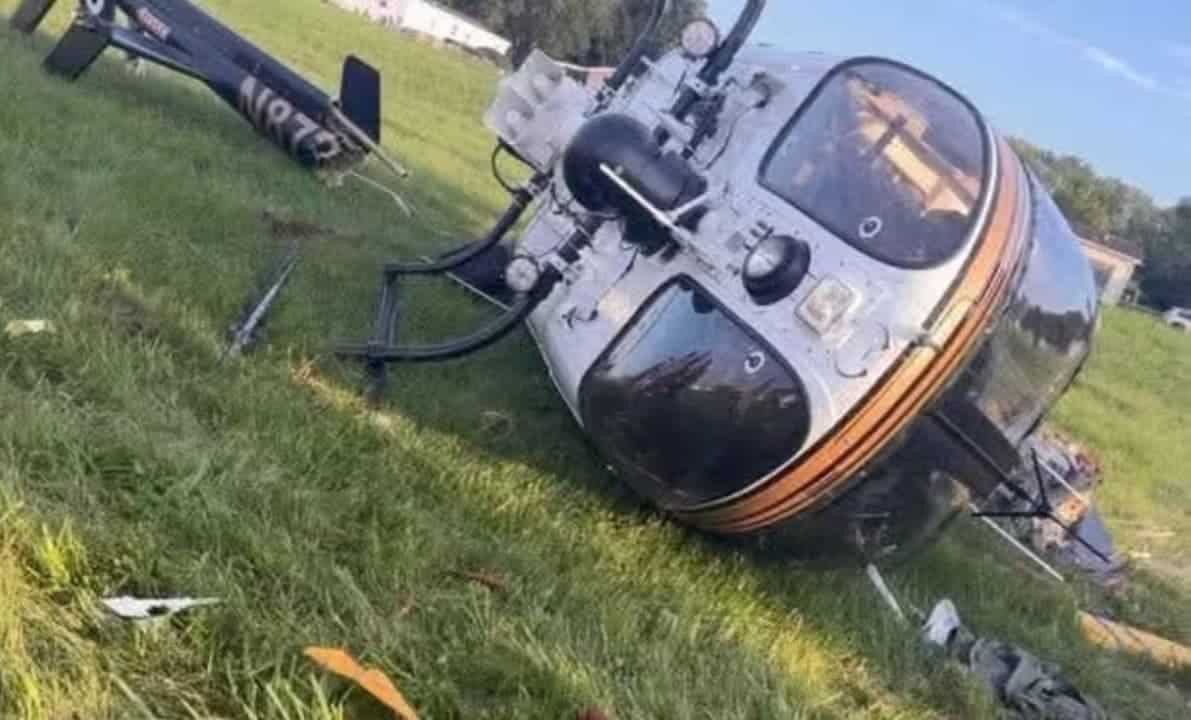
On August 19, 2026, a small plane collided in midair with a Pennsylvania State Police helicopter at Carlisle Regional Airport in Cumberland County, Pennsylvania, killing the plane’s pilot and injuring both troopers aboard the helicopter.
What Happened at Carlisle Regional Airport
The helicopter, a Bell 407 flown by the state police’s aviation unit, was hovering a few feet above a grassy strip beside the runway during a training exercise, according to AVweb. The crew was practicing a low-altitude maneuver known as a hover taxi.
A Cessna 150 was on approach to land at the non-towered field when it veered sharply right in the final seconds before impact, striking the helicopter’s tail rotor and then its main rotor, officials said.
The Cessna’s only occupant, Dr. Paul Sokoloski, 57, an emergency physician at Penn State Health and a licensed multi-engine and commercial pilot, was killed. Cpl. Bryce Corman and Trooper Jason Mills, the helicopter’s two pilots, were hospitalized in stable condition.
“The pilots would not have been able to even see that airplane approaching them,” Pennsylvania State Police Acting Commissioner Col. George Bivens told reporters at the scene.
What Investigators Have Found So Far
Carlisle Regional has no control tower, so pilots announce their positions to each other over a shared radio frequency instead of taking instructions from a controller. As CNN reported, the NTSB said the two aircraft had exchanged radio calls before the collision and found strong evidence the Cessna pilot knew the helicopter was there.
Those calls were not recorded, so investigators do not yet know exactly what was said. Why the Cessna suddenly turned into the helicopter, whether from a mechanical problem, a control input, or something else, has not been determined.
By August 21, the NTSB had recovered memory cards from both aircraft’s onboard electronics and moved the wreckage to a facility for further examination, NBC10 Philadelphia reported. No probable cause has been released.
August 19, 2026
Midair collision. A Cessna 150 struck a Pennsylvania State Police Bell 407 hovering beside the runway at Carlisle Regional Airport, killing the Cessna’s pilot and injuring the helicopter’s two-pilot crew.
August 20, 2026
NTSB update. Investigators said the Cessna pilot and helicopter crew had exchanged radio calls before the collision, though the calls were not recorded and the Cessna’s abrupt turn remains unexplained.
August 21, 2026
Evidence recovery. The NTSB confirmed it had pulled memory cards from both aircraft’s electronics and relocated the wreckage for examination, with no findings released yet.
Why This Kind of Collision Happens at Small Airports
Non-towered fields normally work because every pilot self-announces on the same frequency and listens for traffic in the pattern. A helicopter hovering beside an active runway is routine practice, but it depends on both aircraft hearing those calls and acting on them in time.
Key fact
More than 90% of the roughly 5,000 public-use airports in the US, Carlisle Regional included, have no control tower, according to FAA guidance on non-towered airport operations.
Investigators have focused on how fixed-wing and rotor traffic share airspace before. After last year’s fatal collision between a regional jet and an Army helicopter near Washington, the NTSB pressed Congress for collision-avoidance reforms, though those recommendations targeted controlled airspace around a major airport, not a rural, non-towered field like Carlisle.
Fatal accidents involving small general aviation aircraft, like the Piper PA-28 that crashed near Chandler Airport earlier this year, are also typically probed for a single point of failure in pilot judgment, mechanical condition, or procedure rather than a systemic flaw.
Reality check
Non-towered airports handle the large majority of US general aviation traffic safely every day. A midair collision like this one is rare enough that investigators study it precisely because the self-announce system otherwise works.
Sources and references used for research and fact-checking.
Get the Newsletter
The latest aviation news and stories sent to your inbox.
About the Author

Tim is the owner and lead editor of AeroCorner since 2019, overseeing aviation content covering aircraft, airlines, airports, and the broader aviation industry. Through years of researching, writing, editing, and publishing aviation-focused content, he has developed extensive practical knowledge of commercial aviation and air travel. Based in Asia and a frequent traveler himself, Tim also brings firsthand passenger experience to AeroCorner’s coverage. Outside of publishing, he has also explored aviation firsthand through hands-on flight training in New Zealand.