

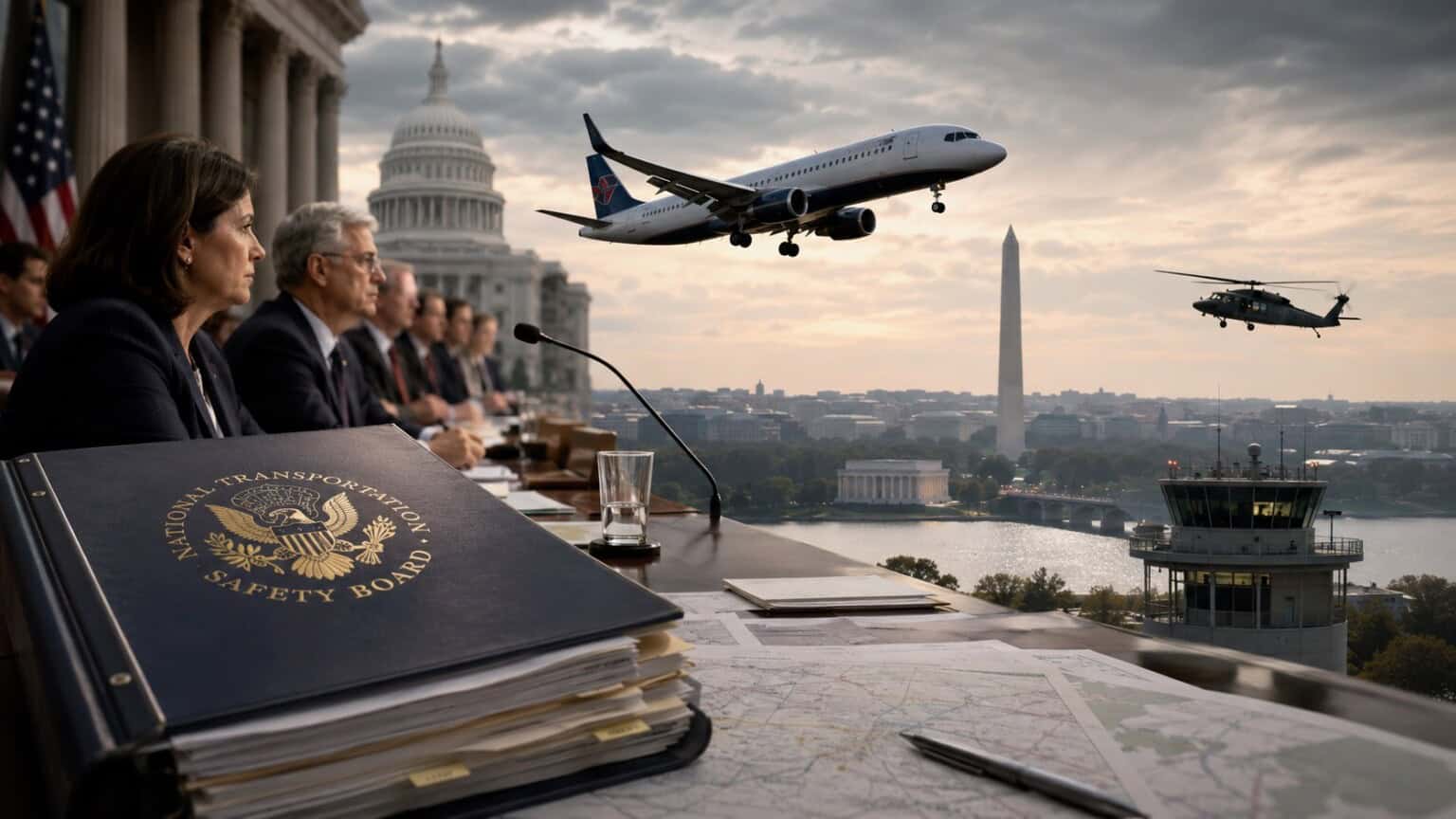
On July 27, 2026, National Transportation Safety Board Chair Jennifer Homendy pressed Congress to break a monthslong standoff and enact all 50 safety recommendations issued after the January 2025 midair collision near Ronald Reagan Washington National Airport. In a letter to House and Senate leaders, she warned that lawmakers had left for the August recess without agreeing on a final aviation safety bill.
“Every day, every minute, that passes without implementation of all 50 NTSB recommendations represents a continued and unacceptable risk to public safety,” Homendy wrote, according to the letter. She said the board had “provided a clear roadmap to improve aviation safety and reduce the risk of another catastrophic midair collision.”
What the NTSB asked for
The collision on January 29, 2025, killed 67 people. An American Eagle regional jet, a PSA Airlines Bombardier CRJ700, collided over the Potomac River with a U.S. Army Sikorsky UH-60 Black Hawk while on final approach to the airport.
The NTSB’s final report, released in January 2026, contained 75 findings and 50 recommendations directed at the Federal Aviation Administration and the Army. Among them: permanently closing the helicopter route that ran past the airport, and suspending the practice of “visual separation,” in which controllers let a pilot take over the job of keeping clear of nearby traffic by sight.
Homendy urged both chambers to “work through differences during this recess so that a final package can be voted on when Congress returns in September.”
Why the fix has stalled
The Senate passed its version, the ROTOR Act, in December 2025. The House passed a different bill, the ALERT Act, in April 2026 by a lopsided 396 to 10. The two have not been reconciled into a single law.
Homendy has argued the House version falls short of what the NTSB actually recommended. She has pointed to language that would ask the FAA to draft rules for “the best locator technology” rather than mandate ADS-B In traffic-awareness equipment outright, and to exemptions for some business jets and small aircraft in busy airspace.
Why the NTSB cannot just fix it itself
The NTSB investigates accidents and issues recommendations, but it has no power to require anyone to act on them. The FAA writes the rules, and in this case Congress is legislating the changes. That gap between finding a cause and forcing a fix is why the board is now lobbying lawmakers in public.
That distinction is the heart of the dispute. A recommendation carries the NTSB’s authority as an investigator, but not the force of law, so how faithfully Congress translates the 50 items into binding requirements determines what actually changes at airports like Reagan National. It is the same layered system that governs how mid-air collisions are prevented across US airspace.
The pressure reflects how rare an accident this was. The crash was the deadliest US commercial aviation disaster in more than two decades, and the board has repeatedly framed it as the result of systemic failures rather than a single mistake. A separate head-on near-miss over the Atlantic this month underscored how thin the margins can be when separation breaks down.
Where it stands
Congress is in recess until September. Homendy has asked negotiators to reconcile the Senate ROTOR Act and House ALERT Act during the break so a final bill can pass when lawmakers return. Until then, none of the 50 recommendations is law.
Sources and references used for research and fact-checking.
Get the Newsletter
The latest aviation news and stories sent to your inbox.
About the Author

Tim is the owner and lead editor of AeroCorner since 2019, overseeing aviation content covering aircraft, airlines, airports, and the broader aviation industry. Through years of researching, writing, editing, and publishing aviation-focused content, he has developed extensive practical knowledge of commercial aviation and air travel. Based in Asia and a frequent traveler himself, Tim also brings firsthand passenger experience to AeroCorner’s coverage. Outside of publishing, he has also explored aviation firsthand through hands-on flight training in New Zealand.