

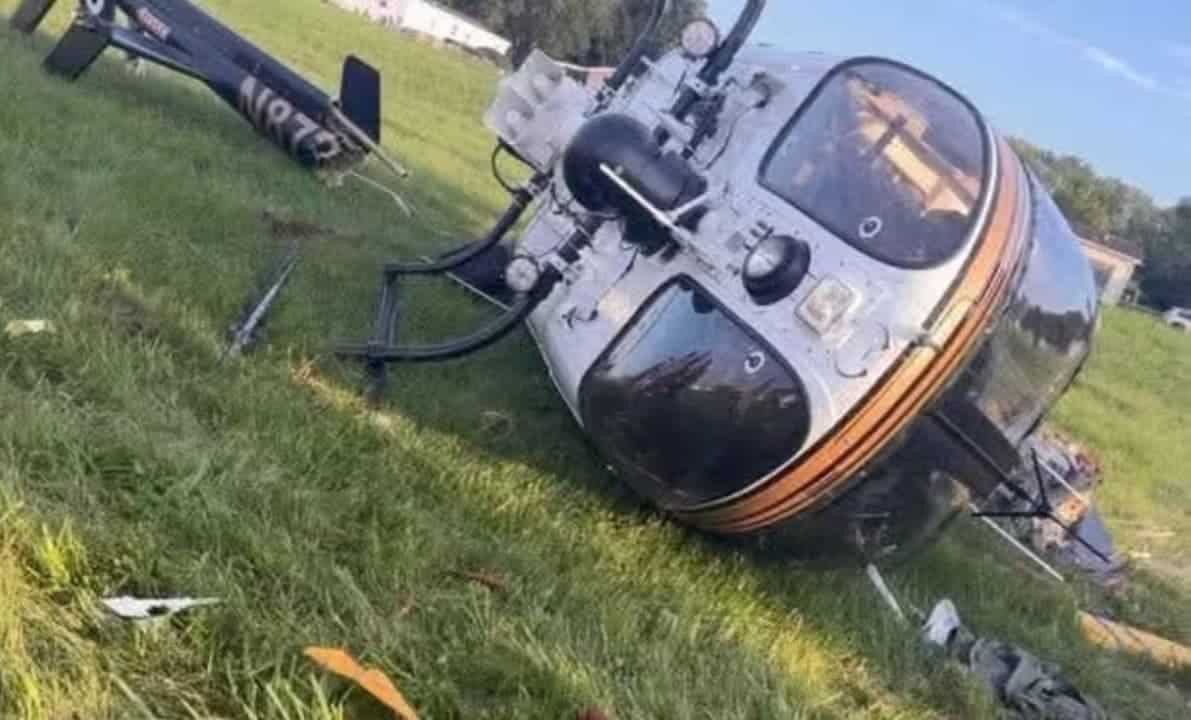
Investigators examining the August 19 midair collision at Carlisle Regional Airport have described an aircraft that was already flying abnormally in the seconds before it struck a hovering Pennsylvania State Police helicopter. Aaron McCarter, the NTSB’s investigator-in-charge, gave the account at a briefing on August 21.
The collision killed the airplane’s pilot, Dr. Paul Sokoloski, and injured the helicopter’s two-trooper crew. No probable cause has been determined.
What the Video Shows
McCarter said video captured the Cessna 150 in what he called an unusual attitude: a steep nose-up pitch with the right wing low, and the wings rocking back and forth. The airplane then briefly leveled.
From there it flew off the right side of Runway 28 and struck the helicopter, according to CBS 21. Investigators have not established when the erratic flying began.
McCarter also clarified the geometry: the Bell 407 was not on the runway when the collision happened. It was beside it, hover-taxiing a few feet above the grass on a training flight.
That detail matters because it rules out the simplest reading of the accident. This was not an airplane landing on a runway that a helicopter was occupying.
Why Rotor Wash Is Now on the List
The NTSB will order weather and aircraft performance studies, including one examining whether rotor wash from the helicopter affected the Cessna, McCarter said. He cautioned that it is far too early to draw any conclusion on that.
Here is why the question is a reasonable one to test. A helicopter in a hover stays up by driving a column of air downward, and close to the ground that column has nowhere to go but sideways.
The result is a fast, turbulent sheet of disturbed air spreading outward from the aircraft. Pilots are taught to give hovering helicopters room for exactly this reason.
A Cessna 150 is about as exposed to that as a certificated airplane gets. It is a two-seat trainer with a maximum takeoff weight around 1,600 pounds (730 kg), and on short final it is slow, low, and carrying very little energy margin.
A disturbance a heavier aircraft would barely register can be a genuine upset for a light trainer in that part of the approach. Whether anything like that happened at Carlisle is precisely what the performance study is meant to answer.
The Recording Gap, and the One Thing That Changes
Carlisle Regional has no control tower, so pilots coordinate with each other on a common traffic advisory frequency rather than with a controller. McCarter confirmed there was reciprocal communication between Sokoloski and the troopers on that frequency before the collision.
What they actually said is gone. The airport was not recording the frequency, and there is no federal requirement that a non-towered field do so.
That is the practical cost of the gap: investigators know the two aircraft were talking, and cannot hear the conversation. McCarter said Carlisle now plans to record the frequency more consistently going forward, per Aero Crew News.
The NTSB also plans to obtain the helicopter’s maintenance records from the FAA and to examine flight records to reconstruct the training scenario the crew was flying.
None of this is a finding
A preliminary report is normally published about 30 days after an accident, and a probable cause typically takes a year or more. The video description, the rotor wash question and the records review are open lines of inquiry, not conclusions, and the NTSB has said explicitly that it is too early to attribute the Cessna’s behaviour to any cause.
Still, the shape of the story has shifted. The first account read as an airplane that turned into a helicopter it should have seen and avoided.
The NTSB’s description points somewhere else: an airplane that was not flying normally before the two flight paths ever converged. That changes what investigators have to explain, and it is why the question of what upset the Cessna now sits ahead of the question of who saw whom.
Sources and references used for research and fact-checking.
Get the Newsletter
The latest aviation news and stories sent to your inbox.
About the Author

Tim is the owner and lead editor of AeroCorner since 2019, overseeing aviation content covering aircraft, airlines, airports, and the broader aviation industry. Through years of researching, writing, editing, and publishing aviation-focused content, he has developed extensive practical knowledge of commercial aviation and air travel. Based in Asia and a frequent traveler himself, Tim also brings firsthand passenger experience to AeroCorner’s coverage. Outside of publishing, he has also explored aviation firsthand through hands-on flight training in New Zealand.