Fighter Jets
Chengdu J-10 Vigorous Dragon
ICAO: J10
China's first stealth fighter, built for long-range air superiority
Updated: by Tim de Vries

The latest aviation news and stories sent to your inbox.
The Chengdu J-20 is China’s first operational stealth fighter, a twin-engine single-seat air superiority aircraft built for the People’s Liberation Army Air Force. It first flew in January 2011, entered service in March 2017, and is known in Chinese as Weilong, or Mighty Dragon, with the NATO reporting name Fagin. Around 500 had been delivered by mid-2026, and the improved J-20A and twin-seat J-20S formally joined the fleet on 3 September 2025. The type is not exported.
Live Fleet Activity (J20)
Fetching live data…


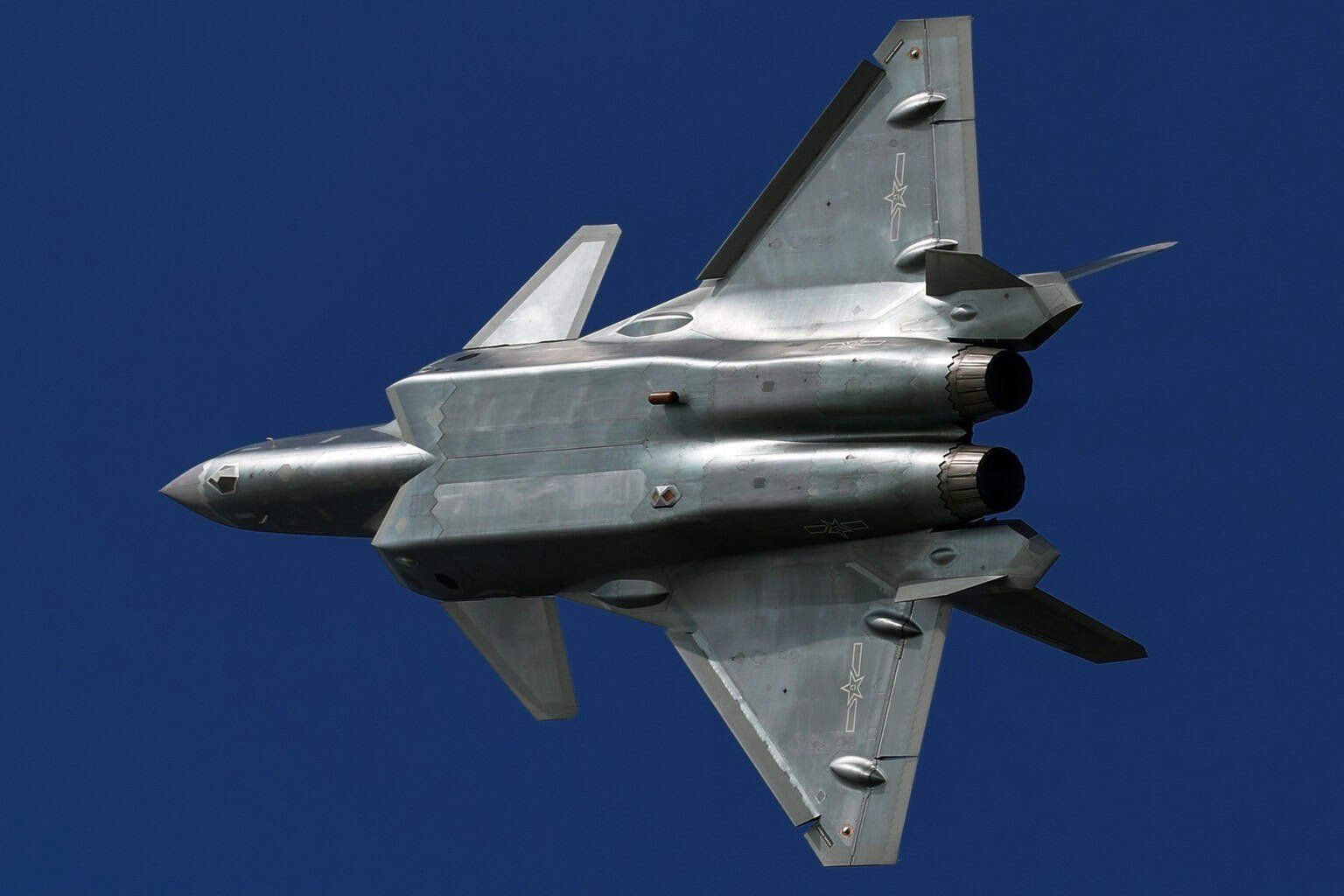


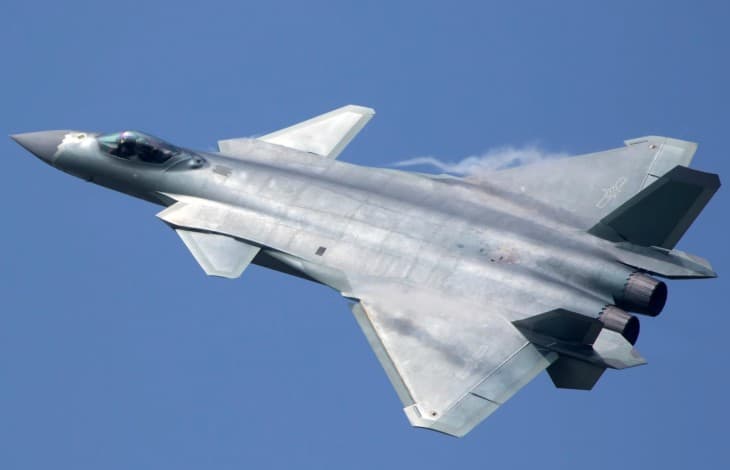
The Chengdu J-20 is China’s first operational stealth fighter, a twin-engine, single-seat air superiority aircraft built by Chengdu Aircraft Corporation for the People’s Liberation Army Air Force. It carries the Chinese name Weilong, usually translated as Mighty Dragon, and the NATO reporting name Fagin.
It first flew on 11 January 2011 and entered PLAAF service on 8 March 2017. That made China the second country in the world to field an operational stealth fighter, after the United States.
The J-20 is designed as an air superiority fighter with precision strike capability, not as a strike aircraft that also fights. Its two large internal bays and its long fuselage are built around carrying long-range air-to-air missiles a long way from home without hanging anything under the wings.
The aircraft is not exported. Every J-20 built serves with the PLAAF, which separates it from most of the other jets on our list of the best Chinese fighter jets.
The J-20 descends from the J-XX program of the 1990s, China’s first serious attempt to define a stealth fighter requirement. Chengdu’s design beat a competing proposal to win the work, and airframe construction began in 2009.
The prototype’s first flight in January 2011 coincided with a visit to China by US Secretary of Defense Robert Gates. Gates said afterward that he had asked President Hu Jintao about it directly, and that Hu told him the test was pre-planned and had nothing to do with the visit.
The aircraft was not shown in public until the 2016 Zhuhai airshow, five years later. Serial production began in October 2017.
The J-20 joined PLAAF training units in March 2017 and combat units in February 2018. The 9th Fighter Brigade at Wuhu Air Base in Anhui province converted to the type between late 2018 and March 2019, replacing its Su-30MKKs.
The J-20 has a long blended fuselage with a chiseled nose and a frameless bubble canopy. Behind the cockpit sit diverterless supersonic inlets, then all-moving canards with pronounced dihedral, then leading-edge root extensions that merge into a delta wing with forward-swept trailing edges.
The tail is unusual. Instead of large fixed fins, the J-20 uses twin outward-canted all-moving fins plus short, deep ventral strakes.

The canard layout is there for a specific reason. A conventional tailplane loses authority at high angle of attack because it stalls, while a canard deflects the other way and keeps working, which preserves pitch control exactly where an air superiority fighter needs it.
Chengdu’s designers claim the canard, leading-edge extension and body-lift combination generates 1.2 times the lift of an ordinary canard delta and 1.8 times that of an equivalent pure delta. The payoff is a smaller wing for a given lift, which cuts supersonic drag.
Chief test pilot Li Gang has described the J-20 as roughly as maneuverable as the Chengdu J-10 while being far better at staying hidden.
Analysts generally rate the J-20’s airframe shaping as serious work rather than an imitation. The chined forebody, the reshaped radome, the electroconductive canopy and the serpentine S-ducts behind the inlets all follow the same logic the F-22 uses, and the ducts hide the engine faces from radar.
Other low-observable details show up across the airframe: a flat fuselage underside holding the main weapons bay, sawtooth edges on bay and access doors, mesh over the cooling ports at the base of the fins, antennas buried in the skin, and radar-absorbent coatings.
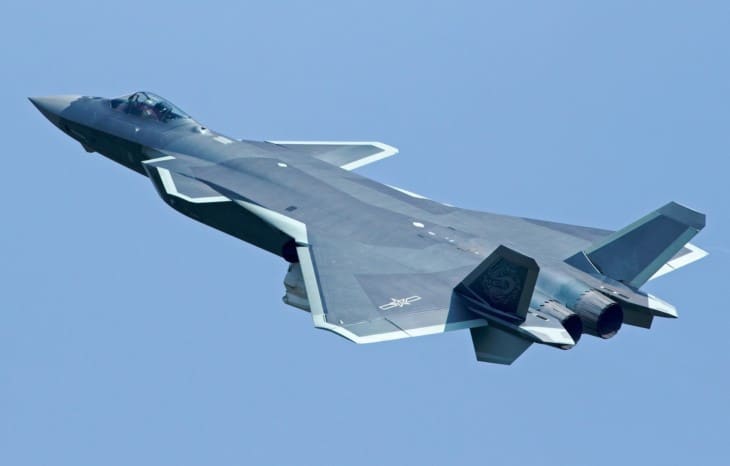
The long-running argument is about the canards. Critics say moving surfaces ahead of the wing guarantee a radar return and compromise the whole design.
That objection is weaker than it sounds. Northrop Grumman’s Advanced Tactical Fighter proposal used canards on a stealth airframe, Lockheed Martin carried canards into early Joint Strike Fighter work, and the X-36 was considered extremely stealthy with them. Deflection can also be managed in the flight-control software, as the Eurofighter does.
The weaker areas are aft. Round engine nozzles on the earlier aircraft were a clear rear-aspect problem, which the serrated nozzles on the WS-10C production jets were introduced to address. For where the J-20 sits against other low-observable designs, see our guide to stealth fighter jets.
Engines have been the J-20’s defining constraint. Prototypes and the first service aircraft used an improved Russian Salyut AL-31FM2, rated at roughly 145 kN in its special power setting, because the intended Chinese engine was not ready.
From 2019 Chengdu switched to the domestic Shenyang WS-10C, rated at 142 to 147 kN with afterburner and fitted with serrated nozzles. The PLAAF began receiving WS-10C aircraft by 2021, and that engine powers most of the fleet flying today.
The WS-15 is the engine the airframe was designed around, rated between roughly 162 and 180 kN. It reached serial production in 2023, and in January 2026 Chengdu released images of a J-20A flying with production WS-15s, moving the program from test aircraft to deliverable ones.
The difference matters because the WS-15 is what turns claimed supercruise into sustained supercruise, and its thrust margin is what the aircraft needs to match the F-22’s acceleration. Reports differ on whether the WS-10C supports limited or full supersonic cruise.
China has never released official details of the J-20’s radar. Janes and other analysts believe it uses a Type 1475 (KLJ-5) active electronically scanned array with about 1,856 transmit and receive modules, and some assess that the nose cross-section could accommodate 2,000 to 2,200 modules in an upgrade.
Around the radar sits an electro-optical suite that looks deliberately similar to the F-35’s. A chin-mounted electro-optical targeting sensor handles air-to-air work, and the EORD-31 infrared search and track plus six passive sensor windows give omnidirectional coverage.
Those passive sensors are the part worth paying attention to. Infrared search and track does not care about radar-absorbent material, which is how a stealth fighter expects to find another stealth fighter.
The cockpit is fully digital, built around one large color touchscreen with three smaller auxiliary displays and a wide-angle holographic head-up display.
The J-20 carries its weapons in three internal bays. The large main bay under the fuselage takes four medium or long-range air-to-air missiles, or precision-guided bombs, while two small lateral bays behind the intakes each hold one short-range PL-10.
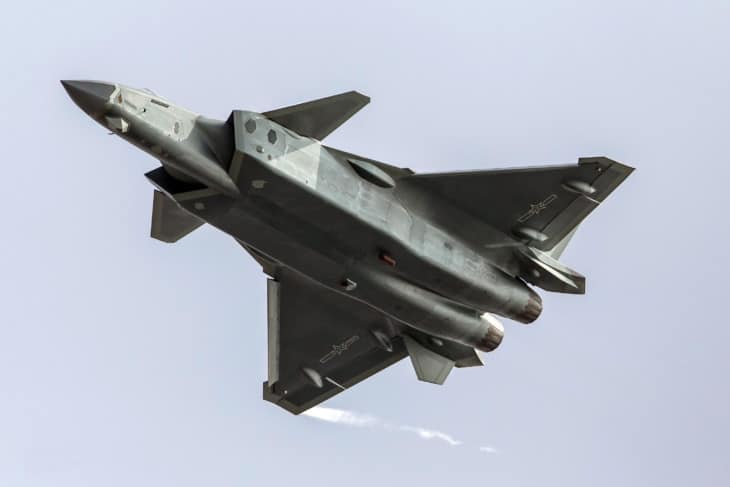
Those lateral bays are a genuinely clever piece of design. The missile rail swings out, the doors close behind it, and only then does the missile fire, so the aircraft is never flying with an open bay waiting for a launch.
The main armament is the PL-15 long-range missile, with the shorter PL-12 and the short-range PL-10 also cleared. The PL-16, a slimmer PL-15 with folded fins meant to let more fit inside, and the very-long-range PL-21 were both reported in development, and the United States assessed in 2023 that China intended to raise the internal missile count in low-observable configuration.
Four underwing hardpoints exist for drop tanks or for carrying up to eight PL-15s externally, which is a ferry and non-stealth configuration rather than a combat one. The J-20 carries no internal gun, which tells you plainly what kind of fight it was built for.
The original J-20 is the aircraft that entered serial production in October 2017, flying first on AL-31FM2 engines and then on WS-10Cs. Analysts originally labeled this one J-20A and the later engine upgrade J-20B, which is why older sources disagree with current ones.
The J-20A is the improved airframe: a slightly raised cockpit, an enlarged spine, a reshaped nosecone and modified intakes optimized for the WS-15, plus overhauled software, avionics, sensors, structures and thermal management. The first prototype was spotted in December 2022.
The J-20S is the twin-seat version, the first twin-seat stealth fighter in the world. It was first seen in October 2021 in primer, revealed at Zhuhai in 2024, and Chinese state media confirmed in 2026 that it is built for air superiority, precision strike, airborne early warning, electronic warfare and manned-unmanned teaming.
Both the J-20A and the J-20S formally joined the PLAAF fleet on 3 September 2025. The back-seater is there to manage sensor data and unmanned wingmen rather than to fly the aircraft, and Chinese media showed the concept in October 2022 with a J-20S controlling a stealthy Hongdu GJ-11 drone.
The full specification table for the aircraft is on this page. A few of those figures need context, because China publishes almost nothing officially and the numbers that circulate come from analysts working from photographs.
The dimensions are the clearest example. Published length runs from 20.3 m to 21.2 m across credible sources, and wingspan from 12.88 m to 13.5 m, so the panel uses the 20.4 m and 13.5 m figures that ICAO’s Doc 8643 entry and the Mitchell Institute’s tracker agree on.
Range and combat radius get quoted against each other constantly. Maximum range figures cluster at 3,200 nm in the ICAO Doc 8643 entry and 3,240 nm in the Mitchell Institute’s tracker, while the Wikipedia specification block gives 5,500 km, about 2,970 nm, flown with two external tanks.
The number that matters for a combat mission is smaller: a radius of roughly 1,080 nm. That reach is the single biggest reason the aircraft is as large as it is.
The speed figure is a Mach number in its original source: Mach 2.0, or about 2,130 km/h at altitude, which is what the panel’s knots value converts. There is no published cruise speed, because the supercruise claims attached to the WS-10C and WS-15 have never come with a number.
There is no official price either. Estimates from analysts have ranged from $30 million to $120 million per aircraft, and the $100 million figure shown here sits at the upper end of that spread rather than being a confirmed cost.
Production has accelerated sharply. USAF analyst Derek Solen estimated 50 to 74 aircraft in service in January 2022; the International Institute for Strategic Studies reported more than 200 produced by the end of 2023.
By mid-2024 Janes put roughly 195 in PLAAF service, with more than 70 delivered between July 2023 and June 2024. Images in September 2025 showed the fleet past 300, and analyst Andreas Rupprecht put the 500th airframe at mid-2026.

The J-20 fleet passed the 187 F-22 airframes ever built back in 2023. AVIC has held an annual rate of 100 to 120 aircraft, and the Royal United Services Institute estimates total production across all variants could reach 1,000 airframes by 2030.
Deployment followed the same curve. J-20s were in combat units in all five theater commands by 2022, and Janes counted twelve brigades operating the type by June 2024.
The J-20 is the bigger aircraft. CSIS puts it at 20.3 to 20.5 m long against the F-22 Raptor‘s 18.90 m, carrying about 12,000 kg of internal fuel to the Raptor’s 8,200 kg.
That is the design’s central trade: reach. The J-20 is built to launch long-range missiles at tankers, airborne early warning aircraft and fighters far out over the Pacific, not to win a turning fight.
The F-22 still holds the advantages that matter most in a stealth-versus-stealth engagement: thrust vectoring, proven supercruise and two decades of tactics development. It is also a closed production line, capped at the 187 airframes the J-20 fleet passed in 2023.
The F-35 Lightning II competes differently. It is the shorter-ranged aircraft with the more mature sensor fusion and the much larger fleet, and it is the one the J-20’s production rate is actually racing.
Our side-by-side breakdown of the F-22 vs J-20 goes through the specifications row by row, and the type appears in our ranking of the best fighter jets in the world.
It depends on the mission. The F-35 has the more mature sensor fusion and a far larger fleet, while the J-20 is the faster aircraft and carries more internal fuel, so it flies considerably further without tanks.
The honest answer is that neither has met the other in combat, and most public comparisons rest on estimated Chinese figures rather than measured ones.
In a close-in fight, the F-22 holds real advantages: thrust vectoring, a smaller frontal radar cross-section and supercruise on proven engines. The J-20 also carries no gun, which limits its options once a fight closes.
The J-20’s answer is to avoid that fight entirely. Its range and its PL-15 missiles are built to strike from a distance at which the F-22 would need a tanker to reach it.
Analyst Andreas Rupprecht put the 500th airframe at mid-2026. Production runs at roughly 100 to 120 aircraft a year, and the Royal United Services Institute estimates the total could reach 1,000 airframes across all variants by 2030.
China has never published a price. Analyst estimates have ranged from $30 million to $120 million per aircraft, with figures near $100 million the most commonly cited.
Mach 2.0, roughly 2,130 km/h at altitude, according to figures Chinese state media released in September 2021. ICAO’s Doc 8643 entry also lists the type’s maximum speed as Mach 2.
Fifth generation. It combines low-observable shaping, internal weapons carriage, an AESA radar and fused multi-spectral sensors, which is the standard definition of the category.
Most of the fleet flies on the Shenyang WS-10C, rated at 142 to 147 kN with afterburner. The newer J-20A uses the more powerful Shenyang WS-15, which began serial production in 2023 and was confirmed flying on a production J-20A in January 2026.
The earliest aircraft used Russian Salyut AL-31FM2 engines, which were dropped from new-build aircraft after mid-2019.
No. It carries no internal cannon, which points to a design built around long-range missile engagements rather than close-in dogfighting.
No. The People’s Liberation Army Air Force is the only listed operator of the type, and no export order has been announced.
Analysts assess the J-20’s overall stealth shaping as robust and considerably more capable than that of the Sukhoi Su-57, which is the more maneuverable of the two. The J-20 also has by far the larger fleet, with roughly 500 airframes built against a much smaller Russian production run.
Sources and references used for research and fact-checking.