Fighter Jets
Chengdu J-10 Vigorous Dragon
ICAO: J10
China's MiG-21: the world's last mass-produced Mach 2 delta-wing fighter
Updated: by Tim de Vries
The latest aviation news and stories sent to your inbox.
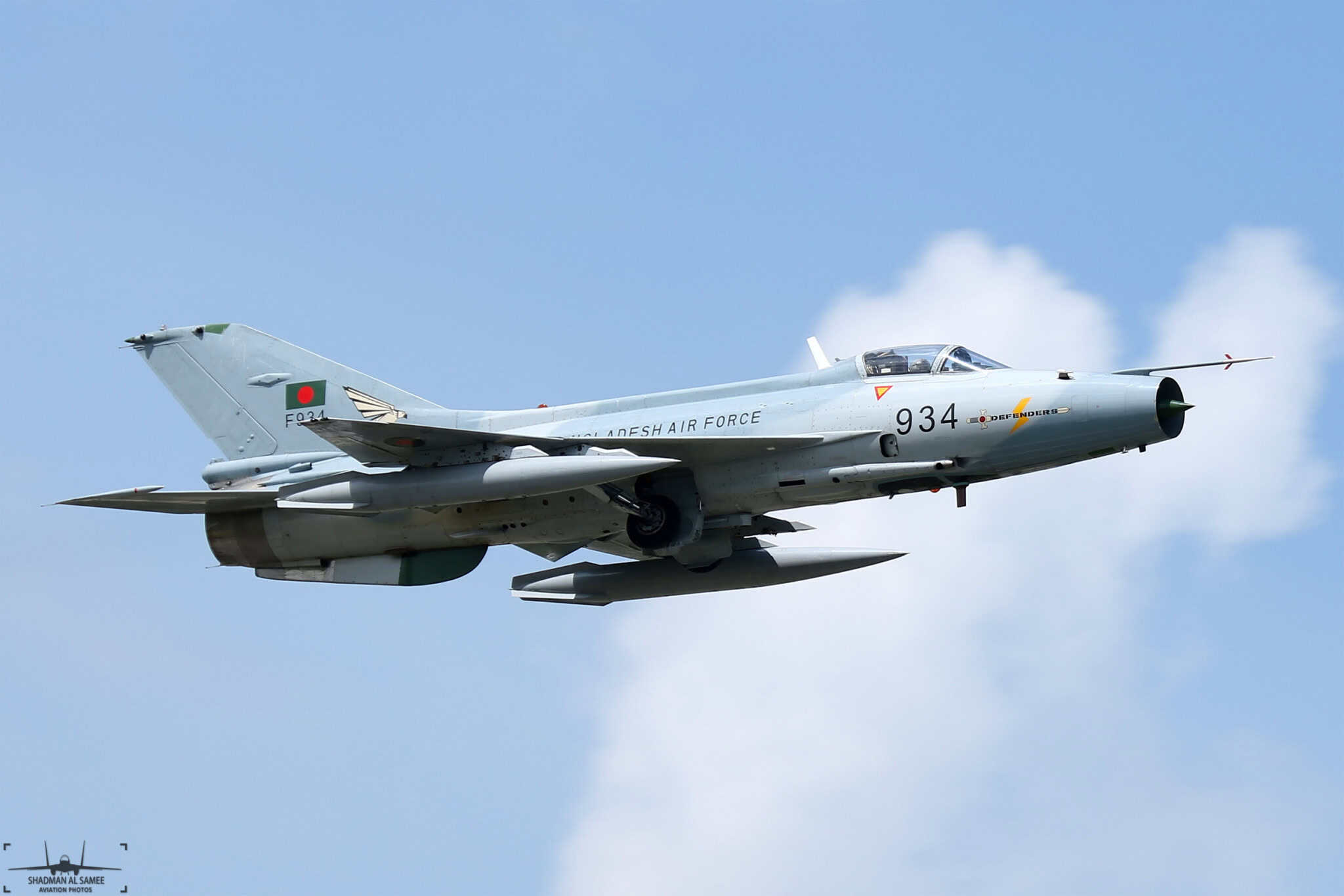
The Chengdu J-7 (export name F-7, NATO reporting name Fishcan) is China’s license-built and reverse-engineered version of the Soviet MiG-21. About 2,400 were built from 1965 to 2013, and the People’s Liberation Army Air Force retired it by the end of 2023. Pakistan, Bangladesh, Iran, Myanmar and several African air forces still fly export versions.


The Chengdu J-7 is China’s version of the Soviet MiG-21, a single-engine Mach 2 fighter with a delta wing. Export customers know it as the F-7, and NATO called it “Fishcan.”
About 2,400 were built between 1965 and 2013. China’s own air force has retired it, but Pakistan, Bangladesh, Iran, Myanmar and several African air forces still fly export versions.
The J-7 is a lightweight interceptor built around a simple idea: climb fast, shoot something down near home, land. It was designed for point defense, not long-range patrols, and its short legs show it.
The Chengdu Aircraft Corporation built most of them, with some work at Guizhou. The Chinese name is Jian-7, and the export designation is F-7. Our MiG-21 page covers the Soviet original.
The answer to “is there an F-7 fighter jet?” is therefore yes, and it is the same airplane as the J-7. Only the name on the paperwork changes.
On March 30, 1962, the Soviet Union and China signed a technology-transfer agreement for the MiG-21. Kits, components and some finished aircraft went to the Shenyang Aircraft Factory.
The design documents were reportedly incomplete, and the Sino-Soviet split soon cut off Soviet help. Chinese engineers had to reverse-engineer parts of the airplane and its engine, and Wikipedia’s summary says they solved 249 major problems along the way.
One early flaw was the hydraulic system, which reportedly grounded up to 70 percent of some squadrons’ aircraft until it was fixed. Domestic production began in March 1964, but the Cultural Revolution hurt quality and slowed output badly.
The J-7 first flew on January 17, 1966. The type only reached its Soviet-designed performance in the mid-1980s, which is why many people think of the J-7 as a 1980s airplane built to a 1950s design.
China built dozens of versions. Migflug and Airforce Technology both count 54, though the exact tally depends on how you count sub-variants.
The ones worth knowing are these:
The two-seat trainers carry an “FT-7” or “JJ-7” label and keep the same basic airframe.

The J-7 is small. It is 48 ft 10 in (14.88 m) long with a wing span of 27 ft 4 in (8.32 m), so it fits in less space than most trainers.
The delta wing lets it climb at a fast rate and fly supersonic without a big wing. It also gives it a thin, light airframe that is cheap to build and easy to maintain, which is why so many poorer air forces bought it.
The trade-off is fuel. A small airframe holds little of it, and the J-7 was never meant to fly far from its home base.
The gun armament is two 30 mm Type 30-1 cannons with 60 rounds each. There are five hardpoints: four under the wings, each rated for up to 500 kg (1,100 lb), and one under the fuselage rated for up to 2,000 kg (4,400 lb).
Air-to-air missiles include China’s PL-2, PL-5, PL-7, PL-8 and PL-9, the Soviet K-13, the French Magic R.550 and the American AIM-9 Sidewinder. It can also carry rocket pods and unguided bombs from 50 kg to 500 kg.
Avionics depend entirely on the variant. Early models have little more than a gunsight and a ranging radar, while the J-7G and the F-7BGI add modern displays and radars.
The full specification table for the aircraft is on this page. A few figures need context.
The range figure is a ferry range, meaning one flight with external tanks and no combat reserve. The combat range is far shorter, about 850 km (528 miles) according to Wikipedia and Airforce Technology, and that is the figure that matters for a point-defense jet.
The maximum speed is a Mach number, about Mach 2, and it applies at altitude with a clean airframe. With missiles, tanks and bombs hung under it, the J-7 flies a good deal slower.
The maximum takeoff weight is 20,100 lb (9,100 kg), and the takeoff run is 2,600 ft (800 m) with landing at 2,450 ft (750 m). The ceiling is 57,400 ft (17,500 m) and the climb rate is 38,400 ft/min (195 m/s).
Sources differ on a few of these. Airforce Technology prints a lower climb rate and a slightly higher ceiling than Wikipedia and Migflug, and we use the second set.
The J-7 started as a copy of the MiG-21F-13, but by the J-7E it was a different airplane. It had a double-delta wing, a more powerful engine, a helmet sight and HOTAS controls.
The J-7 stayed in production until 2013 because it stayed cheap, and export customers could fit Western systems such as British avionics or French Magic missiles.

China’s People’s Liberation Army Air Force started replacing the J-7B with the J-7E in the mid-1990s. Retirement began in 2018, and the type was fully decommissioned by the end of 2023.
The US Air Force’s China Aerospace Studies Institute described the retirement as the point where the PLAAF became a fleet of only fourth- and fifth-generation aircraft. Replacements include the J-10 and the J-20.
Pakistan is the largest operator outside China, with 66 aircraft according to the International Institute for Strategic Studies figure quoted by Reuters. It is replacing the F-7 with the JF-17 Thunder, which is the FC-1 Fierce Dragon built jointly with China.
Bangladesh has flown F-7 variants since the 1980s. It signed a contract for 16 F-7BGIs in 2011, and the last were delivered in 2013, which also closed the production line. So “when did Bangladesh buy the F-7?” has two answers: the first F-7s in the 1980s, and the final batch under the 2011 contract.
Iran bought F-7s in the 1980s. They have never been involved in a known air-to-air combat, and by this century they were mostly used as trainers and test beds.
In March 2026, Israeli strikes on Isfahan reportedly destroyed nine or ten of Iran’s J-7s on the ground, alongside three F-14 Tomcats. A US strike on March 21 reportedly destroyed one more at Yazd. Both figures come from satellite imagery and military footage, not from an official Iranian count. Our Iran Air Force guide covers what remains.

Myanmar set up four squadrons of F-7s in the 1990s, mainly for air defense. Nigeria ordered 12 F-7NI fighters and three FT-7NI trainers in 2008, and Namibia ordered 12 F-7NMs in 2005.
Sri Lanka used F-7BS fighters for ground attack, and Tanzania used F-7As in the Uganda-Tanzania war of 1978 to 1979. Iraq received F-7Ms through Jordan in the 1980s but used them as trainers. Zimbabwe, Sudan and Albania also flew the type.
Accidents have followed the type around. Two Nigerian F-7Ns collided in 2018, killing one pilot, and a Zimbabwe Air Force pilot died on a routine sortie in May 2025.

On July 22, 2025, a Bangladesh Air Force FT-7BGI crashed into the Milestone School and College campus in Uttara, Dhaka, shortly after takeoff. Reuters reported at least 31 deaths, most of them children, and the military blamed mechanical failure.
Generation labels for the J-7 vary because sources disagree on where the MiG-21 era falls, and writers call it second or third generation. What is not in dispute is that it is not a fourth-generation fighter: the US Air Force’s China Aerospace Studies Institute framed its retirement as the PLAAF moving to a fourth- and fifth-generation fleet.
No sources we checked publish a contract value for the F-7BGI deal, so we do not quote a unit price. Production ended in May 2013, so there are no new aircraft, and buyers have always been air forces. For the wider picture, see our ranking of the best fighter jets in the world.
Yes. The F-7 is the export name of the Chinese Chengdu J-7, a license-built and reverse-engineered MiG-21 derivative. Pakistan, Bangladesh, Iran, Myanmar and several African air forces have flown it.
Bangladesh has operated F-7 variants since the 1980s. Its last order was a 2011 contract for 16 F-7BGIs, delivered by 2013.
It is a MiG-21-era design, which sources call second or third generation. It is not a fourth-generation fighter, and China’s air force retired it as it moved to an all fourth- and fifth-generation fleet.
About Mach 2 at altitude with a clean airframe. The exact figure is on the spec panel above, and it drops when the jet carries tanks and weapons.
The F-7 started as a copy of the MiG-21, but later versions such as the J-7E added a new double-delta wing, a more powerful engine and modern avionics. Production ran until 2013, long after the MiG-21 line closed.
No official unit price is published in the sources we checked. Prices were set in export contracts that rarely appear in public.
Not new. Production ended in May 2013, and the customers have always been air forces.
No US service operates it. The main operators are Pakistan, Bangladesh, Iran and Myanmar.
China retired it by the end of 2023. Export versions still fly with at least ten countries, led by Pakistan, though Pakistan is replacing its F-7s with the JF-17.
Sources and references used for research and fact-checking.