Fighter Jets
Sukhoi Su-27 “Flanker”
ICAO: SU27
The swing-wing Soviet strike jet that first flew in 1967 and is still flying combat missions today.
Updated: by Tim de Vries
The latest aviation news and stories sent to your inbox.
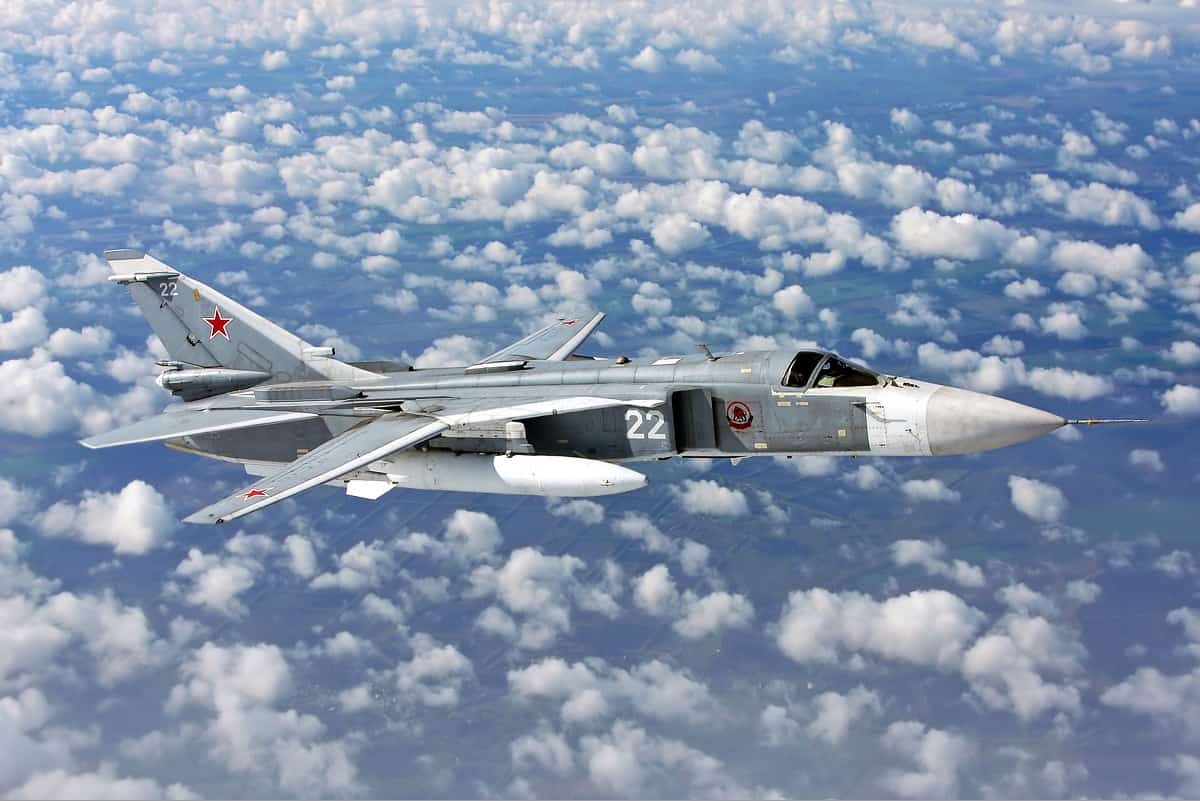
The Sukhoi Su-24 Fencer is a Soviet two-seat, swing-wing, all-weather tactical bomber that first flew in 1967 and entered service in 1974. It was built to hit targets at low level in bad weather, and Sukhoi’s own history calls it the first Soviet aircraft with an integrated digital navigation and attack system. About 1,400 were built before production ended in 1993, and the Fencer still flies with Russia, Ukraine, Iran, Algeria and other operators.
Live Fleet Activity (SU24)
Fetching live data…


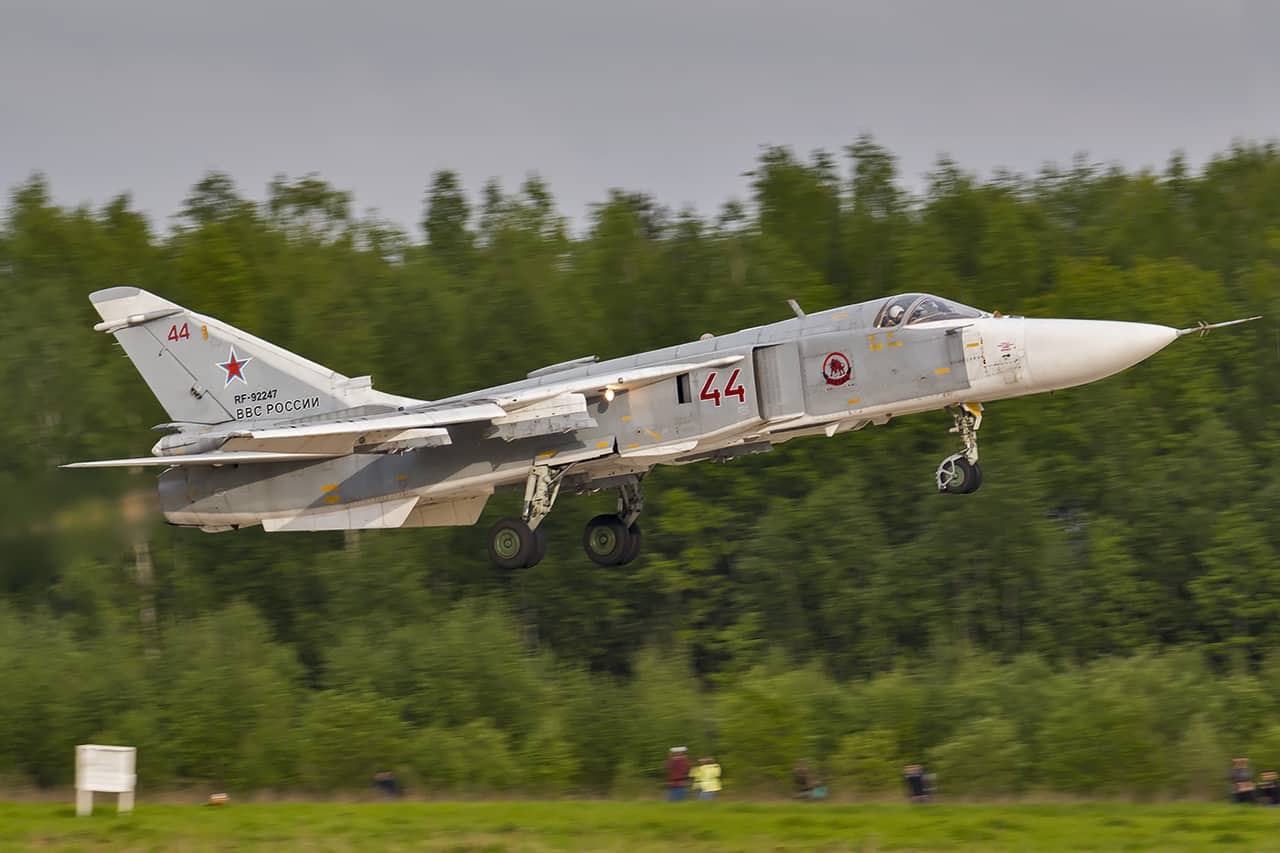

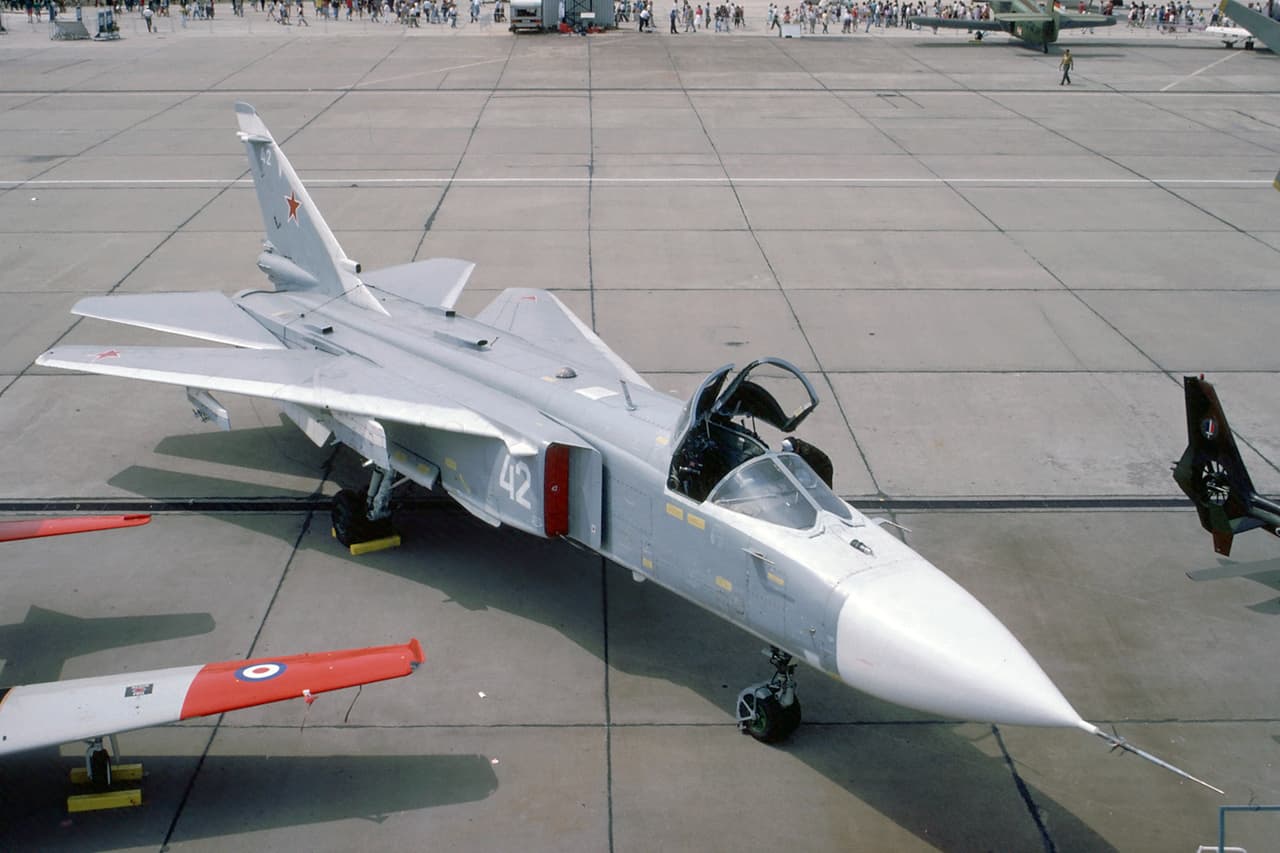


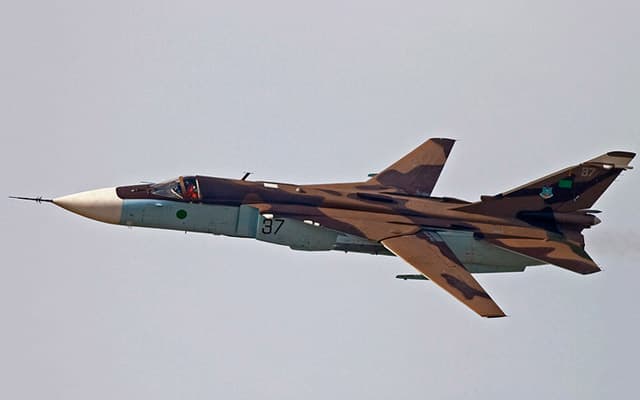
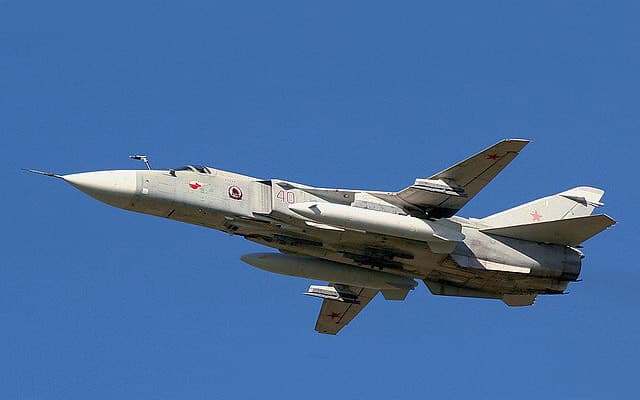
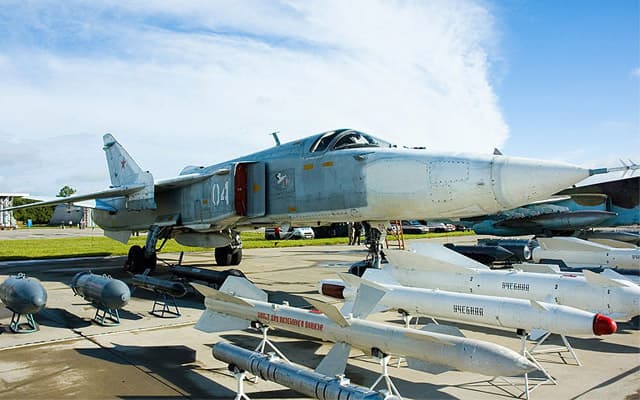
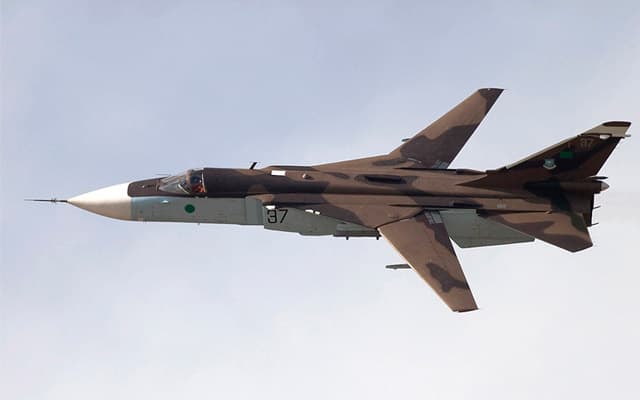
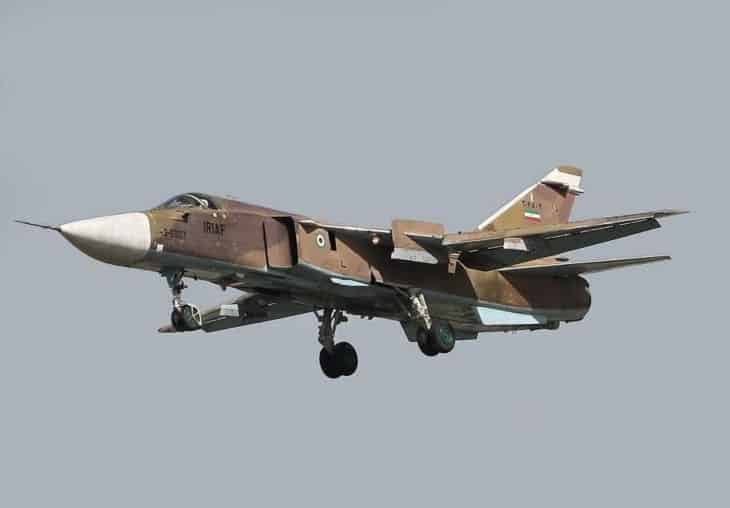
The Sukhoi Su-24, known to NATO as the Fencer, is a Soviet two-seat, swing-wing, all-weather bomber designed to hit targets at low level in bad weather. It first flew on July 2, 1967, entered service in 1974 and was built until 1993, with about 1,400 produced.
Almost 60 years after its first flight, the Fencer is still flying combat missions. Russia, Ukraine, Iran and Algeria all operate it, and it has seen action from Afghanistan to Syria to the Black Sea.
The full specification table for the aircraft is on this page. This article covers what the numbers do not: why it was built, how the swing wing works, how the variants differ, and where the Fencer stands in October 2026.
The Su-24 started with a requirement attached to the Su-7B in 1961. The Soviet Air Force wanted an all-weather version that could make precision strikes, but Sukhoi found the Su-7 airframe was too small to hold the avionics.
The new navigation and attack system was codenamed Puma, and the aircraft was built around it. Sukhoi first tried a delta-wing design, the S-6, which never got past a mockup, and then a six-engine layout with four lift jets for short takeoffs.
The first prototype, the T-6-1, flew on July 2, 1967 with Vladimir Ilyushin at the controls. Testing showed the lift jets took up fuel space and made the transition to normal flight unstable, so Sukhoi dropped the idea.
By then the American F-111 had entered service and shown that a swing wing could work. On August 7, 1968 Sukhoi was told to study a variable-geometry wing, and the T-6-2I flew with one on January 17, 1970.
The first aircraft off the line flew on December 31, 1971, but government trials dragged on because of the complexity of the onboard systems. The type was formally accepted into service on February 4, 1975.
The program was costly in lives. Wikipedia records ten fatal accidents during development that killed thirteen Sukhoi and Soviet Air Force test pilots.
The Fencer’s wing has four sweep settings. It is set to 16 degrees for takeoff and landing, 35 and 45 degrees for cruise at different altitudes, and 69 degrees for low-level dashes.
Spread, the wing measures 57 ft 10 in (17.64 m) from tip to tip. Fully swept it narrows to about 34 feet (10.37 m).
Wikipedia credits the swing wing with excellent short-field performance, and adds that the aircraft’s high wing loading gives a stable ride at low level with minimal gust response.

The crew sits side by side. Wikipedia says the layout was adopted because the large Orion radar antennas needed a wide nose.
Both crew members sit on Zvezda K-36D ejection seats, which let them bail out at any altitude and speed, including during takeoff and landing.

The Puma system gave the Fencer its all-weather ability. It combined two Orion-A radar scanners, a Relyef terrain-clearance radar that provided automatic flight control at low and extremely low altitudes, and an Orbita-10-58 computer.
Sukhoi’s own history, cited by Wikipedia, describes the Su-24 as the first Soviet aircraft to carry an integrated digital navigation and attack system.
Top speed is the figure that gets quoted most and explained least. The spec table lists the high-altitude maximum of 1,028 mph (1,654 km/h), while the sea-level maximum is 817 mph (1,315 km/h).
Early Fencer-A aircraft had variable intake ramps and were rated to Mach 2.18 at altitude. Because the Su-24 flies almost entirely at low level, the ramp actuators were removed to save weight and maintenance, which cut the maximum to about Mach 1.35.
Published Mach numbers disagree, with Mach 1.6 in Wikipedia’s spec block and about Mach 1.35 in its design section and at Military Factory. The mph and km/h figures are the safer ones to quote.
Range needs the same care. The 1,498 nm ferry range in the table is a positioning-flight distance, not what the aircraft achieves on a real attack.
On a lo-lo-lo mission (low altitude all the way) with 3,000 kg of ordnance and external tanks, Wikipedia gives a combat range of 382 miles (615 km). That is the number that tells you how far into enemy territory a Fencer could realistically go.
The two engines each produce 24,700 lbf (110 kN) with afterburner. Maximum takeoff weight is 96,500 lb (43,800 kg), and the weapons load can reach 17,600 lb (8,000 kg).
Service ceiling is 36,000 ft (11,000 m). Wikipedia notes that the Su-24 is used almost exclusively for low-level missions, so altitude is not where the aircraft earns its keep.
The base Su-24 was built from 1971 to 1983, with about 500 produced. Its armament included Kh-23 and Kh-28 guided missiles, and NATO later labeled the sub-variants Fencer-A, B and C as the rear fuselage, antennas and electronic countermeasures changed.
The Su-24M (Fencer-D) is the main version. It first flew as the T-6M-8 prototype on June 29, 1977, was accepted into service in 1983 and was built from 1981 to 1993, with about 770 produced.
The M has a fuselage section 30 inches (0.76 m) longer ahead of the cockpit, which adds a retractable refueling probe. It also carries the PNS-24M inertial navigation system and a Kaira-24 laser designator and TV system, similar to the American Pave Tack, which opened the door to laser-guided and TV-guided bombs and missiles.
Russia’s Su-24M2 upgrade program began around 2000. It added the SVP-24 navigation system, an ILS-31 head-up display and more munitions, including the Kh-31A and KAB-500S.
The Su-24MK is the export version, with downgraded avionics and weapons. It first flew as the Su-24MK on May 17, 1988, was built from 1988 to 1992 and was sold to Algeria, Iraq, Libya and Syria.
Two other variants swap the attack equipment for sensors. The Su-24MR (Fencer-E) is a reconnaissance version built from 1983 to 1993, with 130 produced, and it trades the cannon and attack radar for cameras, side-looking radar and infrared reconnaissance gear.
The Su-24MP (Fencer-F) is an electronic intelligence and jamming version. Only 10 were built.
The Fencer’s fixed gun is a 23 mm Gryazev-Shipunov GSh-6-23M rotary cannon with 500 rounds. Two or four R-60 infrared missiles are normally carried for self-defense, and the R-73E is also listed.
Under the wings and fuselage it can carry a wide range of Soviet-era weapons, including KAB-500 and KAB-1500 guided bombs, RBK cluster bombs and Kh-25, Kh-29 and Kh-58 missiles.
In 2023 the Su-24 took on a new role. After the United Kingdom supplied Storm Shadow cruise missiles to Ukraine, Ukrainian Su-24s began carrying them, and Wikipedia reports that some were fitted with pylons taken from retired RAF Tornado GR4s.
That let Ukrainian crews strike from a safer distance. Ukraine’s Su-24s were reported to have launched the missiles that hit the Black Sea Fleet headquarters in Sevastopol in September 2023 and the corvette Askold in November 2023.
The Soviet Union used some Su-24s in Afghanistan, in strikes in 1984 and again at the end of the war in 1988. No Su-24 was lost there.
During the 1991 Gulf War, Iraq evacuated a large part of its Su-24MK fleet to Iran, where many stayed. Russian Fencers flew in both Chechen wars and over Georgia in 2008, where independent estimates list one to two Su-24 losses even though Russia acknowledged none.

Russia’s 2015 deployment to Syria leaned heavily on the Fencer. Wikipedia, citing The Aviationist, says the vast majority of airstrikes from Khmeimim air base, over 80 percent, were flown by Su-24Ms, mostly with old unguided Soviet bombs.
On November 24, 2015, Turkish F-16s shot down a Russian Su-24M near the Turkey-Syria border. Both crew ejected, but the pilot was killed by rebels on the ground, and Turkey and Russia disagreed on whether the jet had crossed into Turkish airspace.
The Su-24 also became a symbol of Russian pressure on NATO ships. In April 2016 several Fencers flew within 98 feet (30 m) of the destroyer USS Donald Cook in the Baltic Sea.
In Ukraine the Su-24 has flown on both sides. Ukraine used the type in the first hours of the 2022 invasion, and the 7th Tactical Aviation Brigade suffered many losses in the first few months.
Wikipedia reports that a Ukrainian Su-24 of the 7th Tactical Aviation Brigade crashed in Khmelnytskyi Oblast on June 16, 2026 during a combat mission, killing both crew.
Russian Su-24s are also being hit. Ukraine’s National Guard Omega unit said it destroyed a Su-24M on the ground at Saky air base in Crimea with strike drones in July 2026, though there was no independent confirmation.
On August 22, 2026, Ukraine’s president announced that a Russian Naval Aviation Su-24 had been destroyed at Saky in an overnight drone strike. Russian authorities did not comment.
The type also appeared in the 2026 Iran war. Qatar’s defense ministry said its air force shot down two Iranian Su-24s heading toward Qatar on March 2, 2026, a claim The Aviationist reported without independent confirmation.
Estimates of Fencer fleets vary by source and year, and they are hard to check in wartime. The figures below come from Wikipedia’s operator list and should be read as estimates.
Russia is the largest operator, with 260 in the Aerospace Forces as of 2025 and up to 30 Su-24M and 10 Su-24MR in Naval Aviation as of 2024. Wikipedia says Russia will eventually replace the Fencer with the Su-34.
Algeria had 33 Su-24M and Su-24MK and 3 Su-24MR as of 2024. Wikipedia lists Iran with 21 Su-24MKs as of 2026, a count that may not reflect the two Qatar said it shot down.
Ukraine was estimated to have 5 Su-24M and 8 Su-24MR in 2024. Sudan is estimated at about 4, and some Su-24Ms remain airworthy with the Libyan National Army.
Several former operators have retired the type. Kazakhstan put its 13 up for auction in 2023, Azerbaijan no longer operated the Su-24 by December 2021, and it is unclear whether Syria has any flying after the fall of the Assad government.
The Fencer is often called the Soviet F-111, and the comparison is fair. Both use a swing wing for low-level penetration, and Aerospaceweb describes the Su-24 as having capabilities similar to the F-111.
Wikipedia says the Su-24 that emerged from testing was slightly smaller and shorter-ranged than the American jet. It also lists the Panavia Tornado IDS as a similar type.
For more of Sukhoi’s output, see our guide to Sukhoi fighter jets.
Sukhoi is a Russian aircraft design company. The Su-24 was developed in the Soviet Union and passed to Russia and other former Soviet states.
No. Su-24 production ceased in 1993, after about 1,400 were built. Existing aircraft are kept flying through life-extension programs such as the Su-24M2 upgrade.
Wikipedia lists 21 Su-24MKs in the Iranian Air Force as of 2026. Iran’s fleet includes Iraqi jets that were flown to Iran during the 1991 Gulf War.
Qatar said in March 2026 that it shot down two Iranian Su-24s, so the current number may be lower. Fleet counts in wartime are estimates.
The spec table lists a top speed of 1,028 mph (1,654 km/h) at high altitude. At sea level the maximum is 817 mph (1,315 km/h).
Yes. On November 24, 2015, two Turkish F-16s shot down a Russian Su-24M near the Turkey-Syria border. Turkey said the jet entered its airspace after repeated warnings, while Russia said it never left Syrian airspace.
The Su-24 is a bomber, not a fighter, so it is not in that contest. For Russia’s actual fighters, see our ranking of the best Russian fighter jets.
Sources and references used for research and fact-checking.