

Table of Contents
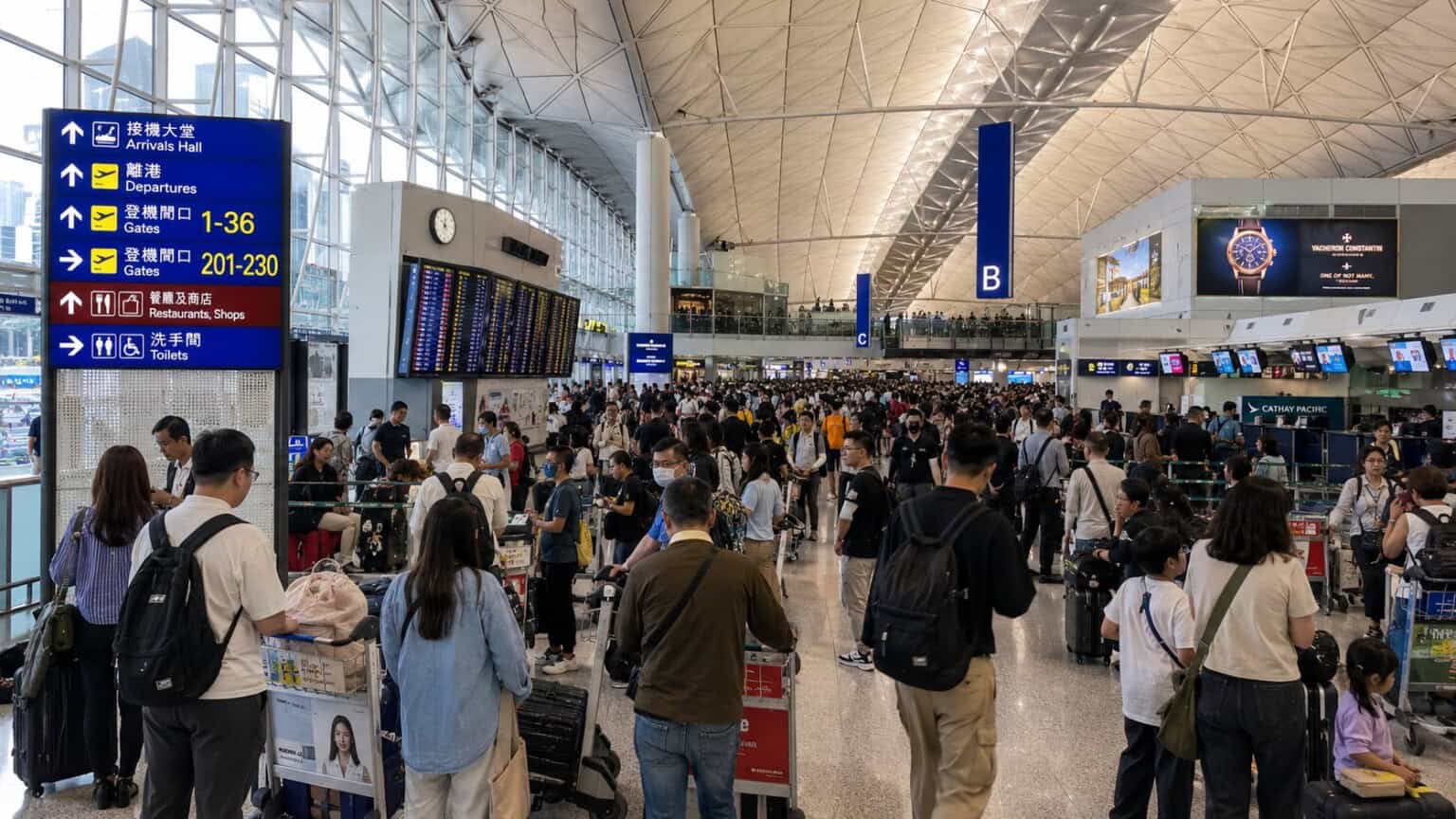
Stand in the departures hall at Hong Kong International Airport and watch the board for Taipei. A flight leaves, another loads, and the counter for the next one is already filling. Seven airlines run this hop, and between them they move close to seven million seats a year across a stretch of water that takes under two hours to cross.
We already know the busiest route on the planet is a domestic one: Seoul to Jeju, entirely inside South Korea. But the moment you add a border, the question changes. Which two countries are connected by the single busiest international air link in the world?
The honest answer is more interesting than a single city pair, because it depends on how you count. This article explains which route wins, why the winner changes depending on the measure, and why it is almost certainly not the route you would guess.
The short answer
By seats, the busiest international route in the world is Hong Kong to Taipei. In 2025 the aviation data firm OAG counted about 6.8 million scheduled seats between the two cities, ahead of every other cross-border route on earth.
By number of flights, a different route wins: Kuala Lumpur to Singapore, a short hop that airlines fly dozens of times a day. So the same question has two correct answers, and the reason comes down to the size of the aircraft on each route.
The short answer, at a glance
By airline seats, the world’s busiest international route is Hong Kong to Taipei, with roughly 6.8 million scheduled seats in 2025 (OAG). By number of flights, the crown goes to Kuala Lumpur to Singapore. Same question, two winners, depending on how you count.
Why short Asian hops, not marquee long-haul routes
The busiest international routes share a profile, and it is the same one that makes Seoul to Jeju the busiest domestic route: two dense, wealthy population centers sitting close together, with heavy business and family travel and no convenient way to make the trip by land.
Hong Kong to Taipei is about 501 miles (806 km) over open sea, so flying is the only realistic option. Both are major financial hubs with deep business, tourism, and family ties, and Taiwan’s status keeps the link firmly international rather than domestic. That combination fills a lot of seats.
Nearly every route near the top of the list looks like this. Nine of the ten busiest international routes by seats in 2025 were in Asia, clustered around Hong Kong, Taipei, Singapore, Kuala Lumpur, Seoul, Tokyo, Jakarta, and Bangkok, plus the Middle East trunk routes linking Cairo, Jeddah, Dubai, and Riyadh.
| Rank | Route | Seats (2025) |
|---|---|---|
| 1 | Hong Kong – Taipei | ~6.8 million |
| 2 | Cairo – Jeddah | ~5.8 million |
| 3 | Kuala Lumpur – Singapore | ~5.6 million |
| 4 | Seoul Incheon – Tokyo Narita | ~5.1 million |
| 5 | Seoul Incheon – Osaka Kansai | ~5.0 million |
| 6 | Jakarta – Singapore | ~4.6 million |
| 10 | New York JFK – London Heathrow | ~4.0 million |
Busiest international routes by scheduled seats, 2025. Source: OAG. The famous transatlantic route sneaks in at number ten.
Notice what is missing. There is no London to Paris, no Los Angeles to Tokyo, no marquee capital-to-capital pairing. The international routes that carry the most people are workmanlike regional shuttles, most of them under two hours, between neighbors with tightly linked economies. They are the opposite extreme from the world’s longest flights, which push past 18 hours.
Seats or flights? Why the winner changes
Here is where the answer splits. “Busiest” can mean the most seats offered, or the most individual flights operated, and international routes flip the leaderboard depending on which you choose.
Hong Kong to Taipei wins on seats because carriers fly it with big twin-aisle widebody jets, aircraft like the Boeing 777, Airbus A330, and A350, each seating roughly 250 to 350 people. Fewer departures, far more seats per departure.
Kuala Lumpur to Singapore works the opposite way. It is a tiny hop of about 185 miles (298 km), flown mostly with smaller single-aisle jets many times a day. Each flight carries fewer people, but there are so many departures that the route racks up more flights than any other international pairing.
One departure every 17 minutes
In recent counts, airlines have scheduled more than 30,000 flights a year between Kuala Lumpur and Singapore, roughly 84 a day, or about one departure every 17 minutes. It is the shortest of the top routes, yet it flies more often than any other international link on earth.
This is exactly the distinction that trips people up with the domestic record too. Seoul to Jeju leads by both measures, but internationally the two crowns land on different routes. When a ranking says “busiest,” always check whether it means seats or flights, because the honest answer is “it depends.”
The myth: it must be London to New York
Ask most travelers to name the busiest international route and they will reach for the great intercontinental corridors: New York to London, or maybe Los Angeles to Tokyo. These feel like the heart of global aviation, thick with business travelers and premium cabins.
The transatlantic myth
New York JFK to London Heathrow is the busiest long-haul route in the world and the busiest across the Atlantic. But among all international routes by seats, it ranks only around tenth. The real leaders are short regional hops in Asia, not marquee transatlantic flights.
The reason is simple math. A long-haul route like New York to London, about 3,451 miles (5,554 km), might see a few dozen widebody flights a day. A short regional route between two neighbors can be flown many times more often, because each aircraft can turn around and fly the leg again within hours.
Frequency, not distance or glamour, is what stacks up seats. The busiest international routes reward density and repetition, and short hops between nearby hubs deliver both far better than any ocean-spanning flagship route can.
There is one more thing worth keeping in perspective. Even the busiest international route is smaller than the busiest domestic ones. Borders, visas, and the bilateral treaties that govern who can fly where all cap international traffic in ways a single country’s domestic network never faces.
Does the answer stay the same every year?
No, and that is part of the fun. These rankings move year to year as economies shift, travel recovers, and airlines add or cut capacity, which is why our ranking of the busiest flight routes is rebuilt every week. Hong Kong to Taipei fell during the pandemic years and climbed back to the top; before that, Kuala Lumpur to Singapore held the seat crown for a stretch.
The lineup near the top is stable in character even when the exact order changes. Expect short Asian and Middle Eastern hops to keep trading places at the top, with the classic transatlantic routes hovering just outside it, for years to come.
So the next time someone confidently tells you the busiest international route is New York to London, you can give the fuller answer. By seats it is Hong Kong to Taipei, by flights it is Kuala Lumpur to Singapore, and the great transatlantic corridor is not even in the top five.
Sources and references used for research and fact-checking.
- OAG, Busiest Flight Routes in the World 2025
- Airline Ratings, Busiest international routes of 2025
- OAG, Kuala Lumpur (KUL) to Singapore Changi (SIN) is the Busiest Global International Route in the World
- CNBC, Kuala Lumpur to Singapore is world's busiest international air route
- AeroCorner, Busiest Flight Routes in the World
Get the Newsletter
The latest aviation news and stories sent to your inbox.
About the Author

Tim is the owner and lead editor of AeroCorner since 2019, overseeing aviation content covering aircraft, airlines, airports, and the broader aviation industry. Through years of researching, writing, editing, and publishing aviation-focused content, he has developed extensive practical knowledge of commercial aviation and air travel. Based in Asia and a frequent traveler himself, Tim also brings firsthand passenger experience to AeroCorner’s coverage. Outside of publishing, he has also explored aviation firsthand through hands-on flight training in New Zealand.