

Table of Contents
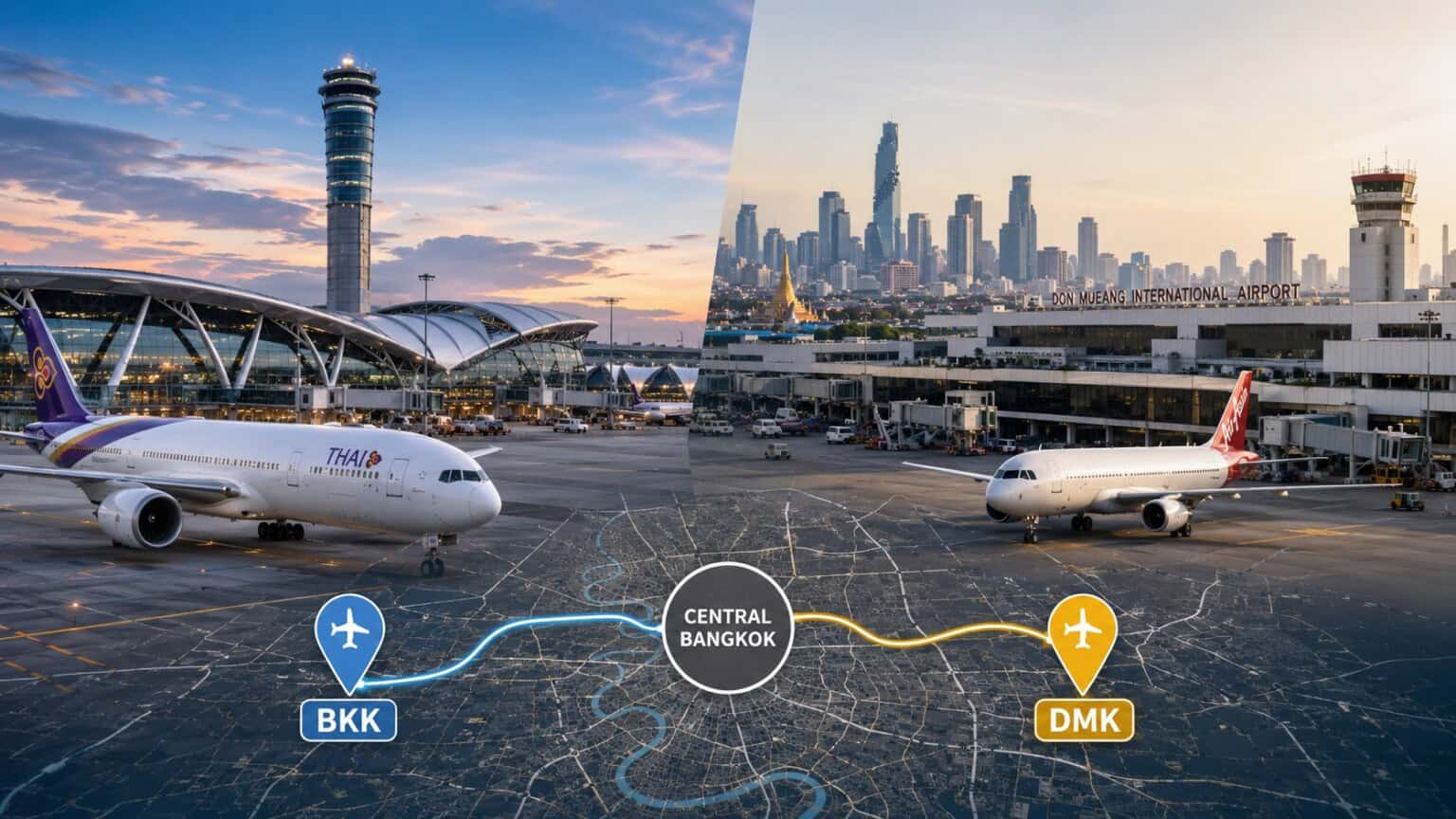
Book a flight to Bangkok and the booking site makes you choose between two codes: BKK and DMK. Neither one looks like it means “Bangkok,” and one of them is hiding a small trick.
BKK did not always belong to the airport that carries it today. For most of the 20th century, that code belonged to Don Mueang, the older airport on the north side of the city. When a new airport opened in 2006, it took BKK for itself and left Don Mueang with letters that barely resemble the city it still serves.
The two airports sit on opposite sides of Bangkok, and the split between them is not leftover confusion. It is now a deliberate strategy that decides which airline you are flying before you have even picked a seat.
The short answer
Don Mueang was Bangkok’s only airport for most of a century, until it ran out of room and Thailand opened Suvarnabhumi in 2006 to take over as the main international gateway.
Cracks in Suvarnabhumi’s brand-new runways forced Don Mueang back into service within a year, and in 2012 the government made the arrangement permanent. Suvarnabhumi keeps the full-service and long-haul carriers. Don Mueang was rebuilt into one of the busiest low-cost airline hubs on earth.
Two airports, one strategy
Don Mueang served Bangkok alone from 1914 until 2006. Suvarnabhumi opened to replace it but ran into structural problems, forcing Don Mueang back into service months later. Since 2012, Thailand has run the two on purpose: Suvarnabhumi for full-service and long-haul airlines, Don Mueang as a dedicated low-cost hub.
Why Bangkok needed a second airport
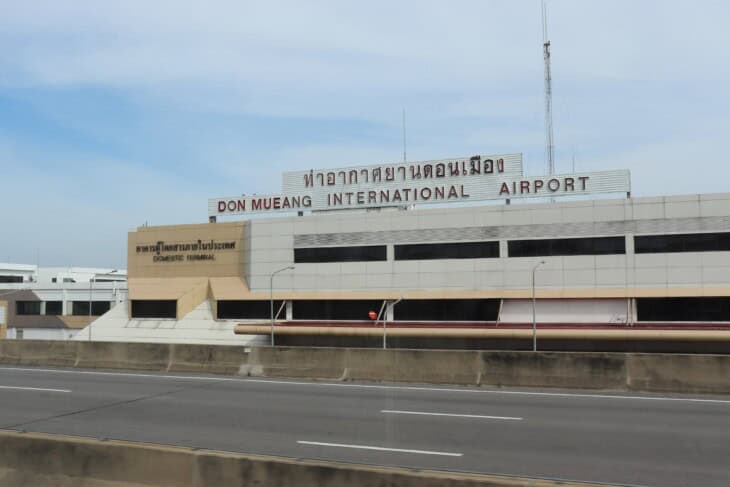
Don Mueang opened in 1914 as a Royal Thai Air Force base, with commercial flights starting in 1924. That makes it one of the oldest continuously operating airports on the planet.
For most of the 20th century it was Bangkok’s only real airport, handling domestic and international flights side by side out of a site boxed in by the city and by the military that still shares it today.
By the 1990s, Thailand’s tourism and trade boom had outgrown that footprint. There was no realistic way to add the runways and terminals Don Mueang needed without room it simply did not have.
Dense neighborhoods pressed in on one side and a Royal Thai Air Force base shared the runways on the other, so a fourth runway or a major new terminal was never really on the table.
Planning for a much larger replacement began in 1996, and construction started in 2002 on marshy land east of the city. Suvarnabhumi Airport opened on September 28, 2006, taking over Bangkok’s international flights and, with them, the BKK code that had belonged to Don Mueang for decades. Don Mueang was recoded DMK, letters with no obvious link to the city it still serves.
The reopening nobody planned
Suvarnabhumi was built on soft Bangkok clay, and it showed almost immediately. Within months of opening, cracks appeared in taxiways and one runway, and by early 2007 inspectors had logged more than 100 fissures.
Some flights were diverted as far as the U-Tapao military airfield southeast of the city while crews closed sections of runway for repair, a scramble nobody had budgeted for in the opening-week plans.


The cracks were only half the problem. Suvarnabhumi had been designed for roughly 45 million passengers a year, and it was already running past that figure within its first years open.
Facing repairs and a terminal already straining under more passengers than planned, Thailand’s prime minister ordered Don Mueang reopened for domestic flights in February 2007, barely five months after it had been retired.
That decision was an emergency fix, not a plan. For the next few years Don Mueang picked up whatever domestic flights Suvarnabhumi could not absorb, with no clear long-term role of its own.
There is a golf course between the runways
Don Mueang’s two runways have an 18-hole golf course, Kantarat, sitting in the grass between them. Golfers play under a red-light system that pauses the round whenever an aircraft is landing, and a round costs around $10 on weekdays.
How the split became permanent
For a few years both airports were quietly competing for some of the same routes, which meant crowded gates at Suvarnabhumi and an underused Don Mueang sitting a short flight away with spare capacity nobody was using well.
The turning point came in 2012. Thailand’s government ordered all low-cost, charter, and non-connecting flights moved to Don Mueang, and Thai AirAsia relocated its entire Suvarnabhumi operation there that October, with Nok Air following.
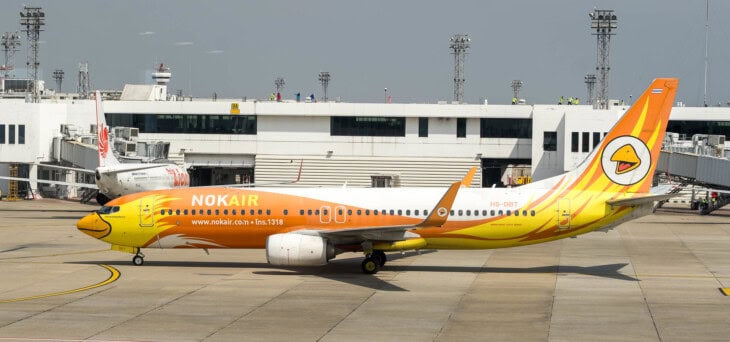
That is when the split stopped being a hand-me-down arrangement and became a strategy. Budget carriers get lower fees and faster turnarounds at a dedicated airport, the same logic behind how discount airlines keep fares low everywhere else in the world.
The strategy worked. By 2015, Don Mueang had grown into one of the largest dedicated low-cost carrier airports on earth, a role it still holds today.
The two airports still sit far enough apart that connecting between them is not casual. There is no direct rail link, and a taxi between them takes roughly an hour depending on Bangkok traffic.
That is exactly why the 2012 policy mattered. Airlines and passengers were pushed to commit to one airport for an entire trip rather than treating Don Mueang as a same-day connection point.
| Suvarnabhumi (BKK) | Don Mueang (DMK) | |
|---|---|---|
| Role | Full-service and long-haul hub | Low-cost carrier hub |
| Distance to central Bangkok | About 19 miles (30 km), east | About 19 miles (30 km), north |
| Flights per day | About 543 | About 222 |
| Airlines | About 118 | About 17 |
| Destinations | About 144 | About 65 |
| Busiest route | Ko Samui, about 35 flights a day | Chiang Mai, about 25 flights a day |
The myth: Don Mueang is just Bangkok’s backup airport
Because Don Mueang closed once and reopened in an emergency, plenty of travelers assume it is a fallback the city keeps around for overflow, not a real airport in its own right.
The numbers say otherwise. Don Mueang runs more than 200 flights a day to 65 destinations, and its dominant carriers built entire regional networks around it on purpose, not because Suvarnabhumi had no room left.
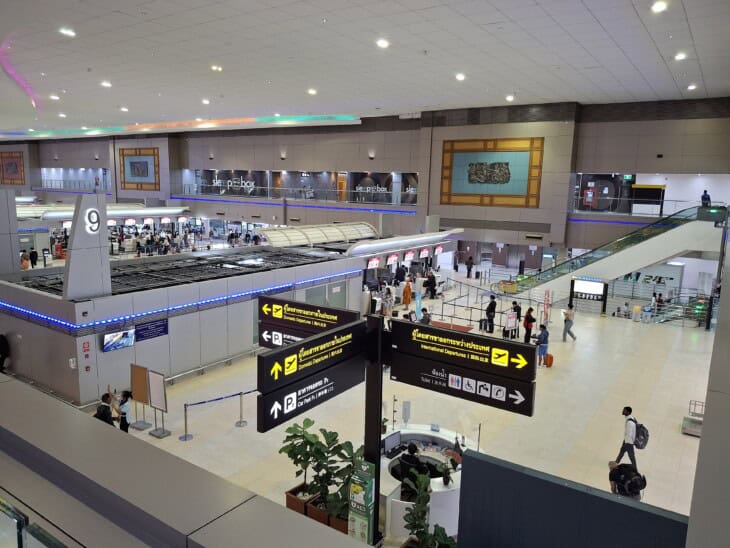
The myth persists partly because Don Mueang looks the part. Its international terminal opened back in 1982 and sits visibly older next to Suvarnabhumi’s glass and steel, which reads as “backup” even when the schedule board says otherwise.
Not a backup airport
Don Mueang is not Suvarnabhumi’s overflow. It is a purpose-built low-cost hub that airlines chose to move into, and one of the largest low-cost carrier airports in the world. Check which airline you are booking, not just which airport looks newer.
The mix-up matters at the gate. Show up at the wrong Bangkok airport with a Thai AirAsia or Nok Air booking, and the other one will not have your flight on the board.
It matters just as much on a connection. Book a full-service flight into Suvarnabhumi and a budget onward flight out of Don Mueang without checking, and the layover you planned can quietly turn into an hour-long taxi ride across the city.
Next time your itinerary shows BKK or DMK, you will know the letters are not random. One code followed the new airport east of the city. The other stayed behind on an airfield that has been flying since 1914, golf course and all.
Bangkok is not alone in splitting itself this way. Tokyo’s Haneda and Narita divided along international and domestic lines before that split broke down, and New York’s three airports answer a similar question of geography, history, and who each one is really built to serve.
Sources and references used for research and fact-checking.
- AeroCorner, Bangkok Suvarnabhumi Airport (BKK)
- AeroCorner, Bangkok Don Mueang Airport (DMK)
- Simple Flying, A Brief History Of Bangkok Suvarnabhumi Airport
- Al Jazeera, Bangkok to operate two airports
- Simple Flying, Bangkok Don Mueang International: The Airport With A Golf Course Between Its Runways
- Airport Information, Don Mueang International Airport (DMK): Bangkok's hub for low-cost airlines
Get the Newsletter
The latest aviation news and stories sent to your inbox.
About the Author

Tim is the owner and lead editor of AeroCorner since 2019, overseeing aviation content covering aircraft, airlines, airports, and the broader aviation industry. Through years of researching, writing, editing, and publishing aviation-focused content, he has developed extensive practical knowledge of commercial aviation and air travel. Based in Asia and a frequent traveler himself, Tim also brings firsthand passenger experience to AeroCorner’s coverage. Outside of publishing, he has also explored aviation firsthand through hands-on flight training in New Zealand.