

Table of Contents
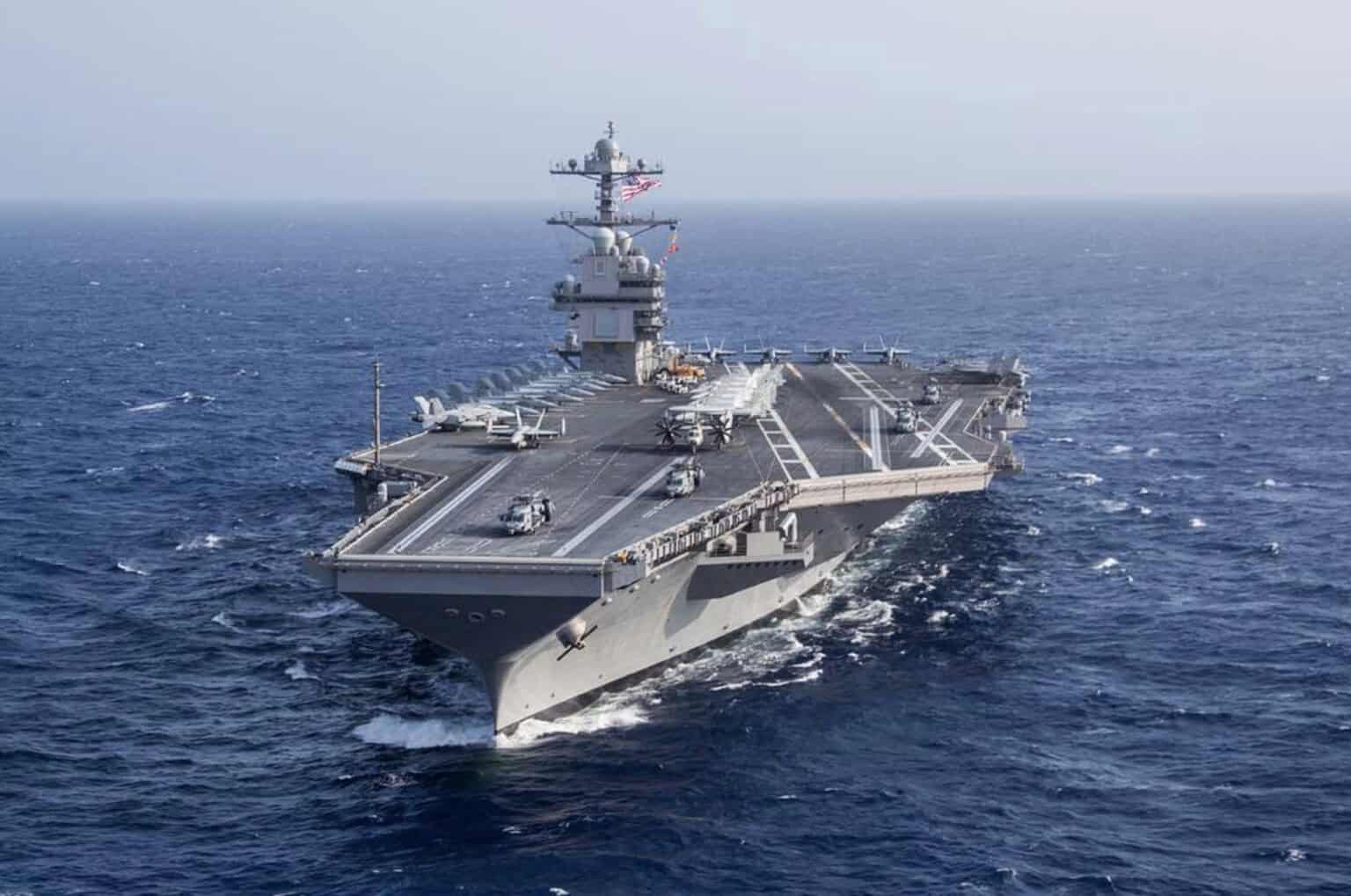
The best aircraft carrier in the world in 2026 is USS Gerald R. Ford. No other ship afloat can put more combat aircraft over a target, more often, for longer, and in 2026 it proved it by staying at sea for more than 300 days.
Almost every list you will find ranks carriers by displacement. That is the wrong measure. A carrier is a floating airfield, so the only ranking that means anything is how many aircraft it can launch and recover in a day, and how long it can keep doing it.
This list ranks the ten most capable carriers in service as of August 2026 by combat output: air wing size and quality, launch and recovery technology, endurance, and the operational tempo each ship has actually demonstrated at sea.
| Rank | Carrier (class) | Navy | Fixed-wing air wing | Launch method |
|---|---|---|---|---|
| 1 | USS Gerald R. Ford (Ford) | United States | Up to 75+ aircraft | Electromagnetic catapult |
| 2 | USS Nimitz and 9 sisters (Nimitz) | United States | 60 to 70 aircraft | Steam catapult |
| 3 | Fujian (Type 003) | China | Around 60 aircraft | Electromagnetic catapult |
| 4 | HMS Queen Elizabeth, HMS Prince of Wales | United Kingdom | 24 to 36 F-35B | Ski jump (STOVL) |
| 5 | Charles de Gaulle | France | Around 30 aircraft | Steam catapult |
| 6 | Shandong (Type 002) | China | 32 to 36 fighters | Ski jump (STOBAR) |
| 7 | USS America, USS Tripoli (America) | United States | Up to 20 F-35B | Flat deck (STOVL) |
| 8 | Liaoning (Type 001) | China | Around 24 fighters | Ski jump (STOBAR) |
| 9 | INS Vikrant | India | Around 30 aircraft | Ski jump (STOBAR) |
| 10 | JS Izumo, JS Kaga (Izumo) | Japan | Around 12 F-35B | Flat deck (STOVL) |
How this ranking works
Four things set the order. First, the air wing: how many combat aircraft the ship carries and how good they are. Second, launch and recovery, because a catapult flies heavier jets with more fuel and weapons than a ski jump can. Third, endurance, where nuclear power removes the fuel limit and leaves food and ordnance as the constraint. Fourth, demonstrated tempo, meaning sorties the ship has actually flown rather than sorties it was designed to fly. Only ships in commissioned service in 2026 that operate fixed-wing combat aircraft are ranked. Helicopter carriers, museum ships, and hulls still fitting out are excluded.
1. USS Gerald R. Ford (Ford class, United States)
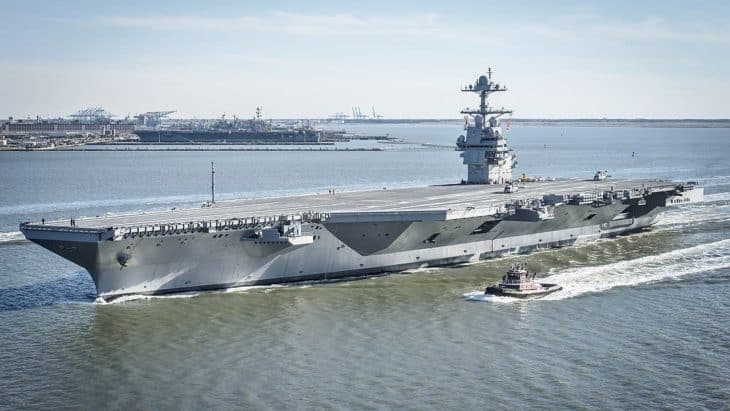
USS Gerald R. Ford displaces about 100,000 tons at full load and runs 1,106 feet (337 m) from bow to stern. Two Bechtel A1B reactors drive it past 30 knots and mean it never needs fuel.
The number that decides the ranking is 160. That is the sorties per day the ship is built to sustain for a month, against 120 for a Nimitz, with a surge capacity of 270 in a single day.
Those numbers come from the Electromagnetic Aircraft Launch System, which replaces steam pistons with a linear motor. EMALS launches an aircraft with a smoother, precisely metered stroke, which cuts airframe fatigue and lets the deck cycle faster.
It is no longer theoretical. In February 2026 the Navy ran a four-day sortie generation test that beat Nimitz-class rates, during a deployment that ran past 300 days and became the longest US carrier deployment since the Vietnam era.
Ford paid for that. It is now in a planned incremental availability expected to last 12 to 18 months, covering hull corrosion, flight deck non-skid, plumbing, and a full recalibration of the catapults and arresting gear.
The best carrier cannot fly the best carrier jet
USS Gerald R. Ford has never deployed with an F-35C. It was delivered without the support and sustainment modifications the stealth fighter needs, so its record 2025 to 2026 cruise flew Super Hornets and Growlers only. USS John F. Kennedy, which sailed from Newport News for acceptance trials on 12 August 2026, is expected to be the first US carrier handed over ready to operate the F-35C from day one.
2. The Nimitz class (United States)
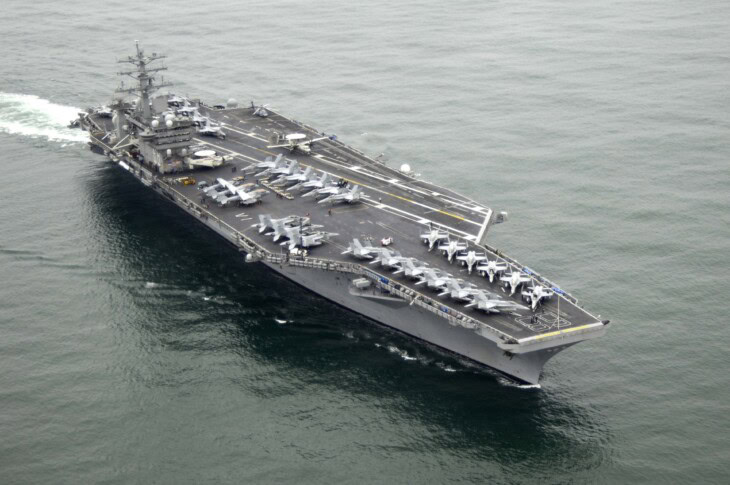
Ford wins on paper. The Nimitz class wins on arithmetic, because there are ten of them and they are the reason the US Navy can keep carriers in two oceans at once.
Each displaces roughly 97,000 tons at full load, measures 1,092 feet (333 m), and carries 60 to 70 aircraft launched by four steam catapults. Two A4W reactors give the same unlimited range as a Ford.
A Nimitz air wing is also the most combat-experienced formation in naval aviation, and unlike Ford these ships already fly the F-35C. If you want the detail on what actually sits on those decks, we break down the numbers in how many planes an aircraft carrier holds.
The class is now shrinking. USS Nimitz herself is on her final cruise, and in March 2026 the Navy pushed her decommissioning back to March 2027 to keep the fleet at the eleven carriers required by federal law until USS John F. Kennedy is delivered.
3. Fujian (Type 003, China)
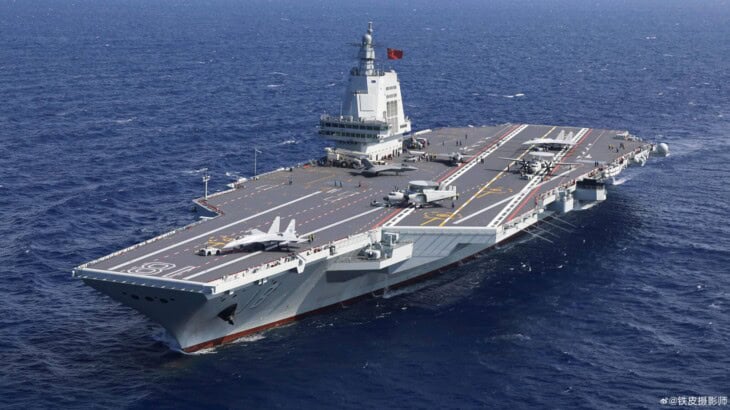
China commissioned Fujian at Sanya on 5 November 2025, with Xi Jinping present. It displaces 80,000 to 85,000 tons at full load, makes about 31 knots, and is the first carrier built outside the United States with catapults instead of a ski jump.
Three electromagnetic catapults change what China can fly from the sea. A ski jump forces a fighter to trade fuel or weapons for lift, and a catapult removes that trade entirely.
The air wing matters more than the hull. Fujian has launched the J-15T, the stealthy J-35, and, critically, the KJ-600 airborne early warning aircraft, which gives a Chinese carrier group its own radar picture for the first time. Our full breakdown of the deck fighters is in the best carrier-based fighter jets in the world.
What keeps Fujian at third is time. It has no deployment record, no proven sortie rate, and a conventionally fuelled hull that ties the group to tankers, which is why it sits behind a class that has been going to war since 1975.
China catapulted a fifth-generation fighter first
Fujian launched the J-35 off an electromagnetic catapult before USS Gerald R. Ford ever deployed with an F-35C. The United States built the technology and the first ship to carry it, and China was first to combine it with a stealth fighter at sea.
The wider balance is closer than the headline count suggests, and we work through it hull by hull in US vs China: aircraft carriers compared.
4. HMS Queen Elizabeth and HMS Prince of Wales (United Kingdom)
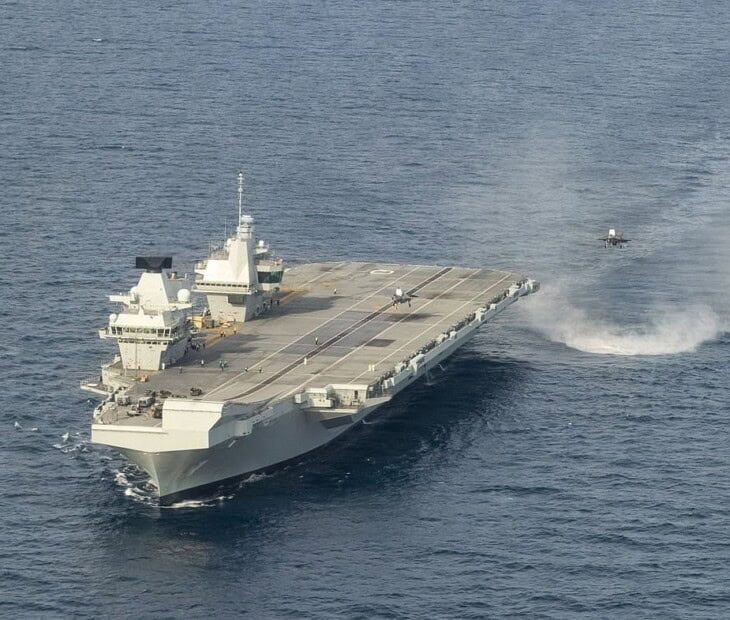
The Queen Elizabeth class is the largest warship the Royal Navy has ever operated, quoted officially at 65,000 tonnes and closer to 80,600 tonnes at deep load, over a length of 932 feet (284 m).
They have no catapults. A 12-degree ski jump launches F-35Bs, which costs range and payload, but buys a far cheaper ship that needs only 679 ship’s crew.
What lifts them above larger hulls is that they have done the job. Operation Highmast sent HMS Prince of Wales as far as Japan and Australia across eight months in 2025, with 24 F-35Bs embarked, the number required for full operational capability.
The strike group came home in November 2025 declared fully operational and ready for NATO tasking. In a war the class can surge to 36 F-35Bs, more stealth fighters than any carrier outside the US Navy.
5. Charles de Gaulle (France)
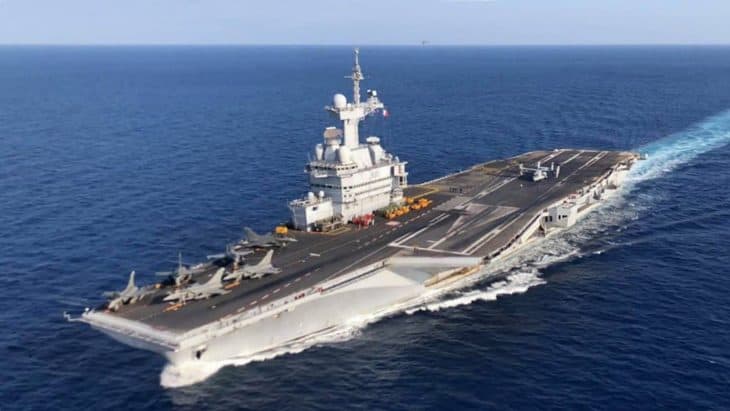
At 42,500 tons Charles de Gaulle is less than half the size of a Nimitz, and it still outranks carriers twice its displacement. Two K15 reactors make it the only nuclear-powered carrier outside the US Navy.
It is also the only non-American carrier flying a fixed-wing radar aircraft, the E-2C Hawkeye, which sees hundreds of miles further than any helicopter-mounted radar and lets the group fight beyond the horizon.
Two steam catapults launch an all-Rafale M air wing of about 30 aircraft, drawn from Flottilles 11F, 12F and 17F, with 4F providing the Hawkeyes. The Rafale M is the only carrier fighter in the world cleared to deliver a nuclear weapon.
The ship works hard for its size. It sailed on Mission La Fayette 26 to the North Atlantic and Baltic on 20 February 2026, redeployed to the eastern Mediterranean in March, and transited Suez in early May.
6. Shandong (Type 002, China)
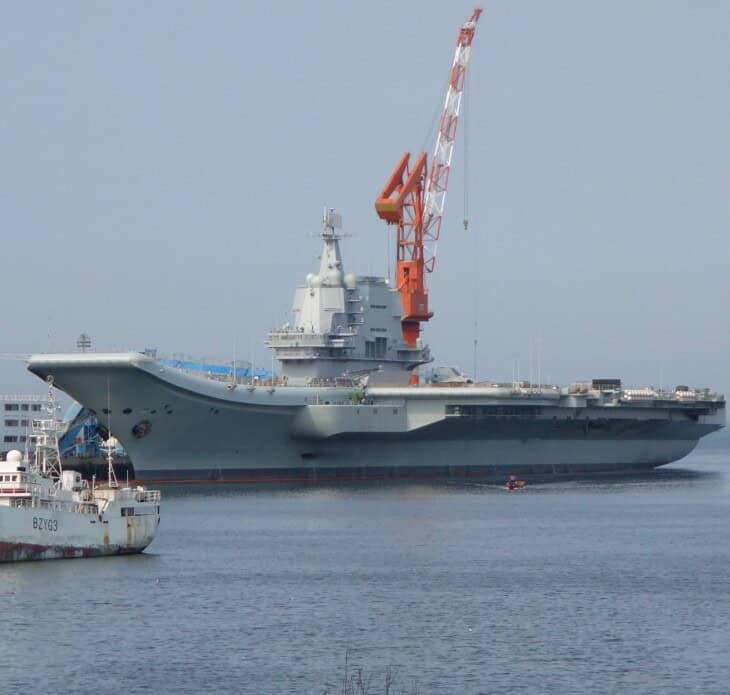
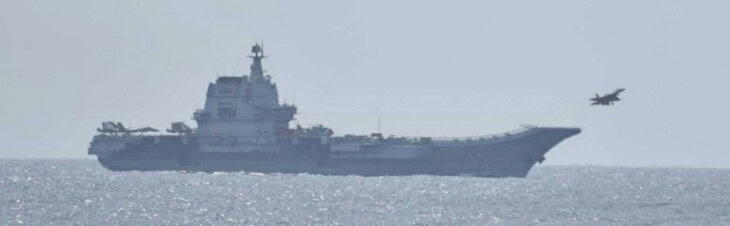
Shandong was China’s first domestically built carrier, commissioned in December 2019. It displaces around 70,000 tons and launches 32 to 36 J-15 fighters off a ski jump.
A ski-jump carrier without catapults or fixed-wing early warning cannot match a CATOBAR ship, and Chinese state media reported in May 2026 that the J-35 has now adapted to ski-jump launch, which would extend fifth-generation aviation to the older decks.
It ranks here on tempo. In June 2025 Shandong operated in the Pacific at the same time as Liaoning, the first confirmed simultaneous two-carrier deployment by the Chinese navy east of the first island chain.
7. USS America and USS Tripoli (America class, United States)
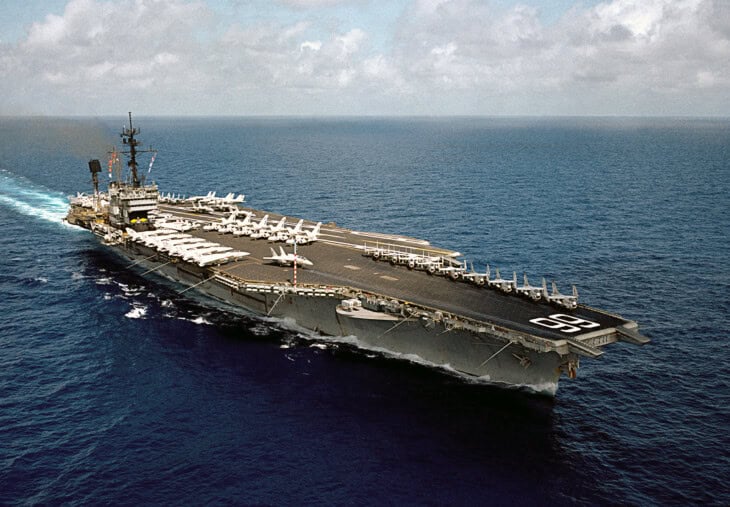
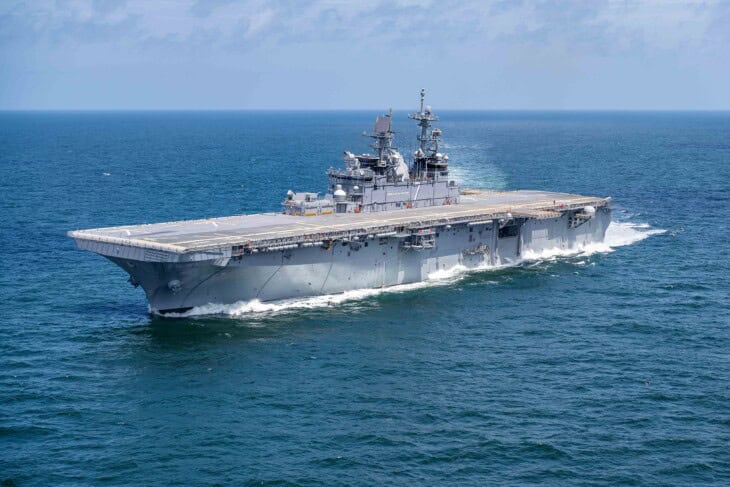
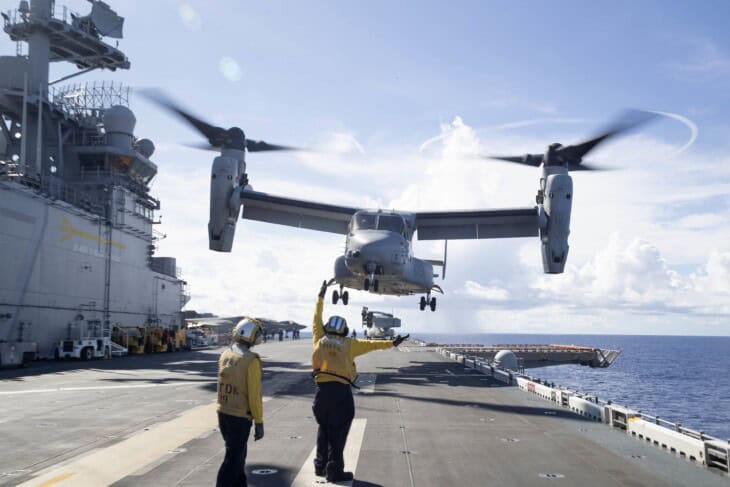
These are officially amphibious assault ships, not carriers. In practice the first two hulls were built without a well deck, which traded landing craft for fuel, hangar space and aviation maintenance.
The result is the “Lightning carrier”: about 45,000 tons of ship carrying up to 20 F-35Bs, a load USS Tripoli demonstrated at sea. That is more fifth-generation fighters than most nations’ entire air forces field.
No catapult, no early warning aircraft, and a short flat deck cap what it can do, so it will never fight like a supercarrier. It earns this place because 20 stealth fighters is a genuine strike package on a hull that costs a fraction of a Ford.
8. Liaoning (Type 001, China)
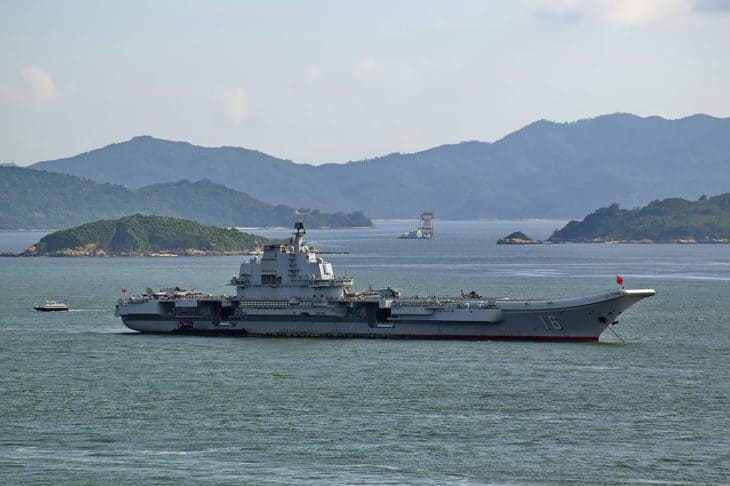

Liaoning began life as the Soviet hull Varyag, bought incomplete from Ukraine and commissioned by China in 2012. For years it was written off as a training ship.
That is no longer true. Its strike group finished a 40-day deployment through the South China Sea and Philippine Sea on 22 June 2026, and during a Western Pacific cruise the previous year Japanese forces counted roughly 550 fixed-wing and helicopter movements from its deck in about three weeks.
It carries about 24 J-15s off a ski jump, so its combat power is modest next to the ships above it. The tempo is what counts, and Liaoning is now generating it.
9. INS Vikrant (India)
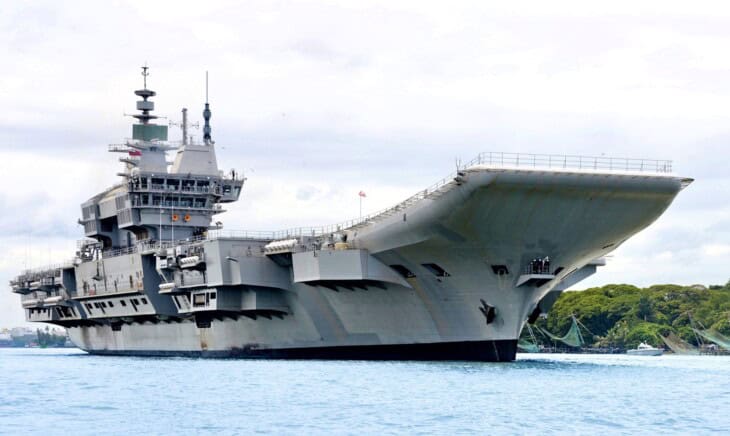
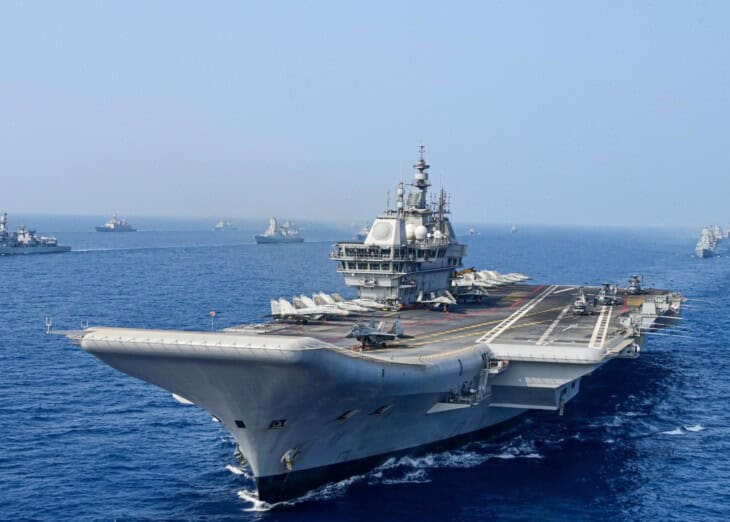
Commissioned in September 2022, INS Vikrant made India one of a handful of countries that can design and build its own carrier. It displaces about 45,000 tons over 860 feet (262 m) and operates roughly 30 aircraft.
The current air wing is the limiting factor. The MiG-29K has a long record of poor availability, and it launches from a ski jump, so it goes to sea with less fuel and fewer weapons than a catapult jet would.
That changes at the end of the decade. India signed for 26 Rafale M fighters in April 2025 in a deal worth roughly $7.4 billion, with deliveries running from 2028 and most of the jets earmarked for Vikrant.
10. JS Izumo and JS Kaga (Izumo class, Japan)
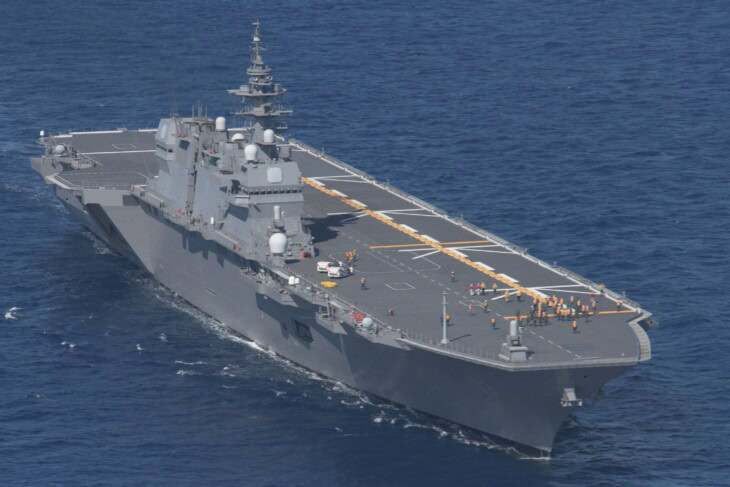
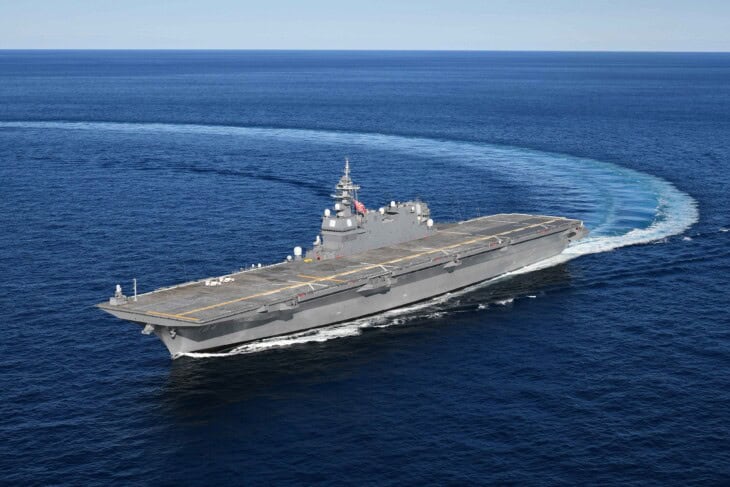
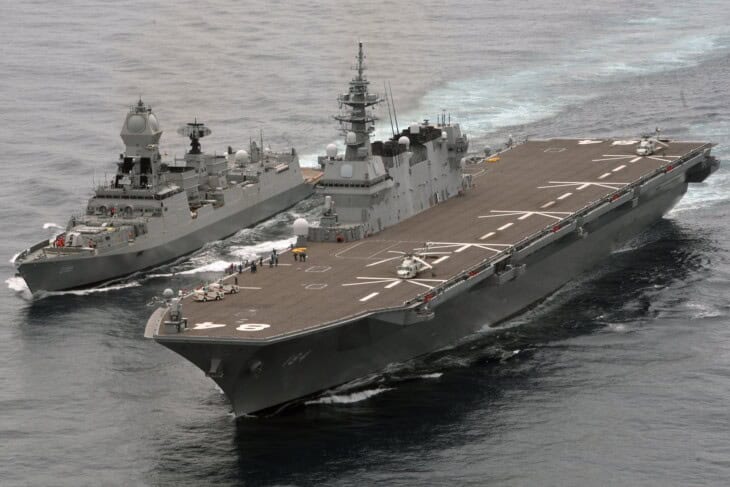
Japan built the Izumo class as helicopter destroyers and is converting both ships into F-35B carriers, a constitutionally sensitive step it spent years avoiding.
At around 27,000 tons and 814 feet (248 m) these are the smallest ships on this list. JS Kaga flew F-35Bs off California in October 2024, including night operations, and JS Izumo’s rebuilt flight deck was revealed in April 2026.
Final conversion work runs to 2028 for Izumo and 2029 for Kaga, and heat from the F-35B’s vertical landings forces pauses between recoveries. A dozen stealth fighters at sea still gives Japan a capability it has not had since 1945.
The near misses
Italy’s Cavour reached initial operating capability with the F-35B in August 2024 and sails with about 15 aircraft, a genuinely capable small carrier that just misses the cut on air wing size.
INS Vikramaditya, Spain’s Juan Carlos I, Italy’s Trieste and Turkey’s drone-carrying Anadolu all operate fixed-wing or unmanned aircraft from a deck without matching the ten above.
One famous name is gone. After nine years and a reported $1 billion of failed repairs, Russia is scrapping Admiral Kuznetsov, leaving the country that pioneered the ski-jump carrier with no carrier at all.
What about the biggest carrier in the world?
Most rankings answer a different question. By displacement the Ford class and the Nimitz class are within a few thousand tons of each other, so size alone cannot separate the two most important carriers afloat, and it tells you nothing about a 42,500-ton Charles de Gaulle that flies catapult strike jets and its own radar aircraft. Tonnage is a rough proxy for hangar space and fuel bunkerage. It is not a measure of combat power, which is why this list ranks sorties instead.
What could change this ranking
USS John F. Kennedy is expected to join the fleet in 2027 as the second Ford-class ship, and unlike Ford it should arrive able to operate the F-35C.
The bigger question mark is over the technology that put Ford at number one. A presidential memorandum signed on 13 August 2026 directs future Ford-class carriers, starting with USS Doris Miller, to revert from electromagnetic catapults to steam and from electromagnetic elevators to hydraulics.
America may go back to steam
EMALS is roughly half installed aboard USS Doris Miller, and General Atomics warned that reversing course now would add significant cost, schedule and integration risk. Analyst Bryan Clark of the Hudson Institute noted that restoring steam lines would require extensive redesign of the ship, and that no supplier has built a steam catapult in more than 20 years.
Fujian is the other variable. Once it completes a real deployment with a full air wing and publishes a sustained sortie rate, third place will be settled on evidence rather than potential.
FAQ
Sources and references used for research and fact-checking.
- Congressional Research Service, Navy Ford (CVN-78) Class Aircraft Carrier Program: Background and Issues for Congress
- USNI News, China Commissions 3rd Aircraft Carrier Fujian
- USNI News, Navy Extends USS Nimitz Service Life to 2027, in line with Carrier John F. Kennedy's Delivery
- Royal Navy, UK's Carrier Strike Group completes eight-month mission as ships and aircraft return home
- USNI News, New White House Memo Calls for Foreign-Built Warships, Return to Steam Catapults on Ford Carriers
- USNI News, China's Liaoning Carrier Strike Group Concludes 40-day Deployment to South China, Philippine Seas
Get the Newsletter
The latest aviation news and stories sent to your inbox.
About the Author

Tim is the owner and lead editor of AeroCorner since 2019, overseeing aviation content covering aircraft, airlines, airports, and the broader aviation industry. Through years of researching, writing, editing, and publishing aviation-focused content, he has developed extensive practical knowledge of commercial aviation and air travel. Based in Asia and a frequent traveler himself, Tim also brings firsthand passenger experience to AeroCorner’s coverage. Outside of publishing, he has also explored aviation firsthand through hands-on flight training in New Zealand.