

Table of Contents
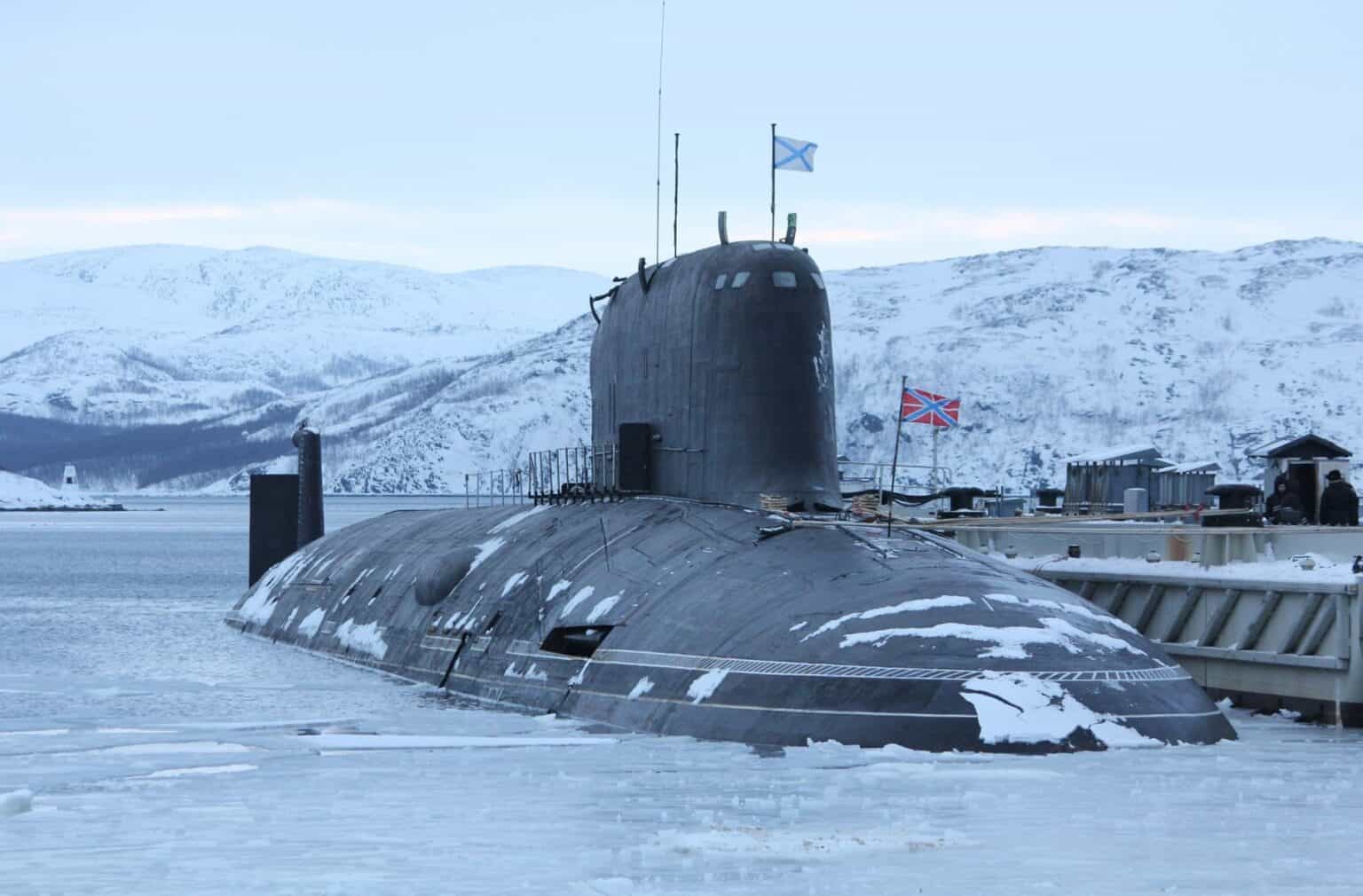
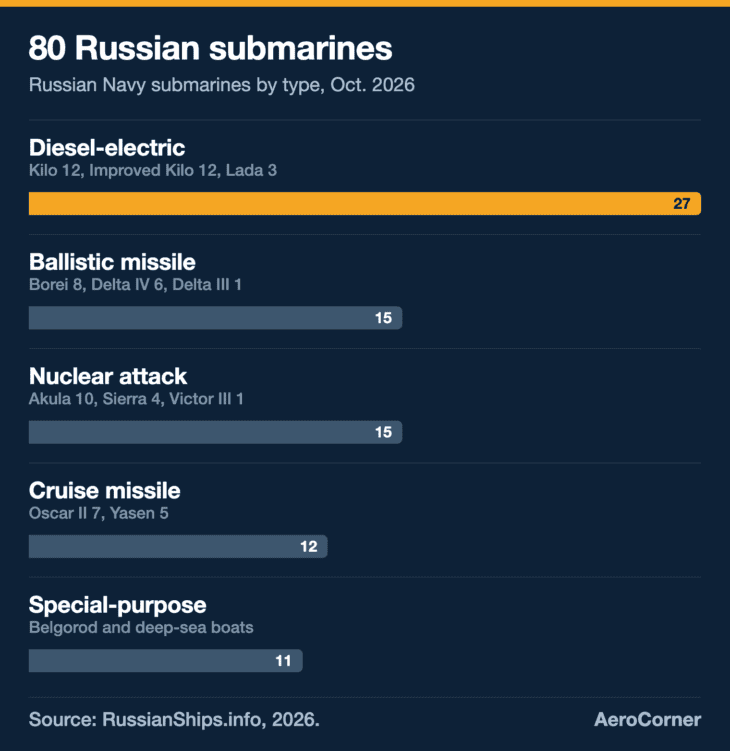
Russia has 80 submarines on its navy list, according to RussianShips.info, which tracks the fleet hull by hull and last updated its count on Oct. 1, 2026. Of those, 69 are combat submarines and 11 are special-purpose and deep-sea research boats.
The twist is in how many actually go to sea. Of the 13 Soviet-designed Akula, Sierra and Victor III attack boats on Wikipedia’s tracked list of active ships, only four are reported active. The rest are in refit, in reserve, or of unknown status.
How Many Submarines Does Russia Have?
80 on the books in October 2026. That figure includes boats in refit and in reserve, because they are still commissioned and listed with a fleet. It also includes 11 special-purpose boats that are not built for combat.
Strip those out and Russia has 69 combat submarines: 42 nuclear-powered and 27 diesel-electric. The Northern Fleet holds 44 of the 80, the Pacific Fleet 27, the Black Sea Fleet seven and the Baltic Fleet two.
The count at a glance
80 Russian Navy submarines listed on Oct. 1, 2026 (RussianShips.info). 15 ballistic missile submarines, 12 cruise missile submarines, 15 nuclear attack submarines and 27 diesel-electric boats make 69 combat submarines. 11 more are special-purpose and deep-sea research boats. The count includes boats in refit and reserve.
The Breakdown: Five Kinds of Submarine
Russian submarines do five different jobs. Ballistic missile boats carry the sea-based nuclear deterrent, cruise missile boats hunt carrier groups and hit land targets, and nuclear attack boats hunt other submarines.
Diesel-electric boats work closer to home. The special-purpose boats are deep-sea research and mission submarines, listed apart from the combat fleet, and 10 of the 11 are nuclear-powered.
| Type | Classes listed | Boats |
|---|---|---|
| Ballistic missile (SSBN) | Borei and Borei-A 8, Delta IV 6, Delta III 1 | 15 |
| Cruise missile (SSGN) | Oscar II 7, Yasen and Yasen-M 5 | 12 |
| Nuclear attack (SSN) | Akula 10, Sierra 4, Victor III 1 | 15 |
| Diesel-electric | Kilo 12, Improved Kilo 12, Lada 3 | 27 |
| Special-purpose and research | Belgorod, Podmoskovye, Orenburg, Sarov and 7 small deep-sea boats | 11 |
| Total | 69 combat, 11 special-purpose | 80 |
Unlike the US Navy, which has no diesel boats at all, Russia still relies heavily on them. Kilos make up every Russian submarine in the Black Sea, and the Improved Kilos there can fire Kalibr cruise missiles.
The modern core is small. Eight Borei-class boats, the newest of them Knyaz Pozharskiy, commissioned on July 24, 2025, carry 16 Bulava missiles each. Five Yasen-class boats are the most modern attack submarines in the fleet. For every class ranked by fighting value, see our guide to the Russian Navy in 2026.
Why Other Sites Say 67, 13 or 80
Search this question and you will find totals anywhere from the 60s to 80, plus a 13 for the boats that matter most. Most of the gap is not disagreement about facts. It is disagreement about what counts as a submarine in service.
80 is the full RussianShips.info list. It counts every commissioned hull, including the 11 special-purpose boats and submarines sitting in refit or reserve.
About 67 is the total on Wikipedia’s list of active Russian Navy ships, which puts it at “c. 67 submarines”: 14 ballistic missile, six cruise missile, 18 nuclear attack, about 19 diesel-electric and about 10 special-purpose. It carries fewer old diesel boats and leaves out the last Delta III, Ryazan.
13 is the number that matters for the nuclear deterrent. The Russian Nuclear Forces Project counted 13 operational ballistic missile submarines in January 2026, five Delta IVs and eight Boreis, carrying 208 missiles between them.
A listed submarine is not a working submarine
Every big total counts boats that cannot sail. The Akula Leopard was still on sea trials in 2026 after a refit and upgrade, another Akula is not expected out of refit until 2028, and the Delta IV Ekaterinburg is listed as inactive and due to be decommissioned.
How Many Are Actually Active
Wikipedia’s list notes the status of each boat, which gives a rough read on readiness. The new submarines are almost all working. The Soviet-era attack boats mostly are not.
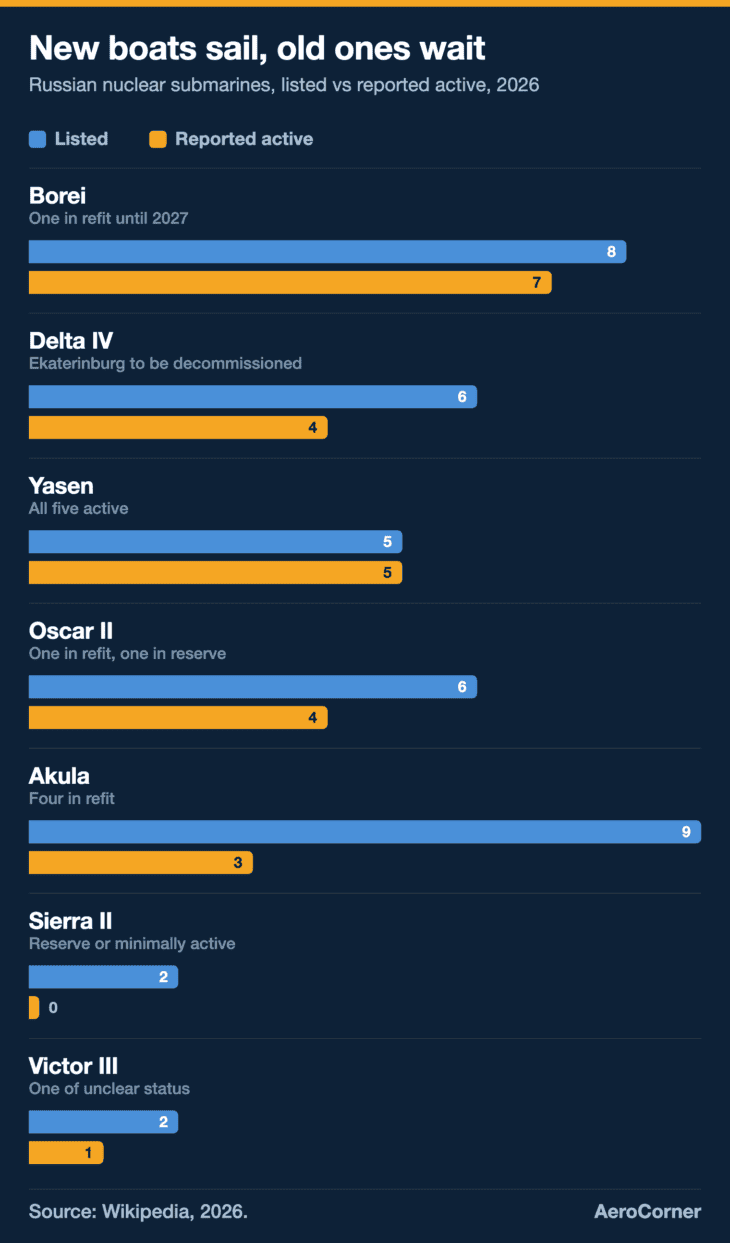
Across the seven nuclear combat classes, the list carries 38 boats and marks 24 of them active. The lone Borei not active, Yuriy Dolgorukiy, is in refit and overhaul until 2027.
The Akula fleet shows the problem. Four boats are in refit, one is in reserve and one is on post-refit trials, leaving three reported active. Both Sierra II boats are described as in reserve or minimally active.
The diesel force has taken war losses too. Ukraine hit the Improved Kilo Rostov-on-Don in a Sevastopol dry dock on Sept. 13, 2023, then said it sank the repaired boat in port on Aug. 2, 2024.
On Dec. 15, 2025, Ukraine’s SBU security service said its Sea Baby underwater drones had knocked another Kilo out of action at Novorossiysk. Russia made no immediate comment, and neither claim has been confirmed by Moscow.
Where the Number Goes Next
New boats are arriving slowly. The Yasen-M Perm, launched on March 27, 2025, is the next one due: Navy commander Admiral Alexander Moiseyev said in March 2026 that its trials would be finished this year and that it would join the Pacific Fleet.
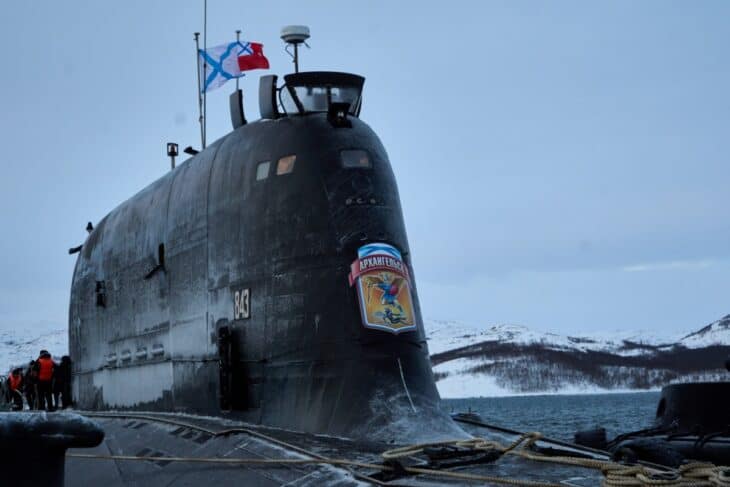

Behind it, the Yasen-M Ulyanovsk was launched on July 28, 2026, and three more Yasens are under construction. Two further Borei-A boats, Dmitry Donskoy and Knyaz Potemkin, have been building since August 2021.
The oddest addition is Khabarovsk, launched at Severodvinsk in November 2025. It is built around the Poseidon nuclear-powered underwater drone and is reported to carry six of them.
Retirements pull the other way. Ekaterinburg is due to be decommissioned, and the Soviet-designed attack boats in reserve are candidates to follow. So the listed total may change little for now, while the share of new boats inside it grows.
80 Against the US Fleet
On paper Russia has more submarines than America. The US Navy has 65 active submarines, every one nuclear-powered, against Russia’s 42 nuclear combat boats.
On ballistic missile boats the two are close: 14 US Ohios against Russia’s 13 operational Delta IVs and Boreis. Russia’s real edge is size, not numbers: the special-purpose Belgorod and the Borei class both sit near the top of the largest submarines in the world.
How the Yasen stacks up against the Virginia and the Seawolf is in our ranking of the best attack submarines in the world.
FAQ
Sources and references used for research and fact-checking.
- RussianShips.info, List of Active Russian Navy Ships and Submarines
- Wikipedia, List of active Russian Navy ships
- Russian Nuclear Forces Project (russianforces.org), Russian strategic nuclear forces: current status
- Wikipedia, Borei-class submarine
- Wikipedia, Yasen-class submarine
- TASS, Trials of Yasen-M-class Perm nuclear sub to be completed in 2026, Navy commander
- Ukrainska Pravda, Ukrainian forces sink Russian Black Sea Fleet submarine in Sevastopol, Ukraine's General Staff
- Al Jazeera, Ukraine claims strike on Russian submarine in Novorossiysk with sea drones
- The War Zone, Russia's New Nuclear Torpedo-Carrying Submarine Has Been Launched
Get the Newsletter
The latest aviation news and stories sent to your inbox.
About the Author

Tim is the owner and lead editor of AeroCorner since 2019, overseeing aviation content covering aircraft, airlines, airports, and the broader aviation industry. Through years of researching, writing, editing, and publishing aviation-focused content, he has developed extensive practical knowledge of commercial aviation and air travel. Based in Asia and a frequent traveler himself, Tim also brings firsthand passenger experience to AeroCorner’s coverage. Outside of publishing, he has also explored aviation firsthand through hands-on flight training in New Zealand.