

Table of Contents
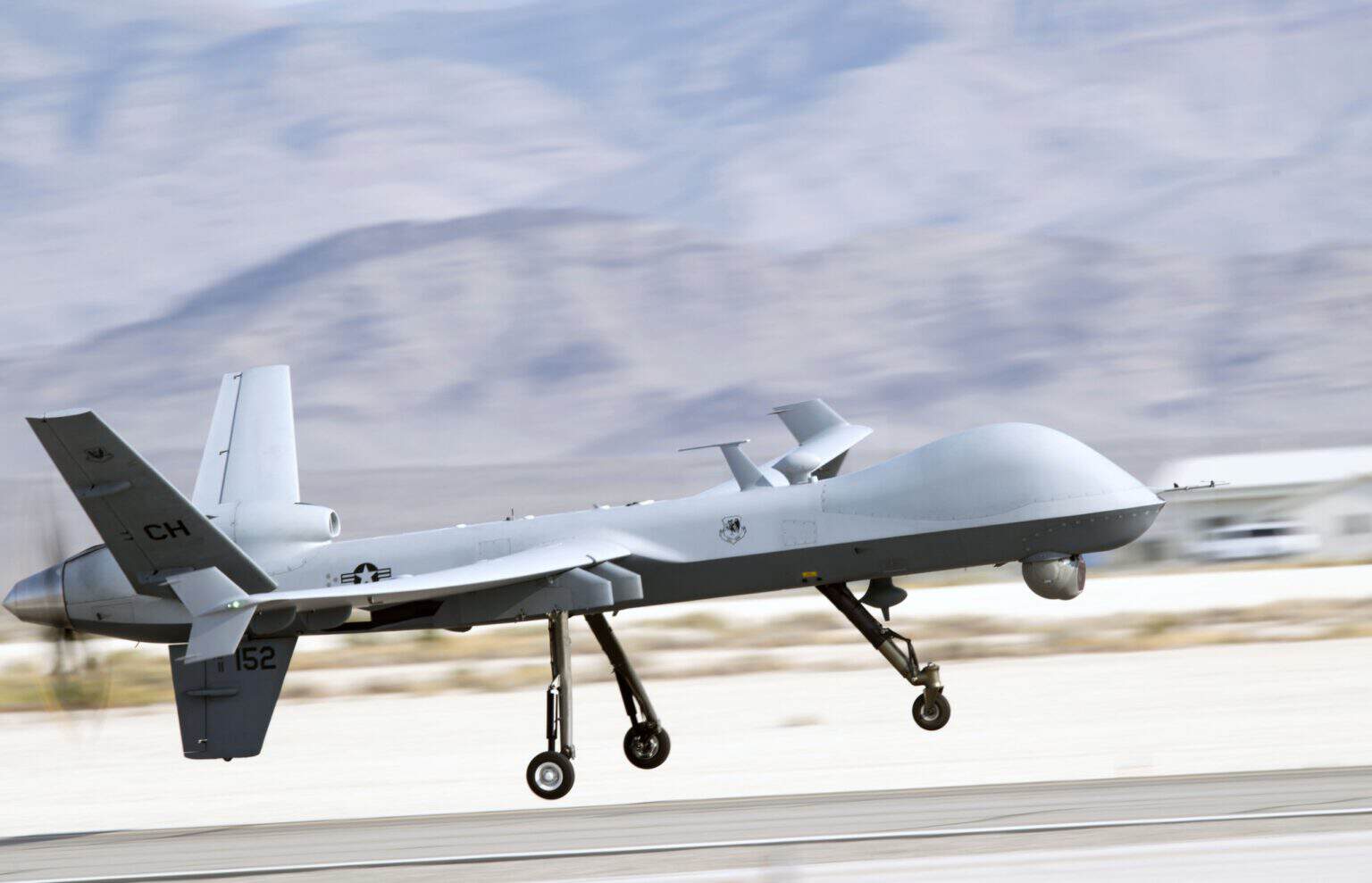
The most important drone in the US military is still the MQ-9 Reaper, the armed General Atomics aircraft the Air Force’s top officer called the “most valuable player” of the 2026 war with Iran. It is also a drone the Air Force is running out of: 135 remained in service in May 2026, down from 351 in fiscal 2022.
This list ranks the 11 US military drones that matter most by one measure: operational weight, meaning what each does for American forces today, weighted by how many are actually flying. A drone in combat outranks a prototype, however impressive the prototype.
It covers the Air Force, Navy, Army and Marine Corps, from 130-foot spy planes to tube-launched loitering munitions. Figures are dated November 2026.
| Rank | Drone | Service | Role | Endurance | Status |
|---|---|---|---|---|---|
| 1 | MQ-9 Reaper | Air Force, Marine Corps | Armed surveillance and strike | Up to 27 hours | In service, production line closed |
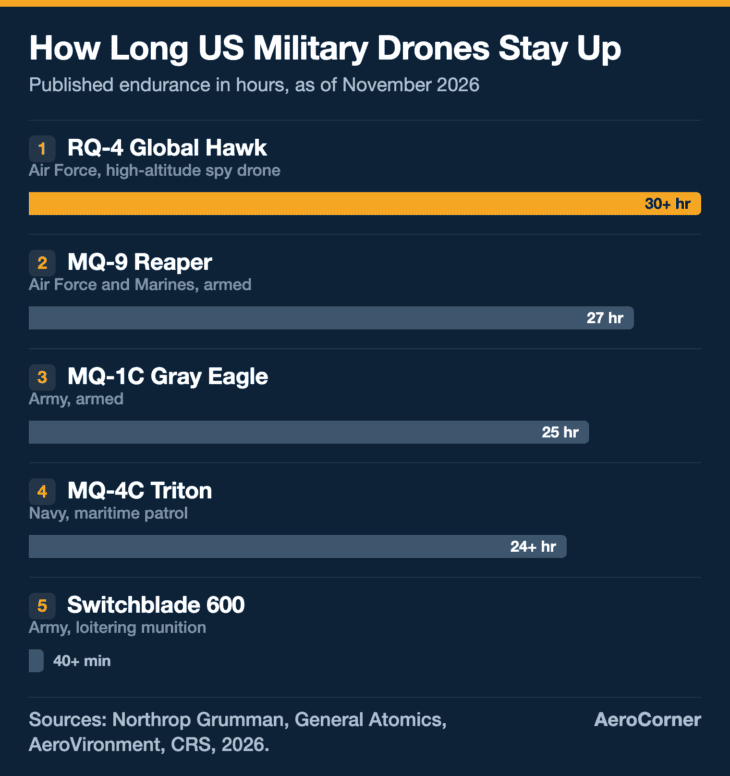
| 2 | RQ-4 Global Hawk | Air Force | High-altitude surveillance | More than 30 hours | In service, 9 aircraft |
| 3 | MQ-4C Triton | Navy | Maritime patrol | 24-plus hours | In service |
| 4 | RQ-170 Sentinel | Air Force | Stealth reconnaissance | Not published | In service |
| 5 | LUCAS | CENTCOM task force | One-way attack | Not published | In combat since Feb. 2026 |
| 6 | Switchblade 600 | Army | Loitering munition | 40+ minutes | In service |
| 7 | MQ-1C Gray Eagle | Army | Armed surveillance | 25 hours | In service, no new Army buys |
| 8 | Skydio X10D | Army | Short-range scouting | Not published | In service |
| 9 | FQ-42A Vengeance | Air Force | Combat drone wingman | Not published | In production |
| 10 | FQ-44A Fury | Air Force | Combat drone wingman | Not published | In production |
| 11 | MQ-25 Stingray | Navy | Carrier tanker | Not published | Low-rate production, IOC 2029 |
How this ranking works
The measure is operational weight: what each drone does for US forces in November 2026, weighted by how many are flying. Aircraft in combat or on daily missions rank first, and programs still in testing or early production rank last, however capable they promise to be. Small hand-launched drones are represented by the Army’s current standard quadcopter, not every model in the inventory.
1. MQ-9 Reaper
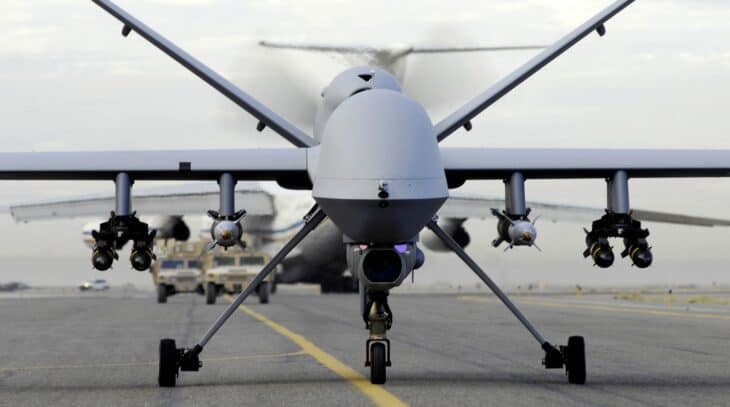

The Reaper is a General Atomics turboprop drone with a 66-foot (20 m) wingspan that can stay airborne for up to 27 hours, according to the Congressional Research Service (CRS). It carries Hellfire missiles and guided bombs as well as cameras and sensors.
The war with Iran began on February 28, 2026. In May testimony, Air Force Chief of Staff Gen. Kenneth Wilsbach called the MQ-9A “maybe the most valuable player” of Operation Epic Fury, according to CRS.
That work cost aircraft. The Washington Post reported in August 2026, citing US officials, that at least 45 Reapers had been lost, roughly a quarter of the pre-war fleet; our breakdown of US aircraft losses in the Iran war shows how that number was counted.
Each one costs $30 million to $50 million depending on its sensors, and CRS reports the MQ-9A production line is closed, with two to three years needed to restart it. The Marine Corps flies the type too: its first squadron, VMU-1, accepted its first two MQ-9As in September 2021.
From 351 Reapers to 135
The Air Force reported 351 MQ-9As in fiscal 2022. By May 2026, after deliberate retirements of older aircraft plus accidents and combat losses, an Air Force official told Congress 135 remained in service, according to the Congressional Research Service. The service says that is still enough for its requirement of 56 combat lines.
The Air Force does not want more Reapers. It wants a cheaper drone called the Massed Modular Aircraft, estimated at about $10 million each, with a goal of 500 in service by 2032.
2. RQ-4 Global Hawk
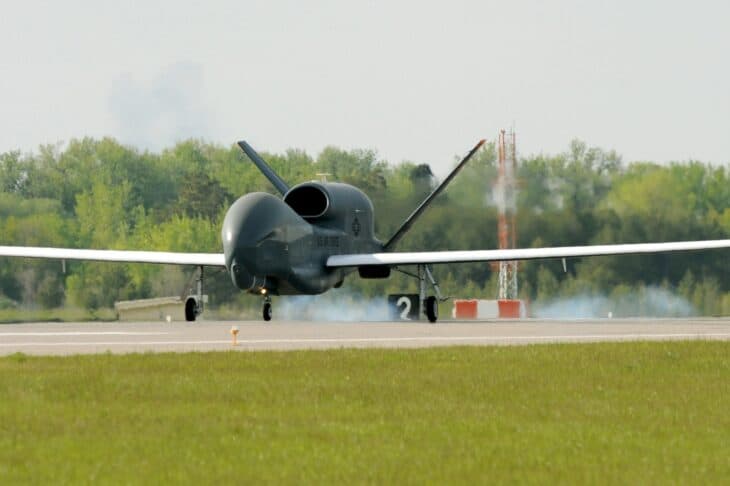

The Global Hawk is the Air Force’s high-altitude giant, a Northrop Grumman jet drone with a wingspan of 130.9 feet (39.9 m) and a service ceiling of 60,000 feet. It carries cameras, radar and signals sensors instead of weapons, and Northrop says it can stay up for more than 30 hours.
It first flew on February 28, 1998, and Northrop says the type has logged more than 320,000 flight hours. Range is listed at 12,300 nautical miles (about 14,200 miles), enough to cross the Pacific without stopping.
The fleet is small and its future has flip-flopped. The Air Force once planned to retire it in 2027, but Congress barred retiring any of the nine remaining RQ-4s until the end of fiscal 2030, and in August 2026 the service said it no longer had a projected retirement date.
3. MQ-4C Triton
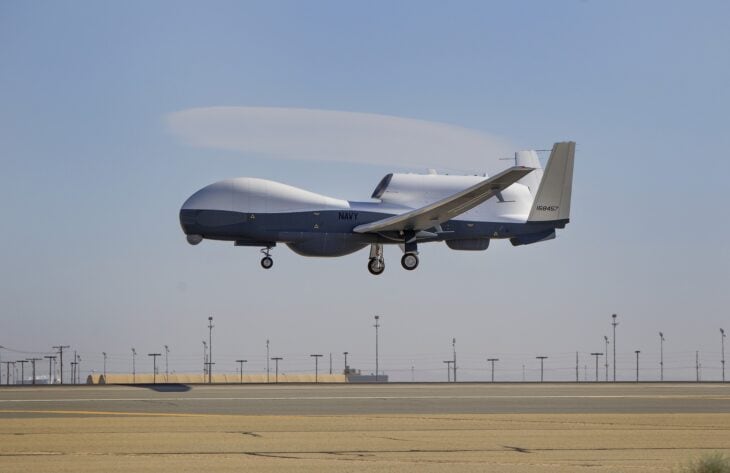

The Triton is the Navy’s maritime patrol drone, derived from the Global Hawk and shaped by the same 130-foot wing. Northrop says it operates above 50,000 feet for 24-plus hours and has a range of 7,400 nautical miles (about 8,500 miles).
It first flew on May 22, 2013, and squadron VUP-19 reached initial operational capability in September 2023, two years later than planned. The Navy once wanted 68 production aircraft, but the program was cut to 27 airframes.
The Iran war tested it too. A Triton crashed on April 9, 2026, at a location the Navy withheld, and the Naval Safety Command listed it as a Class A mishap; the cause had not been made public when the loss was confirmed.
4. RQ-170 Sentinel
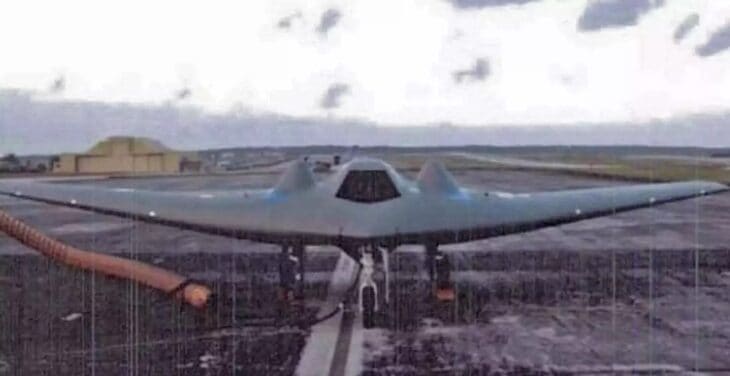

The RQ-170 is a Lockheed Martin stealth flying wing, and almost everything about it is still secret. The Air Force acknowledged it in December 2009 after photos surfaced of a gray tailless drone at Kandahar, which earned it the nickname “the Beast of Kandahar.”
It is flown by the 30th and 44th Reconnaissance Squadrons at Creech Air Force Base, Nevada. At least one watched the Osama bin Laden compound during the May 2, 2011 raid, and in January 2026 Lockheed confirmed the type took part in the mission that captured Venezuela’s Nicolás Maduro.
Even its size is disputed: published wingspan estimates run from under 40 feet (12 m) to about 66 feet (20 m). Estimates of how many were built range from 20 to 30, and one came down in Iran in December 2011.
5. LUCAS
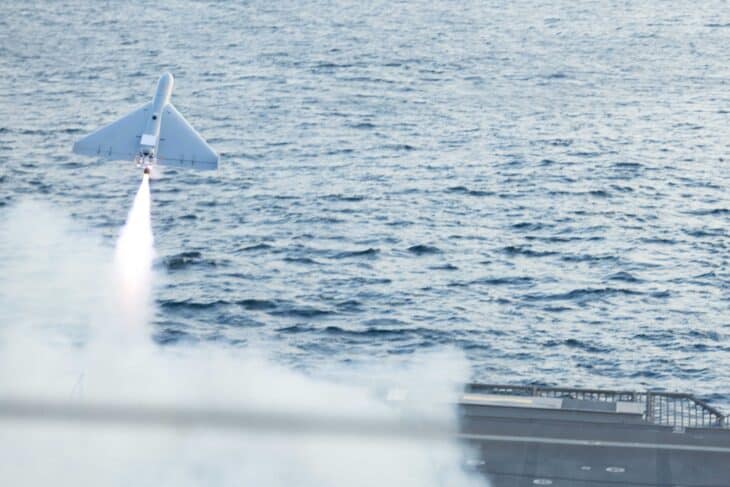

LUCAS, short for Low-cost Uncrewed Combat Attack System, is an American copy of Iran’s Shahed-136 one-way attack drone. It was designed by Arizona-based SpektreWorks and costs about $35,000 per drone, according to a CENTCOM spokesperson.
CENTCOM set up Task Force Scorpion Strike in December 2025 to field it, and Navy personnel test-launched one from the littoral combat ship USS Santa Barbara soon after. On February 28, 2026, CENTCOM confirmed the drones had been used in combat for the first time, launched from the ground in the opening strikes on Iran.
Its real range is not public. SpektreWorks lists 444 miles and up to six hours aloft for its FLM 136 target drone, but The War Zone noted it is unclear whether those figures apply to LUCAS.
6. Switchblade 600
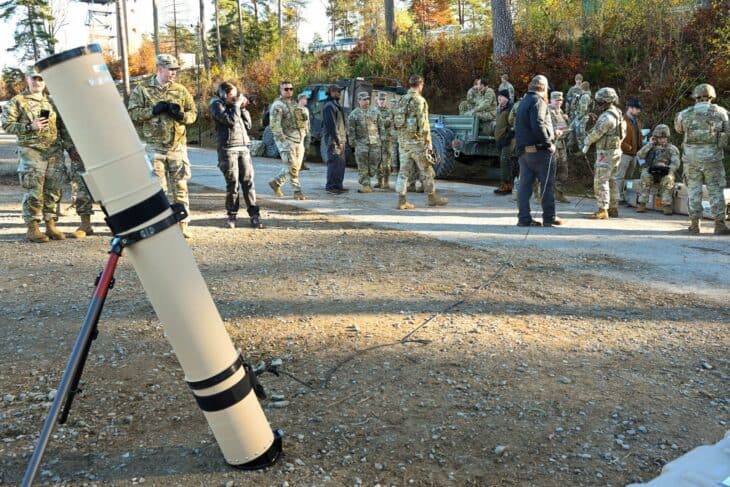

The Switchblade 600 is AeroVironment’s anti-armor loitering munition: it launches from a tube, circles the battlefield, then dives onto its target. AeroVironment lists 40-plus minutes of endurance, a 65-pound (29.5 kg) all-up round and a range of more than 55 miles (90 km) when control is handed to a forward operator.
In August 2024 the Army awarded AeroVironment a contract worth up to $990 million over five years for the Switchblade 300 and 600, and it is pursuing the 600 for its Low Altitude Stalking and Strike Ordnance (LASSO) program. Our ranking of the best kamikaze drones sets it against its foreign rivals.
7. MQ-1C Gray Eagle
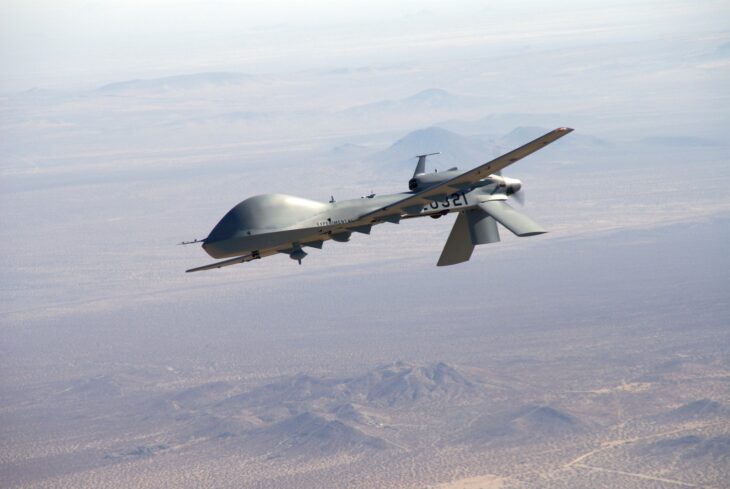

The Gray Eagle is the Army’s armed drone, a General Atomics design derived from the Predator. It has a 56-foot (17 m) wingspan, a maximum takeoff weight of 3,600 pounds (1,633 kg), a 165-horsepower heavy-fuel engine and 25 hours of endurance, and it can carry four Hellfire missiles.
It first flew in October 2004 and entered service in 2009. In May 2025 the Army’s leadership called for canceling “obsolete” drones like the Gray Eagle, and the service stopped buying new ones, with a successor targeted for around fiscal 2028.
Congress pushed back. A budget bill reported in January 2026 would add $240 million for Gray Eagle 25M drones for the Army National Guard.
8. Skydio X10D
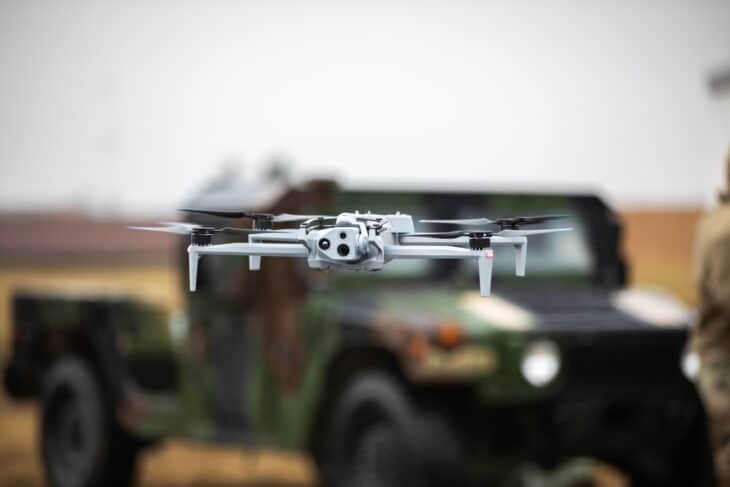

The X10D is a small American-made quadcopter, the Army’s standard short-range scout. Skydio delivered the first systems for Tranche 2 of the Army’s Short Range Reconnaissance program of record in May 2025, hundreds of them to a unit preparing to deploy.
It carries a 48-megapixel telephoto camera and a FLIR thermal sensor, and it is designed to hold position without GPS and to resist jamming. Being American-made matters more since December 2025, when the FCC restricted new foreign-made drones (see the FAQ below).
9. FQ-42A Vengeance
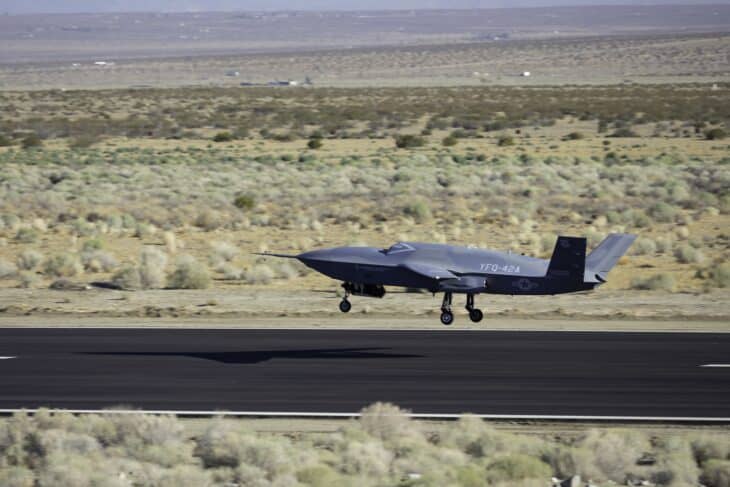

The FQ-42A is General Atomics’ Collaborative Combat Aircraft (CCA), a drone wingman meant to fly with crewed fighters on strike, reconnaissance, electronic warfare and decoy missions. The prototype YFQ-42A first flew on August 27, 2025, at an undisclosed location in California.
In June 2026 the Air Force awarded production contracts to both CCA makers, four months ahead of schedule, and dropped the “Y” prototype prefix. Air Force Secretary Troy Meink announced its official name, Vengeance, on September 14, 2026, replacing the “Dark Merlin” name General Atomics had chosen.
10. FQ-44A Fury
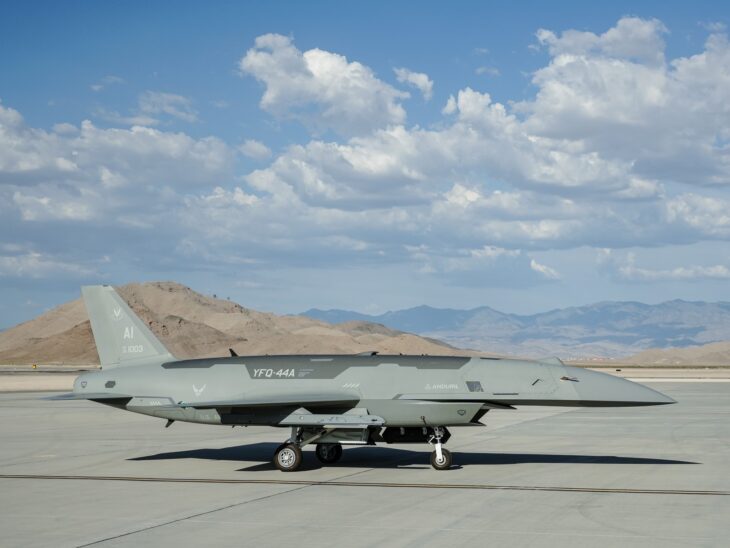

The FQ-44A is Anduril’s CCA and the other half of the Air Force’s split buy. The YFQ-44A first flew on October 31, 2025, from Southern California Logistics Airport in Victorville, 556 days from clean-sheet design to first flight, according to Anduril.
Anduril says it flew with “no operator with a stick and throttle,” only a monitor who directs it at the push of a button. The Air Force says it can buy more than 150 combat-capable CCAs by the end of the decade, toward a long-term goal of about 1,000.
11. MQ-25 Stingray
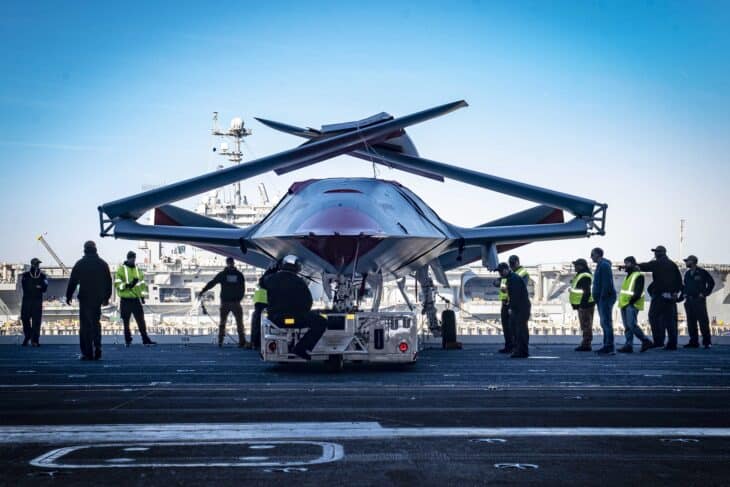

The MQ-25 is Boeing’s carrier-based tanker drone, built to refuel Navy fighters so they can strike from farther away. The Navy’s objective is for it to deliver at least 14,000 pounds (6,350 kg) of fuel at 500 nautical miles (575 miles) from the carrier.
A developmental MQ-25 made its first flight in April 2026, and the Navy approved low-rate initial production in May. Initial operational capability is now expected in 2029, and the Pentagon’s April 2026 estimate put the cost at $255.8 million per aircraft.
Isn't the Predator still flying?
Not in the Air Force. The MQ-1 Predator, the drone that made armed drones famous, was retired by the Air Force on March 9, 2018 in favor of the heavier MQ-9 Reaper. Its bloodline lives on in the Army’s MQ-1C Gray Eagle, a larger derivative of the Predator design.
What comes next
The pattern is the same in every service: fewer expensive drones, many more cheap ones. The Air Force wants to replace $30 million Reapers with $10 million modular drones, the Army has stopped buying Gray Eagles, and a $35,000 Shahed copy went to war within three months of its task force being formed.
For how these aircraft compare with Turkey’s, China’s and Israel’s best, see our ranking of the best military drones in the world.
FAQ
Sources and references used for research and fact-checking.
- Congressional Research Service, MQ-9 Reaper Uncrewed Aircraft System (IF13318)
- Wikipedia, General Atomics MQ-9 Reaper
- The Defense Post, US has lost at least 45 Reapers in Iran war
- Northrop Grumman, Global Hawk
- Wikipedia, Northrop Grumman RQ-4 Global Hawk
- Air & Space Forces Magazine, Air Force Plans Support Contract That Could Keep RQ-4s Flying Into 2030s
- Northrop Grumman, Triton
- Wikipedia, Northrop Grumman MQ-4C Triton
- The Aviationist, U.S. Navy Confirms MQ-4C Triton Crash
- Wikipedia, Lockheed Martin RQ-170 Sentinel
- The War Zone, U.S. Military Has Used Long-Range Kamikaze Drones In Combat For The First Time
- AeroVironment, Switchblade 600
- DefenseScoop, Army awards AeroVironment Switchblade contract worth up to $1B
- General Atomics Aeronautical Systems, Gray Eagle
- Wikipedia, General Atomics MQ-1C Gray Eagle
- Defense Daily, Army looks to begin replacing Gray Eagles with new STOL/VTOL UAS in FY-28
- The War Zone, MQ-1C drones the Army has called obsolete added in new budget plan by Congress
- DroneLife, Skydio delivers first X10D systems for U.S. Army's SRR program
- Defense News, First flight tests begin for Air Force's drone wingmen
- Air & Space Forces Magazine, Anduril's CCA Makes First Flight
- Defense News, US Air Force awards first CCA production contracts to General Atomics, Anduril
- The Aviationist, U.S. Air Force Names CCAs as FQ-42 Vengeance and FQ-44 Fury
- Congressional Research Service, MQ-25 Stingray: Background and Issues for Congress (IF12972)
- Wikipedia, General Atomics MQ-1 Predator
- DroneLife, FCC adds foreign-made drones and components to Covered List
Get the Newsletter
The latest aviation news and stories sent to your inbox.
About the Author

Tim is the owner and lead editor of AeroCorner since 2019, overseeing aviation content covering aircraft, airlines, airports, and the broader aviation industry. Through years of researching, writing, editing, and publishing aviation-focused content, he has developed extensive practical knowledge of commercial aviation and air travel. Based in Asia and a frequent traveler himself, Tim also brings firsthand passenger experience to AeroCorner’s coverage. Outside of publishing, he has also explored aviation firsthand through hands-on flight training in New Zealand.