

Table of Contents
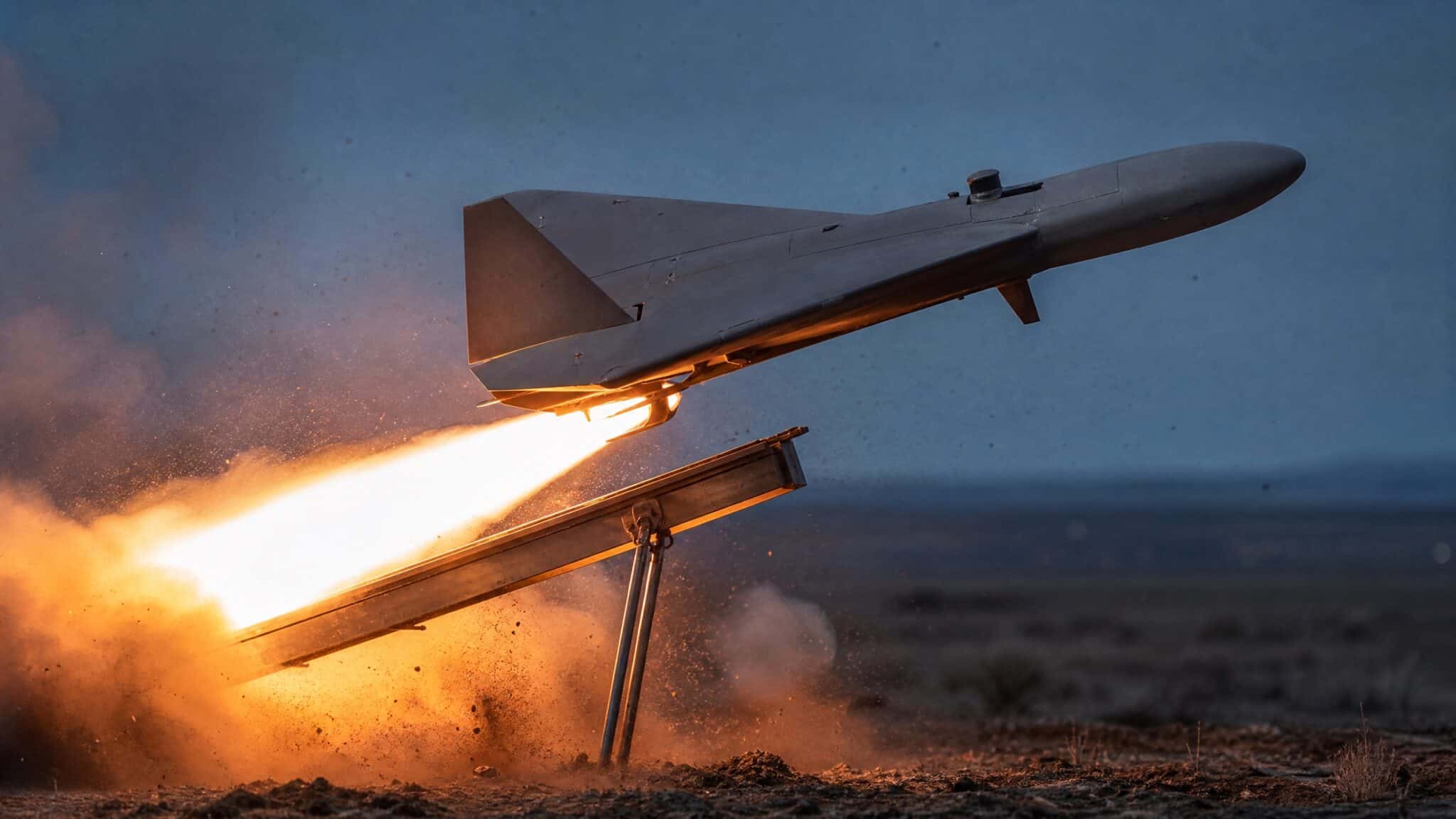
The best kamikaze drone in the world is the Shahed-136, and it is not the most advanced weapon on this list. It is a plywood-and-composite delta wing pushed along by a moped-grade piston engine at 115 mph (185 km/h), and it has done more to reshape modern air defense than anything else flying.
That is the uncomfortable finding of this ranking. Kamikaze drones are not judged by how sophisticated they are. They are judged by what they destroy, how far they reach, and how many of them a country can afford to throw away.
This list ranks the ten most capable one-way attack drones in service as of 2026, measured by verified combat record, reach, warhead, and the scale at which they can actually be fielded. Every entry is a weapon that has been used in a real war, not a trade-show mockup.
| Rank | Drone | Origin | Range | Warhead | Class |
|---|---|---|---|---|---|
| 1 | Shahed-136 / Geran-2 | Iran / Russia | 1,550 miles (2,500 km) | 110 to 200 lb (50 to 90 kg) | Long-range |
| 2 | IAI Harop | Israel | 620 miles (1,000 km) | 51 lb (23 kg) | Anti-radiation |
| 3 | ZALA Lancet | Russia | 25 to 45 miles (40 to 70 km) | 7 to 11 lb (3 to 5 kg) | Tactical |
| 4 | Switchblade 600 | United States | 55+ miles (90+ km) | Javelin-class anti-armor | Tactical |
| 5 | An-196 Liutyi | Ukraine | 620+ miles (1,000+ km) | ~110 lb (~50 kg) | Long-range |
| 6 | Geran-3 / Geran-5 | Russia | 620 to 1,550 miles | 200 lb (90 kg) | Long-range, jet |
| 7 | UVision HERO-120 | Israel | 37 miles (60 km) | 10 lb (4.5 kg) | Tactical |
| 8 | FP-1 | Ukraine | 990 miles (1,600 km) | 88 lb (40 kg) | Long-range |
| 9 | Switchblade 300 / 400 | United States | Up to 40 miles (65 km) | Anti-personnel / anti-armor | Man-portable |
| 10 | WB Group Warmate | Poland | 19 miles (30 km) | HE-FRAG or HEAT | Man-portable |
How this ranking works
Three factors decide the order: verified combat record, destructive reach (warhead multiplied by range), and fieldable scale, meaning how many a country can build and afford to lose. A drone that has destroyed hundreds of real targets outranks a more advanced system with a thin combat history. Only one-way attack munitions qualify, meaning the airframe itself is the weapon and is expended on impact. Reusable armed drones such as the MQ-9 Reaper and Bayraktar TB2 are excluded, as are cruise missiles and improvised FPV quadcopters, both covered separately below.
1. Shahed-136 / Geran-2
.jpg)
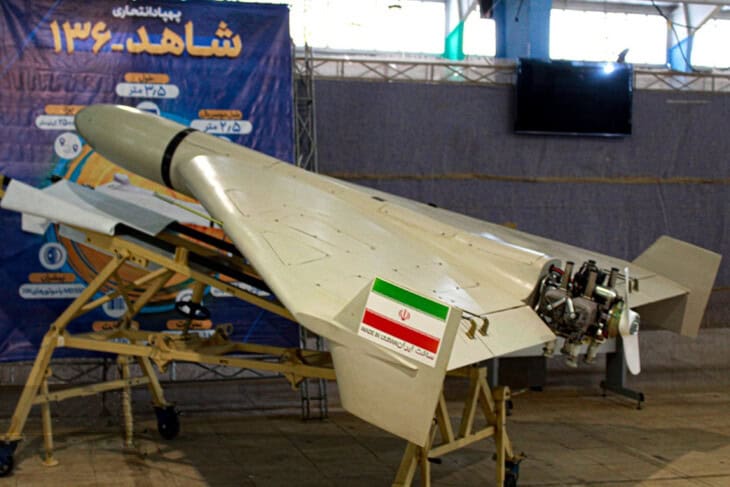
Iran’s Shahed-136, built under license in Russia as the Geran-2, is a 440 lb (200 kg) delta-wing drone with a 1,550 mile (2,500 km) range and a warhead of 110 lb (50 kg), rising to 200 lb (90 kg) on later Russian builds at the cost of range.
On paper it is unimpressive. It flies at 115 mph (185 km/h), which is slower than a Cessna, and its engine is a reverse-engineered German Limbach design. A single fighter can shoot one down without difficulty.
That is exactly why it ranks first. The Shahed is not built to survive, it is built to be cheap enough that the defender goes bankrupt shooting it down.
Estimates put domestic production cost between $20,000 and $50,000 per airframe. A Patriot PAC-3 interceptor costs roughly $4.1 million, and standard doctrine fires two of them at each incoming target.
The math that makes it the best
At 150 to 200 launches a week and two interceptors per engagement, a defender can burn through more than $1.2 billion in Patriot missiles in seven days to stop drones that cost the attacker under $10 million to build. Even the ones that get shot down do their job: the Shahed’s real target is the interceptor stockpile.
Production scale is the other half of the story. By 2026 Russia was assembling roughly 170 Geran-2 airframes a day at the Yelabuga plant, with total output somewhere north of 26,000 units.
Later variants added GLONASS-hardened navigation, thermobaric warhead options, 4G modems for mid-flight control, and Nvidia Jetson processors for onboard image recognition. Some carry infrared cameras. A handful have been seen fitted with air-to-air missiles to hunt the helicopters sent up to intercept them.
2. IAI Harop
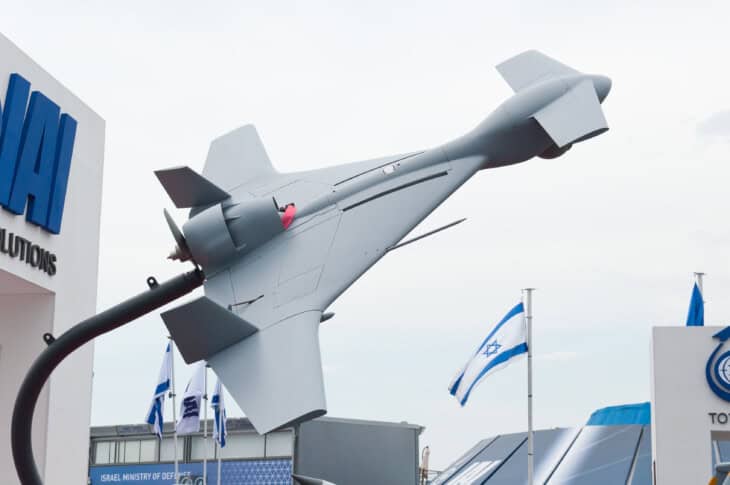
The Harop is the weapon that invented this category, and it still has the longest and densest combat record of anything on this list. Israel Aerospace Industries built it around a simple idea: a drone that hunts radar emitters, circles until one switches on, then dives into it.
It carries a 51 lb (23 kg) warhead, loiters for up to nine hours, reaches 225 knots, and has an operational range of 620 miles (1,000 km) with a 125 mile (200 km) control link.
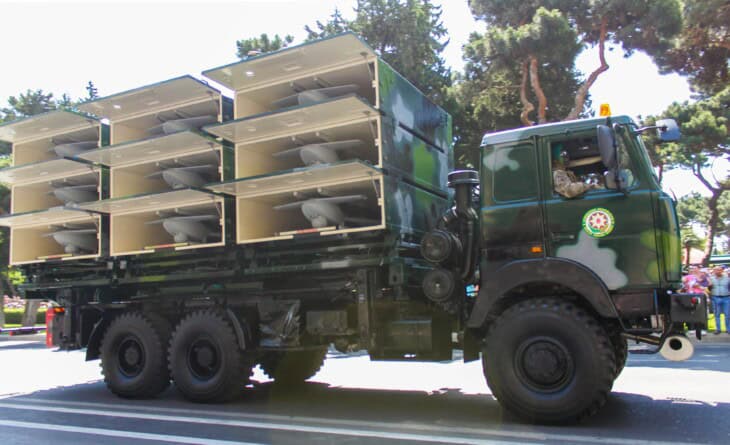
Its record is what earns second place. Harops flew combat in the 2016 Four-Day War in Nagorno-Karabakh, the first interstate conflict in which loitering munitions were used at all, then again in 2020, where Israeli-supplied munitions were widely credited as decisive in Azerbaijan’s victory.
In May 2025 India used Harops against Pakistani air defense sites in Lahore and Karachi during Operation Sindoor, alongside BrahMos and SCALP cruise missiles. That is three separate wars across a decade, against real air defenses.
The Harop is expensive, and that keeps it off the front line in Ukraine, where mass matters more than sophistication. Judged on what it can kill rather than how many can be built, it is the most capable loitering munition in service.
3. ZALA Lancet
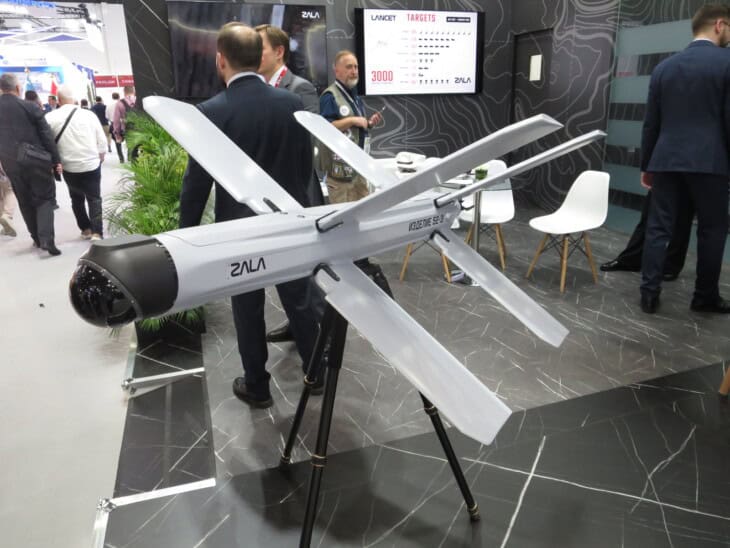
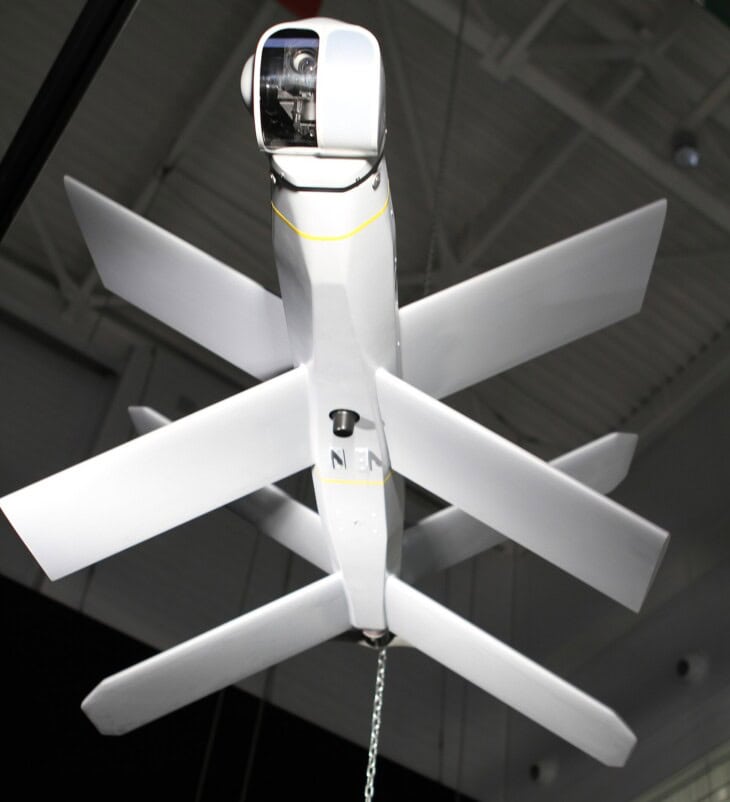
The Lancet is the most under-rated weapon on this list in Western coverage, and by verified kill count it is probably the most cost-effective anti-armor system of the war in Ukraine.
It is small: about 26 lb (12 kg) with a 7 lb (3 kg) warhead on the common Izdeliye-51 variant, an electric motor, a distinctive double-X wing layout, and 40 to 60 minutes of loiter time. Terminal dive speed exceeds 186 mph (300 km/h).
Unit cost is roughly $35,000. For that, it reliably destroys towed artillery, radars, self-propelled guns, and parked aircraft at 25 to 45 miles (40 to 70 km), targets that would otherwise need an aircraft sortie or a guided rocket costing several times more.
Later variants matter. The Izdeliye-52 added an improved electro-optical seeker, and the Izdeliye-53 introduced a four-cell tube launcher and autonomous terminal target selection, reducing the operator’s role in the final seconds.
Built from parts you can order online
Teardowns of recovered Lancets by the Institute for Science and International Security found the airframe packed with foreign commercial components, including Western microelectronics and a widely available Nvidia processing module. The most effective anti-artillery weapon of the war is largely assembled from parts nobody classified as military.
4. Switchblade 600
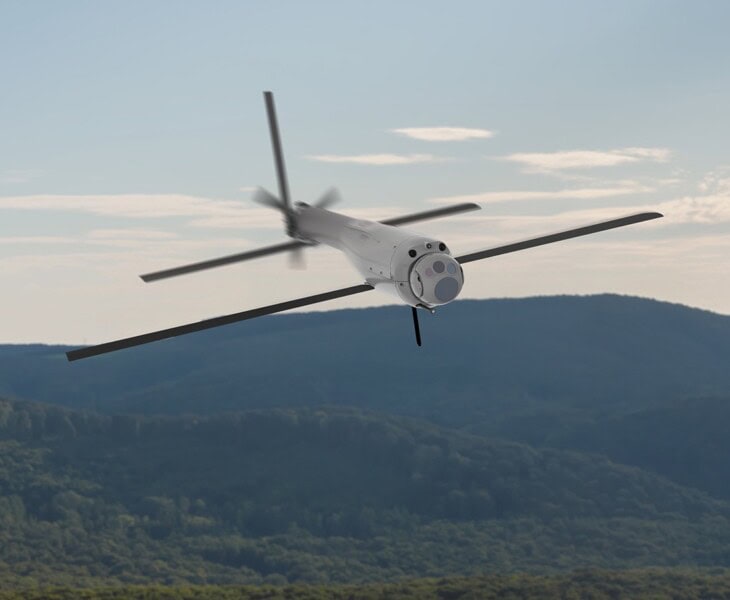
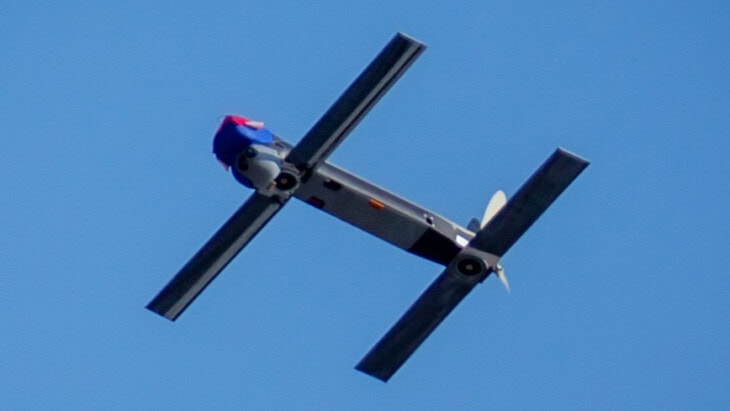
The Switchblade 600 is the best Western tactical loitering munition in service, and AeroVironment publishes real numbers for it, which is rarer in this field than it should be.
It weighs 65 lb (29.5 kg) as a complete round, of which 33 lb (15 kg) is the munition itself. Range is 55+ miles (90+ km) with a forward relay, loiter time is over 40 minutes, and it cruises at 70 mph before sprinting to 115 mph in the terminal dive.
The warhead is derived from the Javelin anti-tank missile, which means it defeats modern armor rather than merely damaging it. It launches from a self-contained tube that needs no separate launcher and sets up in under ten minutes.
Its weakness is price. A Switchblade 600 costs an order of magnitude more than a Lancet, which is why it sits below a cruder Russian system that has destroyed far more equipment. Capability per round is higher; rounds per dollar is not close.
5. An-196 Liutyi
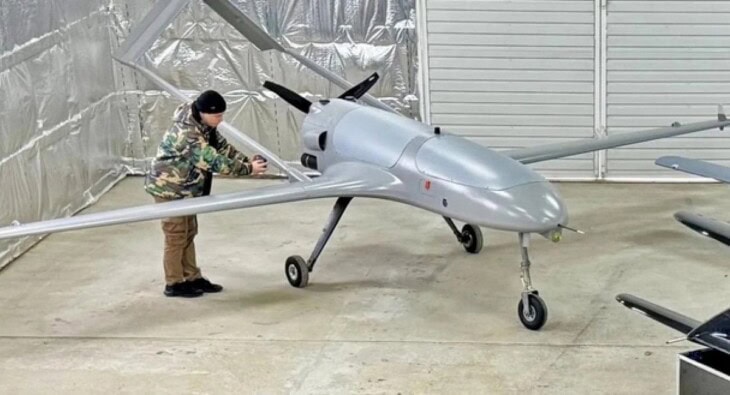
The Liutyi, meaning “Fierce,” is Ukraine’s strategic deep-strike workhorse and the aircraft behind most of the refinery fires deep inside Russia over the past two years.
Built by Antonov as the An-196, it is closer to a small aircraft than a munition: a conventional airframe with a pusher propeller, a reported range beyond 620 miles (1,000 km), and a warhead in the 110 lb (50 kg) class. Ukraine does not publish exact figures.
It ranks here because of what it has actually hit. Ukrainian long-range drones have struck oil infrastructure at Omsk, Tyumen and Yekaterinburg, forcing Russia to disperse air defenses across a country spanning eleven time zones.
In 2026 a modified Liutyi appeared in a new role, configured to carry four missiles rather than fly as a single one-way munition, which blurs the line between this category and a conventional strike aircraft.
6. Geran-3 and Geran-5
The jet-powered Gerans are the most significant new development in this class, and they exist because the propeller Shahed became too easy to shoot down.
The Geran-3 swaps the piston engine for a turbojet, reportedly cruising near 370 mph (600 km/h) with a strike range up to 1,550 miles (2,500 km). That is more than triple the speed of the baseline airframe.
The Geran-5 went further. First used in combat in early January 2026, it pairs a Chinese Telefly turbojet with a 200 lb (90 kg) warhead and a reported 620 mile (1,000 km) range, and has reportedly been released from Su-25 aircraft in flight.
Speed is the whole point. Mobile gun teams and light interceptors that could catch a 115 mph Shahed cannot catch a 370 mph one, which pushes the defense back onto expensive surface-to-air missiles and worsens the cost exchange that made the original so effective.
These rank below their slower parent for one reason: volume. The propeller Geran-2 is still built in vastly larger numbers, and in this category numbers are capability.
7. UVision HERO-120
The HERO-120 is the Israeli answer to the Switchblade 600 and, in several respects, the better-engineered weapon. It weighs 53 lb (24 kg) at launch, carries a 10 lb (4.5 kg) combined anti-armor and anti-personnel warhead, and loiters for a full 60 minutes at 37 miles (60 km).
Its standout feature is the abort capability. The operator can break off an attack mid-dive and send the drone back into a loiter, which matters enormously when the target turns out to be a civilian vehicle.
UVision quotes a typical operating altitude of 1,200 to 3,000 feet, but has demonstrated attacks from 18,000 feet, well above the reach of most short-range air defenses.
The US Marine Corps selected it in 2021 for the Organic Precision Fires programme, and the first US Army production batch cleared final lot acceptance testing in 2026. It sits below the Switchblade 600 only on reach.
8. FP-1
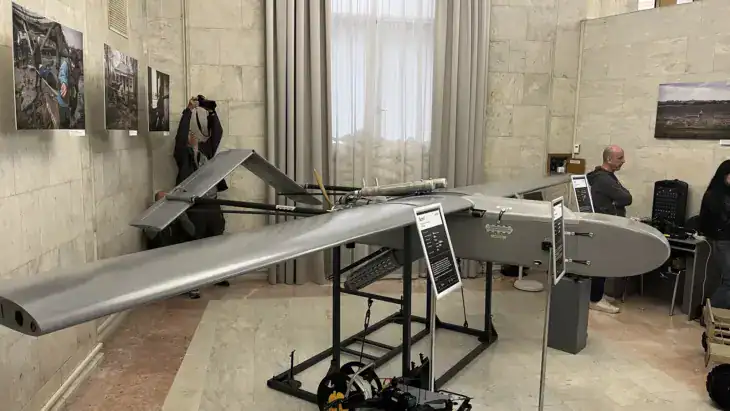
The FP-1 is the cheapest genuinely strategic weapon in the world right now, and it deserves a place on this list on the strength of a single mission.
It carries an 88 lb (40 kg) warhead built from 55 lb (25 kg) of tetryl high explosive wrapped in 33 lb (15 kg) of steel balls, and uses a Starlink terminal for operator control during the final approach.
The airframe is a plywood load-bearing structure with foam wings and a two-cylinder piston engine. Unit cost is around $55,000.
A plywood drone flew for twelve hours to reach Siberia
On 6 July 2026, FP-1 drones struck the Gazprom Neft refinery at Omsk after flying roughly 1,550 miles (2,500 km) in more than twelve hours, the longest-range Ukrainian drone strike of the war. It halted production at Russia’s largest gasoline producer. The aircraft that did it cost less than a mid-range family car.
On 10 August 2026 Ukrainian drones hit the TANECO refinery at Nizhnekamsk in Tatarstan, roughly 750 miles (1,200 km) from the nearest Ukrainian-held ground, killing at least 13 people and wounding 39. It was the deadliest strike of the deep campaign so far.
9. Switchblade 300 and Switchblade 400
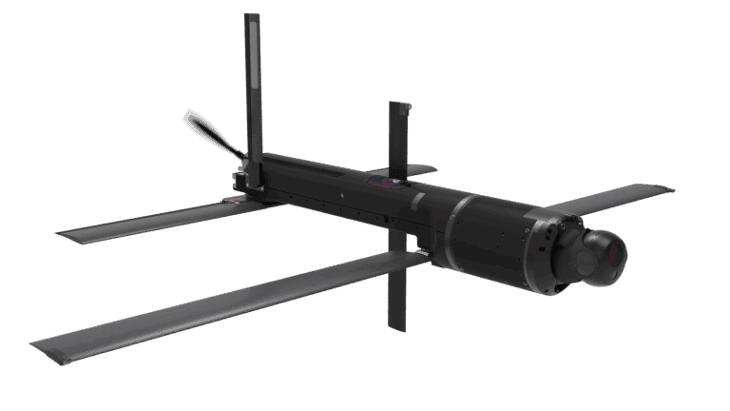
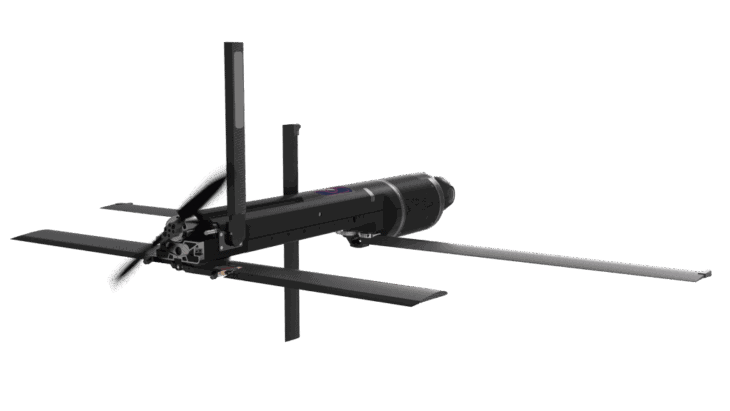
The Switchblade 300 is the original man-portable kamikaze drone, the weapon that made the entire concept famous when the United States sent it to Ukraine in 2022. It fits in a backpack and launches from a tube.
Its warhead is small, sized for people and light vehicles rather than tanks, and its range is short. Combat feedback from Ukraine was mixed, with users citing a fiddly setup and limited effect against armor.
The Switchblade 400 is the fix. At 40 lb (18 kg) it slots between the 300 and the 600, striking armored targets out to 40 miles (65 km) while staying soldier-portable.
The US Army selected it on 4 May 2026 for the Low-Altitude Stalking and Strike Ordnance programme, with procurement plans approaching $1.2 billion across fiscal years 2026 to 2031. That is the American infantry formally replacing anti-tank missiles with drones.
10. WB Group Warmate
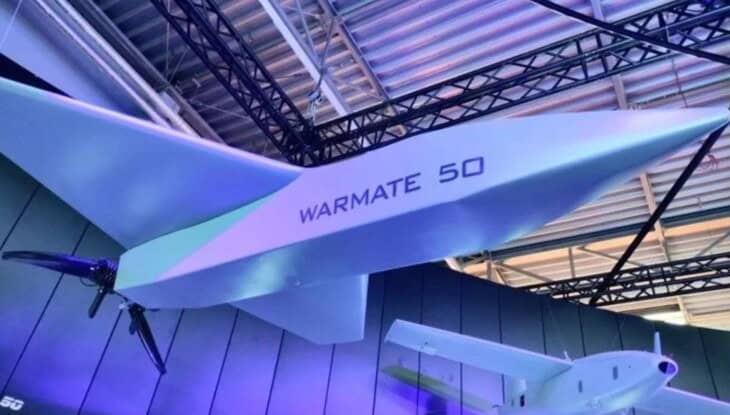
Poland’s Warmate earns the final slot on export reach rather than raw performance. It is one of the most widely fielded loitering munitions outside the three big producers.
The baseline version has a maximum takeoff weight of 13 lb (5.7 kg), a 19 mile (30 km) range, up to 60 minutes of flight, and a top attack speed of 93 mph (150 km/h) with a quoted accuracy of 1.5 m.
Warheads are modular: a high-explosive fragmentation option with 300 g of TNT, or a shaped-charge HEAT round penetrating 200 to 240 mm of rolled homogeneous armor.
It has been used in Ukraine and exported widely, including to Gulf states through WB Group’s partnership in the UAE. The larger Warmate 2 stretches range to as much as 149 miles (240 km).
What people actually mean by “kamikaze drone”
Most articles on this subject fail because they put a $50,000 strategic drone and a $500 hobby quadcopter in the same list. Three genuinely different things get called kamikaze drones, and they are not interchangeable.
Long-range one-way attack drones are strategic weapons. They fly hundreds or thousands of miles on a preprogrammed route to hit a fixed target such as a refinery or power station. The Shahed-136, Liutyi and FP-1 are all in this group.
Loitering munitions are tactical. They are launched at a battlefield area, circle for 30 to 90 minutes while an operator watches the video feed, and dive on a target of opportunity. The Lancet, Switchblade and HERO-120 work this way, and it is the loitering, not the crashing, that defines the class.
FPV attack drones are improvised. They are racing quadcopters with an explosive charge taped on, flown manually through goggles by a pilot a few miles away, and they cost a few hundred dollars each.
Only the first two are covered by this ranking. If you want the wider taxonomy of unmanned aircraft, our guide to the different types of drones covers the reconnaissance and civil categories as well.
What about FPV drones? They have killed more than everything on this list combined
This is the honest objection, and the answer is yes. Cheap FPV quadcopters account for the majority of vehicle and personnel kills in Ukraine, far outstripping every purpose-built loitering munition. They are excluded here because they are not designed weapons: an FPV drone is a commercial airframe with an RPG warhead cable-tied to it, flown by a human pilot to the moment of impact, with a range measured in single-digit miles. Ranking one against a Shahed is like ranking a hand grenade against a cruise missile. Both work, and they are not the same category.
Kamikaze drone vs cruise missile: what is the difference?
The line is genuinely blurry, and it gets blurrier every year. A Geran-5 flying at 370 mph with a 200 lb warhead over 620 miles is functionally a slow, cheap cruise missile.
Three things still separate them. A loitering munition can wait over a target area, it usually keeps a human in the loop who can call off the attack, and it costs one to two orders of magnitude less.
A cruise missile flies a fixed profile to a coordinate at high subsonic speed and cannot be recalled once committed. A Tomahawk costs upward of $1.5 million; a Shahed costs less than a used pickup truck.
The trend runs one way. As jet-powered attack drones get faster, the practical distinction is collapsing into a single question: how much does each one cost you to launch, and how much does it cost your enemy to stop?
Why 2026 is the year this stopped being someone else’s problem
For four years these weapons were understood as a Ukraine and Middle East phenomenon. That ended this summer.
On 4 August 2026 a quadcopter carrying plastic explosives flew past the air defenses at Leipzig/Halle Airport in Germany, a key NATO airlift hub, and struck a Ukrainian cargo aircraft. The charge failed to detonate.
German interior minister Alexander Dobrindt said the attack was carried out by professionals, probably on behalf of a foreign power as part of a hybrid war. US officials and German parliamentary intelligence figures subsequently pointed to Russia.
Ten days later, on 14 August, NATO Baltic Air Policing fighters shot down a drone over Latvia. In March and May 2026, drones crossing out of Russian airspace during Ukrainian long-range attacks had already entered Baltic and Finnish airspace repeatedly.
The pattern is the same one the Shahed established in 2022. A weapon that costs almost nothing forces a response that costs a great deal, and the airport does not need to be hit to be shut down.
April 2016
First combat use between states. Israeli-built Harops fly strike missions in the Four-Day War in Nagorno-Karabakh, the first interstate conflict to use loitering munitions.
2020
Nagorno-Karabakh proves the concept. Harops and Israeli-supplied munitions dismantle Armenian air defenses and are widely credited as decisive in Azerbaijan’s victory.
2022
The Shahed arrives. Iran supplies Shahed-136 drones to Russia; the United States ships Switchblade 300s to Ukraine. Both sides discover the cost-exchange problem at once.
2023
Lancet scales up. Russia’s Lancet becomes the most effective anti-artillery weapon of the war, and Russia begins licensed Geran-2 production at Yelabuga.
May 2025
Operation Sindoor. India uses Harop loitering munitions against Pakistani air defense sites at Lahore and Karachi, the class’s first use between nuclear-armed states.
January 2026
The jet Geran. Russia fields the Geran-5, a turbojet-powered drone with a 200 lb (90 kg) warhead reaching about 370 mph (600 km/h), triple the speed of the original.
May 2026
America commits. The US Army selects the Switchblade 400 for the LASSO programme, with procurement plans approaching $1.2 billion through 2031.
July 2026
Siberia comes into range. Ukrainian FP-1 drones fly roughly 1,550 miles (2,500 km) over twelve hours to halt the Omsk refinery, the war’s longest-range drone strike.
August 2026
NATO gets a demonstration. A drone bomb penetrates Leipzig/Halle Airport on 4 August; a strike on Nizhnekamsk kills 13 on 10 August; NATO fighters down a drone over Latvia on 14 August.
Where this goes next
Two developments will decide the next ranking. The first is autonomy: the Lancet’s Izdeliye-53 already selects its own target in the final seconds, and every major producer is working on the same capability.
The second is the counter-drone economy. Guns, jammers and directed-energy weapons all aim at the same goal, which is making each intercept cost less than the drone it destroys. Until that happens, the attacker keeps winning the arithmetic.
The larger reusable systems are moving in the opposite direction, toward crewed-uncrewed teaming and air-to-air combat. We rank those separately in our guide to the best military drones in the world, and the split between the two classes is now the defining structure of unmanned warfare.
For a sense of how quickly that gap opened, it is worth comparing today’s expendable drones with the generation that preceded them, such as the MQ-1 Predator and MQ-9 Reaper, aircraft designed to come home after every mission.
FAQ
Sources and references used for research and fact-checking.
- AeroVironment, Switchblade 600
- UVision, HERO 120
- International Institute for Strategic Studies, Russia's new jet-powered Gerans
- Covert Shores, Guide to Ukraine's Long Range Attack Drones
- GlobalSecurity.org, Shahed-136 / Geran-2 Loitering Munition
- Al Jazeera, At least 13 killed in Ukrainian drone attack on Russia's Nizhnekamsk
Get the Newsletter
The latest aviation news and stories sent to your inbox.
About the Author

Tim is the owner and lead editor of AeroCorner since 2019, overseeing aviation content covering aircraft, airlines, airports, and the broader aviation industry. Through years of researching, writing, editing, and publishing aviation-focused content, he has developed extensive practical knowledge of commercial aviation and air travel. Based in Asia and a frequent traveler himself, Tim also brings firsthand passenger experience to AeroCorner’s coverage. Outside of publishing, he has also explored aviation firsthand through hands-on flight training in New Zealand.