

Table of Contents
Russia’s most important drone is the Geran-2, its home-built copy of Iran’s Shahed-136. It is a slow, propeller-driven one-way attack drone made by the thousand every month in Tatarstan, and in May 2026 Russia launched 8,161 Shahed-type drones at Ukraine in a single month.
This list ranks the 12 Russian military drone types that matter most by one measure: battlefield impact, meaning what each has done in the war in Ukraine, weighted by how many Russia actually fields. A cheap drone launched by the thousand beats an expensive one that flies a few missions.
Figures are dated November 2026. Most ranges, production rates and kill counts come from Ukrainian intelligence, Russian makers or think tanks during a live war, and each one is attributed.
| Rank | Drone | Role | Reported reach | Status |
|---|---|---|---|---|
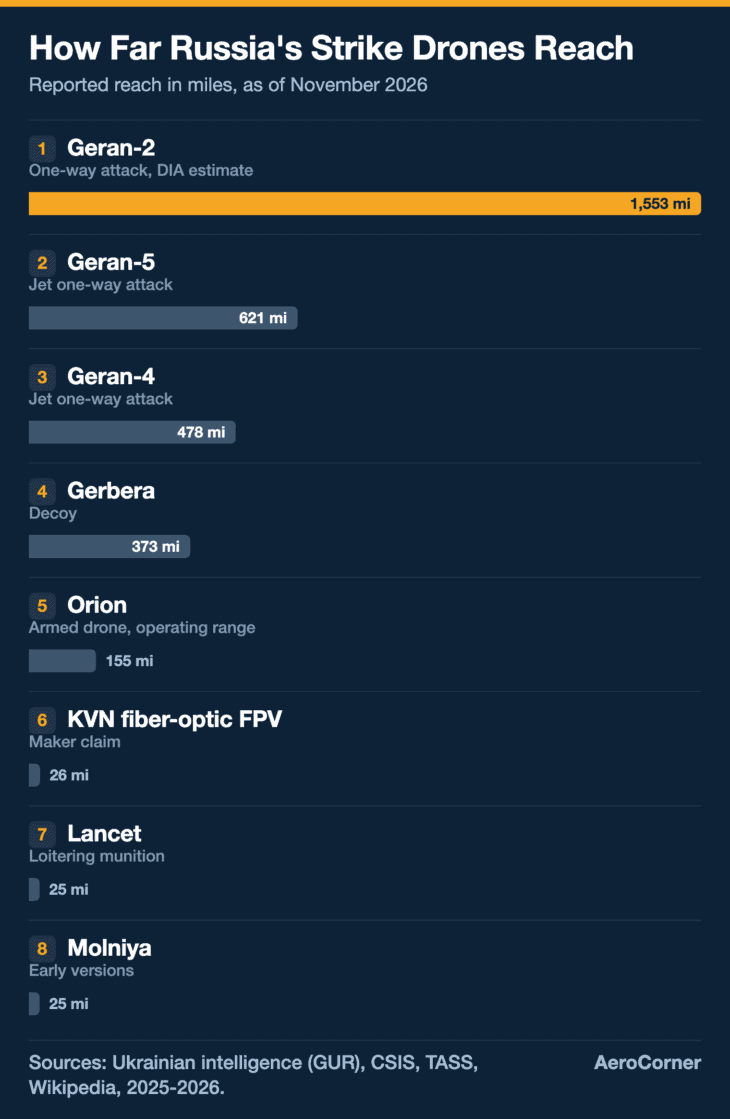
| 1 | Geran-2 | Long-range one-way attack | Up to 1,553 miles (2,500 km), US DIA estimate | Mass production |
| 2 | FPV and fiber-optic FPV (KVN) | Front-line strike | 26 miles (42 km), maker claim for KVN | Mass production |
| 3 | Geran-4 and Geran-5 | Jet one-way attack | 478 miles (770 km) and 621 miles (1,000 km), Ukrainian intelligence | Mass production |
| 4 | Lancet | Loitering munition | 25 miles (40 km) | In service |
| 5 | Orlan-10 | Reconnaissance, artillery spotting | Not reliably published | In service |
| 6 | Gerbera and Parodiya | Decoys | 373 miles (600 km), Gerbera, Ukrainian intelligence | Mass production |
| 7 | Molniya | Cheap fixed-wing strike | About 25 miles (40 km), early versions | In service |
| 8 | Orion (Inokhodets) | Armed long-endurance drone | 155 miles (250 km) operating range, Ukrainian intelligence | In service, small fleet |
| 9 | Supercam S350 | Reconnaissance | Over 149 miles (240 km), maker claim | In service |
| 10 | Forpost-R | Armed reconnaissance | About 155 miles (250 km) | In service |
| 11 | KUB-BLA | Loitering munition | Not published | In service |
| 12 | S-70 Okhotnik-B | Stealth combat drone | Not published | State testing |
How this ranking works
The measure is battlefield impact: what each drone type has done in the war in Ukraine, weighted by how many Russia fields. A type built by the thousand outranks a showpiece flown a few times, which is why the S-70 stealth drone sits last. Reach is shown but not ranked, because nearly every figure comes from Ukrainian intelligence or a Russian maker. Drones still in development, and Iranian imports Russia flies in small numbers, are covered at the end.
1. Geran-2
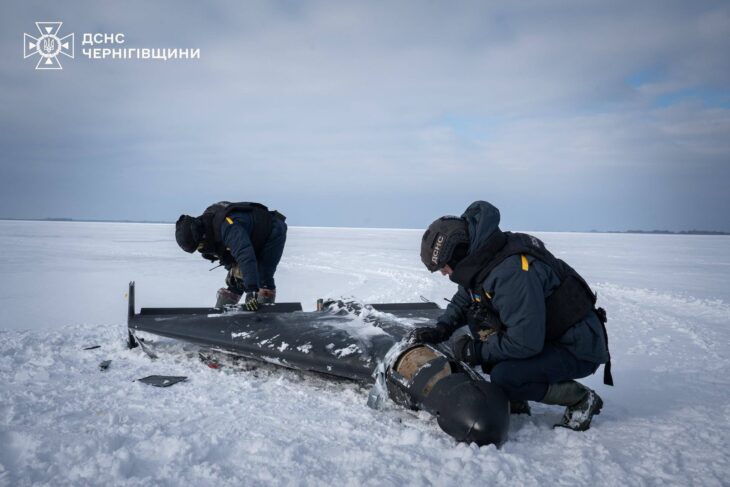

The Geran-2 began as the Iranian Shahed-136, assembled in Russia from Iranian kits. It is now built at a plant in the Alabuga Special Economic Zone in Tatarstan, with a delta wing roughly 8.2 feet (2.5 m) across and a body about 11.5 feet (3.5 m) long.
It cruises at about 115 mph (185 km/h) on a small piston engine, slow enough for machine guns to hit. Russia has made up for that with mass and upgrades: Kyiv Independent reported in July 2025 that warheads had grown from 88 to 110 pounds (40 to 50 kg) to 176 to 198 pounds (80 to 90 kg).
A CSIS study of captured drones, published in September 2026, found Kometa-M8 anti-jam antennas that resist seven sources of interference, Chinese ZTE cellular modems and a Raspberry Pi minicomputer. Nobody publishes an official price, and estimates run from $20,000 to about $80,000; CSIS used $35,000 as a deliberately high figure.
Ukraine’s military intelligence agency (GUR) estimated in August 2026 that Russia builds about 2,800 Geran-2s a month. Our guide to Iranian drones covers the original Shahed family the Geran grew out of.
1,567 drones in 38 hours
Between May 12 and May 14, 2026, Russia launched 1,567 Shahed-type drones at Ukraine in roughly 38 hours, the largest drone attack of the war, according to Ukrainian Air Force data compiled by the Institute for Science and International Security. The same month set the monthly record: 8,161 Shahed-type launches, about 5,181 of them armed strike drones and the rest decoys.
2. FPV and fiber-optic FPV drones
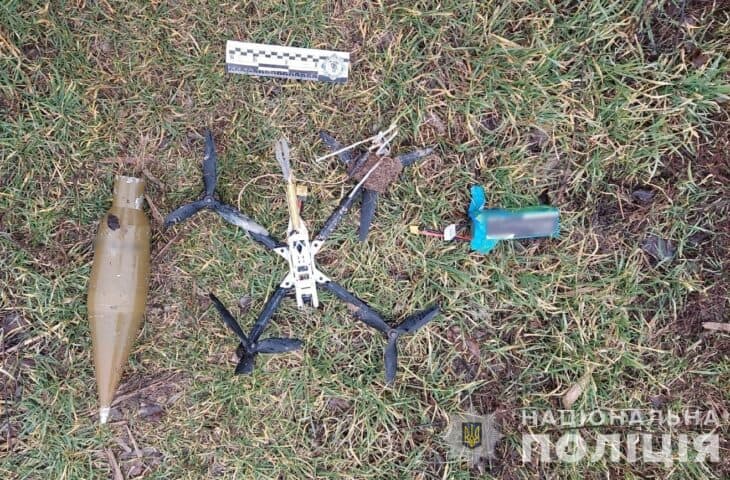

The FPV (first-person-view) drone is a small quadcopter carrying a few pounds of explosive, flown into its target by an operator wearing video goggles. It kills more on the front line than any other Russian drone, and it does it by sheer volume.
Vladimir Putin said in April 2025 that more than 1.5 million drones of all types were delivered to Russian forces in 2024, including about 4,000 FPV drones sent to the front every day. Ukrainian intelligence said in June 2025 that Russia was aiming for 2 million FPV drones that year.
The bigger shift is the fiber-optic FPV, which unspools a hair-thin cable behind it instead of using radio, so it cannot be jammed. The best known, the KVN from the Ushkuynik center in Veliky Novgorod, has a version with a 26-mile (42 km) range that its developer told TASS in September 2026 was in full-scale use, with deliveries since August 2024 “in the millions.”
Ukraine’s Mykhailo Fedorov said in November 2025 that Russia was fielding fiber-optic drones with reach of up to 31 miles (50 km). The Ukrainian drones on the other side of the line are mostly FPVs too, and the two arsenals have pushed each other along.
Many of Russia’s best FPV crews belong to Rubikon, a drone center formed in August 2024 on Defense Minister Andrei Belousov’s orders and estimated at about 5,000 troops by November 2025.
3. Geran-4 and Geran-5 jet drones
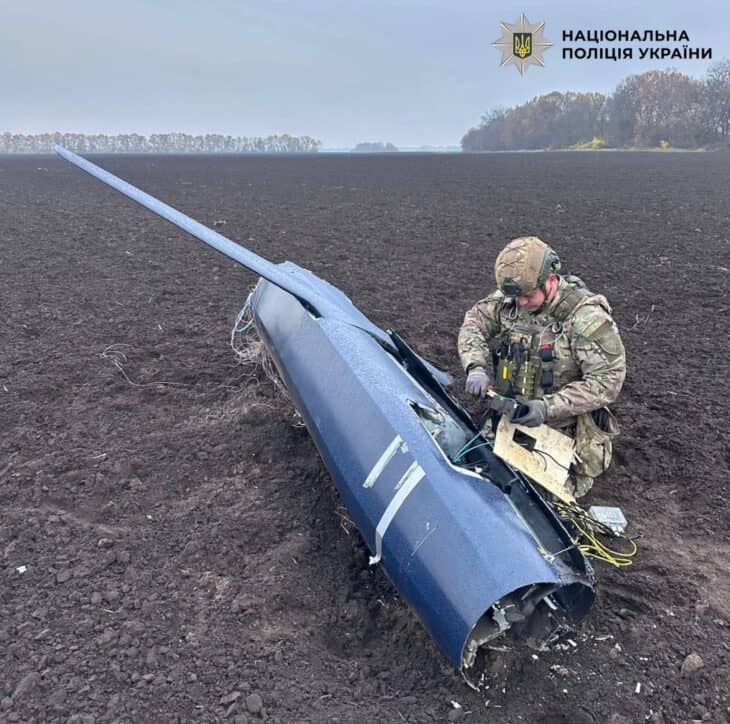

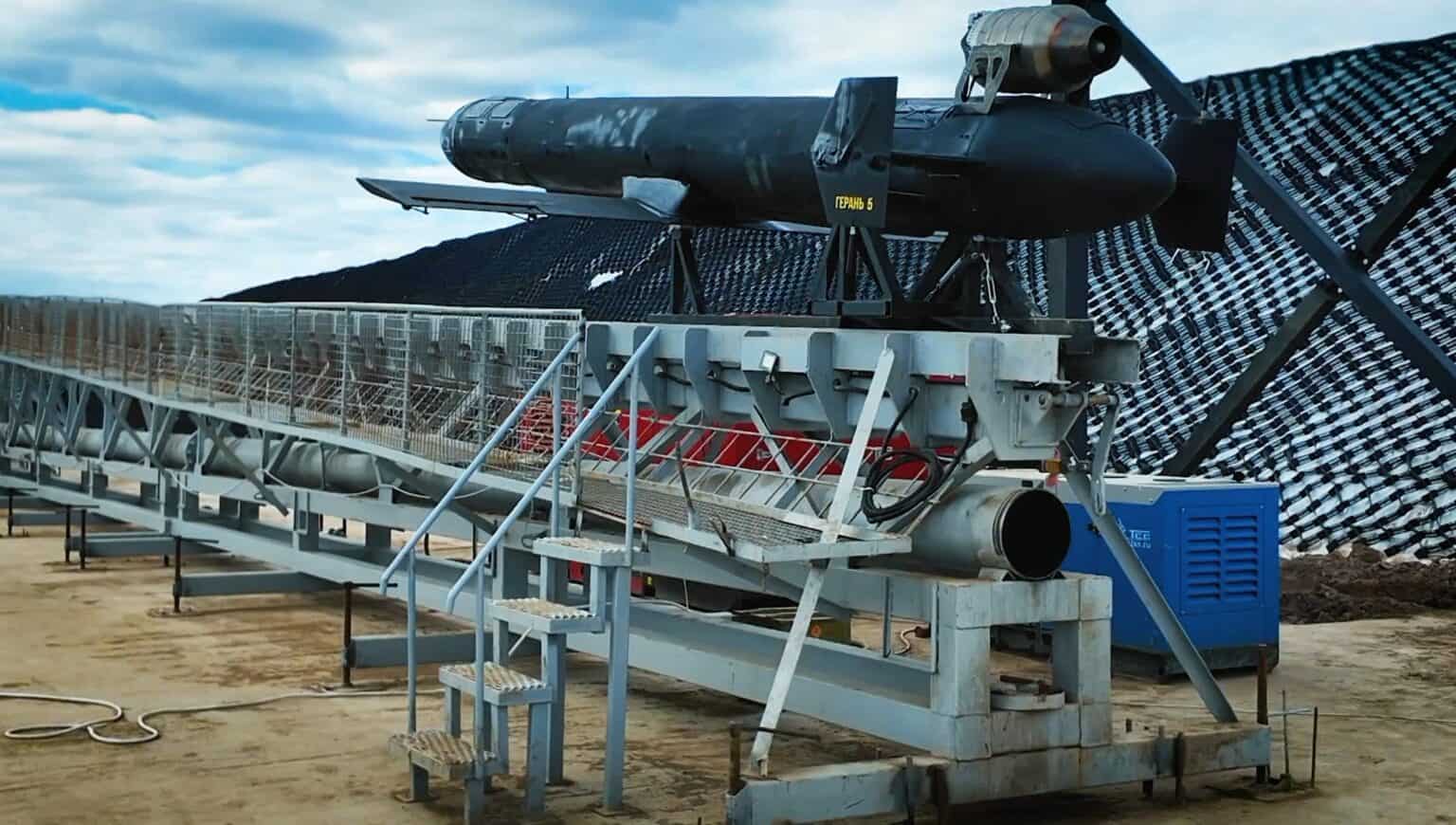
Russia’s answer to Ukrainian air defense has been to make the Geran fast. GUR estimated in August 2026 that Russia now builds about 3,000 jet-powered Geran-4s and Geran-5s a month, more than the propeller Geran-2.
GUR lists the Geran-4 at a 199 mph (320 km/h) cruise and 280 mph (450 km/h) top speed, with a 198-pound (90 kg) warhead and a 478-mile (770 km) range. It first flew on a Chinese Telefly turbojet; GUR reported on October 5, 2026 that a Russian-made copy built at Alabuga had replaced it.
The Geran-5 is bigger again: 21.3 feet (6.5 m) long, 1,764 pounds (800 kg) at takeoff, cruising at 249 to 280 mph (400 to 450 km/h) with a 198-pound (90 kg) warhead over 621 miles (1,000 km), per GUR. Ukrainian intelligence sees similarities to Iran’s Karrar, and the Institute for Science and International Security calls it closer to a small cruise missile than a drone.
Speed works. Ukraine’s General Staff said its forces stopped 89% of conventional Shaheds in October 2026 but only 66% of the jet versions. The first jet model, the Geran-3, was dropped: GUR said in August 2026 that its production had stopped.
4. Lancet
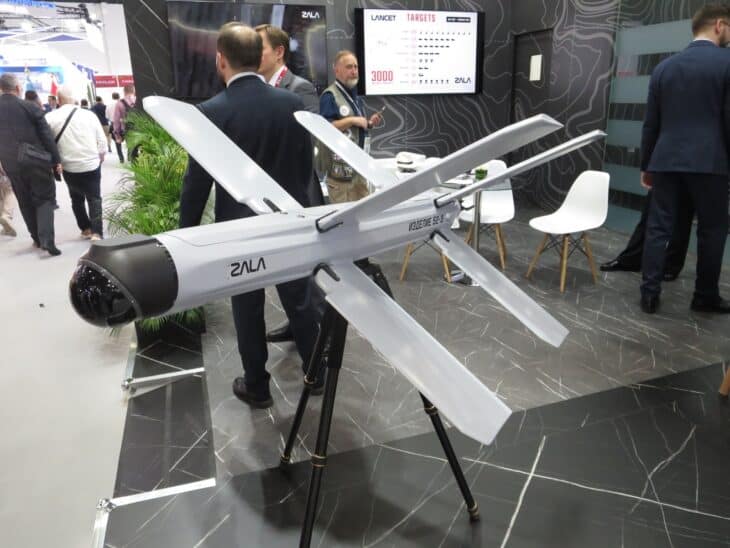

The Lancet, from Kalashnikov’s ZALA Aero Group, was Russia’s breakout weapon of 2023. It is a loitering munition: a small X-winged drone that circles over the front, finds a target on camera and dives onto it.
It weighs up to 26 pounds (12 kg) at launch, reaches about 25 miles (40 km), cruises near 68 mph (110 km/h) and dives at up to 186 mph (300 km/h). The Lancet-3 carried a 6.6-pound (3 kg) warhead, later versions more than 11 pounds (5 kg), and analyst Samuel Bendett told Reuters each costs about 3 million rubles, around $35,000.
The pro-Russian tracker LostArmour counted 1,163 Lancet strikes by February 28, 2024, with 363 targets destroyed and 615 badly damaged. It is one of the best kamikaze drones in the world, but cheap FPVs now do much of its old job.
The decline shows. In October 2026 the pro-Russian figure Pavel Gubarev claimed that about 100 Lancets launched over three months had scored three successful strikes, a claim no one has independently verified.
5. Orlan-10
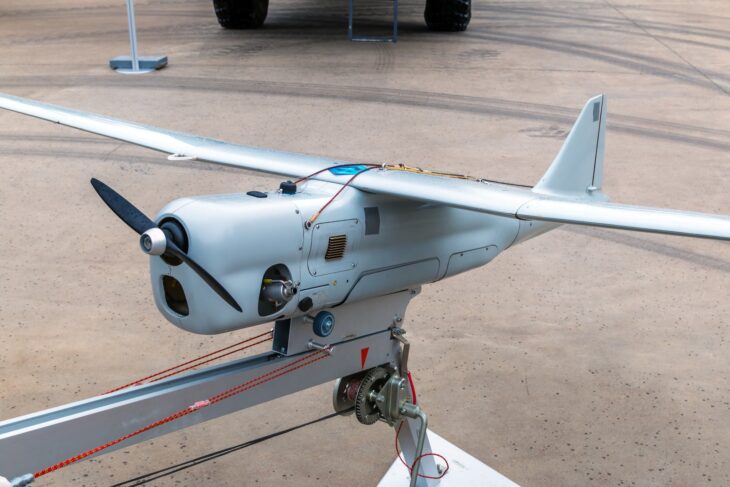

The Orlan-10 is Russian artillery’s eye in the sky. Built by the Special Technology Center in St. Petersburg, this small propeller drone finds targets and adjusts fire for guns and rocket launchers. A Ukrainian commander said in December 2022 that Orlan losses were hurting Russia’s ability to spot for its artillery.
More than 1,000 had been built by 2018, across 11 variants. CBS News reported in January 2023 that downed Orlans carried U.S. and Swiss microchips from Maxim, Microchip and u-blox, despite sanctions.
Russia has also armed it: Oryx lists three “Orlan-10 UCAV” strike versions among Russia’s visually confirmed combat drone losses.
6. Gerbera and Parodiya decoys
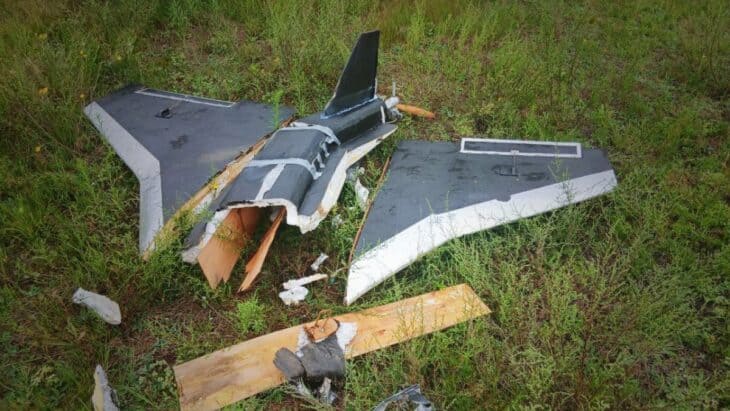

Not every Shahed on Ukrainian radar is real. The Gerbera is a look-alike decoy with a plywood frame and painted foam body that Ukrainian officials estimate costs about $10,000, against tens of thousands for a Geran-2.
GUR lists it at an 8.2-foot (2.5 m) wingspan, 40 pounds (18 kg), 99 mph (160 km/h) and a 373-mile (600 km) range. The Institute for Science and International Security reported in December 2024 that Alabuga could build up to 50 a day, and some carry a warhead of up to 11 pounds (5 kg).
The smaller Parodiya carries no warhead at all, only a radar reflector that makes it look like a Shahed to air defense. GUR said roughly half of the more than 2,000 drones launched in October 2024 were decoys; by 2026, the same institute’s data put real strike drones at about 64% of launches.
7. Molniya
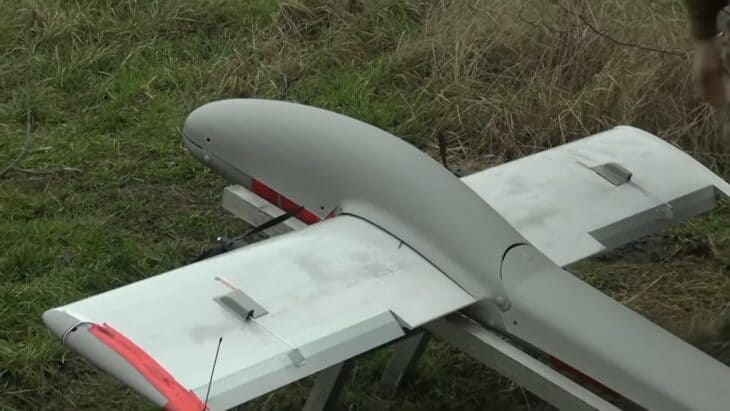

The Molniya (“Lightning”) is a crude fixed-wing strike drone from Atlant Aero that does the Lancet’s job for a fraction of the price. Early versions reached about 25 miles (40 km) with a warhead of around 11 pounds (5 kg), according to 19FortyFive.
The twin-engine Molniya-2 is estimated by Militarnyi at up to $1,600 a unit, and one reconnaissance version, the Molniya-2R, carries a Starlink terminal, according to GUR. In June 2026 Rostec showed the Molniya-13, rated at a 29-pound (13 kg) payload, 75 mph (120 km/h) and 31 miles (50 km).
8. Orion (Inokhodets)
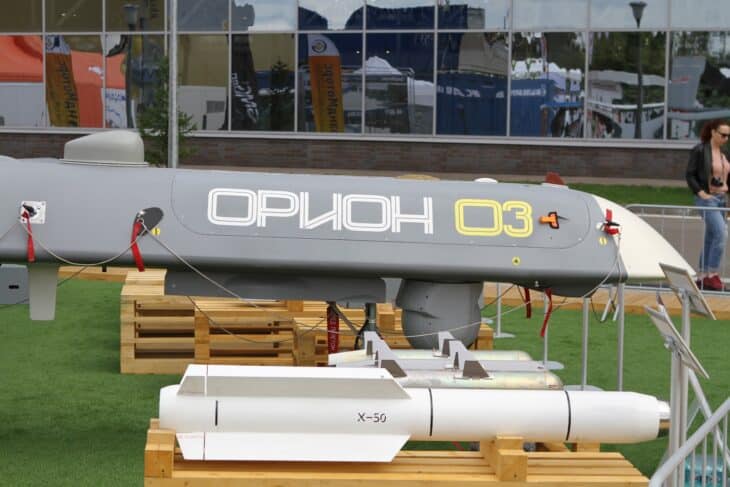

The Kronshtadt Orion is Russia’s closest thing to an American Predator: a long-winged, propeller-driven drone that can stay up for a day and drop guided bombs. TASS gave it a 1-tonne (2,205 lb) takeoff weight and 24 hours’ endurance in 2019, and GUR says it carries up to 551 pounds (250 kg).
GUR lists KAB-20 guided bombs and the S8000 Banderol cruise missile among its weapons, and a 155-mile (250 km) operating range. Oryx counts 16 Orions destroyed in the war.
Ukraine’s 47th Brigade claimed in July 2026 to have downed one with a cheap interceptor drone, valuing the Orion at about $7 million. The maker is under strain too: Militarnyi reported in April 2026 that 154 lawsuits worth 2.6 billion rubles had been filed against Kronshtadt.
9. Supercam S350
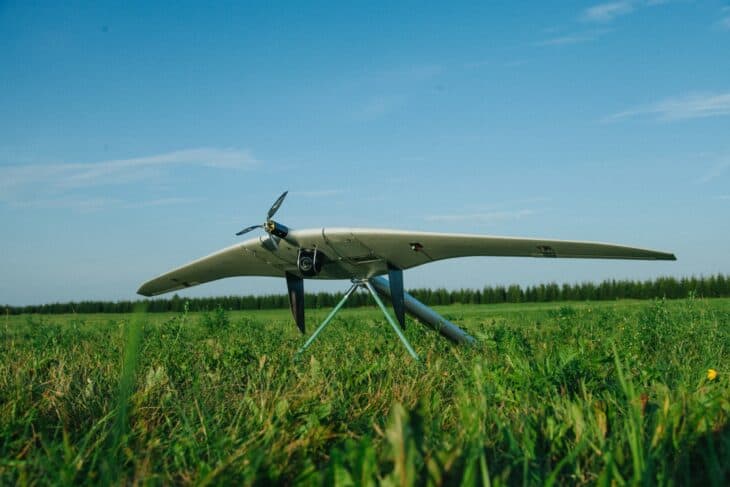

The Supercam S350 is a reconnaissance drone in the Orlan-10’s class that feeds targets straight to artillery. At the World Defense Show in February 2026, its maker claimed a range of over 149 miles (240 km), a flight time of 330 minutes and a takeoff weight of about 33 pounds (15 kg).
It flies at roughly 47 to 75 mph (75 to 120 km/h) and carries a sensor payload of about 4.4 pounds (2 kg), all maker figures.
10. Forpost-R
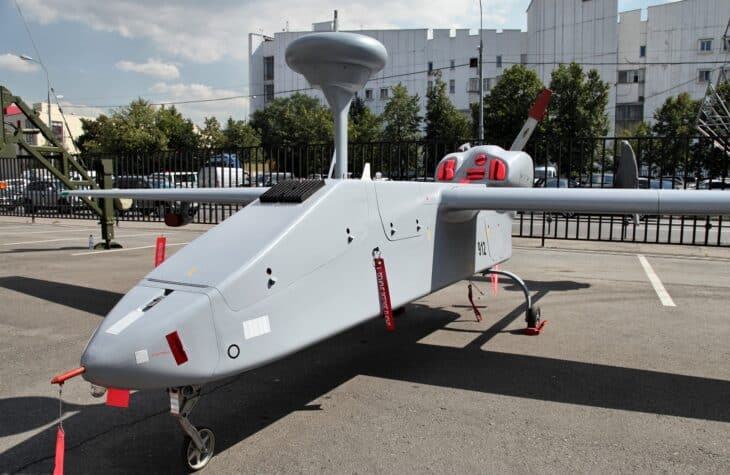

The Forpost started as a licensed copy of Israel’s IAI Searcher II, built by UZGA in Yekaterinburg. The fully Russian Forpost-R first flew in late August 2019, and the Russian Defense Ministry released video in March 2022 of one striking a rocket launcher with guided missiles.
Izvestia, citing defense ministry sources in June 2025, put it at 1,102 pounds (500 kg) at takeoff with up to 220 pounds (100 kg) of munitions, 18 hours’ endurance and about 155 miles (250 km) of range. It was going to Russia’s navy fleets, beginning with the Northern Fleet.
11. KUB-BLA
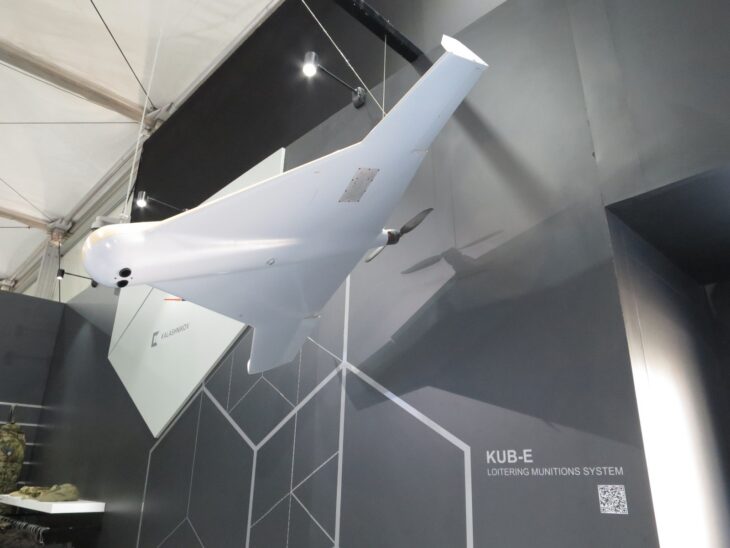

The KUB-BLA is ZALA’s other loitering munition, a small flying wing unveiled at IDEX 2019. It flies for 30 minutes at up to 81 mph (130 km/h) with a 6.6-pound (3 kg) payload.
It was used early in the war, including a Russian Defense Ministry video of a strike on a U.S.-made M777 howitzer in May 2022. LostArmour counted at least 44 documented uses by December 2023, against more than 1,000 Lancet strikes, which shows which drone Russia chose.
12. S-70 Okhotnik-B
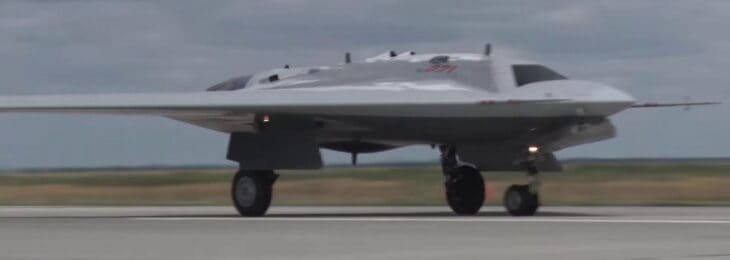

The S-70 Okhotnik (“Hunter”) is Sukhoi’s stealthy flying-wing combat drone, designed to fly alongside the Su-57 Felon fighter. It first flew on August 3, 2019, and the Russian Defense Ministry gave it a takeoff weight of 20 tons, about 44,000 pounds.
Its only confirmed combat appearance ended badly. On October 5, 2024, an S-70 was shot down over Kostiantynivka, Ukraine, by a Russian fighter, most likely an Su-57, apparently after its operators lost control; The War Zone spotted a guided glide bomb in the wreckage.
Izvestia reported in April 2026 that the drone was in state testing, and there is no sign of production deliveries as of November 2026. It ranks last on impact, but it is the type the rest of the world watches.
Who flies them: Russia’s Unmanned Systems Forces
Russia gave drones their own branch of the armed forces. On November 12, 2025, deputy commander Col. Sergey Ishtuganov told TASS that the Unmanned Systems Forces had been established, with operational regiments already formed.
Col. Gen. Denis Lyamin took command on August 5, 2026, according to Izvestia. Ukrainian estimates of the force’s size grew from 10,000 to 20,000 troops in November 2025 to about 114,000 by May 2026.
Is the Geran just an Iranian Shahed?
Not anymore. The first Gerans were Iranian Shahed-136s with Russian paint, and early production assembled Iranian kits. Today they are built in Tatarstan with Russian warheads, Chinese engines, anti-jam satellite navigation, cellular modems and cameras. Iran supplied the design; Russia turned it into a mass-produced family.
What about the Altius, Sirius and Iran’s Mohajer-6?
Russia’s two larger long-endurance drones have not made the list because neither has a combat record. The Altius-U first flew in 2019, but Wikipedia counts only three built, and one crashed into a house near Kazan on July 8, 2025, a crash its maker blamed on electronic jamming.
The twin-engine Kronshtadt Sirius first flew in August 2023 and is still listed as in development. Russia has also flown Iran’s Mohajer-6, and Oryx counts three lost.
Small reconnaissance drones such as the Eleron-3 and ZALA 421-16E also remain in service, in the Orlan-10’s shadow. For how Russia’s arsenal compares with America’s, Israel’s and Turkey’s, see our ranking of the best military drones in the world.
FAQ
Sources and references used for research and fact-checking.
- CSIS, Shahed to Geran: How Russia Continues to Reinvent the One-Way Attack Drone
- CSIS, Calculating the Cost-Effectiveness of Russia's Drone Strikes
- CSIS Missile Threat, Shahed 131 and 136
- Wikipedia, HESA Shahed 136
- Kyiv Independent, How Russia modified Iran's Shahed-136 drones and what it means for Ukraine
- Institute for Science and International Security, May 2026 Updated Analysis of Russian Shahed-type UAVs Deployment Against Ukraine
- Institute for Science and International Security, Russian decoy drones that depend on Western parts pose a great challenge
- Militarnyi, Production of the Geran-4/5 jet drones has surpassed that of the Geran-2
- Militarnyi, Russia halts production of Geran-3
- Defence Intelligence of Ukraine (War and Sanctions), Geran-4
- Defence Intelligence of Ukraine (War and Sanctions), Geran-5
- Militarnyi, Russia uses new Geran-5 kamikaze drone against Ukraine for the first time
- Institute for Science and International Security, September 2026 Updated Analysis of Russian Shahed-type UAVs Deployment Against Ukraine
- Defence Intelligence of Ukraine (War and Sanctions), Gerbera UAV
- Wikipedia, Gerbera (drone)
- Defence Intelligence of Ukraine, Parodiya decoys from Russia fell in Moldova
- LIGA.net, Ukraine downs two out of three jet-powered Shaheds, General Staff says
- Ukrainska Pravda, Putin: more than 1.5 million drones delivered
- Kyiv Independent, Russia aims to produce 2 million FPV drones in 2025, Ukrainian intelligence says
- TASS, KVN fiber-optic drone in full-scale operation
- United24 Media, Russia fields jam-resistant 50km fiber-optic drones
- Wikipedia, Center for Advanced Unmanned Technologies Rubicon
- Wikipedia, ZALA Lancet
- United24 Media, Russia's once-feared Lancet drones are turning into a multimillion-dollar failure
- Wikipedia, KUB-BLA
- Wikipedia, Orlan-10
- 19FortyFive, Russia built a drone from plywood and foam that costs less than a single Orlan-10
- Militarnyi, Lightning-13: Russia's new version of the Molniya UAV
- ArmyInform, Enemy adapted the Molniya drone for aerial reconnaissance: HUR
- Army Recognition, Russia unveils Supercam S350 drone with 240 km range
- TASS, Orion drone delivered to Russian troops
- Kyiv Post, Ukraine's defence intelligence reveals data on Russia's Orion drone
- ArmyInform, Ukraine's 47th Brigade shoots down rare $7 million Russian Orion combat drone
- Militarnyi, Russian Orion UAV maker on verge of bankruptcy
- Oryx, Attack On Europe: Documenting Russian Equipment Losses
- Wikipedia, IAI Searcher
- Caliber.az, Russian Navy deploys advanced Forpost-R armed drones across fleets
- TASS, Sukhoi S-70 Okhotnik-B first flight
- The War Zone, Russia's S-70 Hunter drone was armed when shot down by friendly fighter over Ukraine
- Air and Space Forces Magazine, Why Russia shot down its own S-70 drone over Ukraine
- www1.ru (citing Izvestia), Okhotnik S-70 enters state tests
- TASS, Unmanned Systems Forces established
- Izvestia, Denis Lyamin will lead the Unmanned Systems Forces
- Wikipedia, Unmanned Systems Forces of Russia
- Wikipedia, Sokol Altius
- Militarnyi, Russian Altius drone crashes due to unknown electronic warfare measures
- Wikipedia, Kronshtadt Sirius
Get the Newsletter
The latest aviation news and stories sent to your inbox.
About the Author

Tim is the owner and lead editor of AeroCorner since 2019, overseeing aviation content covering aircraft, airlines, airports, and the broader aviation industry. Through years of researching, writing, editing, and publishing aviation-focused content, he has developed extensive practical knowledge of commercial aviation and air travel. Based in Asia and a frequent traveler himself, Tim also brings firsthand passenger experience to AeroCorner’s coverage. Outside of publishing, he has also explored aviation firsthand through hands-on flight training in New Zealand.