

Table of Contents
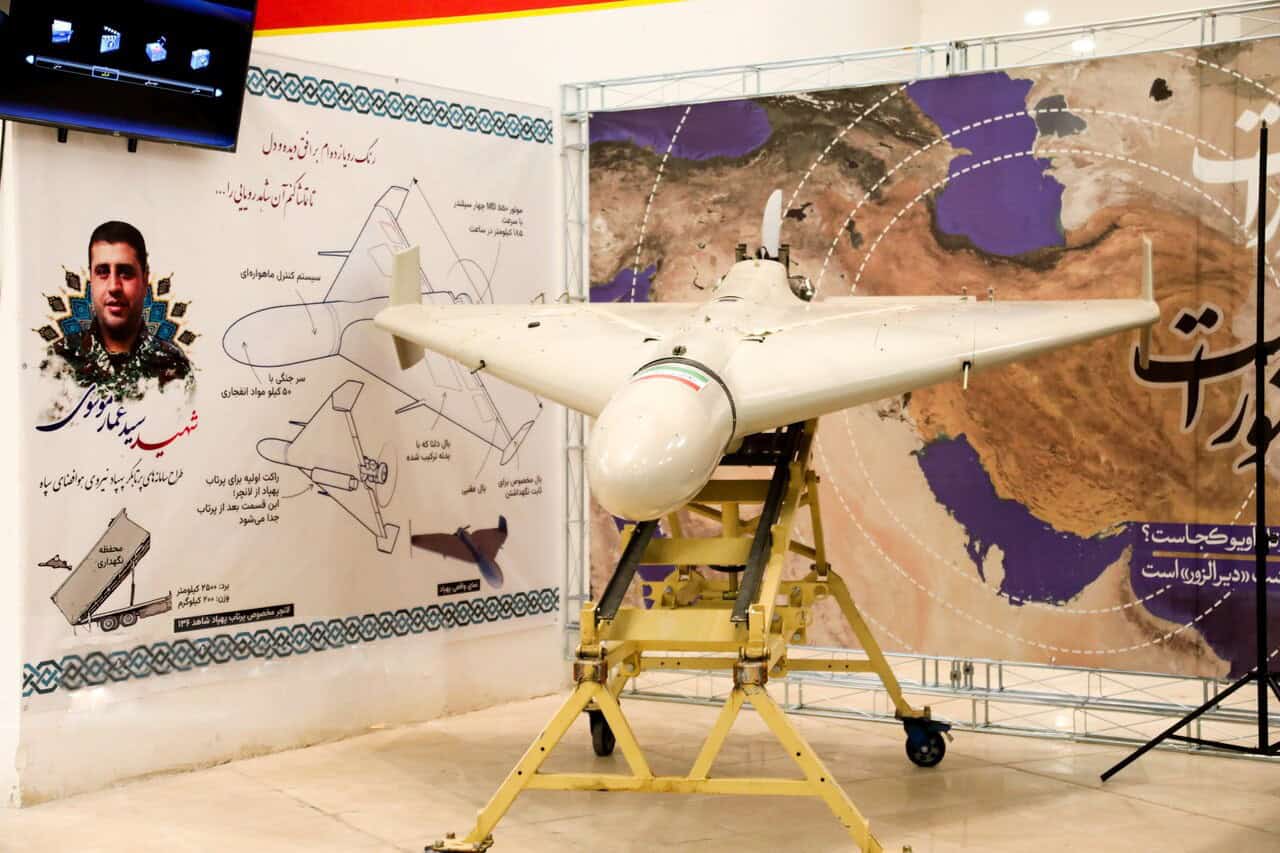
Iran’s most important drone is the Shahed-136, a one-way attack drone costing an estimated $20,000 to $50,000 that has been launched by the tens of thousands, first by Russia against Ukraine and then by Iran itself in the 2026 war.
This list ranks the 12 Iranian drones that matter most by one measure: what each has actually done in combat, weighted by how many are fielded. A drone that has struck targets in several wars outranks a bigger, newer one that has only flown at a parade.
Figures are dated November 2026. Most range and payload numbers are Iran’s own claims, so the table says which ones are estimates by outside analysts and which are not.
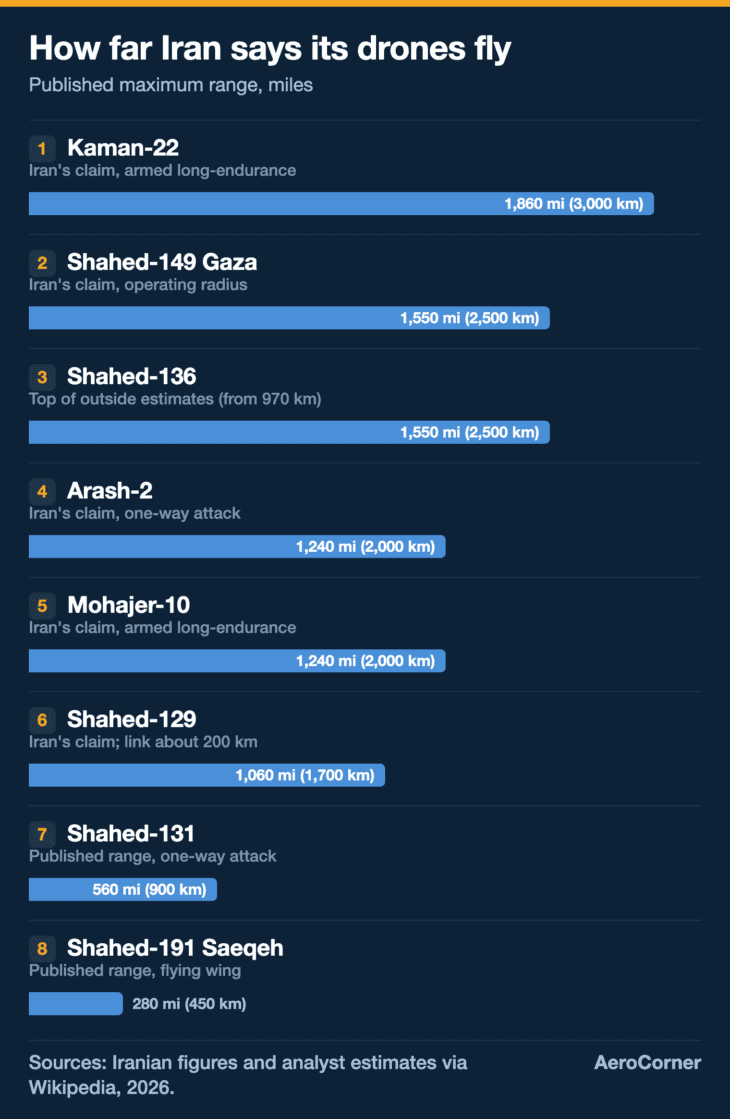
| Rank | Drone | Type | Published range | Combat record |
|---|---|---|---|---|
| 1 | Shahed-136 | One-way attack | 600 to 1,550 miles (970 to 2,500 km), estimates | Ukraine, Gulf, Israel, 2026 war |
| 2 | Shahed-131 | One-way attack | 560 miles (900 km) | Ukraine, 2026 war |
| 3 | Mohajer-6 | Armed reconnaissance | 125 to 310 miles (200 to 500 km) control link | Iraq, Ukraine, Sudan |
| 4 | Shahed-129 | Armed MALE drone | 1,060 miles (1,700 km) claimed | Syria, Gulf |
| 5 | Ababil-3 | Reconnaissance | 62 miles (100 km) round trip | Syria, Iraq, Sudan |
| 6 | Hadid-110 | Jet one-way attack | Not published | 2026 war, Iraqi Kurdistan |
| 7 | Shahed-238 | Jet one-way attack | Not published | Ukraine (Russian use) |
| 8 | Shahed-191 Saeqeh | Flying-wing strike drone | 280 miles (450 km) | Syria |
| 9 | Shahed-149 Gaza | Armed long-endurance | 1,550 miles (2,500 km) radius claimed | None known |
| 10 | Arash-2 | Long-range one-way attack | 1,240 miles (2,000 km) claimed | None confirmed |
| 11 | Mohajer-10 | Armed long-endurance | 1,240 miles (2,000 km) claimed | None known |
| 12 | Kaman-22 | Armed long-endurance | 1,860 miles (3,000 km) claimed | None known |
How this ranking works
The measure is combat record: where and how often each drone has been used in real fighting, by Iran or by the countries and groups it supplies. Ties are broken by how many are known to be in service. Range is shown but not ranked, because Iran publishes figures nobody outside can test, and a reusable drone that needs a radio link to its ground station cannot use a 1,000-mile fuel load anyway. Target drones and hobby-sized quadcopters are left out.
1. Shahed-136
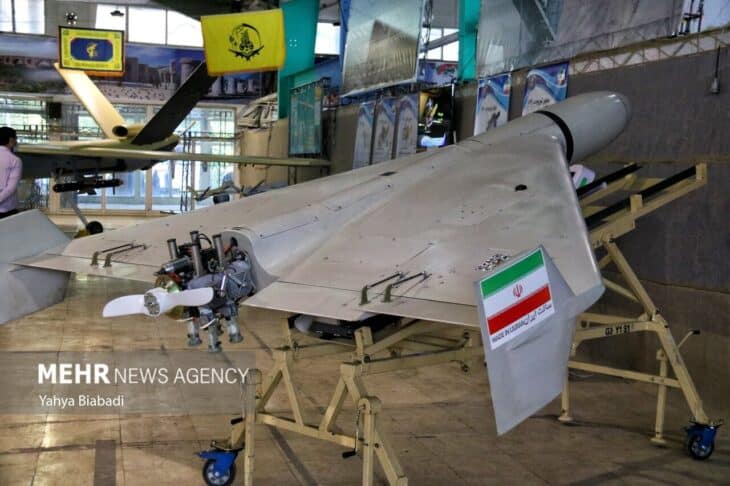

The Shahed-136 is a cropped delta wing about 11 feet (3.5 m) long with an 8-foot (2.5 m) span. It weighs about 440 pounds (200 kg), carries a warhead estimated at 66 to 110 pounds (30 to 50 kg), and flies at just over 115 mph (185 km/h) on a copy of a German two-stroke engine.
It navigates by a commercial-grade inertial system corrected by civilian GPS and GLONASS, and is fired in batches from racks that fit on the back of any truck. Range estimates run from about 600 to 1,550 miles (970 to 2,500 km), and nobody outside Iran has published a firmer number.
No other Iranian drone comes close to its record. Russia used it, as the Geran-2, from September 2022, and Ukrainian data counts more than 38,000 Shahed-type drones launched at Ukraine in 2025 alone. Iran used it against Israel in April 2024 and against US bases and Gulf states in 2026. Our explainer on why the US military copied the Shahed drone covers how it works in detail.
The Shahed now has an American twin
In December 2025, US Central Command deployed a squadron of LUCAS drones, a Shahed-136 clone built by reverse-engineering a captured one, at a build cost of about $35,000 each. Their first confirmed combat use was in February 2026, against Iran.
2. Shahed-131
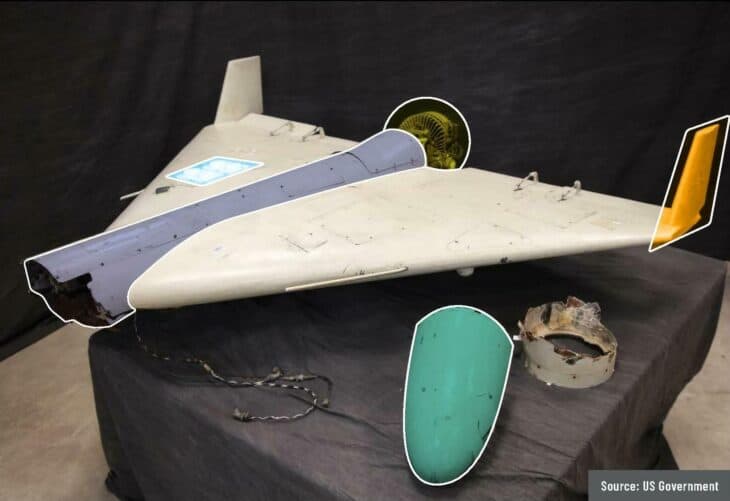

The Shahed-131 is the smaller sibling. You can tell them apart by the wingtip fins, which point only upward on the 131 but both up and down on the 136.
It runs on a 38-horsepower Wankel engine, carries a warhead of about 22 to 44 pounds (10 to 20 kg), and has a published range of about 560 miles (900 km). Its flight controller can connect to Iridium satellites, which in theory lets an operator change its route in flight.
Russia fired it as the Geran-1 from October 2022, and Iran used it alongside the 136 in mass attacks on US bases around the Persian Gulf in 2026. It ranks below the 136 because it carries a far smaller warhead over a shorter range.
3. Mohajer-6
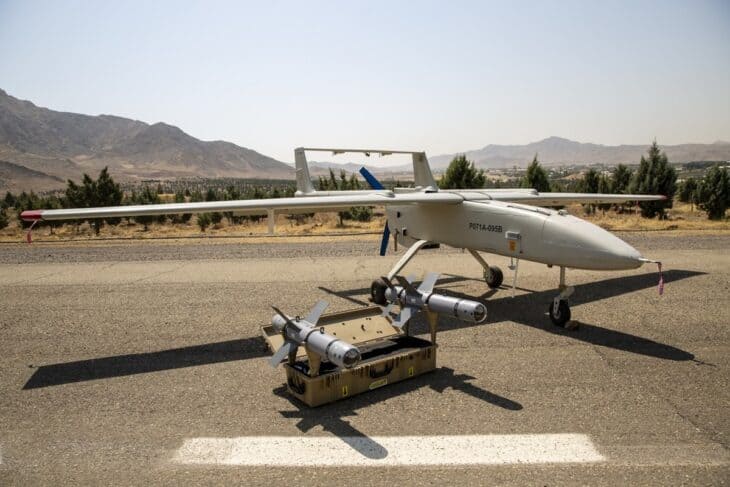

The Mohajer-6 is Iran’s workhorse armed reconnaissance drone, a twin-boom aircraft with a 33-foot (10 m) wingspan that takes off and lands on a runway. It carries a camera turret and, depending on the version, two or four guided missiles, about 220 to 330 pounds (100 to 150 kg) of weapons in all.
It tops out at about 124 mph (200 km/h), stays up for about 12 hours, and flies at 16,000 to 18,000 feet. Its ground station reaches 125 to 310 miles (200 to 500 km), and that link is the practical limit on how far it operates.
What earns it third place is how far it has traveled. Iran used it against PJAK Kurdish militants in 2019 and against Kurdish party offices in Iraq in 2022, sold it to Russia in 2022 (one crashed in the Black Sea near Odesa that September), and supplied Sudan’s army in its civil war. Ethiopia and Venezuela are reported operators too.
4. Shahed-129
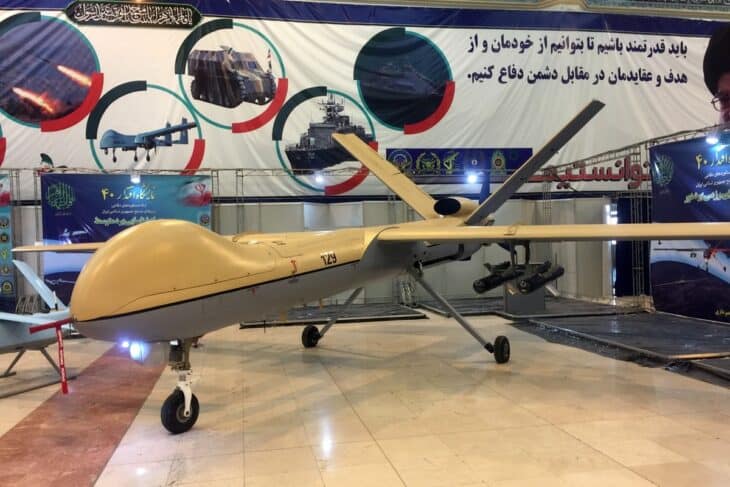

The Shahed-129 is Iran’s answer to the American MQ-1 Predator, with a 52-foot (16 m) wingspan, a Rotax 914 piston engine and a claimed 24-hour endurance. It carries up to four Sadid guided bombs.
Iran claims a 1,060-mile (1,700 km) combat range, but the drone depends on a ground station that Iranian state media itself puts at about 125 miles (200 km). Independent analysts estimate an effective reach of 190 to 250 miles (300 to 400 km).
It made Iran’s first wartime drone strike, in Syria in February 2016, and has flown hundreds of sorties there since. It also lost fights: US F-15Es shot down two near al-Tanf in June 2017, and Pakistan downed a third that month.
On February 3, 2026, a US Navy F-35C shot down an Iranian drone that approached the carrier USS Abraham Lincoln about 500 miles from Iran’s coast. Central Command called it a Shahed-139, a newer development of the 129; Iran’s Tasnim agency said it was a Shahed-129 on a reconnaissance flight.
5. Ababil-3
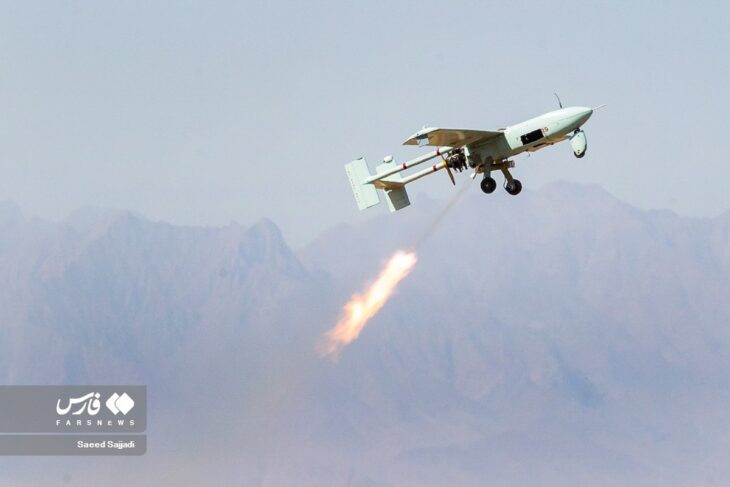

The Ababil-3 is old, simple and everywhere. It is a twin-boom surveillance drone with a 23-foot (7 m) wingspan that flies at up to 124 mph (200 km/h) for about four hours, out to roughly 62 miles (100 km) and back.
An estimated 217 had been built by July 2019, and armed versions appeared by 2020. Syria used it heavily to spot for artillery, Iraqi forces flew it against ISIS from 2014, and Sudan operates it. The older Ababil-2 airframe lives on as the Qasef-1, a loitering munition the Houthis in Yemen have used against Patriot radars.
6. Hadid-110
The Hadid-110 is the drone Iran built to beat the air defenses that stopped most Shaheds. It is jet-powered, flies at more than 315 mph (510 km/h), nearly three times the Shahed-136’s speed, and carries a 66-pound (30 kg) warhead.
The IRGC Ground Force first used it in March 2026, in the retaliation Iran called Operation True Promise IV. In July 2026, The Telegraph reported an upgraded version that flies lower and faster, and two were reportedly used against targets in Iraq’s Kurdistan Region on August 17, without casualties.
Its combat record is short and mostly reported by Iran, which is why it sits sixth. If the speed claims hold, it is the Iranian drone most likely to climb this list.
7. Shahed-238
The Shahed-238 is a Shahed-136 airframe with a small turbojet in place of the piston engine. It was unveiled in November 2023 in three versions: GPS guidance for fixed targets, an electro-optical and infrared seeker, and a radar-homing seeker for hunting air defenses.
Iran claims a top speed of about 310 mph (500 km/h). The jet engine leaves less room for fuel, so its range and warhead are presumed smaller than the 136’s, and Iran has not published either.
Its known combat use is Russian: evidence of at least one Shahed-238 fired at Ukraine emerged in January 2024. Russia has since fielded its own jet-powered Geran-3, one of the weapons in our ranking of the best kamikaze drones.
8. Shahed-191 Saeqeh
The Saeqeh is a flying wing based on the American RQ-170 Sentinel that Iran captured in December 2011. It is about 60 percent of the RQ-170’s size, with a 24-foot (7.3 m) span, and carries two small guided bombs internally.
Published figures give it a cruise speed of 186 mph (300 km/h), an endurance of 4.5 hours and a range of about 280 miles (450 km). Iran says it was used against ISIS in Syria, and in October 2018 released video it said showed one dropping a bomb.
Its most famous flight ended badly. Israel shot one down in February 2018 after it crossed from Syria, and an Israeli air force general said afterward that it imitated Western technology closely.
9. Shahed-149 Gaza
The Gaza is Iran’s MQ-9 Reaper look-alike and one of its biggest armed drones: a 69-foot (21 m) wingspan, a turboprop engine, Iran’s first on a drone, and a claimed 24-hour endurance. Iran says it carries 13 bombs and reaches about 210 mph (340 km/h).
It was unveiled in May 2021 and accepted into service in April 2022. Iran claims a 1,550-mile (2,500 km) operating radius, but no combat use has been documented, so on this list it ranks on potential rather than results.
10. Arash-2
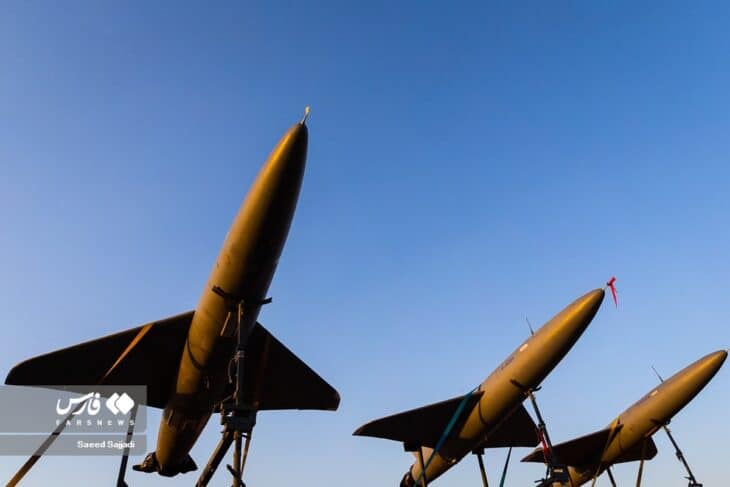

The Arash-2 is a long-range one-way attack drone operated by the Iranian Army’s ground forces since 2020. Iran credits it with a 1,240-mile (2,000 km) strike range and a 330-pound (150 kg) warhead, three times the Shahed-136’s upper estimate.
It is an upgraded Kian-2 with a piston engine in place of a jet. Reports that it may have gone to Russia have not been confirmed, and no strike has been publicly attributed to it.
11. Mohajer-10
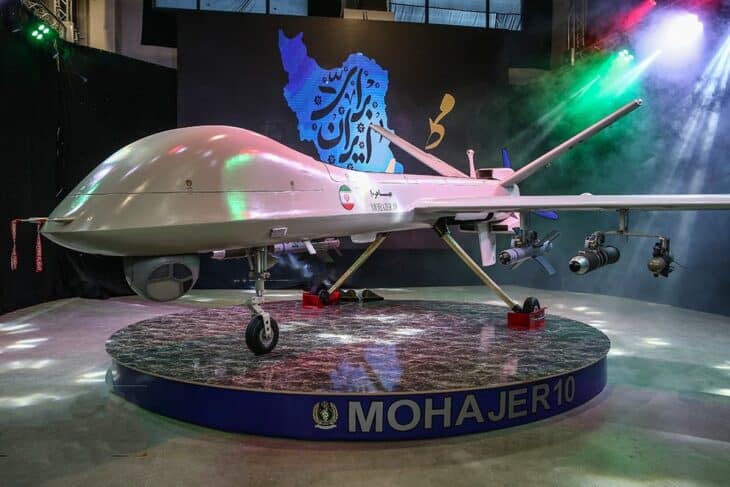

The Mohajer-10, unveiled in August 2023, is the long-range successor to the Mohajer-6. Iran claims a 1,240-mile (2,000 km) range, a 24-hour endurance, a top speed of about 130 mph (210 km/h) and a payload of about 660 pounds (300 kg).
At its unveiling it carried six weapons, including Almas missiles and Ghaem guided bombs. Like the Gaza, it looks like a Reaper and has no documented combat record yet.
12. Kaman-22
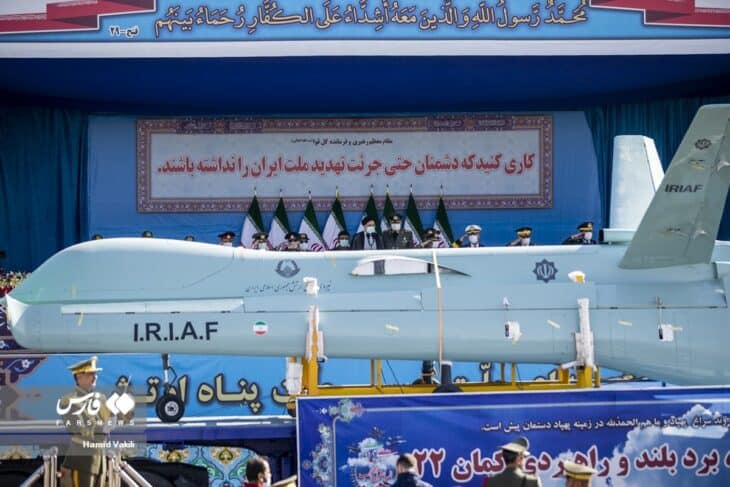

The Kaman-22 is the Iranian Air Force’s own wide-body combat drone, unveiled in 2021 and described by its commander as able to carry every type of munition. Iran claims the longest range of any drone on this list, about 1,860 miles (3,000 km), and a 660-pound (300 kg) payload.
It was reportedly offered to Brazil in April 2025 as a drone free of US export controls. It has no combat record, which is why the drone with the biggest published number ranks last.
What about Iranian drones off New Jersey?
A US congressman claimed an Iranian drone mothership was launching drones off the New Jersey coast. The same day, images showed Iran’s drone carrier, the Shahid Bagheri, still on sea trials off Iran. No Iranian drone has a published range anywhere close to the distance to the United States.
How Iran used its drones in the 2026 war
The US and Israeli strikes on Iran began on February 28, 2026, and Iran answered within hours with missiles and drones. By day four it had launched more than 2,000 drones, according to CSIS, and launches then fell off quickly.
Most were aimed at US bases and Gulf states rather than Israel. CSIS found that nearly 70 percent of the drones and missiles Saudi Arabia reported intercepting were heading for its oil-rich Eastern Province, and the UAE said in early March that of 941 Iranian drones it had detected, 65 fell inside its territory.
Gulf states reported intercepting 80 to 90 percent, figures the US has not independently verified. Patriot missiles were generally not used against the drones; cheaper interceptors, helicopters and fighters were, a cost problem our guide to the best air defense systems explains.
A Shahed brought down a US helicopter
In June 2026, a US helicopter went down near the Strait of Hormuz, and a US official said a Shahed one-way attack drone had downed it. The crew was rescued by a US Navy drone boat, a first. Iran said it had not deliberately targeted the helicopter.
Iran’s drones also lost a base at sea. US Central Command said on March 2, 2026 that it had struck the Shahid Bagheri, the converted container ship the IRGC Navy commissioned in February 2025 as its first drone carrier.
The fighting has stopped and restarted several times since: an April ceasefire, a June memorandum to end the war, and a collapse on July 8. Iran’s manned combat jets, and what the war did to them, are covered in our guide to the Iran Air Force.
How many drones does Iran have?
Nobody outside Iran publishes a reliable count. On November 10, 2026, Bloomberg reported that Iran may still hold thousands of Shahed-type attack drones, while saying the exact size of its drone and missile stockpiles remains uncertain.
Production is the bigger story. Experts quoted by CNBC in March 2026 said Iran may be able to build hundreds of Shaheds a week, and the drone is now mass-produced in Russia as well: Russia launched at least 6,100 Shahed-type drones at Ukraine in October 2026 alone, according to the Hudson Institute.
Iran’s ballistic arsenal is a separate count, covered in our ranking of Iranian missiles by range.
FAQ
Sources and references used for research and fact-checking.
- Wikipedia, HESA Shahed 136
- Wikipedia, Shahed drones
- Wikipedia, Shahed 131
- Wikipedia, Qods Mohajer-6
- Wikipedia, Shahed 129
- The War Zone, F-35 From USS Abraham Lincoln Shoots Down Iranian Drone
- Wikipedia, HESA Ababil
- Wikipedia, Hadid 110
- Wikipedia, Shahed Saeqeh
- Wikipedia, Shahed 149 Gaza
- Wikipedia, Arash (drone)
- Wikipedia, Qods Mohajer 10
- Wikipedia, Kaman 22 (UAV)
- Wikipedia, IRIS Shahid Bagheri
- Wikipedia, 2026 Iran war
- CSIS, Assessing the Air Campaign After Three Weeks: Iran War By the Numbers
- CNBC, Iran's Shahed drones and the cost of air defense
- Iran International, Iran producing 50 ballistic missiles a month despite US strikes
- Hudson Institute, Ukraine Military Situation Report, November 11
Get the Newsletter
The latest aviation news and stories sent to your inbox.
About the Author

Tim is the owner and lead editor of AeroCorner since 2019, overseeing aviation content covering aircraft, airlines, airports, and the broader aviation industry. Through years of researching, writing, editing, and publishing aviation-focused content, he has developed extensive practical knowledge of commercial aviation and air travel. Based in Asia and a frequent traveler himself, Tim also brings firsthand passenger experience to AeroCorner’s coverage. Outside of publishing, he has also explored aviation firsthand through hands-on flight training in New Zealand.