

Table of Contents
The Islamic Republic of Iran Air Force (IRIAF) entered 2026 with just under 300 combat aircraft on paper, and almost every one is a pre-1979 American design or a 1990s Soviet one. The most useful fighter it can still keep flying is the MiG-29. The most capable one it ever owned, the F-14 Tomcat, may no longer exist in flyable form.
Then the war arrived. In the June 2025 Twelve-Day War, Iran’s fighters showed no sign of leaving the ground. Since US and Israeli strikes began on February 28, 2026, they have flown, and open-source loss lists now record dozens of Iranian aircraft destroyed, most of them parked.
This list ranks every combat type the IRIAF still flies by one measure: how much fighting value it adds as of September 2026, weighing what the aircraft can do against how many Iran can realistically put in the air. The support fleet, and the Su-35 order Iran is still waiting on, follow the ranking.
| Rank | Aircraft | Role | Est. fleet entering 2026 | Documented 2026 war losses |
|---|---|---|---|---|
| 1 | MiG-29 Fulcrum | Air defense fighter | 18 to 30 | None documented |
| 2 | F-14A Tomcat | Long-range interceptor | About 35 on paper, about 10 flyable | 3 to 8 at Isfahan |
| 3 | F-4D/E Phantom II | Fighter-bomber | About 63 | 1 documented, more reported |
| 4 | Su-24MK Fencer | Strike bomber | 21 to 30 | 3 |
| 5 | F-5E/F Tiger II | Light fighter-bomber | 50 to 60 | 2 |
| 6 | Mirage F1EQ/BQ | Multirole fighter | 17 to 23 | None documented |
| 7 | Kowsar, Saeqeh, Azarakhsh | Homebuilt F-5 derivatives | About 15 | None documented |
| 8 | F-7 (Chinese MiG-21) | Interceptor | 12 to 14 | 10 |
| 9 | Yak-130 | Trainer, light combat | About 8 | 1 |
How this ranking works
Aircraft are ranked by combat value in September 2026: what the type can do, weighed against how many Iran can actually fly. Nobody outside Iran can inspect its fleet, so every count here is an estimate, and ranges show where trackers disagree. Losses count only aircraft shown destroyed in imagery, official footage or official statements. Missiles and drones are excluded, because the Revolutionary Guard, not the air force, operates them.
1. MiG-29 Fulcrum: The Fighter Iran Can Still Keep Flying
.jpg)
.jpg)
.jpg)
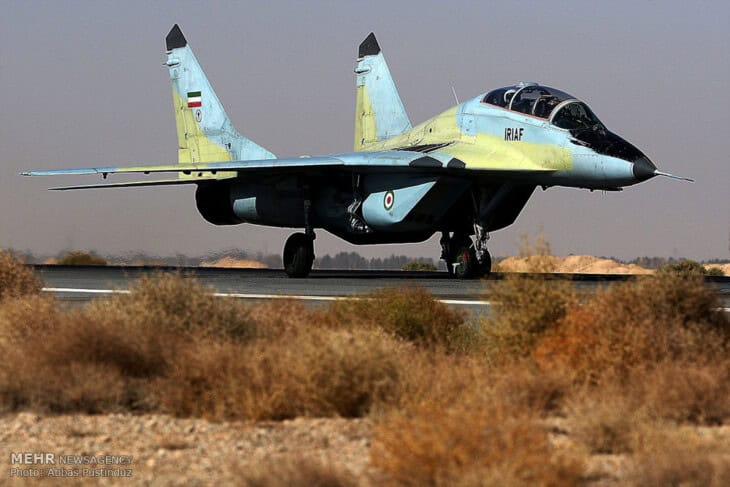
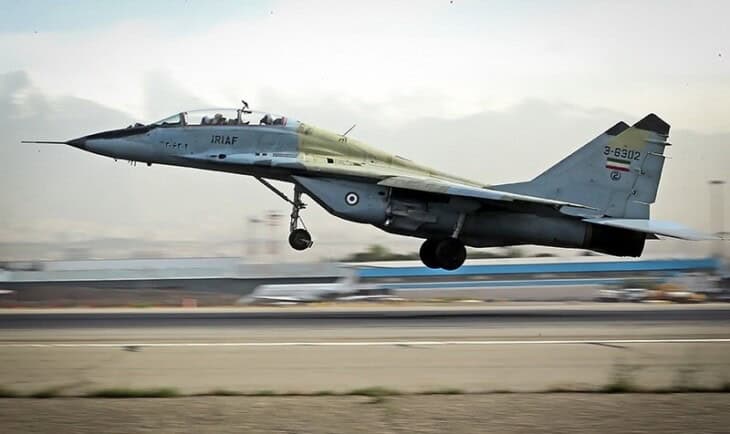
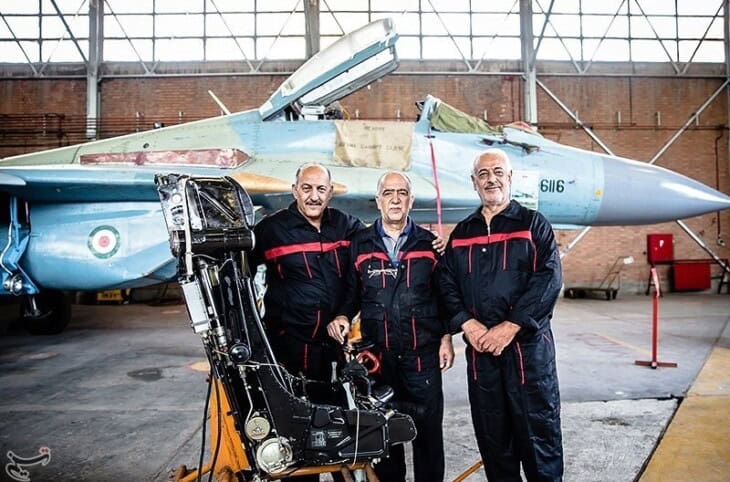
The MiG-29 takes the top spot not because it is the best fighter Iran ever bought, but because it is the only one with a supply line. It is the one fighter type in the fleet that Russia has recently topped up.
Iran bought at least 24 MiG-29s from the Soviet Union, 20 single-seaters and four two-seat trainers, and the first became operational in October 1990. Between four and nine more arrived in 1991, flown in by Iraqi pilots escaping the Gulf War.
In September 2025, Iranian lawmaker Abolfazl Zohrevand said a batch of Russian MiG-29s had arrived at Shiraz as a “short-term solution” while Iran waits for the Su-35. He never gave a number, which is why fleet estimates run from 18 to 30.
In the 2026 war, IRIAF MiG-29s flew intercepts against drones and missiles over Iranian cities, armed with 1980s-era R-27R and R-73 missiles. No Iranian MiG-29 appears on the open-source loss lists so far.
Keep the ranking in perspective. Nothing Iran flies today would place anywhere near a list of the best fighter jets in the world; the MiG-29 is simply the best fighter Iran can still sustain.
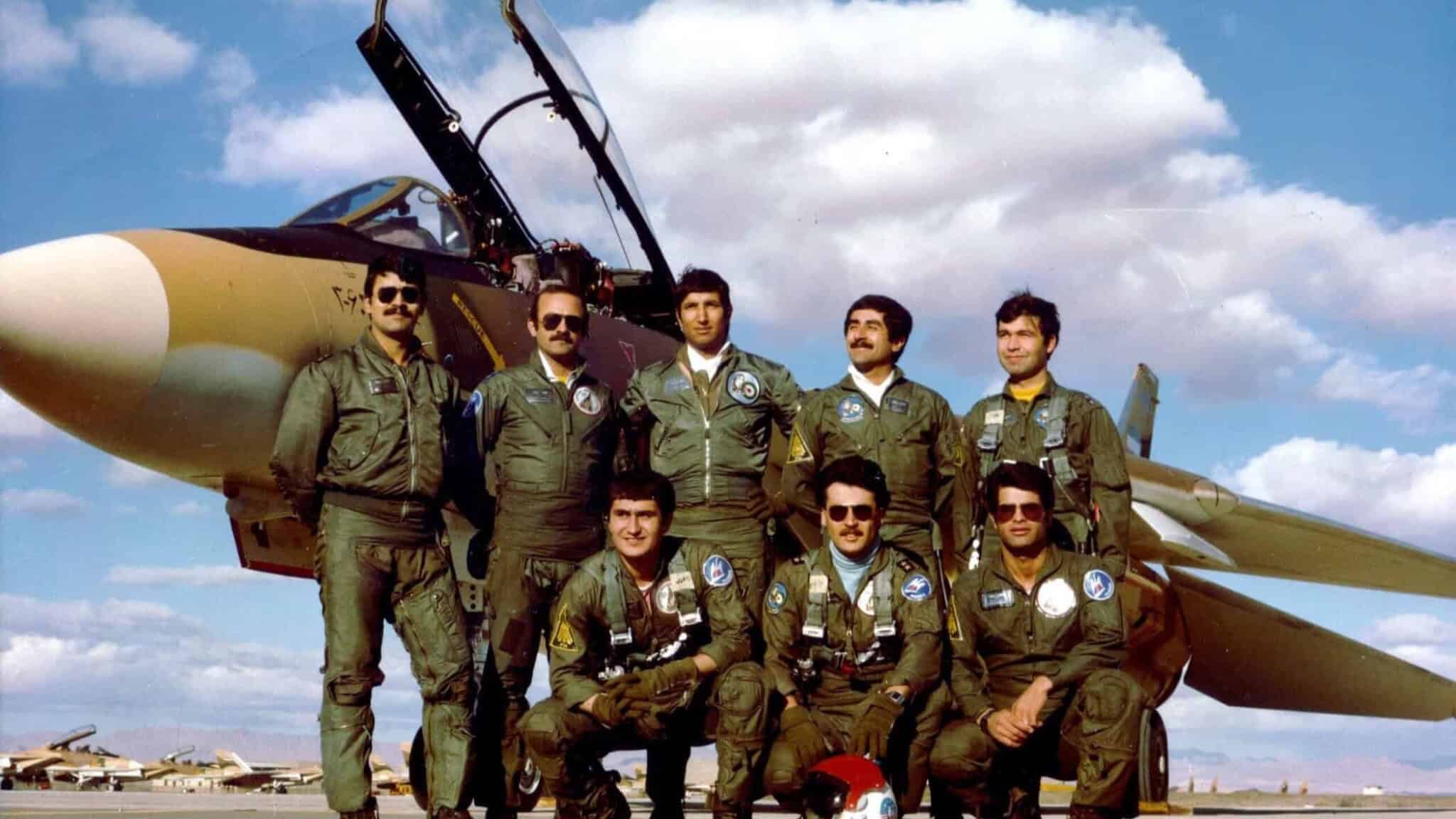
2. F-14A Tomcat: The Best Jet Iran Owns, If It Still Flies
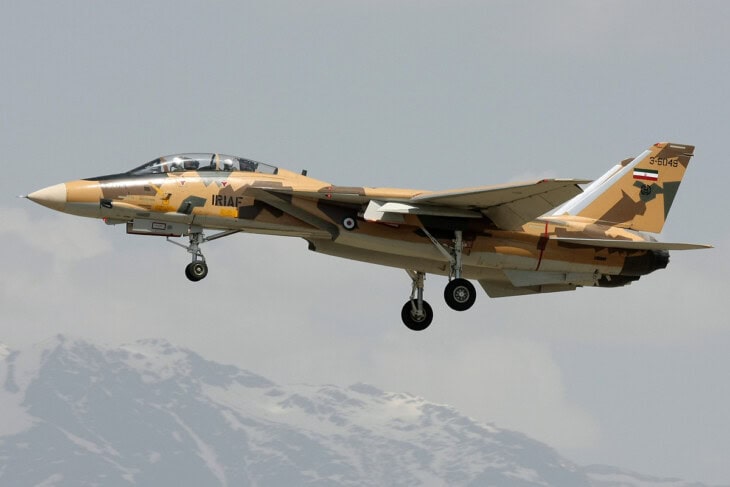
On paper, nothing else in the fleet comes close. The F-14 Tomcat’s AWG-9 radar could track 24 targets at once, and its AIM-54 Phoenix missile gave Iran the longest reach of any fighter it has ever flown.
Iran was the Tomcat’s only export customer. It ordered 80 under the Shah and received 79 before the 1979 revolution, then used them hard against Iraq: Iran claimed at least 160 Iraqi aircraft shot down, 55 of them confirmed, for the loss of 16 Tomcats.
The fleet then spent four decades flying without American parts. Historian Tom Cooper estimates only about 10 were operational when the 2026 war began, even though trackers still list around 35 airframes.
In early March 2026, Israel struck the 8th Tactical Fighter Base at Isfahan, believed to house every remaining Tomcat, and said the fleet was finished. Satellite imagery confirmed at least two, and probably three, destroyed jets; some counts reach eight, though Cooper says some of those were wooden decoys.
Then on June 10, 2026, Iranian state media released footage of an F-14 returning from a mission. Nobody has independently dated or located the clip, so whether Iran still has a flyable Tomcat is genuinely unresolved. That uncertainty is the only reason it ranks second rather than first.
3. F-4 Phantom II: The Backbone of Iran’s Strike Fleet
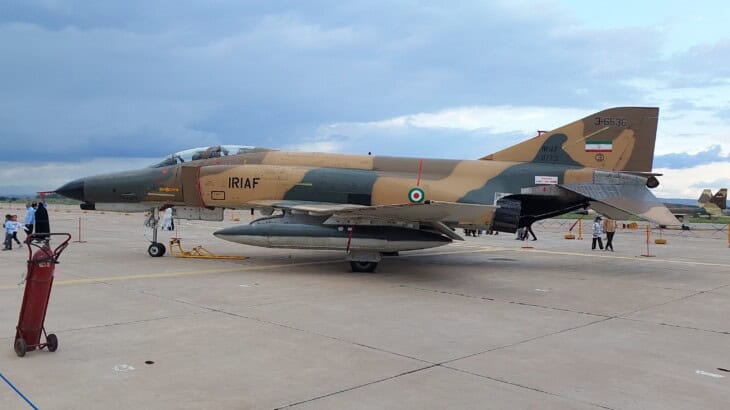
The Phantom is the IRIAF’s largest fast-jet fleet and its main strike tool. The US delivered 225 F-4D, F-4E and RF-4E Phantoms to Iran before the revolution, making it the type’s second-largest export customer.
Around 63 remain on paper in 2026, which makes Iran the biggest of the three air forces still flying the Phantom. Three F-4Es of the 91st Tactical Squadron at Bandar Abbas flew at the 2024 Kish Air Show.
In the 2026 war, Phantoms were among the IRIAF jets that tried to hit US bases in the Gulf, flying extremely low to survive. At least one was destroyed on the ground at Tabriz on March 1, and further losses are reported, but not documented, at the 3rd Tactical Air Base in Hamadan province.
It ranks below the Tomcat because it is a bomb truck, not a fighter that can win control of the air. It ranks above the Su-24 because Iran has more than twice as many of them.
4. Su-24MK Fencer: Iran’s Only Dedicated Bomber
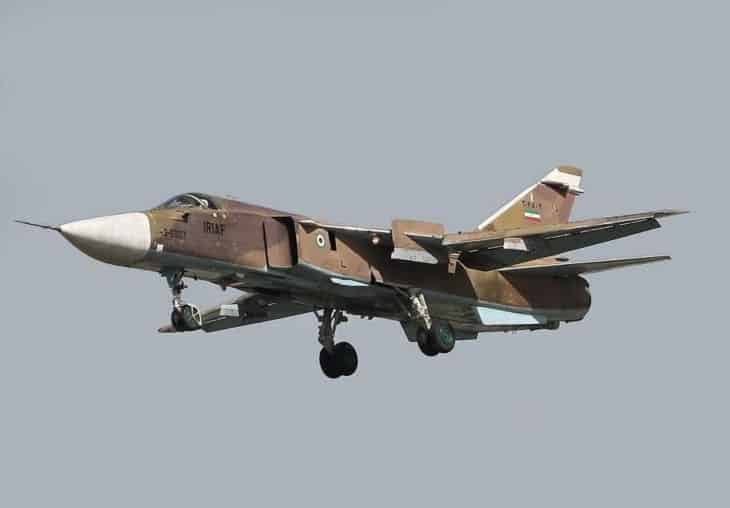
The Su-24MK is a swing-wing Soviet strike aircraft and the only dedicated bomber in the IRIAF. Iran also uses it as a “buddy” tanker to refuel other strike jets.
Iran’s fleet came from two directions: jets bought from the Soviet Union around 1991, and airframes flown in that same year by Iraqi pilots fleeing the Gulf War. One 2026 count puts 21 in service; the GlobalMilitary tracker lists 30.
The Su-24 flew the IRIAF’s most dramatic sortie of the war. On March 2, 2026, two of them ran toward Al Udeid Air Base and Qatar’s Ras Laffan gas complex at about 80 feet, and a Qatari F-15QA shot both down when they were reportedly two minutes from their targets.
Those were the first air-to-air kills in the Qatar Emiri Air Force’s history. A third Su-24 was destroyed on the ground at Ahvaz three days later.
5. F-5E/F Tiger II: The Light Fighter That Reportedly Hit a US Base
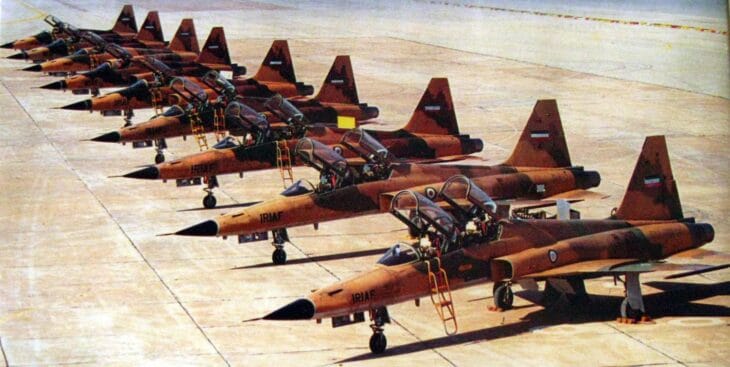

The F-5 Tiger II is Iran’s second-largest fighter fleet, with 50 to 60 on paper, including two-seat F-5F trainers. It is small, simple and old, and Iran has flown it since 1974, long enough to build its whole homegrown fighter industry on it.
Its moment came in the opening days of the 2026 war. NBC News reported, citing US officials and congressional aides, that an Iranian F-5 got through the air defenses at Camp Buehring in Kuwait and bombed the base.
A 1970s light fighter bombed a US base
According to the NBC News report, the Camp Buehring raid was the first time an enemy fixed-wing aircraft had struck an American military base in years. The Pentagon has not commented. Iran’s newest fighters did not do it; a jet type Iran has flown since 1974 did.
The F-5 ranks fifth because the raid is the exception, not the rule. Two F-5s have been documented destroyed so far, one at Tabriz on March 1 and one at Ahvaz on March 5, and it carries far less than a Phantom or a Fencer.
6. Mirage F1: Iraq’s Jets, Iran’s Air Force
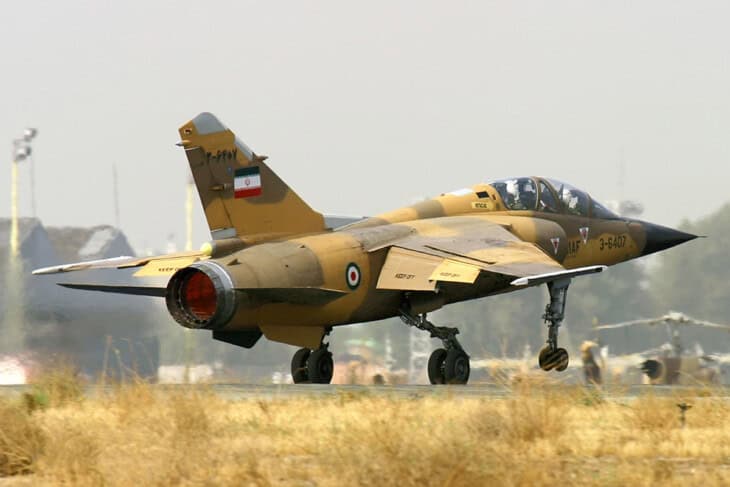
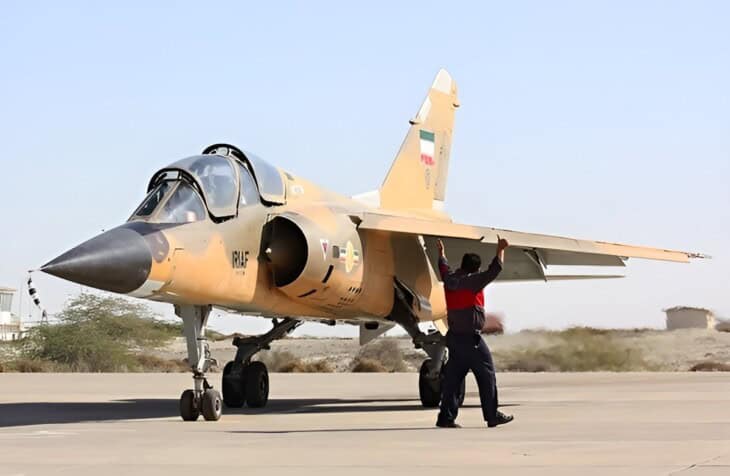
Iran never bought a Mirage F1. It got them in 1991, when Iraqi pilots flew 24 F1EQ fighters and F1BQ two-seaters to Iran to escape the Gulf War coalition, and Iran kept them.
Between 17 and 23 are still counted in 2026. One was shot down near the Afghan border in 2001 by the Taliban while flying against drug smugglers, and none has appeared on the 2026 loss lists.
They rank sixth: capable French multirole jets from the 1970s, but a small fleet that Iran has had to keep running for 35 years with no French support at all.
7. Kowsar, Saeqeh and Azarakhsh: The Homebuilt F-5s
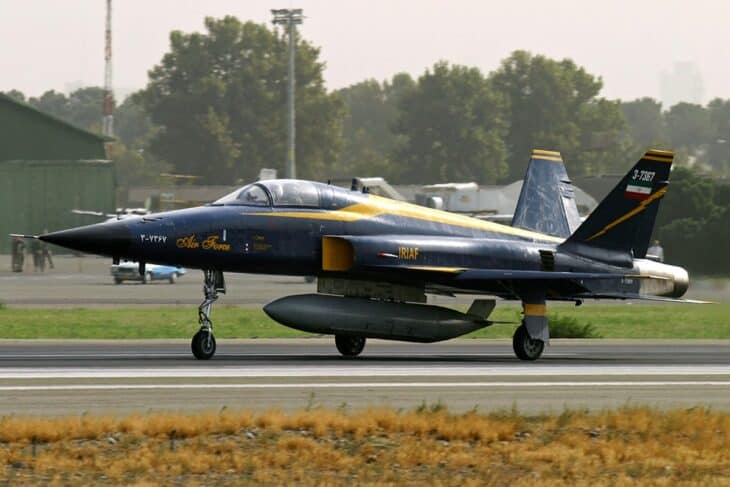

Cut off from Western suppliers, Iran taught itself to build fighters by copying the one it knew best. The Azarakhsh, Saeqeh and Kowsar are all derived from the F-5.
The Kowsar is the newest. Its assembly line opened at HESA in Isfahan in November 2018, and three were handed to the air force in June 2020. Iranian state media calls it “100-percent indigenously made”; Western analysts see it mainly as a trainer for a new generation of pilots.
Together the three types add up to about 15 jets. They rank seventh because they prove Iran can build airframes, but they fly like the 1970s design they are based on, and there are too few to matter in combat.
8. F-7: The Fleet the War Nearly Erased


The Chengdu F-7 is China’s derivative of the Soviet MiG-21, and Iran flew about a dozen as interceptors alongside two-seat FT-7 trainers.
No IRIAF fighter type has lost more airframes in the war. Satellite imagery showed nine F-7s destroyed at Isfahan on March 9, 2026, and another was hit at Yazd on March 21, which accounts for most of the fleet.
Whatever survives ranks eighth: a 1960s design built for short-range interception, now down to a handful.
9. Yak-130: The Trainer Pressed Into Combat
.jpg)
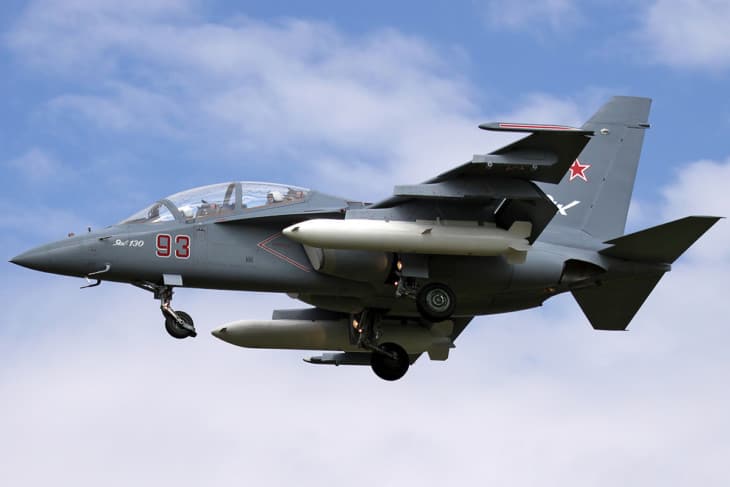
The Yak-130 is a Russian advanced jet trainer. Iran’s first two were pictured at the 8th Tactical Air Base near Isfahan in September 2023, meant to prepare cadets for frontline fighters such as the Su-35.
In the war, Iran armed them with short-range missiles and flew them alongside MiG-29s to intercept drones. On March 4, 2026, an Israeli F-35I shot one down over Tehran, which Defense News reported as the first time an F-35 had killed a crewed aircraft.
About eight remain on tracker counts. They rank last because they are trainers first, and the only one known to have met a modern fighter did not survive it.
The Rest of the Fleet: Tankers, Transports, Trainers and Helicopters
.JPG)
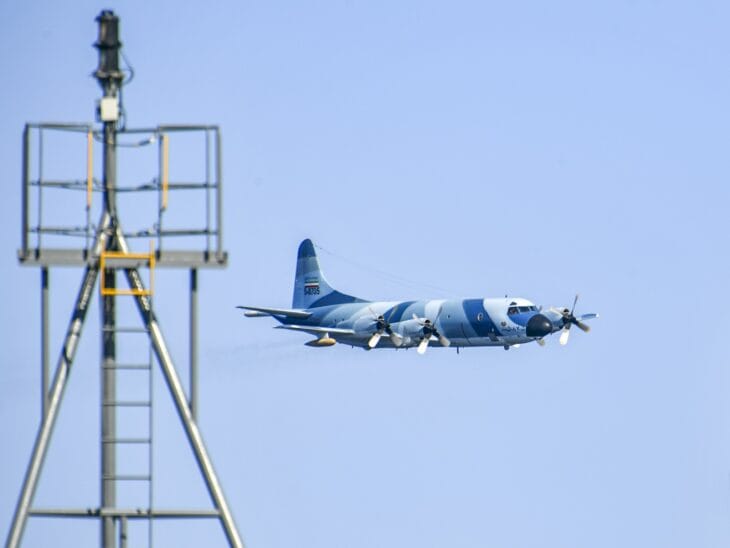
If the fighters were thinned, the fleet behind them was gutted. Iran’s aerial refueling depended on a handful of Boeing 707 and 747 tankers bought under the Shah, and in June 2025 Israel destroyed a KC-707 at Mashhad that was reportedly the only one Iran could still fly.
The 2026 strikes finished much of the job on the ground. Open-source loss lists record Boeing 707 and 747 tankers, five C-130 Hercules and a P-3F Orion maritime patrol aircraft destroyed at airfields including Mehrabad in Tehran and Kerman between March and April.
Tallies differ by who is counting. The GlobalMilitary tracker puts Iran’s total aircraft losses in the war above 90 airframes, concentrated in the transport and tanker fleet, while Wikipedia’s list of documented losses counts 43 Iranian military aircraft.
| Aircraft | Role | Tracker count |
|---|---|---|
| C-130E/H Hercules | Tactical transport | 24 |
| Il-76 | Heavy transport | 8 |
| Fokker F27 | Transport | 8 |
| Pilatus PC-6 Porter | Utility transport | 15 |
| Boeing 747 | Tanker, transport | 6 |
| Boeing 707 | Tanker, transport | 3 |
| Dassault Falcon 20 and 50 | VIP transport | 4 |
| P-3F Orion | Maritime patrol | 2 |
| Pilatus PC-7 | Basic trainer | 45 |
| MFI-17 Mushshak | Primary trainer | 25 |
| Bell 206 | Light helicopter | 10 |
| CH-47C Chinook | Heavy-lift helicopter | 5 |
| Mi-28NE | Attack helicopter, first arrived January 2026 | 1 |
That imbalance between a hollowed-out air force and a busy war is deliberate. Iran long ago moved its real long-range punch into ballistic missiles and cheap one-way drones like the Shahed, run by a different service entirely.
What about the missiles that keep hitting US bases?
Mostly, those are not the air force. Iran’s ballistic missiles and long-range drones, including those behind the September 2026 strike that damaged US jets in Jordan, sit with the Islamic Revolutionary Guard Corps Aerospace Force, a separate service. The IRIAF is the regular army’s air arm, and this list covers its aircraft only.
What Iran Is Waiting For: The Su-35

The aircraft that would actually reshuffle this list has not arrived. Leaked Russian documents published in October 2025 describe a deal worth about €6 billion for 48 Su-35 fighters, with deliveries running from 2026 to 2028.
By July 2026, Russia’s Komsomolsk-on-Amur plant had finished 20 of them, with Iran paying to keep them in Russia, and about ten more were expected by the end of the year, Military Watch Magazine reported. No delivery to Iran had been confirmed as of mid-September 2026.
The holdup is the base, not the jets: Hamadan, the planned Su-35 home, is still being rebuilt after strike damage, which is why Iran’s Su-35s are still sitting in Russia.
Would 20 Su-35s put Iran back in the fight? Only partly. The Su-35 is a capable 4.5-generation fighter but not a stealthy one, and the aircraft Iran has faced since 2025 include fifth-generation jets like the F-35I that downed its Yak-130.
FAQ
Sources and references used for research and fact-checking.
- Wikipedia, List of aircraft of the Iranian Air Force
- Wikipedia, Islamic Republic of Iran Air Force
- Wikipedia, List of aviation shootdowns and accidents during the 2026 Iran war
- Wikipedia, 2026 Iran war
- Wikipedia, 2026 Iran war ceasefire
- GlobalMilitary, Islamic Republic of Iran Air Force Inventory 2026
- Wikipedia, Grumman F-14 Tomcat
- The Aviationist, Israeli Air Force Strikes Iranian F-14 Tomcat Fleet at Isfahan Air Base
- The War Zone, Iranian F-14 Tomcats Meet Their Doom In Israeli Airstrikes
- 19FortyFive, Israel Said It Destroyed Iran's Last F-14 Tomcats in March: Three Months Later, Tehran Released Footage of One Still Flying
- Wikipedia, McDonnell Douglas F-4 Phantom II
- Wikipedia, Mikoyan MiG-29
- The Jerusalem Post, Iran's Air Force receives batch of Russian MiG-29s
- The Aviationist, Qatari F-15QAs Confirmed Behind Shootdown of Iranian Su-24s
- The Aviationist, Report Claims Iranian F-5 Bombed U.S. Base in Kuwait During Opening Phase of War
- Wikipedia, HESA Kowsar
- Defense News, Israeli F-35 notches first kill of a manned fighter in downing of Iranian Yak-130
- The Aviationist, Iran's Air Force Receives First Russian Yak-130 Advanced Jet Trainer Aircraft
- Wikipedia, Sukhoi Su-35
- Iran International, Leaked Russian files show Iran's €6bn plan to buy 48 Russian fighter jets
- Military Watch Magazine, Russia's Largest Fighter Factory Has Completed 20 Su-35 Fighters For Iran
- The Aviation Geek Club, First two Sukhoi Su-35SE Flanker-Es delivered disassembled to Iran
- Reuters via Military Times, Iran attack on base in Jordan damaged American military aircraft, US official says
Get the Newsletter
The latest aviation news and stories sent to your inbox.
About the Author

Tim is the owner and lead editor of AeroCorner since 2019, overseeing aviation content covering aircraft, airlines, airports, and the broader aviation industry. Through years of researching, writing, editing, and publishing aviation-focused content, he has developed extensive practical knowledge of commercial aviation and air travel. Based in Asia and a frequent traveler himself, Tim also brings firsthand passenger experience to AeroCorner’s coverage. Outside of publishing, he has also explored aviation firsthand through hands-on flight training in New Zealand.