Fighter Jets
Grumman F11F Tiger
ICAO: F11F
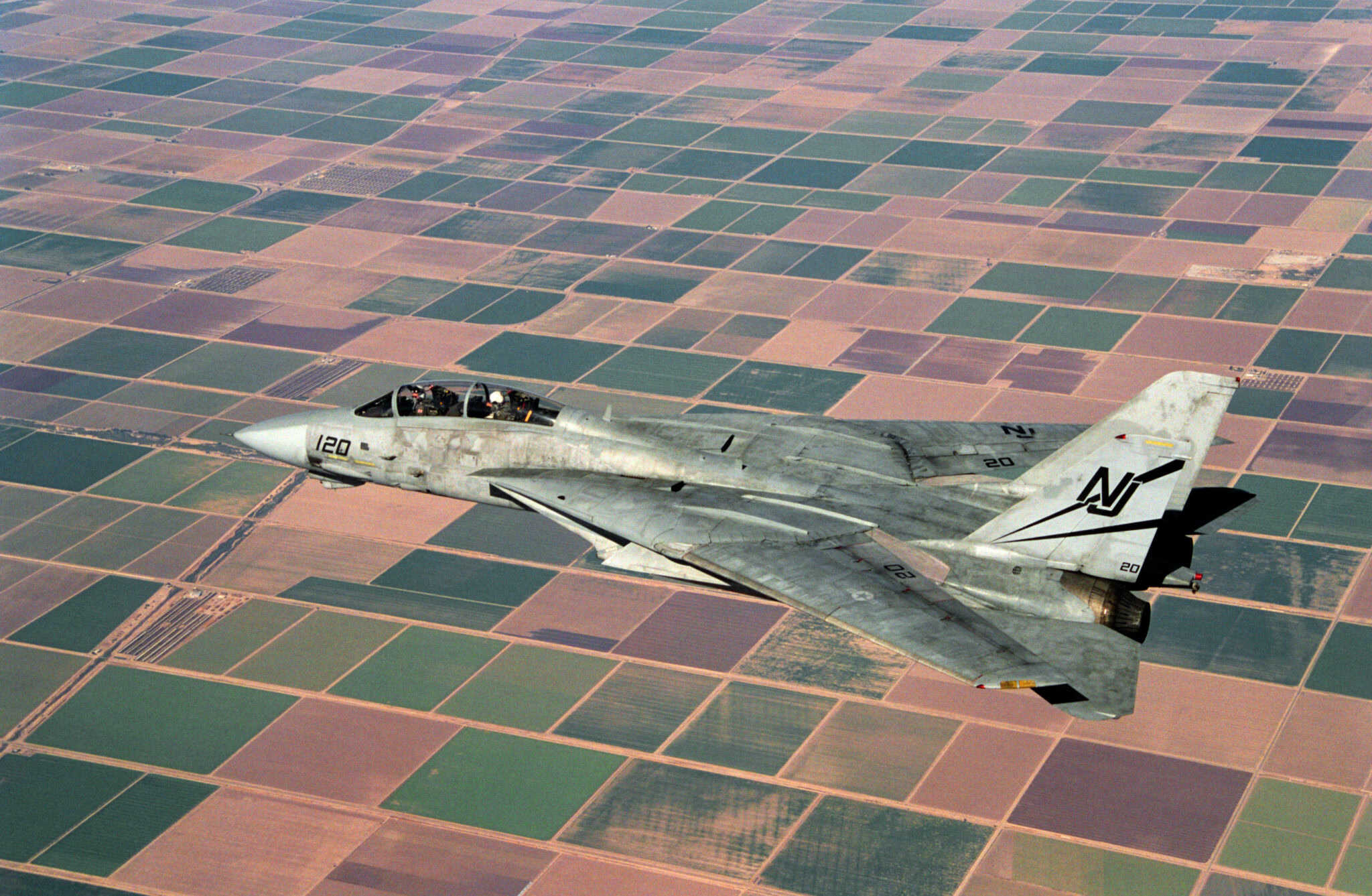
The Grumman F-14 Tomcat was the U.S. Navy's swing-wing carrier interceptor, built to kill Soviet bombers and missile launch platforms far beyond the range of the carrier group.
Updated: by Tim de Vries
The latest aviation news and stories sent to your inbox.
The Grumman F-14 Tomcat is a carrier-based, variable-sweep-wing fighter that served as the U.S. Navy’s primary fleet-defense interceptor from 1974 until its retirement in 2006. Built around the AWG-9 radar and the long-range AIM-54 Phoenix missile, it could track 24 targets and engage 6 at once, a reach no other fighter matched for decades. Iran, the only export customer, flew the last airworthy Tomcats, and whether any survived the March 2026 Israeli strike on their home base at Isfahan is still unresolved.
Live Fleet Activity (F14)
Fetching live data…




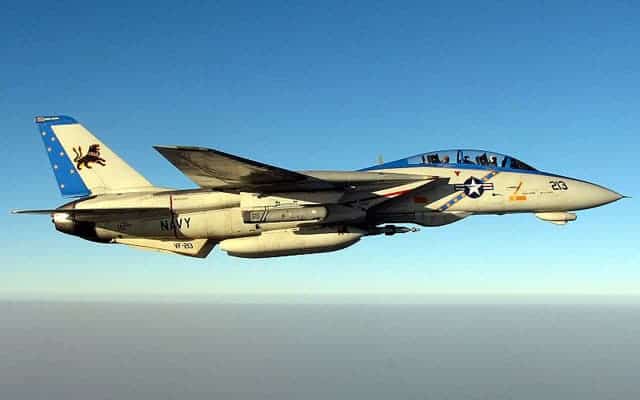
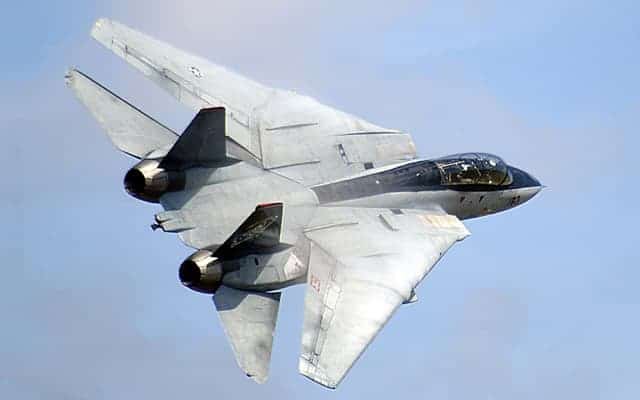
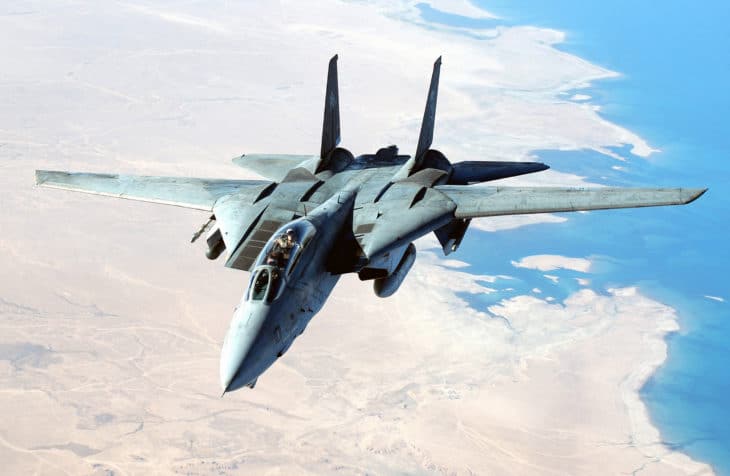
The F-14 came out of a Cold War problem the U.S. Navy could not solve with the aircraft it had. Soviet bombers and submarines were fielding long-range anti-ship missiles, and the fleet needed an interceptor that could kill the launch platforms far beyond the range of the carrier group.
An earlier attempt, the carrier version of the General Dynamics F-111B, was too heavy and handled poorly around the boat. Congress cut its funding in 1968, and the Navy was free to write its own requirement.
Grumman had partnered on the F-111B and had already been studying alternatives. Its Model 303 design won the Naval Fighter Experimental (VFX) contract in January 1969. The F-14 first flew on 21 December 1970, reached initial operational capability in 1973, and deployed in September 1974 aboard USS Enterprise, replacing the McDonnell Douglas F-4 Phantom II.
The name “Tomcat” partly honored Vice Admiral Thomas Connolly, whose testimony against the F-111B helped kill it, and it fit Grumman’s tradition of feline fighter names running back to the Wildcat and Hellcat.
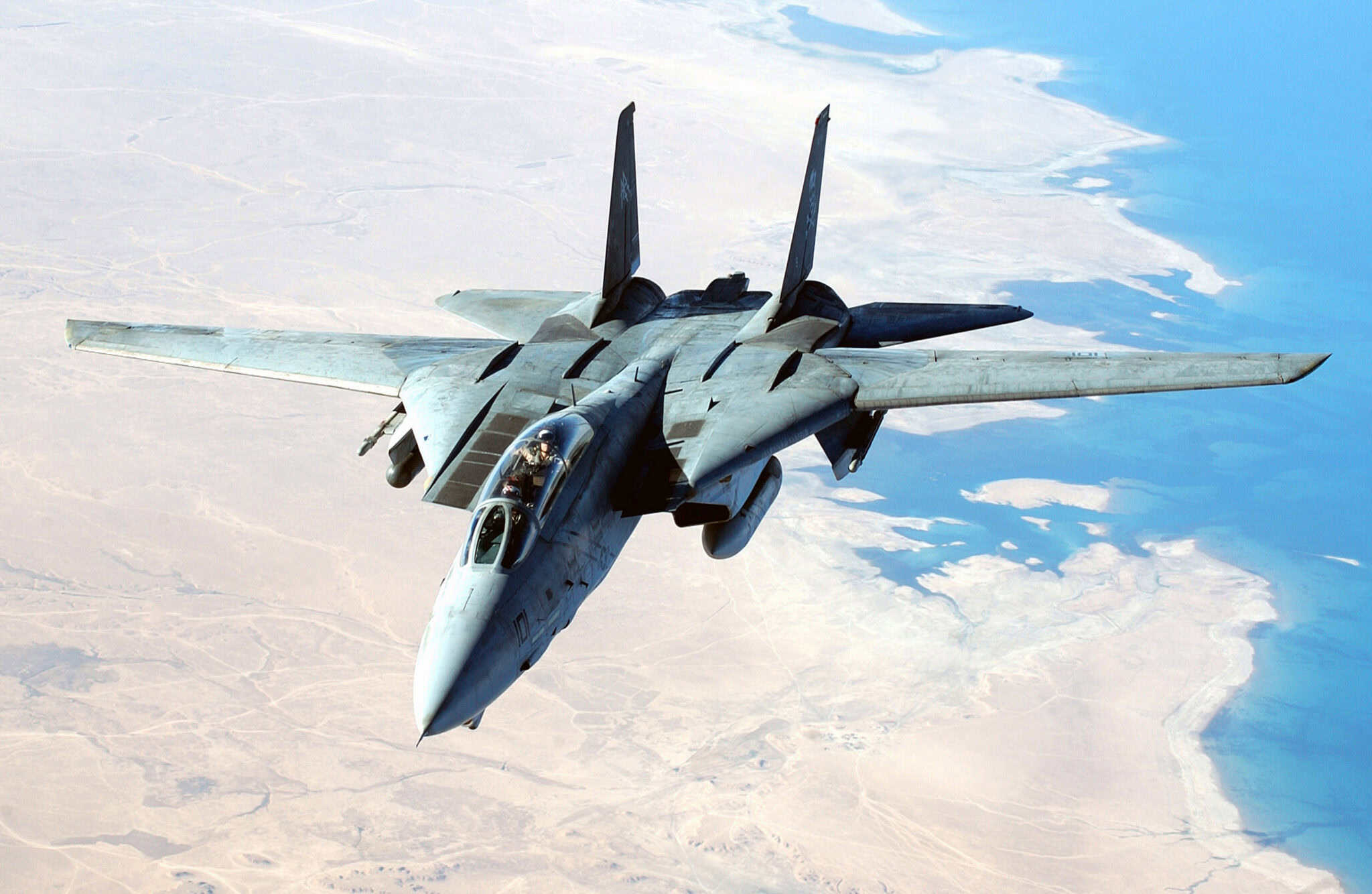
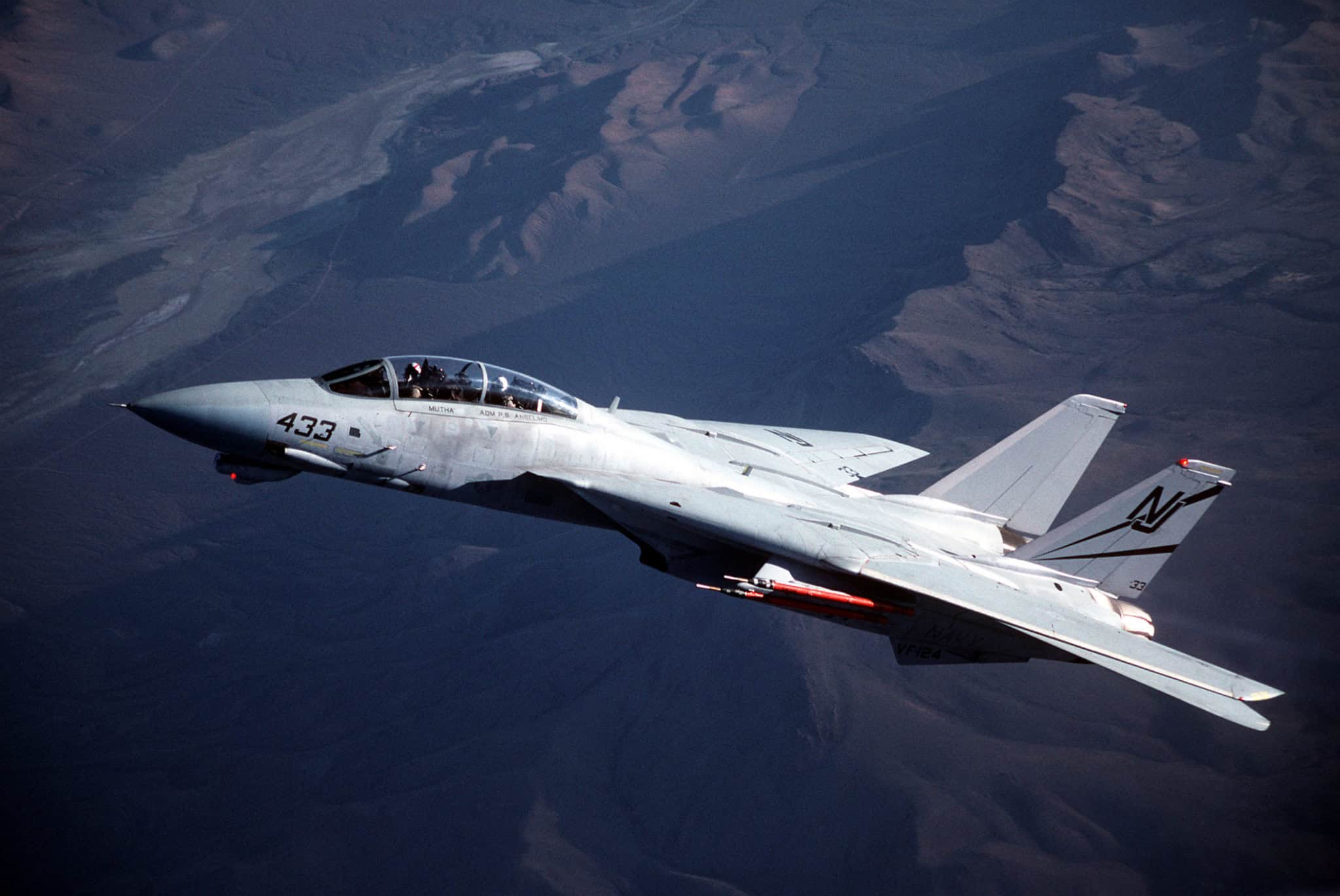
The Tomcat’s wings pivot between 20 degrees and 68 degrees of sweep in flight. A Central Air Data Computer moves them automatically to hold the best lift-to-drag ratio as speed changes, and the pilot can override it by hand.
Forward sweep gave the big fighter the low-speed lift it needed to get aboard a carrier. Full aft sweep thinned the wing for a Mach 2-plus dash. On deck, the wings can “oversweep” to 75 degrees so they tuck over the tailplane and take up less parking space.
Grumman spaced the wing pivots far apart and put the weapons pylons on the fixed inner glove, not the moving wing. That kept the center of lift from shifting much as the wing swept, which cut trim drag at speed. The wide fuselage between the engines also makes lift, so the Tomcat’s effective wing loading is lower than its wing area suggests.
The mission lived or died on the radar. The Hughes AN/AWG-9 could track 24 targets at once and guide missiles against six of them at the same time, a capability no other fighter matched for decades.
Its partner weapon was the AIM-54 Phoenix, a roughly 1,000-pound missile with a reach beyond 100 nautical miles (115 miles, 190 km) and a top speed above Mach 5. A Tomcat could carry six, though the weight stressed the airframe and the usual load was two or four.
The U.S. Navy fired the Phoenix in combat only three times, all of them at Iraqi aircraft over the no-fly zone in 1999, and never scored a kill with it. Iran is the only operator to have shot anything down with the missile, during its war with Iraq in the 1980s. The F-14D later swapped the AWG-9 for the digital AN/APG-71 and added an infrared search-and-track sensor.
The F-14A flew on two Pratt & Whitney TF30 turbofans that were never meant for a fighter. They were adapted from the F-111 program, and the Navy always planned to replace them but ran out of money.
Navy Secretary John Lehman called the TF30 and F-14 pairing “probably the worst engine and airframe mismatch we have had in years.” The engine stalled easily at high angle of attack and during hard throttle movement, which could throw the jet into a yaw departure and an unrecoverable flat spin. Roughly 28 percent of all F-14 accidents were attributed to the engine.
The fix arrived in 1987 with the F-14A Plus, later renamed F-14B, which fitted the General Electric F110-GE-400. The F110 added enough thrust for a better-than-1-to-1 thrust-to-weight ratio at low fuel and let the aircraft launch from the catapult without afterburner. The F-14D used the same engine.
Grumman built 712 Tomcats between 1969 and 1991. The great majority were F-14As: 558 for the U.S. Navy and 79 for Iran.
The F-14B combined the F110 engine and the ALR-67 threat receiver with the original AWG-9 radar. Grumman built 38 new B-models and upgraded dozens of A-models to the standard, and a later program rebuilt 81 of them again as the F-14B (Upgrade).
The F-14D Super Tomcat, first delivered in 1991, was the definitive version: F110 engines, a glass cockpit, the APG-71 radar, new ejection seats, and a combined infrared and optical sensor under the nose. Grumman completed 37 new D-models and rebuilt 18 A-models to D(R) standard before production ended.
The Tomcat was designed to shoot down aircraft and missiles, and it did. Two F-14s downed two Libyan Su-22s over the Gulf of Sidra in August 1981, and two more shot down two Libyan MiG-23s in the same waters in January 1989.
Its first heavy combat use was actually reconnaissance. Fitted with the TARPS camera pod, the F-14 became the Navy’s primary tactical reconnaissance platform after the RF-8 Crusader retired in 1982.
In the 1990s the Navy added the LANTIRN targeting pod and then the JDAM satellite-guided bomb, turning the fighter into the “Bombcat.” F-14s flew strike missions over Bosnia, Kosovo, Afghanistan from the opening night of October 2001, and Iraq. The last American F-14 combat sortie ended aboard USS Theodore Roosevelt on 8 February 2006.
The Tomcat was expensive to keep flying. It was a 1970s airframe with hydraulically actuated variable-geometry wings and analog systems at its core, and it demanded far more maintenance hours per flight hour than the aircraft that replaced it.
The F/A-18E/F Super Hornet could cover fleet defense and strike in one airframe that shared parts, training, and tanker plumbing with the F/A-18C already in every air wing. The Navy chose commonality and lower cost over the Tomcat’s raw reach.
The official retirement ceremony was held at Naval Air Station Oceana on 22 September 2006. The very last F-14 flight was a ferry hop to Long Island on 4 October 2006.
After retirement, most surviving airframes went to the “Boneyard” at Davis-Monthan Air Force Base in Arizona. In 2007 the Navy announced it would shred them rather than store them.
The reason was Iran. It was the only other F-14 operator, it was hunting for spare parts on the open market, and intact boneyard jets were a parts supply. The Defense Department suspended sales of F-14 components in January 2007, the stored airframes went to the shredder from July 2007, and in August 2009 the boneyard reported that the last of them had been hauled away with 11 still sitting in desert storage.
A handful survive as museum pieces. The proposed “Maverick Act” would let the Navy transfer three specific F-14Ds to the U.S. Space and Rocket Center in Huntsville, Alabama, and supply the spare parts to make one of the three flyable for airshows and commemorative events. The Senate passed it by unanimous consent on 28 April 2026, and it had not become law as of September 2026.
Iran ordered the F-14 under the Shah in 1974 to intercept Soviet MiG-25 flights, choosing it over the F-15 Eagle after a fly-off. Seventy-nine of the 80 aircraft were delivered before the 1979 revolution ended the order.
Cut off from U.S. support, Iranian crews still used the Tomcat hard during the 1980–1988 war with Iraq. Iran claims its F-14s shot down at least 160 Iraqi aircraft, of which 55 are confirmed, against 16 Tomcats lost. Historian Tom Cooper credits pilot Jalil Zandi with 11 kills, making him the highest-scoring Tomcat pilot in history.
Iran kept the fleet alive for decades with cannibalized parts and a locally built Phoenix replacement, the Fakour-90. Estimates of how many remained airworthy have ranged from a handful to about 25, nearly all of them at the 8th Tactical Fighter Base near Isfahan.
Israeli strikes destroyed two long-derelict F-14As parked at Mehrabad in Tehran in June 2025, then hit the Isfahan base itself on the night of 7 March 2026. Israel said the strike ended the fleet, but satellite imagery confirmed only two or three wrecked Tomcats there.
In June 2026 Iranian state television released footage it presented as an F-14 returning from a mission. The clip has never been independently dated or located, so whether an airworthy Tomcat still exists anywhere is genuinely unresolved.
The Tomcat is the aircraft in the 1986 film Top Gun. Two real Navy squadrons, VF-51 and VF-111, provided the F-14As for the flying sequences, and several serving officers flew in the movie, including Robert Willard, who went on to command the U.S. Pacific Fleet.
The film cemented the Tomcat as a pop-culture icon, and the 2022 sequel Top Gun: Maverick brought a museum F-14 back to the screen for its climax. That cultural weight is a large part of why the public still asks about an aircraft the Navy retired in 2006.
The full specification table for the F-14 is on this page. A few figures need context.
The panel lists a top speed near Mach 2.34, about 1,342 knots at altitude. In practice the Tomcat was rarely flown near that number; the limit came from the engine inlet ramp scheduling, not thrust, and the TF30 and F110 versions shared the same maximum speed despite very different static thrust.
The range figure of about 1,600 nautical miles is a maximum-range number, not a distance the aircraft could fly out and return from. Combat radius depended on the mission: roughly 500 nautical miles escorting a strike, about 200 on a deck-launched intercept, and around 150 on fleet air defense, where the point was never distance but the ability to hold station for close to two hours.
The thrust shown is for the F110-GE-400 of the F-14B and F-14D. Published figures differ because they measure different things: the Navy’s own characteristics document gives 26,950 pounds-force static and uninstalled, against 23,400 installed at sea level, rising to 30,200 at Mach 0.9.
The original TF30 produced about 20,900 pounds-force. Swapping it for the F110 raised the rate of climb by 61 percent and gave the aircraft 60 percent more striking range in the overland attack role.
At an empty weight of 43,735 lb (19,838 kg) and a maximum takeoff weight near 74,500 lb (33,700 kg), the F-14 was the largest and heaviest fighter ever to operate from a U.S. carrier deck.
Only Iran might be, and it is unresolved. The U.S. Navy retired and then shredded its fleet, leaving Iran as the sole operator. Israeli strikes hit Iran’s main Tomcat base at Isfahan in March 2026 and Israel said the fleet was finished, but Iranian state television released footage in June 2026 of an F-14 returning from a mission, and that clip has never been independently verified. A 2026 U.S. bill would return one museum F-14D to flying condition for airshows.
To keep spare parts away from Iran. Iran was the only other F-14 operator and was buying components on the open market, so stored American jets at the Arizona boneyard were a parts source. The Navy began shredding retired Tomcats in July 2007, and by August 2009 the last of them had been hauled out of the boneyard for scrapping.
Reach. The AWG-9 radar tracked 24 targets and engaged six at once, and the AIM-54 Phoenix could hit a target more than 100 nautical miles (115 miles, 190 km) away. No other fighter of its era could see or shoot that far, and the variable-sweep wing let a jet that big still work from a carrier.
Yes. The F-14A is the fighter flown by Maverick in the 1986 film Top Gun, with aircraft supplied by Navy squadron VF-51. A restored F-14 also appears in the 2022 sequel Top Gun: Maverick.
The F-14D had a flyaway cost of about 38 million dollars in 1998. The full program cost per aircraft, which includes development, support, and spares, was considerably higher.
The F-14 is generally classed as a fourth-generation fighter, part of the U.S. “Teen Series” alongside the F-15, F-16, and F/A-18. Its design incorporated air-combat lessons from Vietnam against smaller, more agile MiGs.
The F-14 is 62 ft 9 in (19.13 m) long. Its wingspan is 64 ft 2 in (19.55 m) with the wings forward and about 38 feet (11.6 m) swept fully back. It stands 16 feet (4.88 m) tall at the tail.
The Boeing F/A-18E/F Super Hornet. It took over both the fleet-defense and strike roles the Tomcat had filled, in an airframe that shared maintenance, training, and parts with the F/A-18C Hornets already aboard every carrier.
Sources and references used for research and fact-checking.