
Fighter Jets
Grumman F-14 Tomcat
ICAO: F14
The all-weather night bomber that flew Navy strikes for 34 years.
Updated: by Tim de Vries

The latest aviation news and stories sent to your inbox.
The Grumman A-6 Intruder was a two-seat, carrier-based attack aircraft built to hit targets at night and in bad weather. It flew with the US Navy and Marine Corps from 1963 to 1997, from Vietnam to Desert Storm. Grumman built 693 between 1962 and 1992. The Navy retired the last of them in 1997.
Live Fleet Activity (A6)
Fetching live data…


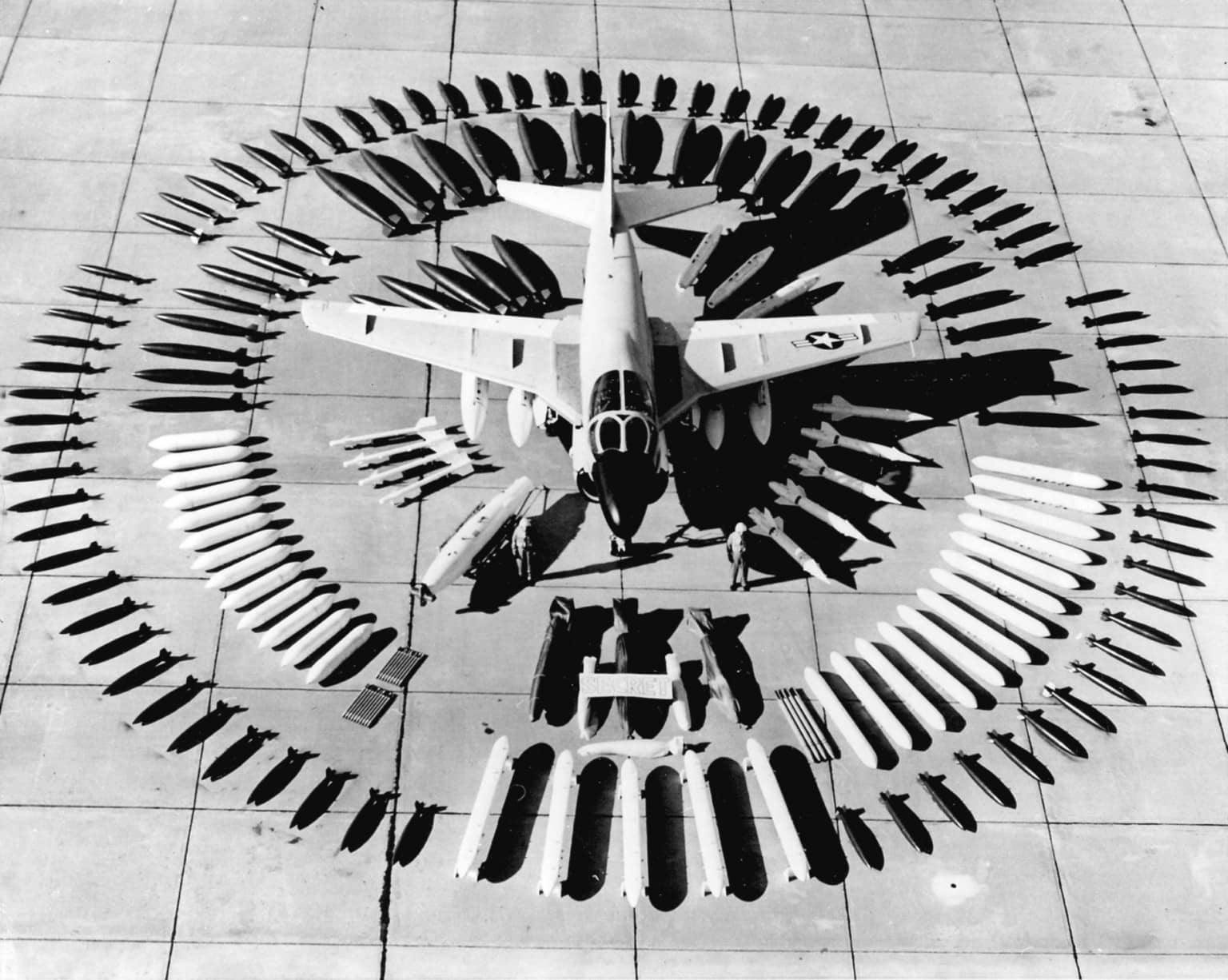


The Grumman A-6 Intruder was a two-seat, carrier-based attack aircraft built to find and hit targets at night and in bad weather. It flew with the US Navy and Marine Corps from 1963 to 1997, from Vietnam to Desert Storm.
It was a bomber, not a fighter. No version carried an internal gun, and its job was to deliver a heavy bomb load accurately at night and in poor weather.
Grumman built 693 Intruders between 1962 and 1992. Only the Navy and Marine Corps ever flew them, the last were retired in 1997, and none is airworthy in private hands today.
In February 1957 the Navy asked industry for a jet attack aircraft to replace the piston-engined Douglas A-1 Skyraider. It wanted an all-weather bomber for long-range Navy strikes that could also operate from short strips in support of the Marines.
Eight companies submitted eleven designs. Grumman’s entry, its Type G-128, won, and the Navy ordered eight development aircraft.
The first one, designated A2F-1, flew on April 19, 1960. The type was redesignated the A-6 in 1962.
The Intruder reached VA-42, the medium attack training squadron, in February 1963. VA-75 became the first fleet squadron to fly it, from October 1963, and the Marines received theirs in 1964.
The A-6 seated its crew side by side. The pilot sat on the left and the bombardier/navigator, or B/N, sat on the right, working the radar and the attack system.
Sitting side by side, both crew members looked at the same radar picture. It was not a pretty aircraft, and at its retirement The Virginian-Pilot described the fleet as “pug-nosed, noisy jets.”
Grumman proposed tailpipes that tilted downward to shorten takeoffs. Varying the angle proved not worthwhile, from carriers or short strips, so the pipes were fixed at a seven-degree downward angle.
The wingtips hid another oddity. The trailing edge of each tip split open, above and below the wing, to act as a speed brake.
The heart of the early A-6A was DIANE, the Digital Integrated Attack/Navigation Equipment. It combined a Norden AN/APQ-92 search radar, a separate AN/APG-46 tracking radar, a radar altimeter and a Doppler navigation radar, and it gave the A-6 bombing accuracy at night and in poor weather.
The Intruder family grew into tankers, radar hunters and jammers as well as bombers. The main versions, in order:
The original production model, with 480 built. It took the type into combat over Vietnam in 1965.
Nineteen A-6As were converted to A-6Bs between 1967 and 1970 to attack enemy air defenses with AGM-45 Shrike and AGM-78 Standard anti-radiation missiles. Twelve more became A-6Cs in 1970, fitted with a TRIM pod carrying infrared and low-light TV cameras for night attacks.
The definitive version, with about 445 built, some 240 of them rebuilt from earlier Intruders. It replaced DIANE with a single Norden AN/APQ-148 multimode radar and an inertial navigation system, and it entered service in 1971.
From 1979 the A-6E TRAM (Target Recognition and Attack Multi-Sensor) added a forward-looking infrared sensor boresighted with a laser designator. That let the crew see targets in the dark and guide laser-guided bombs onto them.
After a series of wing-fatigue problems, about 85% of the fleet was re-winged with composite wings, and the rewinged, upgraded A-6E reached initial operational capability with VA-75 in fiscal 1988. The later SWIP upgrade added a radar warning receiver and the AGM-88 HARM, AGM-84E SLAM and AGM-65 Maverick missiles.
Seventy-eight A-6As and 12 A-6Es were converted into aerial tankers. They lost the DIANE system and gained an internal refueling system, and their retirement left a gap in Navy tanker capacity.
The EA-6A was a two-seat electronic warfare version for the Marine Corps, with 28 built. The four-seat EA-6B Prowler followed, with 170 built. The Prowler served until 2019, 22 years after the last A-6 bombers.
The A-6F was an ambitious late upgrade with two General Electric F404 turbofans of 10,800 lb (48 kN) thrust each, extra pylons, a new radar and digital avionics. The Navy chose not to put it into production, preferring to spend on the A-12 Avenger II.
The example at the Cradle of Aviation Museum in Garden City, New York, flew for a total of two and a half hours before the program ended.
The A-6 had five hardpoints, each rated at 3,600 lb (1,633 kg). Together they could carry 18,000 lb (8,165 kg) of weapons and fuel tanks.
It could carry up to 28 Mk 82 500 lb (227 kg) bombs. Over its life the A-6 also carried Shrike, Standard ARM and HARM anti-radiation missiles, Maverick and Walleye guided weapons, and the Harpoon and SLAM missiles.
It was also a nuclear delivery aircraft, able to carry up to three B43, B57 or B61 bombs. It could carry AIM-9 Sidewinder air-to-air missiles, but no Intruder of any version had an internal gun.
VA-75 took the A-6 into combat over Vietnam in 1965, flying from the USS Independence. The squadron lost the type’s first aircraft of the war on July 14, 1965.
The Intruder became the Navy’s night striker, often attacking alone or in pairs. On one mission, two A-6s struck a North Vietnamese power plant at night with 26 500 lb bombs.
Seventeen A-6 pilots and bombardier/navigators received the Navy Cross for heroism in Vietnam. The Intruder fought the same air war as the fighter jets of the Vietnam War.
The cost was heavy. The Navy and Marine Corps lost 84 A-6s of all series during the war, and the last was shot down by ground fire on January 24, 1973.
On December 4, 1983, Syrian missiles shot down an A-6 and an A-7 Corsair II during a strike in Lebanon. The A-6 pilot, Lt. Mark Lange, was killed, and his B/N, Lt. Robert Goodman, was captured and released on January 3, 1984.
In April 1986, A-6s of VA-34 from the USS America and VA-55 from the USS Coral Sea struck Libya in Operation El Dorado Canyon.
On April 19, 1988, during Operation Praying Mantis, VA-95 Intruders from the USS Enterprise sank the Iranian frigate Sahand and badly damaged the frigate Sabalan.
Navy and Marine A-6s flew more than 4,700 combat sorties in the 1991 Gulf War. Three were shot down by missiles and anti-aircraft fire.
The A-6 was the Navy’s main laser-guided bomb aircraft in that war. The Smithsonian credits TRAM-equipped A-6Es with 85% of the laser designations and laser-guided bomb drops of Desert Storm.
The Intruder’s last combat missions were flown over Bosnia in 1994.
Of the 84 Intruders lost in Vietnam, Wikipedia’s breakdown attributes 56 to anti-aircraft guns and ground fire, 10 to surface-to-air missiles and 2 to MiG fighters. The other 16 were lost to operational causes.
That makes 68 shot down in Vietnam. With the one lost over Lebanon in 1983 and the three lost in the Gulf War, the sources used here record 72 A-6s brought down by enemy fire.
The Marine Corps retired its last A-6E on April 28, 1993, and replaced it with the two-seat F/A-18D Hornet.
The Navy’s end came quickly as a cost-cutting move under post-Cold War budget pressure. The last operational A-6 launch took place from the USS Enterprise on December 19, 1996, and the Navy formally retired the type on February 28, 1997.
The last two A-6 squadrons, VA-75 and VA-196, retired their aircraft that day. VA-75, the first fleet squadron to fly the Intruder, had made its last cruise to the Mediterranean aboard the USS Enterprise.
In all, 19 Navy and five Marine Corps squadrons flew the type.
Many airframes went straight to the desert. By February 1997 about 300 were already stored at Davis-Monthan Air Force Base near Tucson, Arizona.
Others went to sea. In the summer of 1996, 71 were sunk in the Atlantic to form the St. Augustine Intruder Reef, about 25 miles (40 km) off Florida, and a second reef site was created 30 miles (48 km) off Daytona Beach.
The planned replacement was the McDonnell Douglas A-12 Avenger II, a stealthy flying-wing carrier bomber. The Navy wanted 620 of them.
The program ran badly over budget and behind schedule, and the design grew about 30% heavier than its specification, a serious problem for a carrier aircraft. Defense Secretary Dick Cheney cancelled it on January 7, 1991, and the resulting legal fight was not settled until 2014.
That left the Navy with no dedicated successor. F-14 Tomcats fitted with LANTIRN targeting pods filled the precision-strike role in the interim, and the F/A-18E/F Super Hornet eventually absorbed the mission.
The two share an airframe lineage, which is why they are often confused. The EA-6B Prowler was developed from the A-6, but it was a four-seat electronic warfare aircraft built to jam enemy radar rather than to drop bombs.
Grumman lengthened the forward fuselage to fit a four-seat cockpit, and the Prowler carried up to five jamming pods where the Intruder carried bombs. The Navy retired it in June 2015 and the Marine Corps in March 2019.
Both aircraft share the ICAO type designator A6, which covers every member of the family.
The full specification table for the A-6E is on this page. A few of its figures are quoted in very different forms elsewhere, so they need context.
Range is the most confusing. The 2,818 nm in the table is the ferry range, the distance for a one-way delivery flight rather than a strike.
On a real strike the distance was far shorter. Wikipedia gives a combat range of 919 nm, about 1,058 miles (1,702 km), for a high-low-high mission carrying six Mk 83 bombs and three drop tanks.
The 563-knot top speed, about 648 mph (1,043 km/h), is the Federation of American Scientists figure, and Wikipedia gives 560 knots at sea level. Either way the A-6 was subsonic, and its normal cruise speed was 412 knots (474 mph).
The maximum takeoff weight in the spec table is the shore-based limit. For a carrier takeoff the Federation of American Scientists gives a lower figure, 58,600 lb (26,580 kg).
Ceiling figures differ by source. The table uses the 42,400 ft (12,900 m) in Wikipedia’s specification block, while the Federation of American Scientists and some references give 40,600 ft (12,375 m).
Many Intruders survive in museums. A-6E 154167 is at the Smithsonian’s Steven F. Udvar-Hazy Center in Chantilly, Virginia, after more than 7,500 flying hours, 767 arrested landings and 712 catapult launches.
The National Naval Aviation Museum in Pensacola, Florida, displays an A-6E that served with VA-196. Others are aboard the USS Midway Museum in San Diego, the USS Lexington in Corpus Christi, Texas, and at Patriots Point in South Carolina.
The Museum of Flight in Seattle, the Pima Air & Space Museum in Tucson and the Flying Leatherneck Aviation Museum at MCAS Miramar also have A-6Es. Two A-6F Intruder IIs are displayed in New York, at the Intrepid Sea, Air & Space Museum in New York City and the Cradle of Aviation Museum in Garden City.
You cannot buy one. The FAA’s aircraft reference file, in the release dated September 11, 2026, lists no Grumman A-6 model at all, so no Intruder is on the US civil register.
No. The US Navy retired the A-6 in February 1997 and the Marine Corps in April 1993, and no other country ever operated it. No A-6 is airworthy in private or civilian hands, the FAA register lists none, and the surviving aircraft are museum displays.
The Navy and Marine Corps lost 84 A-6s to all causes during the Vietnam War. By Wikipedia’s breakdown, 68 of those were shot down: 56 by guns and ground fire, 10 by surface-to-air missiles and 2 by MiGs. The remaining 16 were operational losses.
By the Navy’s own use of it, yes. It stayed in front-line service for 34 years, 17 of its crew members received the Navy Cross in Vietnam, and in Desert Storm TRAM-equipped A-6Es made 85% of the laser designations and laser-guided bomb drops.
It had real weaknesses too. It was subsonic, 84 were lost in Vietnam, and wing-fatigue problems led to about 85% of the fleet being re-winged.
The Navy meant to replace it with the A-12 Avenger II stealth bomber, but that program was cancelled in January 1991. In practice the F/A-18E/F Super Hornet took over the Navy’s strike mission, with LANTIRN-equipped F-14s filling in, and the Marine Corps replaced its A-6s with the F/A-18D Hornet.
Grumman built 693 A-6s between 1962 and 1992, including about 445 of the A-6E version, some 240 of which were rebuilt from earlier aircraft.
No. Retired Intruders went to museums, to storage at Davis-Monthan, or were sunk as artificial reefs off Florida. The FAA’s aircraft reference file (release dated September 11, 2026) contains no Grumman A-6 model, so no Intruder is registered to a private owner in the United States.
Its top speed was about 563 knots, or 648 mph (1,043 km/h). It cruised at about 412 knots (474 mph). It was a subsonic aircraft powered by two Pratt & Whitney J52 turbojets of 9,300 lb thrust each.
Its two-person crew worked as a team on the attack. The pilot on the left flew the aircraft while the bombardier/navigator on the right ran the radar and attack system, and sitting side by side, both could watch the same radar picture.
The first A-6 cost $4.6 million, and by 1983 inflation and new equipment had pushed the price to $36 million, according to The Virginian-Pilot. The Federation of American Scientists gives a unit cost of $43 million in fiscal 1998 dollars.
Sources and references used for research and fact-checking.