Military Propellor Planes
Grumman F7F Tigercat
ICAO: F7F
The Grumman F8F Bearcat was the U.S. Navy's last piston-engine Grumman fighter, built for climb rate and too late to see combat in World War II, yet it went on to fly in Indochina and win air races.
Updated: by Tim de Vries
The latest aviation news and stories sent to your inbox.
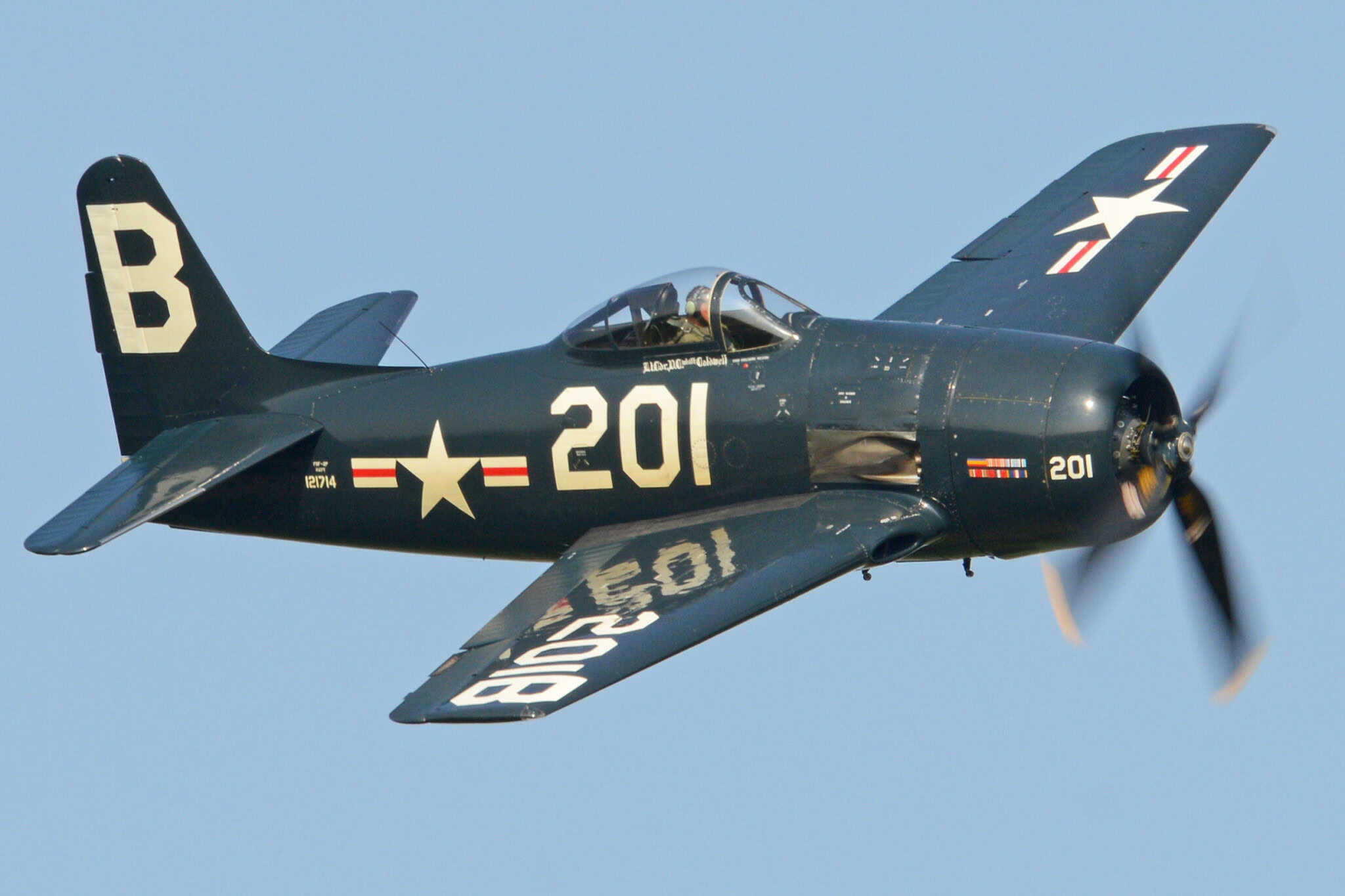
The Grumman F8F Bearcat was the last piston-engine fighter Grumman built for the U.S. Navy, a small, light carrier fighter designed around one idea: climb faster than anything else. It reached squadrons in 1945, too late for World War II, and went on to fly with the Blue Angels, French forces in Indochina and South Vietnam.
Live Fleet Activity (F8F)
Fetching live data…


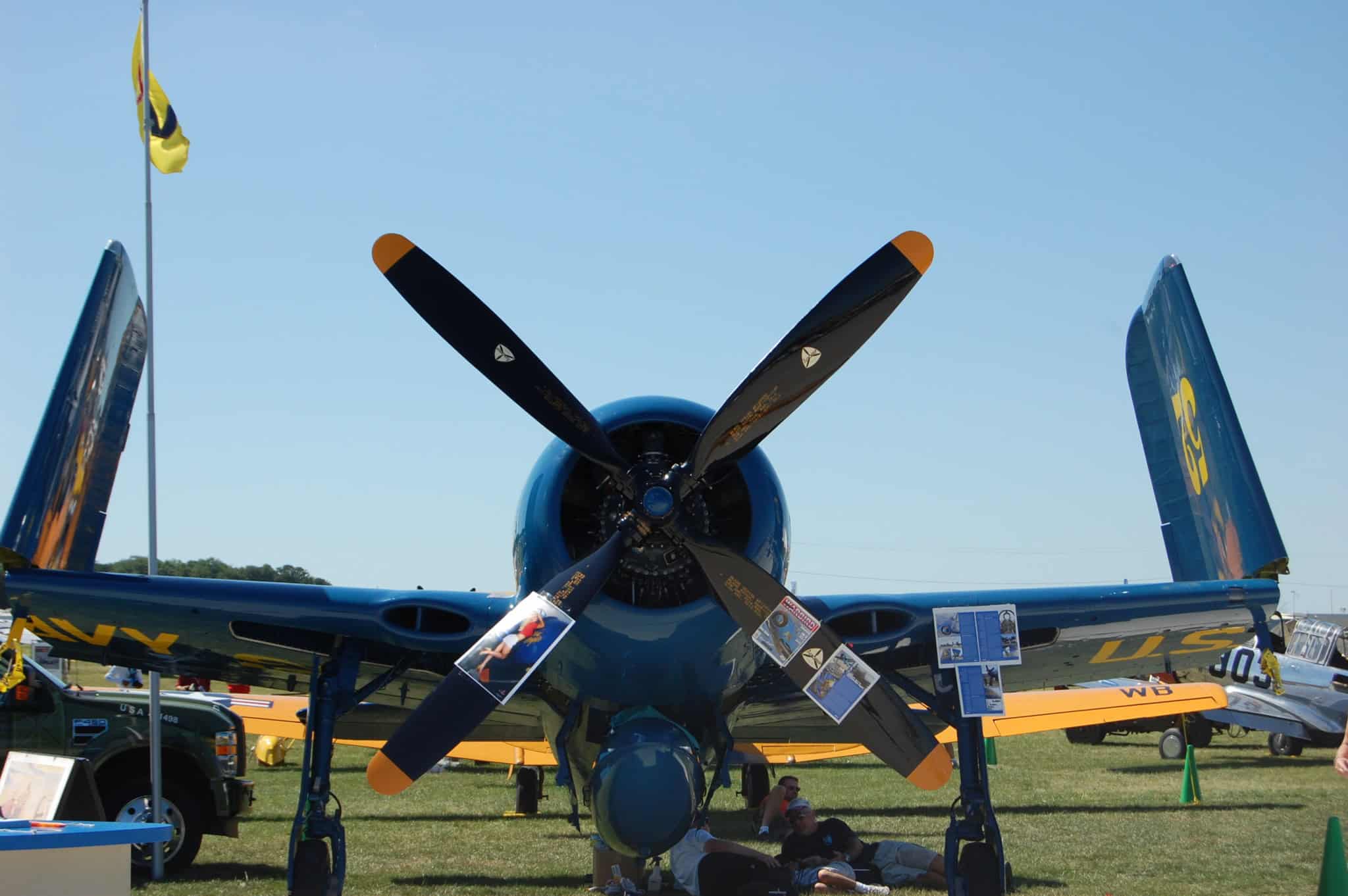

The Bearcat traces back to a meeting at Pearl Harbor on June 23, 1942. Wildcat pilots told Grumman vice president Jake Swirbul what they wanted next, and Lt. Cdr. Jimmie Thach stressed climb rate above everything else.
The Navy also wanted a fighter small enough to fly from escort carriers, which were limited to the F4F Wildcat. Grumman kept the powerful Pratt & Whitney R-2800 engine and shrank the airframe around it.
The design was finished in November 1943, and the Navy ordered two XF8F-1 prototypes on November 27, 1943. Grumman’s internal designation was G-58.
The first prototype flew on August 21, 1944, although one account gives August 13. Corwin “Corky” Meyer was Grumman’s project pilot.
The first production aircraft went to Fighter Squadron 19 (VF-19) in February 1945, and the unit was operational by May 21, 1945. The Pacific War ended before the squadron saw action, so the Bearcat never fought in World War II.
Next to the F4U Corsair, the Bearcat was marginally slower but more maneuverable and faster to climb. That trade followed from the original request, which put climb rate first.
In 1946 an unmodified F8F-1 climbed to 10,000 feet in 94 seconds. That time stood as a record for 10 years, until a jet fighter beat it.
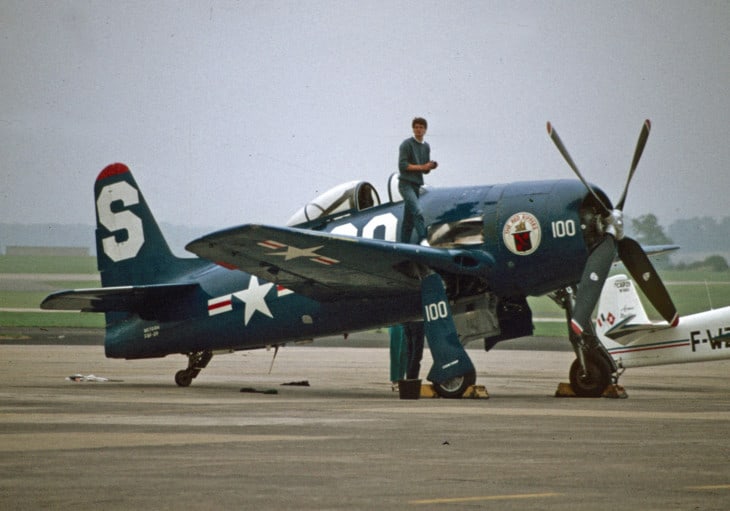
Grumman built 1,265 Bearcats in total. The main versions were the F8F-1, with 658 built, and the F8F-2 with 293 built.
Smaller batches included the F8F-2P photo-reconnaissance version (60) and the F8F-2N night fighter (12). Sources disagree on the exact counts of the F8F-1B and F8F-1N subtypes, so they are left out here.
The full specification table for the aircraft is on this page.
The F8F-2 carried four 20 mm cannons. It could also carry 5-inch rockets under the wings and a 1,000 lb bomb under the fuselage. Pacific Wrecks lists four .50 caliber machine guns instead of the cannons, so check the variant before quoting an armament.
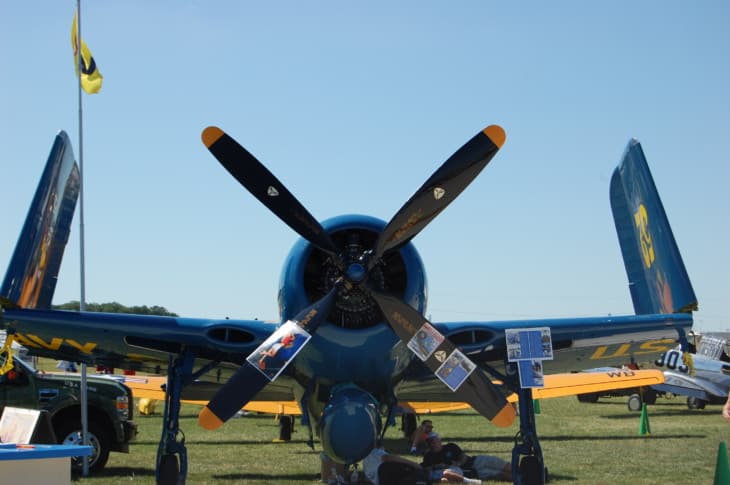
The Navy’s Blue Angels converted to the F8F-1 on August 25, 1946, replacing the Hellcat as the team’s second demonstration aircraft. The Bearcat is the aircraft that introduced the team’s diamond formation.
The team flew Bearcats until it was temporarily disbanded in 1950 during the Korean War.
The Bearcat’s only wartime service came with other air arms. Nearly 200 went to French forces in 1951 and were used mainly for ground support in Indochina, because the Viet Minh had no air force.
After the French withdrew in 1954, 28 surviving aircraft went to South Vietnam, which operated them from 1956. Retirement began in 1960, and A-1 Skyraiders and T-28 Trojans replaced them.
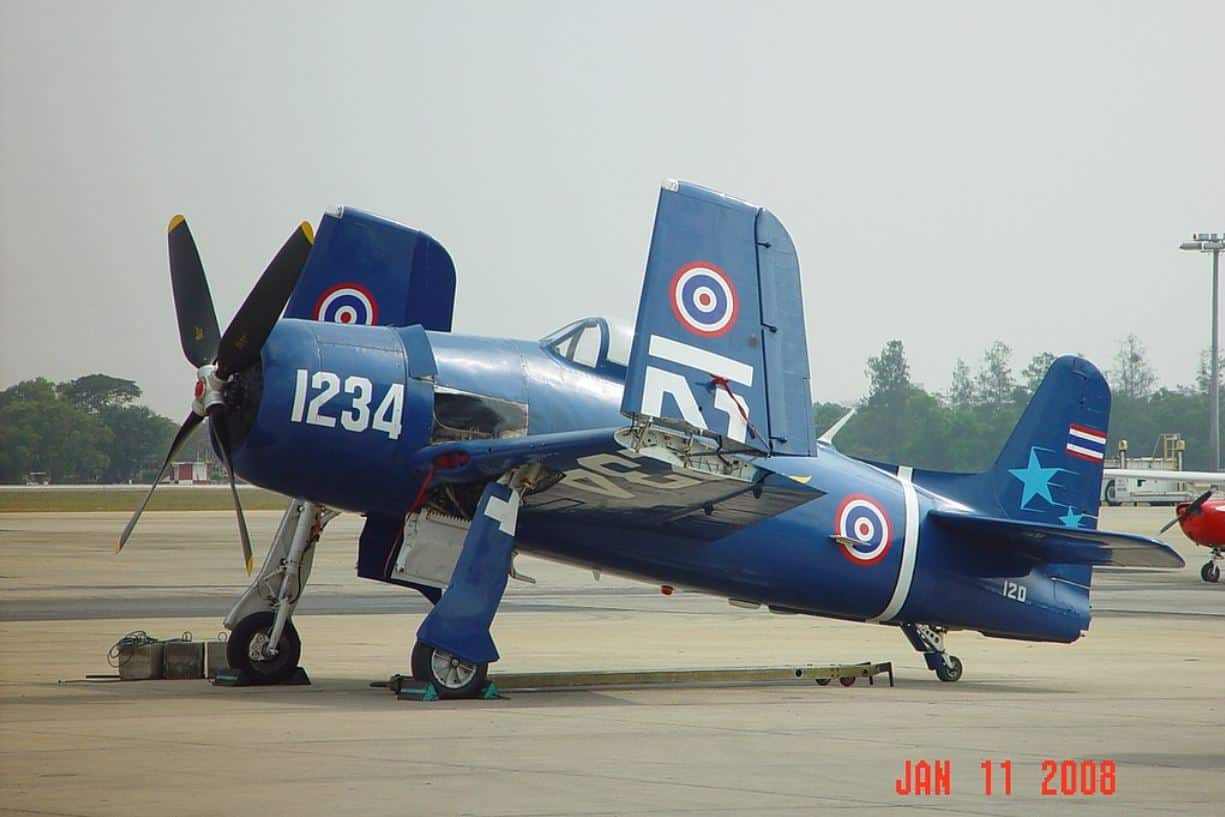
Thailand also bought several Bearcats from the U.S. Navy in the late 1940s and designated the F8F-1 the B.Kh.15.
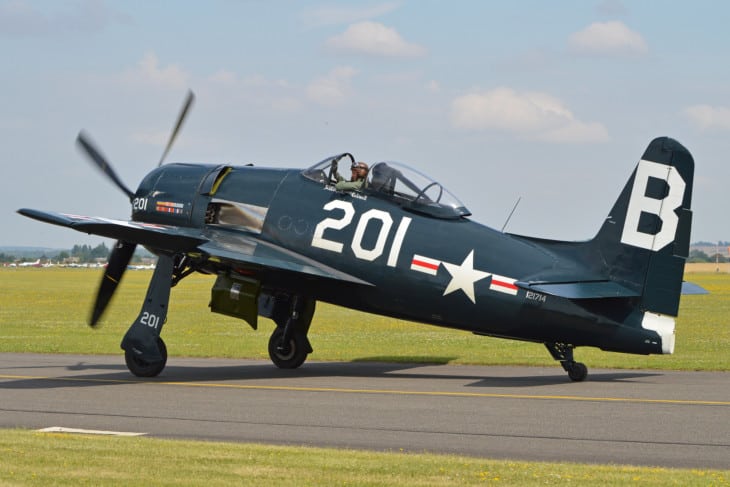
A stock Bearcat flown by Mira Slovak won the first Reno Air Race in 1964. The airframe was ideal for racers: a big engine in a small, light fuselage.
The most famous racer was Rare Bear, an F8F-2 built in 1946 and built under construction number 122629. Lyle Shelton found it as a severely damaged wreck in Indiana in 1969 and first flew it again on September 13, 1969.
Its original Pratt & Whitney engine was replaced by a Wright R-3350 from a Douglas Skyraider. On August 21, 1989, Rare Bear set a 3 km world speed record for piston-engine aircraft of 528.33 mph (850.26 km/h), and it still stands in that class.

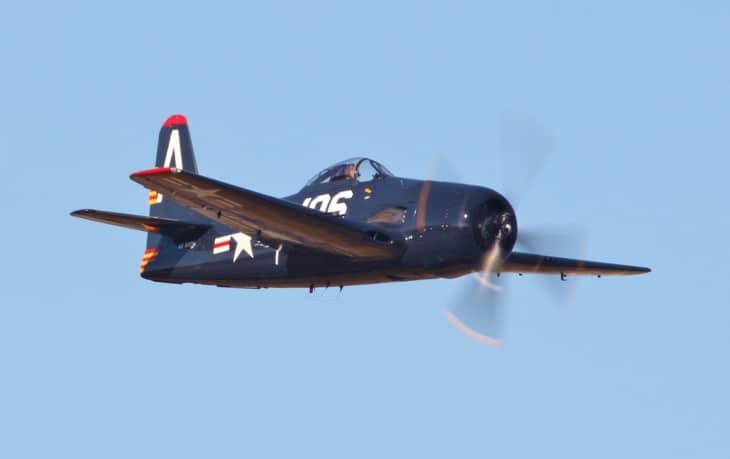
Wikipedia’s survivor list names 12 airworthy Bearcats as of October 2026. Ten are in the United States, one is in the UK (an F8F-2P at Duxford) and one is in Thailand. More are on display or under restoration.
Not with the U.S. Navy in World War II, because the war ended before its first squadron was operational. French forces used about 200 Bearcats in Indochina from 1951, and South Vietnam flew 28 of them from 1956.
It depends on the job. The Bearcat was marginally slower than the Corsair but more maneuverable and quicker to climb, so it suited point defense from small carriers.
Wikipedia’s survivor list names 12 airworthy aircraft as of October 2026. Counts shift as restorations finish and aircraft are lost, so treat it as a snapshot.
The full specification table is on this page. It gives the F8F-2’s dimensions, weights, engine, speed, range, ceiling and climb rate.
Grumman built 1,265 Bearcats, including 658 F8F-1s and 293 F8F-2s.
Sources and references used for research and fact-checking.