Fighter Jets
Grumman F-14 Tomcat
ICAO: F14
Grumman's first jet and the Navy's Korean War workhorse
Updated: by Tim de Vries
The latest aviation news and stories sent to your inbox.
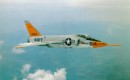
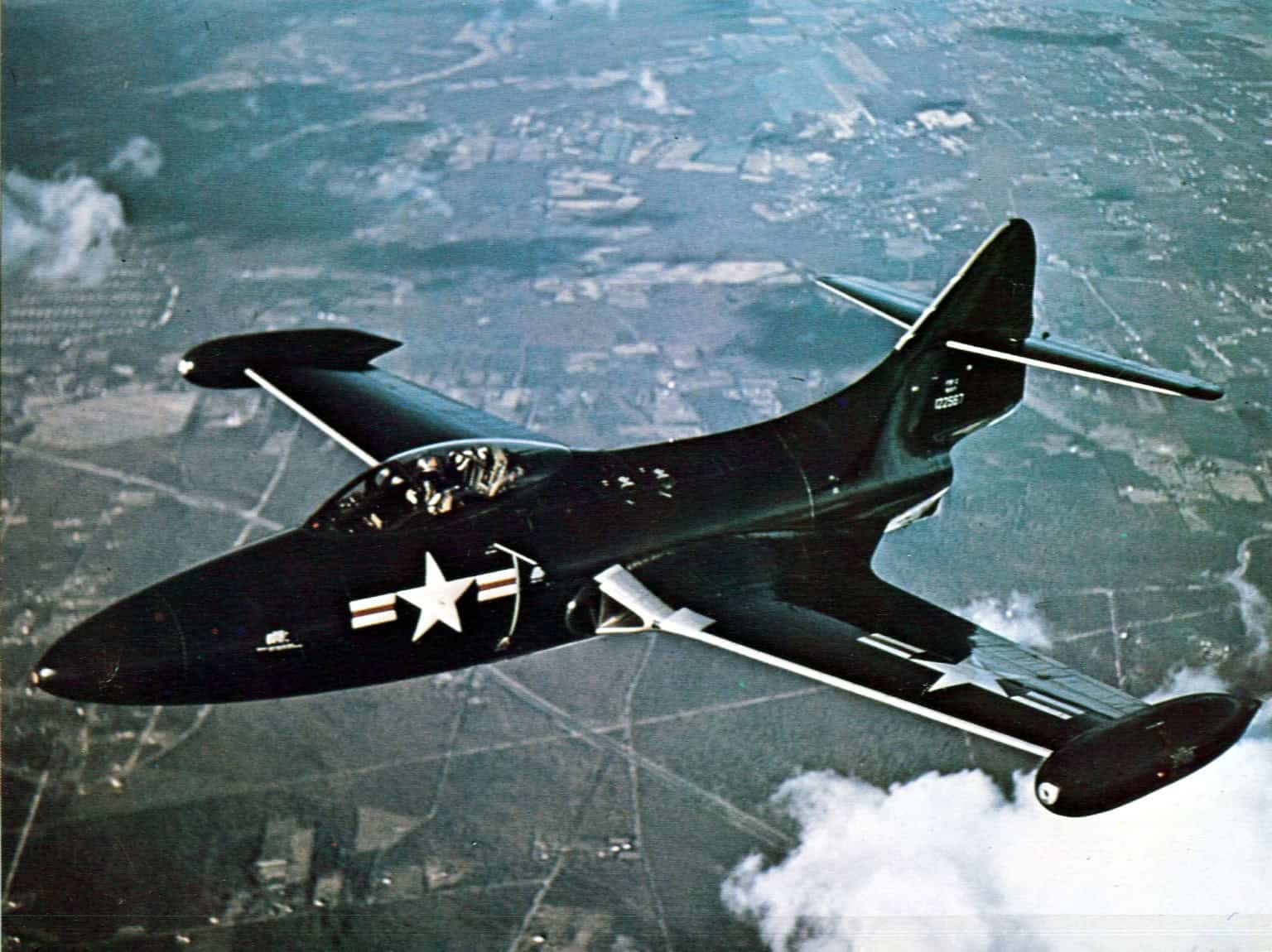
The Grumman F9F Panther was the U.S. Navy’s first jet fighter to see air-to-air combat and Grumman’s first jet. A single-engine, straight-wing carrier fighter with four 20 mm cannons and fixed wingtip fuel tanks, it was the most widely used Navy jet fighter of the Korean War and the Blue Angels’ first jet.
Live Fleet Activity (F9F)
Fetching live data…


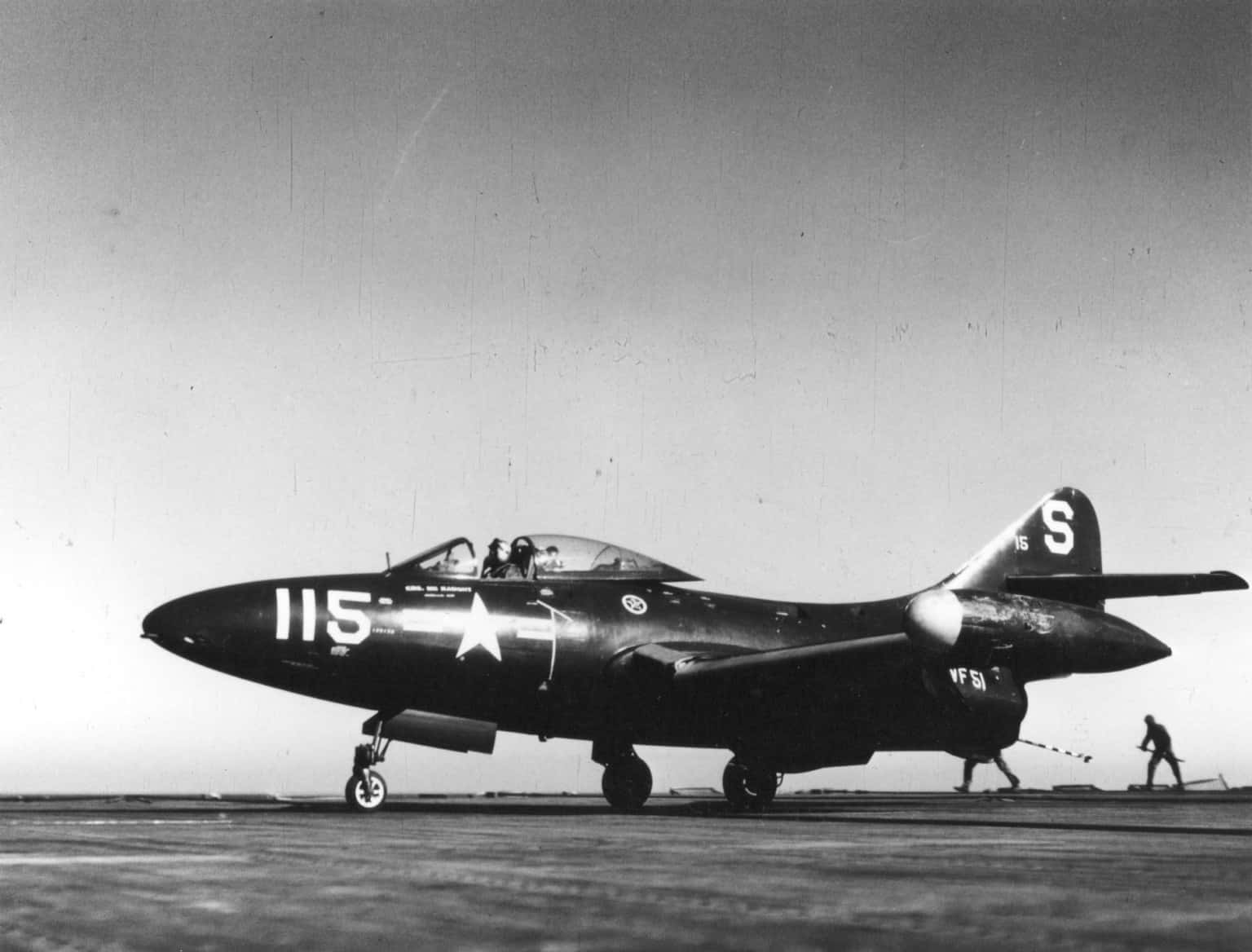


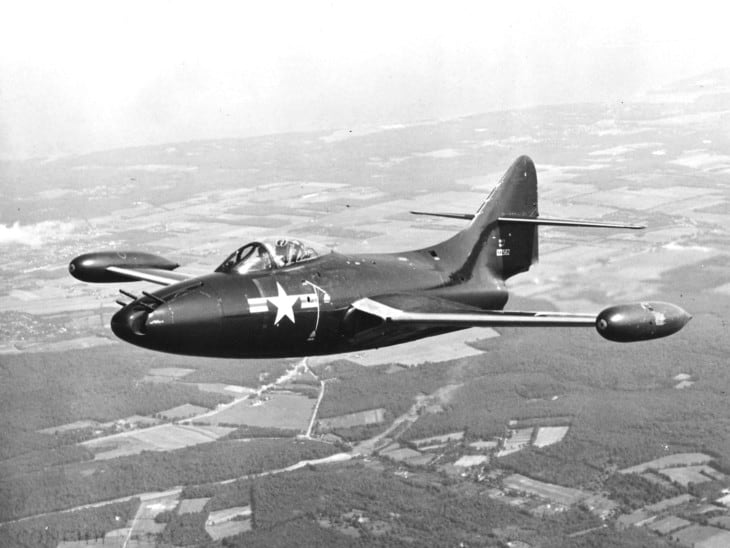
The Grumman F9F Panther was Grumman’s first jet fighter and the U.S. Navy’s first jet to fight in the air. Panthers were the first carrier jets to fly in combat, in July 1950, and they went on to become the most widely used Navy jet fighter of the Korean War.
It was a single-seat, straight-wing fighter with four 20 mm cannons, fixed fuel tanks on its wingtips and a single centrifugal-flow turbojet. The MiG-15 outclassed it on paper. Panther pilots still scored the first shootdown of a jet in Naval Aviation history, and one of them fought what is described as the longest dogfight in U.S. Navy history.
The Panther began as a night fighter. Grumman’s G-75 design was entered in a 1946 Navy competition for a carrier-based jet night fighter, and it was drawn with four engines in pairs, side by side in each wing.
The Navy picked the Douglas F3D Skyknight on April 3, 1946, but a week later it gave Grumman a contract for two XF9F-1 prototypes as a fallback.
Grumman had already concluded that the G-75 had little growth potential. The Bureau of Aeronautics reworded the contract to cover three prototypes of a new single-engine day fighter, the G-79, and that design became the Panther.
American jet engines of the day were not considered reliable enough, so the Navy chose the British Rolls-Royce Nene, rated at 5,000 lbf, to be license-built by Pratt & Whitney as the J42.
The thirsty engine left too little room for fuel in the wings and fuselage. Grumman’s answer was a pair of permanently mounted wingtip tanks, which also improved the roll rate.
Test pilot Corky Meyer flew the first prototype on November 21, 1947. The second followed five days later. Early stability problems were fixed quickly, and carrier suitability trials began in May 1949.
About 1,385 Panthers were delivered to the Navy, according to the Naval History and Heritage Command. Most were F9F-2s and F9F-5s.
In 1962 the surviving aircraft took new tri-service designations: the F9F-3 became the F-9B, the F9F-5 the F-9D and the F9F-5P the RF-9D.
When the Korean War began, the Panther was ready. On July 3, 1950, Panthers launched from USS Valley Forge, flying the first combat missions by carrier jets.
That same day, Lt. (jg) Leonard Plog of VF-51, flying an F9F-3, shot down a propeller-driven Yak-9 for the Navy’s first air victory of the war.
On November 9, 1950, Lt. Cmdr. William Amen, commanding officer of VF-111, shot down a MiG-15 near the Yalu River bridges at Sinuiju. It was the first MiG-15 shot down by a carrier jet pilot.
Panther pilots claimed seven MiG-15s during the war, for the loss of two F9Fs in air-to-air fighting. Most of the Panther’s war was spent on the ground-attack mission instead. Navy and Marine Panthers flew about 78,000 sorties, and the Planes of Fame Air Museum credits them with nearly half of all the air-to-ground missions the two services flew in Korea.
Much of that work was flak suppression, attacking the antiaircraft guns that were shooting at the strike aircraft behind them. It was one of the most dangerous jobs of the war, and many Panthers were damaged or lost to the guns they were hunting. Pilots did appreciate one thing: an air-conditioned cockpit, a welcome change from humid piston-engine fighters.

For a wider view of the jets on both sides, see our guide to Korean War fighter jets.
The Panther’s most famous fight stayed secret for decades. On November 18, 1952, Lt. Royce Williams of VF-781 was flying combat air patrol from USS Oriskany off North Korea when seven Soviet Naval Aviation MiG-15s came out from the Russian mainland toward the task force.
Williams and his wingman were ordered to put themselves between the MiGs and the carriers. Four of the MiGs opened fire. Williams hit the trailing MiG, his wingman followed it down, and Williams was left alone against six.
What followed lasted about 35 minutes. CNN’s account describes constant turning and weaving, the one area where the F9F could compete with the faster MiG, until Williams was out of ammunition. He shot down four MiGs.
He landed on Oriskany with his hydraulics gone. The crew counted 263 holes in his Panther, which was damaged beyond repair and pushed over the side.
The fight was classified because Soviet pilots were not officially in the war, and Williams was told not to talk about it. He received the Silver Star in 1953, which was upgraded to the Navy Cross in 2023. On February 24, 2026, at 100 years old, he was awarded the Medal of Honor during the State of the Union address.
Two future astronauts flew Panthers in Korea. Neil Armstrong flew F9F-2s with VF-51 from USS Essex and flew 78 combat missions.
On September 3, 1951, Armstrong’s Panther hit a cable strung across a valley, which sliced through the right wing. He flew the damaged jet back over friendly territory and ejected near Pohang.
John Glenn flew Panthers as a Marine Corps pilot. The F9F-2 at the National Naval Aviation Museum in Pensacola, Bureau Number 123050, is one he flew, and he once brought it back with a hole in the tail that he could put his head and shoulders through.
Boston Red Sox star Ted Williams also flew the F9F in Korea as a Marine pilot.

The Panther was also the first jet flown by the Blue Angels. The team traded its F8F Bearcats for F9F-2s in 1949, according to the team’s own aircraft history.
The F9F-2 era ended in 1950, during the Korean War. From 1951 the Blue Angels flew the F9F-5 until 1955, then moved to its swept-wing descendant, the F9F-8 Cougar.
The full specification table for the F9F Panther is on this page, and it describes the F9F-5, the most-built version. It comes from the Navy’s own Standard Aircraft Characteristics sheet of June 1952, based on flight tests at the Naval Air Test Center. A few figures need context.
The top speed in the table, 525 knots (604 mph, 972 km/h), was reached at sea level at combat weight on military power. The figure most references quote, 503 knots or 579 mph, is the same jet at 5,000 feet, at fighter takeoff weight with full tip tanks, on normal power. The swept-wing MiG-15 was faster than either.
The J48 turbojet was rated at 6,250 lbf dry. Injecting water raised takeoff thrust to 7,000 lbf, and the Panther carried 25 gallons of water for that purpose.
The fuel figure of 1,000 gal (3,800 L) is the rounded total of 763 gallons in two self-sealing fuselage cells and 240 gallons in the two wingtip tanks. The tip tanks were fixed and could not be dropped in flight.
The range in the table, 1,130 nm (1,300 mi, 2,090 km), is a combat range at an average cruise speed of 418 knots (481 mph, 774 km/h). The combat radius, out and back, was 420 nautical miles. Climb is shown at combat weight. At fighter takeoff weight, the F9F-5 climbed at 5,090 feet per minute.
Carrier limits sat below the field limits. The catapult limit was 20,600 lb, and an arrested landing on a carrier was limited to 14,000 lb. On a calm day at sea level, a fighter-weight Panther needed a takeoff run of 2,257 feet.
The MiG-15 was faster, climbed better and could dive harder, thanks to its swept wing. Williams called it the best fighter in the world at the time. The straight-winged Panther could compete only in the turn.
As the war went on, Panthers were tasked mostly with ground attack. Concern that the Panther was inferior to the MiG is what led Grumman to design a swept-wing version.
The Panther was replaced by its own derivative. Grumman’s Design 93 put a swept wing on the Panther fuselage, and the result, the F9F-6 Cougar, kept the F9F designation number. From 1952 the Navy began supplementing its Panthers with Cougars.
The Panther left front-line Navy service in 1956. The last Marine combat squadrons kept their F9F-5s until late 1957, and Navy and Marine reserve units flew Panthers until 1958. A few served on into the 1960s as drones and drone controllers.
Argentine Naval Aviation was the Panther’s only foreign operator. It bought 28 ex-Navy F9F-2Bs in 1957 and put 24 into service, keeping the rest for spares. They were the first jets of Argentine Naval Aviation.
The catapult on the carrier ARA Independencia was too weak to launch a Panther, so they flew from land. One landed on the ship during trials in July 1963, the first jet to land on an Argentine carrier, and was craned off in port.
Argentine Panthers saw combat during the 1963 navy revolt, when rebel-held aircraft attacked an Army tank column advancing on Punta Indio Naval Air Base. One Panther was shot down. The type was retired in 1969 for lack of spare parts and replaced by the A-4Q Skyhawk.
More than a dozen Panthers are on public display in the United States. Among them:
In Argentina, Panthers survive as gate guardians at Puerto Belgrano and Punta Indio and at the National Naval Museum in Tigre.

Three names stand out. Neil Armstrong flew 78 combat missions in F9F-2s with VF-51 and ejected from one in 1951, John Glenn flew Panthers with the Marines, and Royce Williams shot down four Soviet MiG-15s in a single Panther fight in 1952.
Its own swept-wing derivative, the Grumman F9F-6 Cougar, which kept the F9F designation number. The Navy began adding Cougars in 1952, and the Panther left front-line Navy service in 1956.
About 1,385 Panthers were delivered to the Navy, according to the Naval History and Heritage Command. The F9F-5 was the most numerous version, with 616 built, followed by 567 F9F-2s.
Yes. Panthers flew the first carrier jet combat missions on July 3, 1950, and flew about 78,000 sorties in Korea. Pilots claimed seven MiG-15s, and Argentine Panthers attacked Army tanks during the 1963 navy revolt.
The F9F-5 reached 525 knots (604 mph, 972 km/h) at sea level at combat weight, according to the Navy’s 1952 flight-test figures. The often-quoted 579 mph is the same aircraft at 5,000 feet, at fighter takeoff weight, on normal power.
The F9F-2 used the Pratt & Whitney J42, a license-built Rolls-Royce Nene, and the F9F-3 used the Allison J33. The F9F-5 used the Pratt & Whitney J48, a license-built Rolls-Royce Tay.
Its early jet engine burned fuel quickly, and there was not enough room in the wings and fuselage for the fuel it needed. Grumman added permanently mounted wingtip tanks, which also improved the roll rate.
Sources and references used for research and fact-checking.