Fighter Jets
Grumman F-14 Tomcat
ICAO: F14
Grumman's carrier-based supersonic fighter, flown by the US Navy and the Blue Angels
Updated: by Tim de Vries

The latest aviation news and stories sent to your inbox.
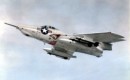
The Grumman F11F Tiger was a single-seat, carrier-based supersonic fighter built for the US Navy. It began as a private Grumman design study in 1952, first flew on July 30, 1954, and was built from 1954 to 1959. The Navy redesignated it the F-11 in 1962. Its frontline career was short, but the Tiger trained Navy pilots and flew with the Blue Angels until 1969.
Live Fleet Activity (F11F)
Fetching live data…


The Grumman F11F Tiger was a single-seat, carrier-based supersonic fighter flown by the US Navy. The Navy renamed it the F-11 in 1962, so you will see both names.
It was the first supersonic fighter Grumman produced. Its frontline career lasted only about four years, but the Tiger kept flying as a trainer and as the Blue Angels’ demonstration jet until 1969.
It also left one of aviation’s strangest stories: in 1956 a test pilot flew into his own cannon fire.
The Tiger began in 1952 as a privately funded Grumman study, internally called G-98, to modernize the F9F-6/7 Cougar. By the time the design was frozen in 1953 it had little in common with the Cougar.
Grumman applied the area rule, which pinches the fuselage where the wings join to cut transonic drag. The Navy ordered two prototypes, first as the XF9F-8 and then as the XF9F-9.
The wing carried full-span leading-edge slats and trailing-edge flaps. Roll control came from spoilers instead of ailerons, and the tailplane was all-moving in anticipation of supersonic flight.
For carrier storage the wingtips folded down by hand. The engine was the Wright J65, a license-built version of the British Armstrong Siddeley Sapphire.
The first prototype flew on July 30, 1954. The afterburning J65 was not ready, so it flew without one, and it still came close to Mach 1 on that first flight.
The second prototype had the afterburner and became the second supersonic US Navy aircraft, after the Douglas F4D Skyray. The Navy gave the type its F11F-1 designation in April 1955.
Carrier trials began on April 4, 1956, when an F11F-1 landed on and launched from USS Forrestal.

Sources disagree on when the Tiger entered service. Wikipedia dates it to 1956, while the National Naval Aviation Museum says the first production aircraft reached the Navy in March 1957.
The full specification table for the aircraft is on this page. These notes explain the figures that people quote against each other.
The panel’s top speed is 654 kt (753 mph, 1,211 km/h), and that is a sea-level figure. At altitude the Navy lists the Tiger at Mach 1.1.
That does not make it a Mach 1.1 fighter in the way the number suggests. According to Wikipedia’s account, which draws on RAND research, the Tiger was never capable of sustained supersonic flight in an operational configuration.
Afterburning thrust is 10,500 lbf (47 kN), against 7,450 lbf dry. Wikipedia’s specification block puts the thrust-to-weight ratio at only 0.5.
The service ceiling in the panel is 49,000 ft (14,900 m), the figure in the Navy’s Standard Aircraft Characteristics sheet and on the National Naval Aviation Museum’s page. Some museum placards print a lower 41,900 feet, and one reference site lists 42,000 feet. If you see a different ceiling elsewhere, that is why.
Range is 1,110 nm (1,280 mi, 2,060 km) in the panel. Wikipedia lists limited range and endurance among the reasons the Tiger’s frontline career was so short.
The Tiger carried four 20 mm Colt Mk 12 cannon in the nose, with 125 rounds per gun. Four hardpoints could carry AIM-9 Sidewinder missiles, rocket packages, or a drop tank.
The avionics were basic by later standards: a UHF radio, a direction-finding receiver, a VOR navigation receiver, an IFF transponder and the AN/APG-30A fire-control radar.
On September 21, 1956, Grumman test pilot Tom Attridge was test-firing the Tiger’s four cannon. Many sources call it the first jet aircraft to shoot itself down.
He entered a shallow 20-degree dive in afterburner and fired a four-second burst, then a second burst to empty the belts. The airplane kept descending at about half a G.
That is the whole trick. The cannon rounds slowed quickly from air drag and dropped away on their curved path, while the Tiger kept accelerating down. About 11 seconds after firing, Attridge flew through his own bullets.
Investigators found three hits: the windshield, the right engine intake lip and the nose cone. A 20 mm round was recovered from the engine’s first compressor stage.
The engine began to fail, and Attridge crash-landed in trees less than a mile short of the runway. He survived with a broken leg and broken vertebrae, and Popular Mechanics reports he was back on flight status in under six months.
Attridge first assumed he had hit a bird. The rounds did not destroy the Tiger outright: they crippled its engine, and the aircraft was lost in the forced landing.
Seven Navy squadrons flew the Tiger. VF-21 and VF-33 served in the Atlantic Fleet, and VA-156, VF-24, VF-51, VF-121 and VF-191 served in the Pacific Fleet.

The Tiger operated from Intrepid, Lexington, Hancock, Bon Homme Richard, Shangri-La, Forrestal, Saratoga, Ranger and Independence.
The last of 199 Tigers was delivered on January 23, 1959. The Navy cancelled 231 more, along with an 85-aircraft photo-reconnaissance version, the F11F-1P.
The Tiger’s frontline career lasted about four years. By 1961 it had been permanently withdrawn from carrier operations.
The main reason was the Vought F8U Crusader, which was considerably faster. The F-8 Crusader and later the F-4 Phantom II took over the Navy’s fighter role.
The J65 engine also had a reputation for unreliability. Planes of Fame calls the Tiger significantly underpowered and the engine “a constant source of trouble.”
The Tiger then moved to the Naval Air Training Command in South Texas, at NAS Chase Field and NAS Kingsville. Students flew the TF-9J Cougar first and then got a brief taste of supersonic flight in the F-11.
The Blue Angels flew the Tiger from 1957 to 1969, far longer than the fleet did. The Tiger came in short-nose and long-nose forms, and later production aircraft had the longer nose.

The Phantom replaced it as the team’s jet. The National Naval Aviation Museum’s own Tiger, BuNo 141828, flew with the team from 1967 to 1969, the last seasons of Tiger demonstrations. Today’s team is covered in our Blue Angels guide.
The Super Tiger was a 1955 proposal to fit the new General Electric J79 engine into the Tiger airframe. Only two were built.
On April 18, 1958, Lieutenant Commander George Watkins flew one to a world altitude record at Edwards Air Force Base. The National Naval Aviation Museum gives the altitude as 76,828 feet (23,417 m), while the FAI-certified figure was 23,449 meters (76,932 feet). Wikipedia also credits the Super Tiger with reaching Mach 2.04 in 1957.
Swiss evaluators judged it ahead of its competitors on overall technical performance, but Switzerland bought the Mirage III on cost and spare-parts grounds. The Navy never ordered it.
The designations are a mess, so here is the short list. The F9F-9 was the original Navy designation, and the F11F-1 (later F-11A) was the production single-seat fighter, with 199 built.
The F11F-1P was a cancelled photo-reconnaissance version, the F11F-1F was the J79-powered Super Tiger, and the F11F-1T was a tandem-seat trainer that was never built.
As of October 2026, none of the sources we checked list an airworthy F-11 Tiger. Wikipedia says the last Tigers to fly were two modified Blue Angels airframes used for thrust-reverser tests, which ran from March 1974 into 1975.
Roughly 20 are on display. They include examples at the National Museum of Naval Aviation in Pensacola, the Pima Air & Space Museum in Tucson, the Planes of Fame Air Museum in Arizona, the Air Zoo in Michigan and the California Science Center in Los Angeles.
The Navy withdrew it from carrier service by 1961 because the Vought F-8 Crusader was considerably faster. The Tiger’s J65 engine was also unreliable, and its range and endurance were limited.
During a 1956 cannon test, pilot Tom Attridge fired in a shallow dive and then kept descending while the bullets slowed and dropped. About 11 seconds later his Tiger flew into them, damaging the windshield, the engine intake and the engine, and he crash-landed short of the runway.
Before 1962, F11F meant Grumman’s eleventh fighter design for the Navy: the first F is for fighter, and the last F is Grumman’s manufacturer letter. After the 1962 tri-service system, the type became the F-11, with F again meaning fighter.
Yes, but not for long. The Navy lists Mach 1.1 at altitude, but RAND research cited by Wikipedia says the Tiger could not sustain supersonic flight in an operational configuration.
Most references give 199 Tigers, built from 1954 to 1959. Planes of Fame lists a higher total, so counts vary slightly by source.
Yes. The team flew the Tiger from 1957 to 1969, until it switched to the F-4 Phantom II.
As of October 2026, we found no airworthy Tiger listed. The last ones to fly were two test aircraft in 1974 and 1975, and surviving airframes are museum exhibits.
No. The General Dynamics F-111 Aardvark is a completely different swing-wing strike aircraft, and it has no connection to Grumman’s Tiger.
Sources and references used for research and fact-checking.